Best Apex Trader Funding Supported Platforms for Prop Traders
This article explains how Apex trader funding supported platforms like Rithmic, Tradovate, and WealthCharts work together in 2026 to route orders, enforce prop firm rules, and support both discretionary trading workflows. It shows how modern prop traders can combine these platforms with tools like TradersPost to manage multi account, multi asset execution while staying within Apex constraints.

Co-Founder / CSO

Key Takeaways
- Apex trader funding supported platforms in 2026 operate as a stack of three layers, the prop firm and account rules, the execution platform, and the workflow or automation layer.
- Rithmic, Tradovate, and WealthCharts are the core Apex Trader Funding supported platforms, each serving different roles in speed, user interface, and strategy or analytics.
- Discretionary traders get the best results by keeping manual control over entries while using tools like TradersPost for automated exits, risk management, and copying trades across Apex accounts.
- Multi account and multi asset execution is a key edge, using a neutral hub like TradersPost to route one trading decision into multiple Apex and personal accounts while respecting each account's rules.
- Practical setups typically start with a simple single account workflow in Tradovate, then scale into multiple Apex evaluations and funded accounts, all coordinated through centralized execution and consistent risk logic.
How Apex Trader Funding Supported Platforms Work in 2026 for Modern Prop Traders
Apex trader funding supported trading platforms in 2026 all solve the same core problem, but with very different approaches, getting your orders from your screen to the exchange, while satisfying prop firm rules, risk limits, and technology constraints.
With Apex, there are three main layers involved every time you trade:
* Apex defines the rules, drawdowns, trailing thresholds, and product limits. * Your accounts are technically hosted with a clearing partner and accessed through supported platforms like Rithmic, Tradovate, or WealthCharts. * Whether you are in an evaluation or funded phase, the platform has to respect those constraints in real time.
* These are the primary Apex trader funding platforms that connect directly to the futures exchanges. * They handle order routing, risk checks, and fills. * Each platform has its own strengths, for example low latency routing, web based convenience, or integrated charting and analytics.
* This is where modern prop traders are doing the real work in 2026, coordinating multiple Apex accounts, combining discretionary entries with automated exits, and syncing trades across firms. * Instead of being locked into a single charting package, traders can generate signals in TradingView or other tools, then execute through Apex trader funding supported trading platforms without rewriting their entire workflow. * Automation is no longer all or nothing, you can confirm entries manually, auto manage stops and targets, and copy trades across evaluation and funded accounts while staying inside Apex rules.
Core Apex Trader Funding Platforms: Rithmic, Tradovate, and WealthCharts Compared
If you trade with Apex, you will see the same three names over and over in 2026: Rithmic, Tradovate, and WealthCharts. All are Apex Trader Funding supported platforms, but they solve different problems for different types of prop traders.
At a high level:
- Rithmic is the low level execution engine.
- Tradovate is the futures trading front end and account infrastructure.
- WealthCharts is the charting and strategy layer that can sit on top of Apex accounts.
Think of them as stackable pieces rather than interchangeable products.
Rithmic: Execution and Market Access
Rithmic is built for speed and direct connectivity. For Apex traders, it is best suited if you:
- Run faster intraday strategies where a few ticks of slippage matter.
- Use third party platforms that connect through Rithmic for order routing.
- Care more about fill quality and stability than about having an all in one interface.
The downside, it is more technical, and the user experience can feel dated compared to newer web based platforms.
Tradovate: Modern Futures Front End
Tradovate is the most approachable of the Apex Trader Funding platforms. It shines if you:
- Want a clean web and mobile interface with built in DOM, ladders, and brackets.
- Trade discretionary but still want reliable bracket orders, OCOs, and basic automation.
- Plan to copy trades across multiple Apex or live accounts through tools that integrate with Tradovate.
Latency is usually fine for most intraday and swing traders, but it is not aimed at ultra high frequency use.
WealthCharts: Strategy First, Execution Second
WealthCharts is more of a charting and strategy environment that can connect to Apex accounts. It fits traders who:
- Want rich indicators, screeners, and strategy building tools in one place.
- Prefer to design and test ideas visually, then execute through supported connections.
- Are comfortable with a more complex platform in exchange for analytics depth.
For many Apex traders, the practical choice is not "Rithmic vs Tradovate vs WealthCharts", it is deciding which one is your primary interface, then layering tools like TradersPost on top to handle automation, multi account routing, and prop firm specific execution rules.
Best Platforms for Discretionary Apex Traders Who Want Automation Without Losing Control
Most Apex trader funding supported trading platforms in 2026 assume you are either fully manual or fully automated. Discretionary traders usually sit in the middle, you want to call the shots on entries, but you do not want toit exits, risk, and multiple accounts.
For that middle ground, evaluate platforms less by their indicator library and more by how they handle three things:
- How easy it is to trigger automation from a discretionary decision
- How much visibility you keep over every order and rule
- How gracefully they work with Apex rules and multiple accounts
A practical discretionary plus automation stack for Apex often looks like this:
- Charting and decision layer: TradingView, WealthCharts, or your preferred analysis platform. You mark levels, wait for price action, then confirm the trade with a click or an alert.
- Execution and automation layer: a tool like TradersPost that listens to your alerts, then handles order routing, bracket orders, and risk logic into your Apex accounts on Tradovate or Rithmic.
- Prop firm constraint layer: account level max size, daily loss, and auto flatten rules that reflect Apex limits, so you are less likely to violate by mistake.
This lets you keep full discretion on:
- When to enter
- When to skip a marginal setup
- When to scale in or out
While automating the parts that usually break under pressure:
- Stop and target placement
- Trailing logic and partials
- Copying the same trade to several Apex evaluations or funded accounts
The best Apex trader funding platforms for this style are the ones that treat automation as a servant, not a pilot, they execute your rules, they do not invent new ones.
Multi Account and Multi Asset Execution: Platforms That Simplify Prop and Retail Workflows
Most traders do not blow up because their read of the market is terrible, they blow up because their execution is fragmented. One Rithmic account here, three Tradovate prop accounts there, a retail futures account on the side, maybe some stocks or crypto in another window. By the time you click through each DOM, the opportunity or your discipline is gone.
This is where multi account and multi asset execution becomes the real edge case for Apex trader funding supported trading platforms in 2026.
At a high level, you want your stack to solve three problems:
- One decision, many accounts
- One workflow, many asset classes
- One risk framework, regardless of where the order is routed
In practice, that usually means combining the core Apex trader funding platforms with a neutral execution layer.
For example:
- Use TradingView or another charting platform to define the setup.
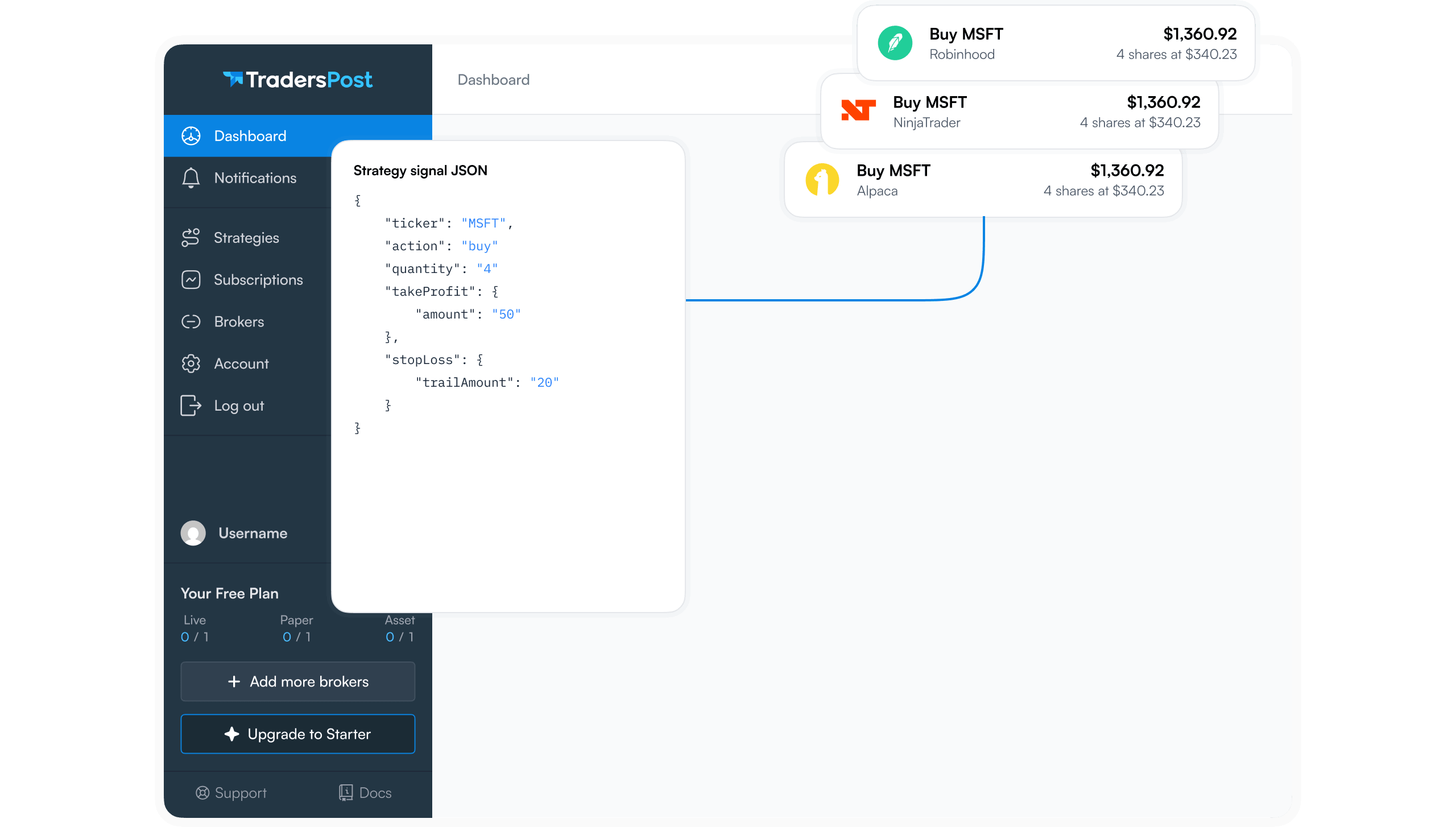
- Send the signal into TradersPost as the execution hub.
- Let TradersPost route that signal into:
- Multiple Apex Rithmic or Tradovate accounts, with per account scaling. - A separate futures or stocks brokerage account for your own capital. - Optional options or crypto exposures if your strategy supports it.
Instead of clicking the same trade five times, you define:
- Which accounts are linked to a given strategy.
- How size should scale account (evaluation vs funded vs personal).
- How stops and targets should adapt to each account's rules and tick values.
The benefit is not just convenience, it is constraint alignment. You can respect Apex drawdown rules, keep retail risk capped, and still express a single discretionary idea across everything you trade, without juggling platforms or retyping orders.
In other words, the best Apex trader funding supported platforms in 2026 are not just the charting or order entry tools, they are the combinations that let you treat your whole prop and retail footprint as one coherent execution plan.
Practical Setup Examples: From Single Apex Evaluation to Scaled Funded Accounts Across Platforms
To wrap this up, it helps to see how real traders actually stitch these Apex Trader Funding supported platforms together, from a single evaluation to a scaled, multi platform setup.
Example 1: First Apex evaluation, simple and focused
You are trading one ES contract on a single Apex evaluation.
- Platform: Tradovate, because it is clean, browser based, and directly supported.
- Workflow:
- Do your analysis in TradingView. - Place discretionary entries in Tradovate with a simple bracket (stop + target). - Use a fixed daily loss limit and walk away once it is hit.
At this stage, your goal is not clever automation. It is rule compliance and clean execution on one account.
Example 2: Multiple evaluations across Apex trader funding supported platforms
You pass one evaluation and spin up several more.
- Platforms: 2 Rithmic accounts and 3 Tradovate accounts, all Apex trader funding platforms.
- Workflow:
- Keep charting in TradingView. - Use TradersPost as the execution hub to: - Route one signal into all 5 accounts. - Scale size per account based on account balance or risk. - Standardize stops and targets so every account follows the same risk logic.
You still decide entries manually, but you stop manually copying orders. That is where most prop traders make expensive mistakes.
Example 3: Funded accounts plus your own capital
Now you have funded Apex accounts and a retail futures account.
- Platforms: Rithmic for Apex, Tradovate or another broker for your personal account.
- Workflow:
- One discretionary decision in TradingView. - TradersPost copies that decision into: - Your Apex funded accounts, respecting their rules. - personal account, possibly with different sizing and partial profit logic. - You can tighten risk on prop accounts while letting winners run more aggressively in your own account.
The pattern is the same across all apex trader funding supported platforms 2026 offers: keep your analysis where you like it, centralize execution, and scale only when your process is stable.
If you decide to build on the platforms in this guide, the real edge will come from how cleanly you execute across all your Apex and live accounts. Whether you script everything or trade discretionarily with rules, it can help to separate signal from execution so you are not fighting platforms, logins, and prop rules in real time. TradersPost was built for that layer, connecting your existing analysis tools to Tradovate and ProjectX accounts so you can scale what already works, with fewer operational mistakes.
What platforms does Apex Trader Funding use?
Apex Trader Funding primarily supports Rithmic, Tradovate, and WealthCharts, each connecting you to futures markets with different workflows, fees, and tools. Rithmic is favored for low latency and depth of market, Tradovate for an all-in-one platform with built-in order flow tools, and WealthCharts for charting, analytics, and multi asset workflows that can complement your Apex accounts.
What platform does Apex use?
In the context of Apex Trader Funding, "Apex" uses multiple third party trading platforms rather than a single proprietary one. Most traders choose between Rithmic based platforms, Tradovate, or WealthCharts, depending on whether they prioritize speed, advanced charting, automation, or multi account management for their funded and evaluation accounts.
How do Apex Trader Funding supported platforms work for prop traders in 2026?
In 2026, Apex Trader Funding supported platforms connect your evaluation or funded accounts to futures markets through data and order routing backends like Rithmic or Tradovate, while the front end platform handles charts, DOM, and order entry. Many traders now combine multiple platforms, for example one for execution and another for analytics or automation, to create a tailored prop trading workflow.
Which Apex Trader Funding platform is best for discretionary traders who still want automation?
For discretionary traders who want some automation without giving up control, platforms that support bracket orders, trade management algorithms, and semi automated strategies are ideal. Many Apex traders use Rithmic based platforms or Tradovate for fast manual entries with attached stops and targets, then layer in simple automation like trailing stops, partial profit taking, or time based exits to standardize risk.
What is the difference between Rithmic, Tradovate, and WealthCharts for Apex accounts?
Rithmic is mainly a low latency connection and execution environment used by many third party platforms, making it popular for active scalpers and DOM traders. Tradovate combines data, routing, and a full trading front end in one subscription, which appeals to traders who want simplicity. WealthCharts focuses on powerful charting, scanning, and analytics, and can be used alongside execution platforms to guide decisions.
Can I trade multiple Apex accounts and assets on one platform?
Yes, many Apex Trader Funding supported platforms in 2026 allow you to trade multiple Apex accounts and even combine prop and personal accounts in one interface. Some platforms let you mirror orders across accounts, manage different risk profiles, and trade multiple asset classes, such as futures, forex, or equities, from a unified workspace to simplify complex prop workflows.
How do I choose the best Apex Trader Funding platform for my strategy?
To choose the best Apex Trader Funding platform, match the platform's strengths to your trading style, such as scalping, swing trading, or automation. Consider factors like execution speed, charting quality, order types, multi account support, and cost. Many traders test two platforms in parallel during evaluations, then commit to the one that feels most intuitive and reliable under real trading conditions.
Can I use one platform for analysis and another for executing Apex trades?
Yes, many prop traders in 2026 use one platform for analysis, such as WealthCharts or a dedicated charting tool, and another for execution, such as a Rithmic based DOM or Tradovate. This split setup lets you keep charts, scanners, and higher time frame analysis clean, while using a lean, fast interface for entries and exits, which can reduce clutter and execution errors.