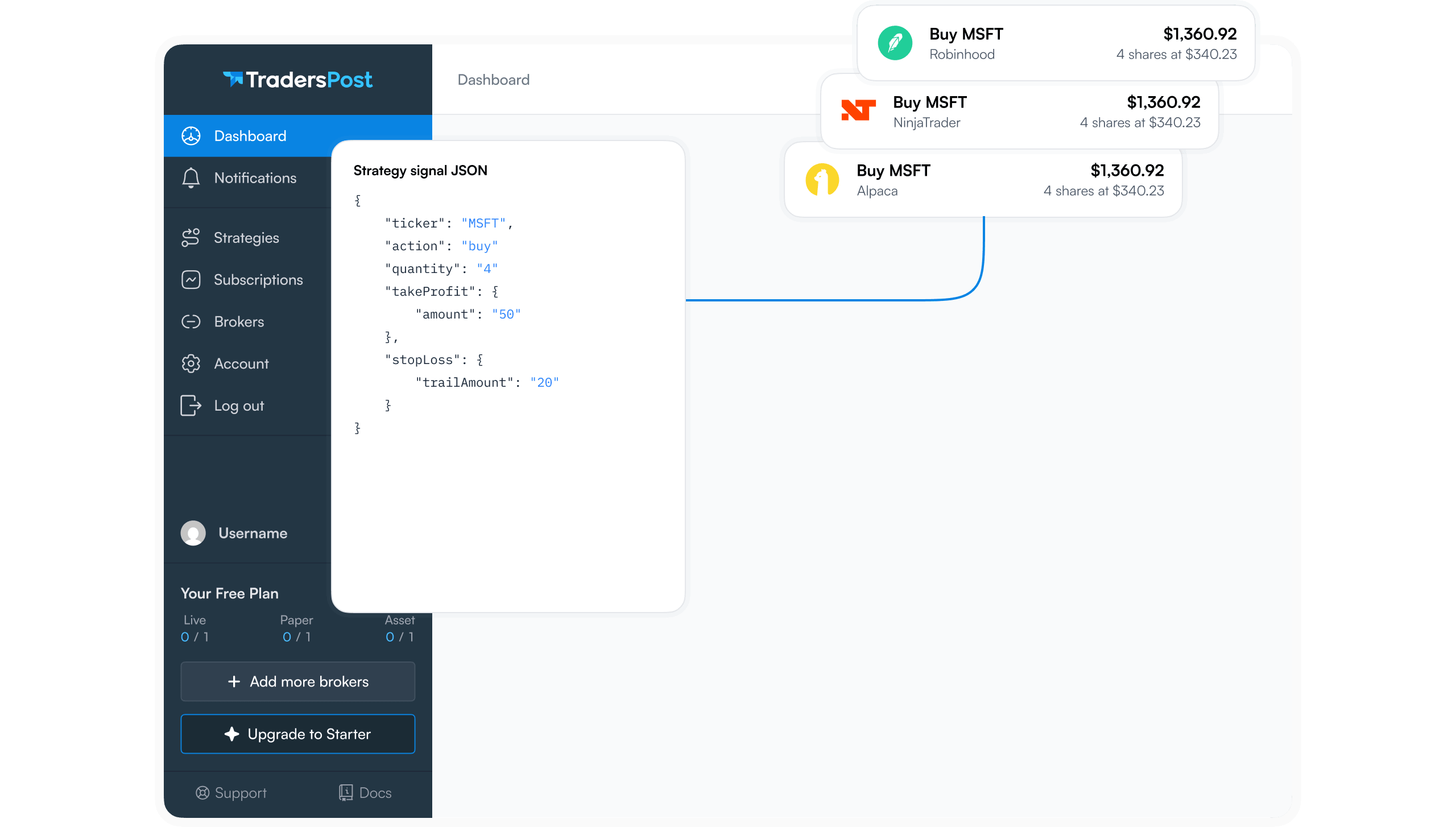
Debug Trading Strategies Without Risk
Learn how to test and debug automated trading strategies using manual approval mode, protecting live capital while validating your strategy logic and execution.

Marketing

The most nerve-wracking moment in automated trading comes when you flip the switch from paper trading to live execution. What if there's a bug in your strategy? What if your JSON is malformed? What if position sizing is miscalculated? These fears keep traders stuck in paper trading mode, never making the leap to live markets.
There's a better way: manual trade approval mode.
The Manual Approval Safety Net
TradersPost includes a feature that's often overlooked but incredibly valuable for strategy validation: the ability to disable auto-submit on your strategy subscription.
When auto-submit is disabled, your alerts still flow from TradingView to TradersPost, your strategy logic still executes, and TradersPost still processes the trade—but nothing is sent to your broker until you manually approve it.
This creates a powerful debugging environment where you can:
- Verify your signals generate correctly
- Inspect the JSON payload before execution
- Confirm position sizing calculations
- Validate symbol formatting
- Check that account balances are sufficient
All without risking actual capital.
How It Works
When you set up a strategy subscription in TradersPost, you'll see an "Auto Submit" toggle. By default, it's enabled—alerts automatically execute as orders with your broker. Disable this toggle and the behavior changes dramatically:
- Your TradingView alert fires normally
- TradersPost receives the webhook
- The trade appears in your TradersPost dashboard with "Pending Approval" status
- You review the trade details
- You click "Approve" or "Reject"
- Only approved trades are sent to your broker
This manual gate provides the safety of paper trading with the realism of live connections. You're using your actual broker account, seeing real market prices, and testing with your real account balance—but you maintain complete control over execution.
Why This Beats Standard Paper Trading
Traditional paper trading has limitations:
Overly Optimistic Fills: Paper accounts often assume perfect execution at market prices without slippage or partial fills. This doesn't reflect reality, especially for larger positions or less liquid markets.
No Real Risk Psychology: When it's play money, you don't experience the emotional component of trading. The fear and excitement that affect decision-making in live trading are absent.
Different Data Sources: Some paper trading environments use delayed data or simplified order matching that doesn't mirror live market microstructure.
Account Balance Unrealistic: Starting with $100,000 in paper money doesn't reflect the reality of trading with $5,000 in real capital. Position sizing and risk calculations need testing at your actual account size.
Manual approval mode solves these issues:
- Uses your live broker account and actual balance
- Shows real slippage in fills (though you control whether to accept them)
- Triggers the same psychological responses as live trading
- Tests your infrastructure end-to-end with real connections
You get authentic market feedback while retaining full control.
Setting Up Manual Approval Mode
The setup is straightforward:
Step 1: Create your strategy subscription in TradersPost linking your strategy to your broker account
Step 2: Configure all your position sizing, risk parameters, and symbol mappings
Step 3: Disable the "Auto Submit" toggle
Step 4: Create your TradingView alerts pointing to your TradersPost webhook
Step 5: Let your strategy generate signals
Step 6: Monitor your TradersPost dashboard for pending trades
Step 7: Review and approve/reject each trade manually
During this testing phase, you'll catch issues that would have caused failed orders or unexpected behavior in full automation:
- Incorrect symbol formats (BTCUSD vs. BTCUSDT)
- Position sizing that exceeds buying power
- Malformed JSON that would be rejected
- Alert syntax errors
- Side-swapping behavior you didn't intend
Each catch is a bullet dodged—a problem you discovered before it cost you money.
Understanding Position Sides
One critical concept to understand while debugging is position sides in TradersPost:
Bullish Only: Your strategy can only take long positions. Sell signals with no existing position are rejected. This mode prevents accidentally opening short positions when you only intend to trade long.
Bearish Only: Mirror image of bullish—only short positions allowed. Buy signals without an open position are rejected.
Both: Allows both long and short positions. With side-swapping enabled, a buy signal when short will close the short and open a long position (and vice versa).
During debugging, pay close attention to which side setting you've chosen. If your strategy is bullish-only but you're sending sell signals expecting them to close long positions, they'll be rejected as invalid. You'll see this clearly in pending trade review, where TradersPost explains why a trade would be rejected.
The DCA Strategy Example
Consider a Dollar Cost Averaging (DCA) strategy designed to automatically accumulate a position during dips. This strategy should only take long positions—there's no shorting in DCA.
During setup with manual approval:
Test 1: Send a buy signal when flat (no position)
- Expected: Opens new long position
- Reality: Verify position size matches your configuration
- Approve if correct
Test 2: Send another buy signal while already long
- Expected: Adds to existing position (if enabled) or rejected
- Reality: Confirm your "Add to Position" setting works as intended
- Adjust configuration if needed
Test 3: Send a sell signal while long
- Expected: Closes or reduces long position
- Reality: Verify it exits completely (not reversing to short)
- Approve and monitor
Test 4: Send a sell signal when flat
- Expected: Rejected (bullish-only mode)
- Reality: Confirm rejection with appropriate error message
- No approval needed—trade correctly rejected
Through this process, you're validating every edge case before enabling auto-submit.
Common Issues Caught in Manual Review
Symbol Mismatches: Your TradingView chart uses "BTCUSD" but your broker expects "BTCUSDT". The pending trade shows exactly what symbol will be sent, letting you fix the mapping.
Price Precision: Crypto exchanges have specific tick sizes. Your strategy might send $104.23456 but the exchange requires $104.23. Manual review shows the adjusted price before execution.
Insufficient Funds: Your position size calculation doesn't account for existing positions. The manual review shows the margin requirement and available balance, revealing the issue.
Time-Based Logic Errors: Your strategy is supposed to only trade during certain hours, but signals are firing outside that window. Manual review lets you see the timestamp of each signal and identify the logic error.
Quantity Calculation Mistakes: You intended 1% of equity but it's calculating 10% due to a formula error. Manual review shows the exact quantity before it executes.
Each of these issues would have caused failed orders, unexpected positions, or blown accounts in full automation. Manual approval catches them risk-free.
Transitioning to Full Automation
Once you've validated your strategy through manual approval:
- Run it for a week approving trades manually and tracking performance
- Verify all edge cases have executed correctly (entries, exits, add-to-position, side-swapping)
- Check slippage statistics to ensure execution quality meets your expectations
- Confirm position sizing is appropriate for your account size and risk tolerance
- Monitor market conditions to ensure your strategy behaves across different volatility regimes
When everything checks out, enable auto-submit with confidence. You've battle-tested your automation against real market conditions with real broker connections—just without risking capital during the debugging phase.
When to Use Manual Approval Long-Term
Even after moving to full automation, manual approval remains valuable in specific scenarios:
New Strategy Launch: Always test new strategies manually first, even if they're based on proven concepts.
Major Strategy Updates: If you modify your entry logic, position sizing, or exit conditions, revert to manual approval to validate the changes.
Volatile Market Conditions: During extreme volatility (earnings, economic reports, geopolitical events), manually approve trades to avoid unexpected slippage or gaps.
Account Size Changes: If you significantly increase your trading capital, test your position sizing calculations manually before resuming automation.
Broker Changes: Switching to a new broker means new API behavior—test manually first.
After Extended Breaks: If your strategy has been paused for weeks or months, manually approve the first several trades to ensure market conditions still support your approach.
Manual approval isn't a crutch for traders afraid of automation—it's a professional risk management tool that lets you validate changes before committing capital.
The Psychology of Control
There's a psychological benefit to manual approval that's worth noting: it maintains your connection to your trading decisions.
Full automation can create a dangerous detachment where you stop understanding why your strategy is taking trades. You just see P&L numbers without comprehending the underlying logic. Manual approval forces you to think through each trade:
- Why is this signal firing now?
- Does this entry make sense given current market conditions?
- Is my strategy adapting appropriately to volatility changes?
This ongoing engagement keeps you connected to your trading process and more likely to notice when market conditions have shifted in ways that invalidate your strategy assumptions.
Key Takeaways
Manual trade approval in TradersPost offers the perfect middle ground between paper trading and full automation. It provides:
- Real market connections without execution risk
- Authentic testing of position sizing and risk management
- Visual inspection of every trade before it executes
- Learning opportunities as you approve/reject trades manually
- Smooth transition path to full automation with confidence
Whether you're launching your first automated strategy or you're an experienced algo trader testing new concepts, manual approval mode removes the fear from going live. You maintain complete control while building the confidence that your automation works exactly as intended—a critical step that separates sustainable automated trading from blown accounts.
Start conservative, test thoroughly, and only automate what you've validated. Manual approval makes this process practical and risk-free.