Dollar-Cost Averaging Strategy Guide for Trading Automation
Learn how to implement a dollar-cost averaging (DCA) strategy using automated trading webhooks and TradingView alerts for consistent position building.

Marketing

Dollar-cost averaging (DCA) is a buying strategy that allows you to purchase assets at regular intervals regardless of the current price. This time-tested approach helps investors build positions systematically while reducing the impact of market volatility on their overall investment.
Understanding Dollar-Cost Averaging
At its core, DCA is about consistency rather than timing. The strategy involves buying a fixed dollar amount of an asset on a predetermined schedule, whether prices are high or low. This disciplined approach removes emotion from the investment process and can lead to a better average cost basis over time.
When prices decline significantly, your fixed investment amount purchases more shares or units. When prices rise, you purchase fewer. Over an extended period, this mechanical approach can result in an average purchase price that smooths out market volatility.
Benefits of Automated DCA
Automating your dollar-cost averaging strategy provides several advantages over manual execution. First, automation ensures you never miss a scheduled purchase due to forgetfulness or hesitation. The emotional difficulty of buying during market downturns often prevents investors from following through with their plans.
Second, automated DCA allows you to take advantage of precise timing intervals. Rather than buying monthly or quarterly, you can configure purchases at any frequency that suits your strategy, from weekly to daily or even hourly intervals.
Third, automation through webhooks and alerts provides a complete audit trail of your purchases. You can review historical execution prices and analyze the effectiveness of your DCA schedule over time.
Setting Up Automated DCA with Webhooks
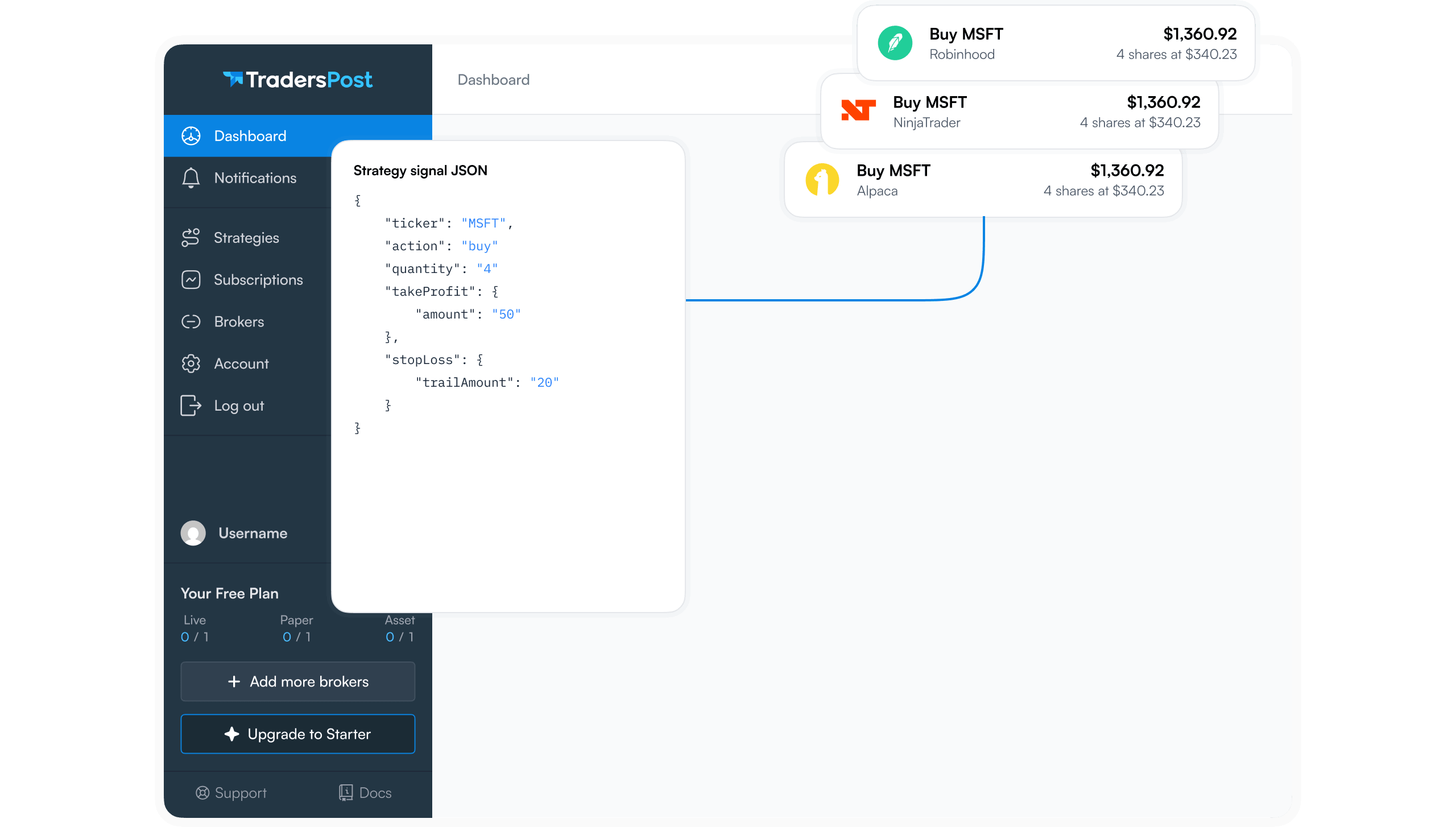
The technical implementation of an automated DCA strategy requires several components working together. You need a source for your trading signals, a webhook to receive those signals, and a brokerage connection to execute the trades.
Start by creating a subscription in your trading automation platform. This subscription generates a unique webhook URL that will receive your trading signals. Copy this webhook URL as you will need it in the next steps.
Next, configure your signal source. If using TradingView, create an alert on the chart for the asset you want to purchase. The alert conditions should trigger at your desired intervals. For testing purposes, you might use a very short timeframe like every 10 seconds to verify the system works correctly.
Within your alert configuration, replace the default message with a properly formatted JSON payload. This payload should specify the ticker symbol, the action (buy), and the quantity or dollar amount for each purchase. Many platforms provide example payloads in their documentation that you can customize.
In the notifications section of your alert, paste the webhook URL you copied earlier. This tells the alert system where to send the signal when conditions are met.
Strategy Message Formatting
The message format for your DCA strategy needs to contain specific information about the trade you want to execute. A basic DCA message includes the ticker symbol for the asset, the action type (typically "buy"), and the quantity to purchase.
Some platforms allow you to use placeholder variables instead of hardcoded values. For example, you might use a strategy order alert message variable that pulls information from your strategy parameters. This approach provides more flexibility as you can change quantities or symbols without editing the alert.
Alternatively, you can construct the entire message manually using the example format provided by your webhook service. This gives you complete control over every parameter in the trade request.
Testing Your DCA Bot
Before committing real capital, thorough testing is essential. Set up your DCA bot on a short interval timeframe to see multiple executions within a few minutes. This allows you to verify that signals are being sent correctly and trades are executing as expected.
Watch the webhook logs to confirm that each alert generates an entry. The logs should show the timestamp of each signal, the payload contents, and the response from your broker. Any errors or rejected orders will appear here for troubleshooting.
Start with a paper trading account or very small position sizes during initial testing. Only after you have confirmed dozens of successful executions should you scale up to your intended investment amounts.
Customizing DCA Intervals
The optimal interval for your dollar-cost averaging strategy depends on several factors including market volatility, your investment timeline, and cash flow availability. More frequent purchases provide better price averaging but also incur more transaction costs.
For longer-term investors, weekly or bi-weekly DCA schedules work well. These frequencies align with typical paycheck schedules and allow sufficient time between purchases for meaningful price movements.
Active traders might implement daily DCA strategies, particularly during periods of high volatility. Some even use multiple-times-daily purchases to capture intraday price swings.
Consider the specific characteristics of the asset you are purchasing. Highly volatile cryptocurrencies might benefit from more frequent DCA intervals, while stable large-cap stocks might work well with monthly purchases.
Position Sizing for DCA
Determining the appropriate amount to invest with each DCA purchase requires balancing several considerations. Your total capital allocation to the strategy, expected holding period, and risk tolerance all factor into the equation.
A common approach divides your total intended investment by the number of planned purchases. For example, if you want to deploy 10,000 dollars over 20 weeks, each weekly purchase would be 500 dollars.
Some investors prefer using a percentage of their portfolio rather than fixed dollar amounts. This approach naturally scales your purchases as your account grows. A strategy might invest 1 percent of the account value each week, adjusting the purchase size based on current account equity.
Managing DCA Positions
While dollar-cost averaging focuses primarily on entries, you should also consider how you will eventually exit these accumulated positions. Some investors use DCA to build long-term holdings with no predetermined exit. Others combine DCA entries with technical or fundamental exit signals.
One approach pairs DCA buying with trailing stop losses. As you accumulate shares and the price appreciates, a trailing stop protects your gains while allowing further upside potential. This combines the systematic entry advantage of DCA with risk management on the exit.
Another option uses profit targets based on your average cost basis. Once the position reaches a certain percentage gain above your DCA average price, you might take partial or full profits. The proceeds can then be recycled into new DCA campaigns.
Common DCA Mistakes to Avoid
Even with automation, several pitfalls can undermine your DCA strategy. The first is abandoning the plan during extreme market conditions. The greatest benefit of DCA often comes from purchases made during market downturns, yet this is precisely when fear tempts investors to stop buying.
Another mistake is using DCA for assets in structural decline. Dollar-cost averaging works best for quality assets experiencing temporary volatility, not failing companies or obsolete technologies. No amount of averaging down will salvage a fundamentally broken investment.
Over-diversification can also dilute the benefits of DCA. Running too many simultaneous DCA strategies spreads your capital thin and makes it difficult to build meaningful positions in any single asset. Focus on your highest-conviction opportunities.
Monitoring DCA Performance
Regular review of your automated DCA strategy helps identify what is working and what needs adjustment. Track your average cost basis over time and compare it to the asset's price history. Effective DCA should produce an average cost somewhere in the middle range of prices during your purchase period.
Monitor execution quality by reviewing fill prices against prevailing market prices at the time of each purchase. Significant slippage might indicate you need to adjust your order types or timing.
Analyze the relationship between your purchase intervals and price volatility. If volatility is high but your intervals are too infrequent, you may miss opportunities to buy at better prices. Conversely, very frequent purchases during stable periods add costs without much benefit.
Scaling Your DCA Strategy
Once you have validated your DCA approach with a single asset, you can expand to multiple strategies running in parallel. Automated execution makes managing several simultaneous DCA campaigns practical.
Consider staggering the start dates of multiple DCA strategies to spread your entry timing. This provides additional diversification in your purchase prices across different assets and time periods.
You might also implement tiered DCA strategies that adjust purchase amounts based on price levels. Buy larger quantities when prices are below certain thresholds and smaller amounts at higher prices. This adds a value-oriented component while maintaining the DCA discipline.
Advanced DCA Techniques
Experienced traders combine DCA with other analytical approaches to enhance results. Some use volatility-adjusted DCA that increases purchase frequency during high volatility periods when price dislocations are more common.
Another advanced technique employs reversion-to-mean triggers within the DCA framework. Rather than purely time-based purchases, trades execute when the asset deviates significantly from its moving average. This maintains the systematic accumulation principle while adding a valuation component.
You can also implement conditional DCA that activates or pauses based on broader market conditions. For example, your strategy might increase DCA frequency when a market breadth indicator suggests oversold conditions, and reduce it during extreme overbought readings.
Integration with Broader Portfolio Strategy
Dollar-cost averaging should fit within your overall investment approach rather than existing in isolation. Consider how your DCA positions complement other holdings and strategies in your portfolio.
Some investors use DCA specifically for their core long-term holdings while employing different strategies for opportunistic or tactical positions. This creates a stable foundation through DCA while leaving room for active management elsewhere.
The cash flow requirements of your DCA schedule must align with your liquidity needs. Ensure that your automated purchases do not leave you short of cash for living expenses or other investment opportunities that may arise.
Conclusion
Dollar-cost averaging offers a disciplined, emotion-free approach to building investment positions over time. Automation through webhooks and alerts ensures consistent execution without the need for manual intervention. By carefully configuring your DCA intervals, position sizing, and monitoring processes, you can implement a robust systematic investment strategy that works around the clock. The key is thorough testing, appropriate position sizing, and the discipline to maintain your strategy through various market conditions.