How to Trade 3x Leveraged ETFs Using Futures Signals
Learn how to generate trading signals from NASDAQ futures and execute them on 3x leveraged ETFs like TQQQ and SQQQ for enhanced returns without margin requirements.

Marketing

Trading leveraged ETFs offers an innovative way to gain amplified market exposure without the complexity of futures contracts or margin requirements. By generating signals from futures data and executing trades on 3x leveraged ETFs, you can capture enhanced returns while maintaining the simplicity of stock trading.
Understanding the Strategy Foundation
This approach combines the continuous data advantages of futures contracts with the accessibility of leveraged exchange-traded funds. The strategy generates signals based on NASDAQ futures (NQ) movements but executes trades on TQQQ (3x long) and SQQQ (3x inverse) ETFs.
Why Use Futures for Signal Generation
Futures contracts trade nearly 24 hours per day, providing continuous price data without overnight gaps. This continuous trading creates more reliable technical indicators compared to equity markets that close each day.
Moving averages, momentum indicators, and other technical tools calculated on futures data remain consistent overnight. Stock market gaps can distort these indicators, potentially triggering false signals or missing legitimate trade opportunities.
Benefits of Trading Leveraged ETFs
Leveraged ETFs provide several advantages for traders who want amplified exposure without futures complexity:
- No margin requirements or separate futures account needed
- Trade using standard stock brokerage accounts
- Fractional share trading available at many brokers
- No expiration dates or contract rollovers
- Excellent liquidity in popular leveraged ETFs
Setting Up Your Trading System
Creating an automated system that generates signals from futures data requires careful setup and testing. Understanding each component ensures reliable execution and helps you avoid common pitfalls.
Choosing Your Data Source
TradingView provides an excellent platform for developing strategies using futures data. The platform offers clean futures data, a robust scripting language (Pine Script), and webhook capabilities for sending alerts to trading platforms.
Access NQ futures data by searching for "NQ1!" on TradingView. The "1!" designation automatically rolls to the front month contract, ensuring continuous data without manual contract switching.
Pine Script Strategy Development
Pine Script enables strategy development directly on TradingView charts. Start with simple concepts and add complexity gradually as you validate each component.
Key Pine Script concepts for this strategy:
- Input variables for customizable parameters
- Technical indicator calculations (moving averages, momentum, etc.)
- Entry and exit logic based on indicator values
- Alert conditions that trigger when trades should execute
Testing Your Strategy Logic
Backtesting reveals how your strategy would have performed historically. However, remember that backtesting on futures data while trading ETFs introduces tracking differences that backtests cannot fully capture.
Forward testing provides more realistic performance expectations. Run your strategy with small position sizes or paper trading before committing significant capital.
Common Strategy Approaches
Several strategy types work well when generating signals from futures data. Each approach has distinct characteristics and optimal market conditions.
Momentum-Based Strategies
Momentum strategies identify when markets begin moving strongly in one direction. These strategies capture intermediate trends lasting days to weeks.
A momentum strategy might use rate of change calculations combined with standard deviation measurements. When price movement exceeds normal ranges with strong momentum, the strategy enters positions aligned with that momentum.
These strategies typically show lower win rates but larger average wins compared to losses. A profit factor of nine or ten is possible during strong trending periods.
Moving Average Systems
Moving average crossover systems provide straightforward trend-following signals. The most common approach uses exponential moving averages of different lengths (like 8 and 21 periods).
Buy signals occur when the faster moving average crosses above the slower moving average. Sell signals trigger when the faster average crosses below. These simple systems can be surprisingly effective, especially when combined with additional filters.
Consolidation and Breakout Trading
Markets spend significant time consolidating in ranges before breaking out into new trends. Strategies that identify consolidations and trade the subsequent breakouts can capture significant moves.
This approach requires careful distinction between true breakouts and false signals. Adding volume confirmation or momentum filters helps reduce false breakout trades.
Managing Slippage and Divergence
Trading one instrument while generating signals from another creates challenges you must understand and manage.
Futures-ETF Tracking Differences
While TQQQ and SQQQ track the NASDAQ index, they are not perfect proxies for NQ futures. Several factors create tracking differences:
- Futures can trade at premiums or discounts to spot prices
- Different contract months may show price variations
- Leveraged ETFs experience daily rebalancing effects
- Trading hours differ between futures and ETF markets
These differences rarely cause major problems but should be monitored. Significant divergences may require strategy adjustments.
Dealing with Contract Rollovers
Futures contracts expire quarterly, requiring traders to roll positions to the next contract. When using front month continuous data (like NQ1!), this rollover happens automatically in your data feed.
However, price differences between expiring and new contracts can create apparent jumps in your continuous data. These jumps do not represent actual market movements and should not trigger trading signals.
Testing on historical data spanning multiple contract rollovers reveals whether your strategy handles these events appropriately.
Risk Management Essentials
Leveraged ETFs amplify both gains and losses. Robust risk management becomes even more critical when trading these instruments.
Position Sizing for Leveraged Products
The 3x leverage inherent in TQQQ and SQQQ effectively triples your exposure. If you normally risk one percent of capital per trade, consider reducing position size to maintain that same risk level when trading 3x products.
Calculate position size based on your stop loss distance and acceptable risk per trade. Account for the leverage factor in these calculations.
Stop Loss Placement
Stop losses protect capital when trades move against you. For strategies generating signals from futures but trading ETFs, stop loss placement requires consideration.
Some traders place stop losses based on the futures chart where signals generate. Others base stops on the actual ETF price action. Each approach has merits and drawbacks.
Using futures-based stops maintains consistency with your signal generation logic. Using ETF-based stops accounts for actual execution prices and ETF-specific volatility.
Managing Multiple Entries
Grid-style strategies or strategies that scale into positions create additional complexity. Track your overall exposure carefully when adding to positions.
Consider using separate tracking for each entry level. This allows you to exit portions of positions independently based on different profit targets or stop levels.
Automating Trade Execution
Automated execution removes emotion from trading and ensures signals execute without delay. Setting up automation requires connecting your signal generation platform to your broker.
Using Webhook Alerts
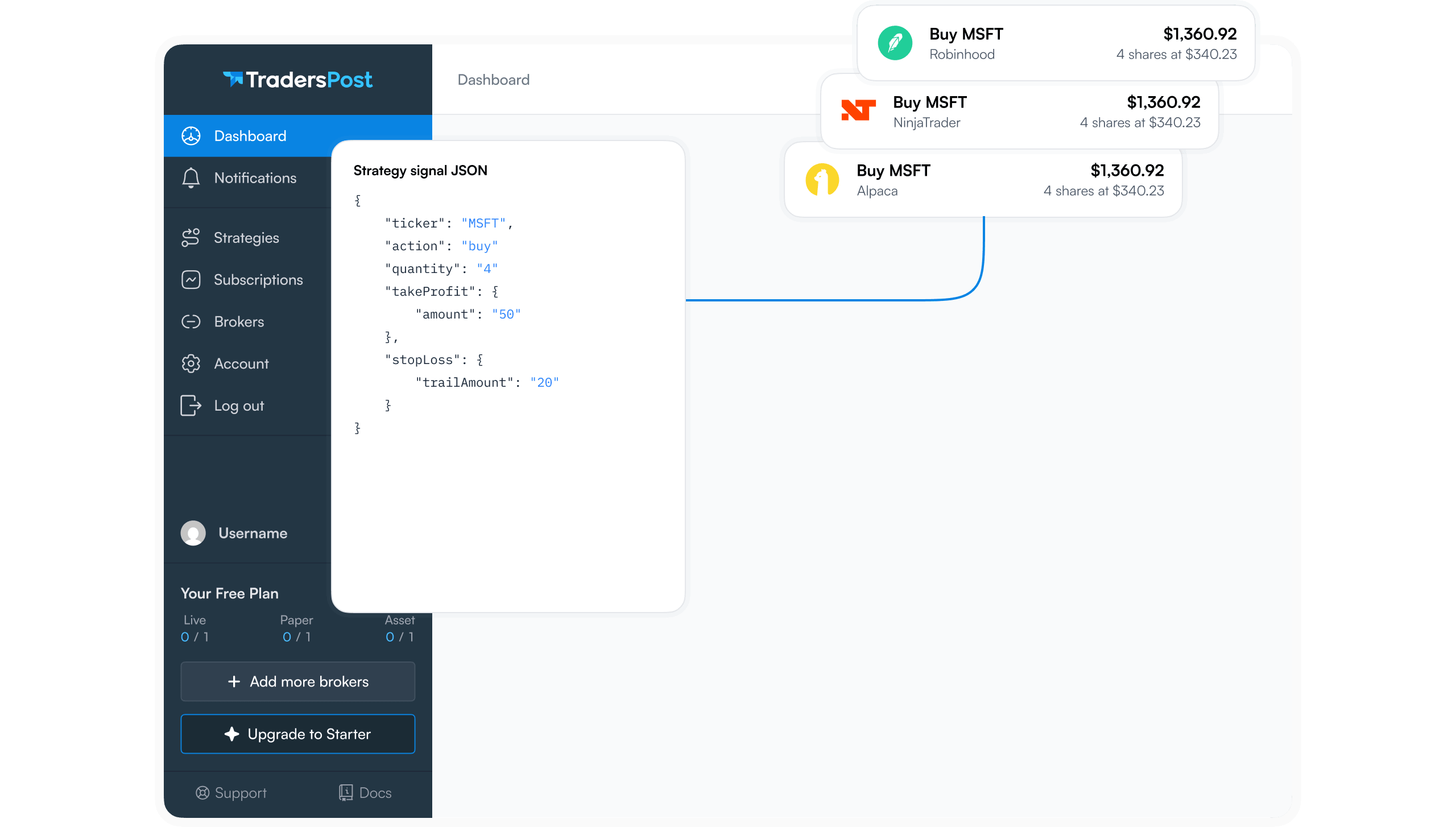
TradingView alerts can trigger webhook calls that send trade information to automated trading platforms. These webhooks contain JSON data specifying the ticker, action (buy or sell), quantity, and other trade parameters.
Platforms like TradersPost receive these webhooks and translate them into broker-specific order formats. This automation eliminates manual order entry and reduces execution delays.
Crafting Alert Messages
Alert messages must contain all information needed to execute trades correctly. At minimum, include:
- Ticker symbol for the specific ETF to trade
- Action (buy or sell)
- Quantity or position size
- Signal identifier (helps track which strategy triggered the alert)
Test your alert message format thoroughly before running strategies with real money. Incorrect formatting can cause rejected orders or unintended trades.
Strategy Optimization Considerations
Optimizing strategy parameters improves performance but introduces risks of overfitting to historical data.
Parameter Testing
Test how different parameter values affect strategy performance. For example, try moving average lengths from 5 to 50 periods in increments of five.
Look for parameter ranges that show consistent profitability rather than single optimal values that jump dramatically from surrounding values. Clustered good results suggest robust parameters while isolated peaks suggest overfitting.
Calculating on Every Tick
Pine Script strategies can calculate on every tick (each price change) or only on bar closes. Calculating on every tick enables more precise entries and exits but requires careful logic to avoid repeated signals within the same bar.
For faster timeframes (one to five minutes), tick calculation may significantly improve results by catching optimal entry and exit points. For longer timeframes (hourly or daily), bar close calculation typically suffices.
Forward Testing Adjustments
Forward testing often reveals opportunities to improve your strategy. You might notice specific conditions where the strategy performs particularly well or poorly.
Make adjustments based on these observations, but verify changes against historical data to ensure you are not curve-fitting to recent market behavior.
Debugging Your Strategy
Even experienced developers encounter bugs and logic errors. Systematic debugging saves time and prevents trading losses from flawed code.
Using Pine Script Logs
Pine Script's log functionality allows you to output variable values at specific points in your code. Review these logs to verify calculations match your expectations.
Check that:
- Indicators calculate correctly
- Entry conditions trigger at appropriate times
- Exit logic fires when expected
- Variables contain expected values
Visual Debugging with Labels
Placing labels or markers on your chart at entry and exit points provides visual confirmation that your strategy logic works correctly. Colors can indicate entry types (long vs short) or other strategy-specific information.
Visual debugging helps identify patterns in your entries and exits. You might notice the strategy consistently enters too early or exits too late, insights difficult to spot in numerical logs.
Understanding Strategy Performance Metrics
Evaluating strategy performance requires looking beyond simple profit and loss. Several metrics provide insight into strategy quality.
Profit Factor
Profit factor divides gross profit by gross loss. A profit factor above two indicates you make twice as much on winners as you lose on losers. Profit factors of four to five suggest strong strategy performance.
However, profit factor alone does not tell the complete story. A strategy with excellent profit factor but very few trades may not provide adequate opportunities.
Win Rate Analysis
Win rate measures what percentage of trades are profitable. Higher win rates feel better psychologically but do not necessarily indicate superior strategies.
Mean reversion strategies often show high win rates with relatively small wins and occasional large losses. Trend following strategies frequently show lower win rates but much larger average wins compared to average losses.
Maximum Drawdown
Maximum drawdown measures the largest peak-to-trough decline in your account. This metric reveals the psychological and financial stress your strategy might create.
Ensure maximum drawdown remains within your risk tolerance. A strategy with excellent returns but 50 percent maximum drawdown may not be tradeable for most people despite its profitability.
Adapting to Market Conditions
Markets cycle through different regimes. Strategies that work well in trending markets may struggle in choppy, range-bound conditions.
Recognizing Market Regimes
Develop the ability to recognize what type of market environment currently exists. Simple regime filters help strategies adapt or shut down during unfavorable conditions.
Common regime indicators include:
- Average True Range (ATR) for volatility measurement
- ADX (Average Directional Index) for trend strength
- Relationship between price and moving averages
- Market breadth indicators
Strategic Position Sizing
Consider varying position size based on market regime or recent strategy performance. Increase size during favorable conditions and reduce size when conditions turn challenging.
This dynamic approach helps you maximize profits during good periods while protecting capital during difficult stretches.
Conclusion
Trading 3x leveraged ETFs using signals generated from futures data combines the best aspects of both markets. You gain the data quality and continuity of futures markets while maintaining the simplicity and accessibility of equity trading.
Success with this approach requires careful strategy development, robust risk management, and thorough testing. Start with simple strategies and gradually add complexity as you validate each component.
Remember that the 3x leverage amplifies both gains and losses. Size positions appropriately and never risk more than you can afford to lose on any single trade.
With proper implementation, this hybrid approach offers an effective way to trade actively while managing the complexities that can make futures trading challenging for newer traders.