Volatility Arbitrage Explained
Volatility arbitrage trades implied versus realized volatility, not price direction. Learn how delta hedging works, what the variance risk premium is, and who can access it.

Marketing

Volatility arbitrage is one of those terms that sounds more precise than it is. The strategy does not lock in a riskless spread the way classical arbitrage does. What it actually does is bet that implied volatility, the forward-looking number embedded in option prices, will differ from realized volatility, the actual movement the underlying delivers, in a predictable direction. That gap, and who captures it, is what the trade is really about.
The mechanics matter because they determine who can actually run the strategy. Delta hedging, rehedging costs, margin requirements, and the shape of the payoff distribution all influence whether the edge survives after friction. This article works through each of those layers: what the variance risk premium is, how delta hedging isolates a volatility position, why the edge is largely institutional, and what retail traders can realistically access.
If you have traded options before and want to understand the structural logic behind premium-selling strategies, this is the framework that connects the pieces.
Not the Arbitrage You Think
Implied vs. Realized Volatility
Implied volatility is extracted from current option prices using a pricing model. It represents the market's consensus expectation for how much a security will move over the option's remaining life. Realized volatility is measured after the fact as the actual standard deviation of returns over a specified window. One is a forecast; the other is the outcome.
Volatility arbitrage bets that the gap between these two numbers will close in a predictable direction. The trade is not about predicting price direction. It is about predicting whether options are priced rich or cheap relative to what the underlying will actually do. That is a subtler and harder question than it might appear.
Why 'Arbitrage' Is a Misnomer
Classical arbitrage is riskless by definition: you buy low and sell high simultaneously and pocket a guaranteed spread. Volatility arbitrage carries model risk, rehedging costs, and genuine tail exposure. There is no locked-in profit at entry. The correct framing is a volatility risk premium trade: you are compensated for bearing variance risk, not for exploiting a mechanical pricing error.
The term persists because the trade is constructed to be direction-neutral, which superficially resembles a market-neutral position. But direction-neutral is not risk-free, and conflating the two is how traders undersize their hedges and oversize their positions.
The Variance Risk Premium
What the Research Shows
Index options have historically priced implied variance above the variance that was subsequently realized. This gap, the variance risk premium, is the structural reason most volatility arbitrage strategies run net short volatility. Sellers of index volatility have collected a persistent premium over time by absorbing this difference between what the market feared and what actually happened.
The premium is not constant. It compresses in calm markets and widens around stress events. Timing and position sizing therefore matter as much as the structural direction of the trade.
Why the Premium Exists
Portfolio managers pay above-fair-value for index options because the downside protection they provide is worth more than its actuarial cost during drawdowns. That demand-side imbalance transfers wealth from buyers of variance protection to sellers willing to absorb tail risk. The variance risk premium is compensation for providing insurance, not a free lunch. Sellers face the same left-tail events that buyers are hedging against, and when those events arrive, the losses can be severe.
How the Trade Is Expressed
Options-Based Approach
The most direct expression of volatility arbitrage is buying or selling an option and delta-hedging the resulting position to isolate volatility exposure. Selling a straddle or strangle (short a call and a put at or near the money) is the retail-accessible version: you collect premium if realized volatility stays below implied over the holding period.
Variance swaps and volatility swaps are OTC instruments that deliver a pure volatility payoff without an options position, but they are not available to retail traders. For most practitioners outside institutional desks, options are the instrument.
VIX Products and ETPs
Structured products linked to VIX futures, such as volatility ETPs, offer a retail-accessible proxy for short volatility exposure. However, they introduce roll costs and path dependency that differ materially from a direct options position. These products express a view on the shape of the VIX futures curve as much as on implied versus realized volatility, and the distinction is not trivial. Short-volatility ETPs have experienced severe drawdowns during volatility spikes, illustrating that the tail risk in these instruments is real and concentrated. They are not a clean substitute for a delta-hedged options position.
Delta Hedging Is the Whole Game
Why Delta Hedging Isolates Volatility
An unhedged option position profits or loses based on the direction of the underlying as much as on volatility. Hedging away delta leaves a position whose P&L is driven primarily by the difference between implied and realized volatility. That is the isolation the strategy requires.
A delta-hedged long option position profits when realized volatility exceeds what was priced in at purchase. A delta-hedged short option position profits when realized volatility falls short of implied. As the underlying moves, delta changes, which requires continuous rebalancing of the hedge to maintain direction-neutrality. The rebalancing is not incidental; it is what converts an options position into a volatility position.
The Cost of Rehedging
Every rehedge trades the underlying or a related instrument at bid or ask, generating transaction costs that eat into the volatility spread being harvested. Continuous hedging is theoretically ideal but practically impossible; discrete rehedging intervals introduce path dependency and gamma risk between adjustments.
At Interactive Brokers, US equity options carry a base commission of USD 0.65 per contract for accounts trading up to 10,000 contracts per month,1 with OCC clearing fees of USD 0.025 per contract applied on top.1 Each rehedge leg compounds these costs. The breakeven volatility spread narrows as rehedging frequency increases, which is why high-frequency execution infrastructure is an institutional advantage.
Gamma and Theta as P&L Drivers
A delta-hedged long option is long gamma and short theta: it profits from large realized moves but bleeds time decay each day volatility stays low. A delta-hedged short option is the mirror image: it collects decay but can lose sharply when realized volatility spikes. The trade-off between gamma and theta determines whether the position nets positive over a holding period, and it is sensitive to the path of realized volatility, not just its average. A strategy can have a positive expected value on average and still lose money on a specific path that stays quiet until it does not.
Why the Edge Is Largely Institutional
Friction Kills the Spread
The variance risk premium in index options has historically been a few volatility points wide. Transaction costs from commissions, bid-ask spreads, and margin requirements can consume a substantial portion of that edge for small accounts running frequent rehedges.
At tastytrade, equity options open at USD 1 per contract, capped at USD 10 per leg, with no closing commission.2 These rates are among the most retail-friendly available. Yet the costs still compound across frequent rehedges, and retail accounts receive no volume rebates. Institutional desks trade in size that earns tighter market-maker spreads and volume discounts, reducing per-contract friction to a level retail cannot replicate.
Model Risk and Tail Events
Delta hedging requires a model to compute delta. Black-Scholes delta is the standard, but it assumes constant volatility, which is demonstrably false in practice. When volatility regimes shift suddenly, model-implied deltas can be wrong by enough to turn a nominally delta-neutral position directional at the worst moment.
The payoff distribution of a short volatility strategy has a heavy left tail: small, frequent gains punctuated by occasional large losses during volatility spikes. That shape means that a string of winning months does not validate the strategy's risk profile; the left tail is always there, waiting for the right catalyst.
Capital Requirements and Margin
Short options require margin, and margin calls during a volatility spike can force liquidation at the worst possible time. Portfolio margin, available to qualifying accounts at brokers like Interactive Brokers, reduces the margin required by modeling the actual risk of a hedged position, but it requires a higher account minimum and approval. An undercapitalized short-volatility position cannot survive the drawdown required to recover. Position sizing relative to account equity is the primary risk control, not stop-loss orders or hedging overlays.
What Is Actually Accessible to Retail
Selling Premium Without Full Delta Hedging
Most retail traders express the variance risk premium by selling options outright or in spreads, accepting residual directional risk rather than hedging it away continuously. Credit spreads, iron condors, and short strangles are common structures. Spreads cap the maximum loss at a defined level; naked positions expose the seller to large losses on a sharp move. Neither is volatility arbitrage in the strict sense, because both retain significant delta and gamma exposure. But both benefit structurally from implied volatility exceeding realized volatility over time, which is the same underlying premise.
Sizing on the Worst Case, Not the Average
Because the payoff distribution is negatively skewed, sizing on average expected return produces positions too large to survive the tail event. A sound approach is to determine the maximum drawdown the account can absorb without forced liquidation and work backward to a position size that survives that scenario. Treating the strategy as a risk premium with a tail attached, rather than as an arbitrage, forces more conservative sizing and clearer stop rules. The distinction between those two framings is not semantic; it changes the number of contracts you put on.
Automating Defined-Risk Structures
Systematic entry and exit rules reduce emotional overrides at expiration or during drawdowns, which is where discretionary short-volatility traders most often lose discipline. Defining the maximum loss at order entry, rather than deciding whether to exit during a spike, removes the most dangerous decision point from the process.
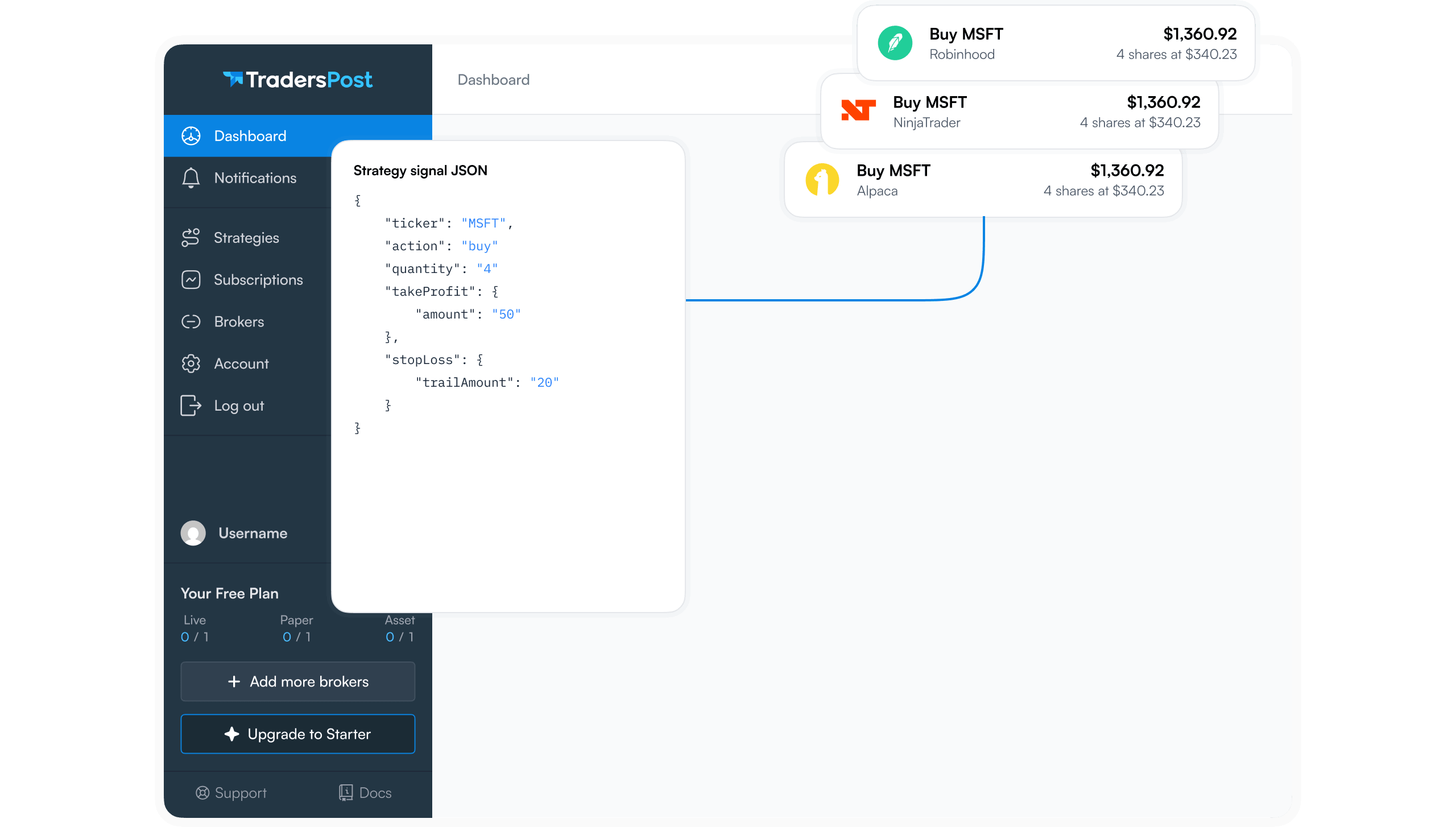
TradersPost supports bracket orders with both take-profit and stop-loss legs for stocks, options, and futures on connected brokers, allowing traders to lock in the maximum loss at entry and remove the temptation to override exits during a volatility spike. Automated execution also enables consistent delta monitoring schedules: a TradingView alert can fire when delta drift exceeds a threshold, triggering a rebalance signal rather than relying on manual checks.
Bottom Line
Key Takeaways
- Volatility arbitrage is a bet that implied volatility overprices realized volatility, not a riskless spread trade. The name is a misnomer; the correct framing is a volatility risk premium trade.
- Index options have historically delivered a positive variance risk premium for sellers, but the left tail is severe. The premium is not constant and compresses in calm markets.
- Delta hedging isolates volatility exposure by stripping out directional P&L, but every rehedge costs commissions and clearing fees that narrow the viable spread. At Interactive Brokers, those costs run USD 0.65 per contract plus USD 0.025 OCC clearing for accounts under 10,000 monthly contracts.1 Continuous hedging is an institutional capability, not a retail one.
- Retail traders can access the variance risk premium through premium-selling structures, but should size on the worst case and treat the strategy as a risk premium with a tail, not an edge that always pays.
- At tastytrade, equity options open at USD 1 per contract capped at USD 10 per leg with free closes.2 Even at these rates, frequent rehedges compound costs that a small account cannot absorb without eroding the edge.
Frequently Asked Questions
What is the difference between implied and realized volatility?
Implied volatility is derived from current option prices and reflects the market's expectation of future price movement over the option's life. Realized volatility is measured after the fact as the actual standard deviation of the underlying's returns over a specified period. Volatility arbitrage profits when these two diverge in a predictable direction, typically when implied runs above what is subsequently realized.
Do you have to delta hedge to run a volatility arbitrage strategy?
Pure volatility arbitrage requires delta hedging to strip out directional exposure and isolate the volatility bet. Without hedging, an options position also profits and loses based on the direction of the underlying, making it a mixed directional and volatility bet rather than a pure volatility trade. Most retail traders skip continuous delta hedging and sell premium outright or in spreads, accepting residual directional risk in exchange for simpler execution.
What is the variance risk premium and why does it persist?
The variance risk premium is the consistent tendency for implied variance in index options to exceed subsequently realized variance, leaving a positive spread for volatility sellers. It persists because portfolio managers are willing to overpay for downside protection relative to its actuarial cost, creating a structural demand imbalance that transfers wealth to sellers willing to absorb tail risk. The premium is not constant and compresses during low-volatility regimes, so the edge is not uniform across market environments.
How do transaction costs affect volatility arbitrage for retail traders?
At Interactive Brokers, US equity options are charged USD 0.65 per contract for accounts trading under 10,000 contracts per month, plus OCC clearing fees of USD 0.025 per contract.1 At tastytrade, opening an equity option costs USD 1 per contract, capped at USD 10 per leg, with no closing commission.2 Each rehedge adds a round-trip cost; if rehedges are frequent, these costs can consume a substantial portion of the volatility spread being harvested, particularly for small accounts with no volume discounts.
Is volatility arbitrage suitable for retail traders?
The pure form, involving continuous delta hedging and access to instruments like variance swaps, is largely institutional due to infrastructure requirements, margin advantages, and transaction cost advantages that retail accounts cannot replicate. Retail traders can express a similar view by selling option premium in defined-risk structures, but the strategy carries a heavy left tail and demands conservative position sizing. Treating it as a risk premium that occasionally produces large drawdowns, rather than as a reliable income stream, is the more accurate framing for setting expectations and sizing positions.
References
1 Interactive Brokers Options Commissions
2 tastytrade Pricing