Funded Futures Family Velocity Plan Explained
Velocity is FFF's cheapest monthly plan, but its intraday trailing drawdown changes everything. Full rules, payout numbers, and lineup comparisons.

Marketing

The FFF Velocity plan is the cheapest monthly entry in the Funded Futures Family lineup, starting at $79 per month for a 25K account with no activation fee and no funded-account fee.1 That low price comes with a trade-off that shapes every decision on the plan: Velocity is the only FFF plan that uses intraday trailing drawdown on both the evaluation and the funded account. If you take profit quickly and trade defined milestones, the plan works well. If you let winners run, the same drawdown model that keeps the price low is what ends accounts.
This breakdown covers the full fff velocity plan rule set: pricing, evaluation specs, drawdown mechanics, the standard payout cycle, the Daily Payout Add-On, and how Velocity compares to Prime, Premier+, and Straight-to-Funded. Numbers are pulled from the official FFF plan pages as reviewed in September 2026.
Velocity Numbers at a Glance
Pricing across account sizes
Base pricing runs $79 per month for the 25K account up to $325 per month for the 150K account, with no activation fee and no monthly funded-account fee.1 The Daily Payout Add-On costs an additional $29 to $69 per month depending on account size, bringing the 25K total to $108 per month.1 Promo codes rotate; Velocity has run at 85% off with code FFF, so the checkout price frequently differs from the list price.1
Evaluation specs
The evaluation requires a minimum of three trading days to pass, with no maximum time limit and unlimited evaluation accounts and resets.1 A 40% consistency rule applies during the evaluation: the largest single day's profit cannot exceed 40% of total evaluation profit.1 Profit targets scale by account size: $2,500 on the 25K, $4,000 on the 50K, $7,000 on the 100K, and $10,000 on the 150K, with max loss limits of $1,250, $2,250, $3,250, and $4,750 respectively.1
The Intraday Trailing Drawdown
How it works in real time
The drawdown floor on Velocity is monitored continuously and includes unrealized profit. The threshold is the highest account value (open positions included) minus the max drawdown amount.1 The floor ratchets up the moment a new equity peak is printed, open trades included, and it never comes back down.1 Touching the threshold at any point during the session breaches the account, even on a day that would have closed green.1
Why it is on every Velocity account
Intraday trailing drawdown applies to both the evaluation and the funded account, making it the only FFF plan where this stricter model is present at every stage.1 That stricter model is a large part of why Velocity is the cheapest monthly plan in the FFF lineup.1 Traders who take profit quickly barely feel the intraday model; traders who let winners breathe face the most exposure to mid-session breaches.1
Intraday vs end-of-day: key difference
Prime and the end-of-day configurations of Premier+ use EOD drawdown, where the floor is recalculated once per session from the closing balance, so intraday swings never move it.2 On EOD plans, the floor also locks once it reaches the starting balance; further gains stop dragging it up. Velocity has no such lock.1 A position that runs into open profit and then pulls back can breach a Velocity account mid-session but would leave an EOD account untouched at the same close.
Velocity Asks More Than Its Siblings
Profit targets vs the lineup
Velocity's 25K evaluation profit target is $2,500, which is 10% of account size and double Prime's $1,250 target at the same size.2 Premier+ Fast Pass and Standard share a $1,500 target on the 25K; Velocity's $2,500 is the highest evaluation target in the FFF lineup at that account size.3 The higher targets carry through every size: Velocity 50K requires $4,000 versus $3,000 for both Prime and Premier+ at the same account size.23
Funded contract scaling
Funded Velocity accounts do not start at full contract size. Available contracts scale with simulated profit in the account, recalculated at the end of each session, never mid-day, until the plan maximum is reached.1 On the 25K account, traders start at 1 mini or 10 micros and reach the maximum of 3 minis or 30 micros once simulated profits reach $2,000.1 Scaling does not apply during the evaluation phase.1
How the Standard Payout Cycle Works
The three-day rhythm
Standard Velocity requires three trading days between payout requests, with at least three winning days of $200 or more in profit and $1,500 in cumulative profit on the 25K account.1 Profit requirements between payouts scale by account size: $1,500 on 25K, $3,000 on 50K, $6,000 on 100K, and $9,000 on 150K.1 Per-payout maximums on standard Velocity are $750 on 25K, $1,250 on 50K, $2,250 on 100K, and $3,250 on 150K, with a 90/10 split from the first dollar on every payout.1
The 40% consistency rule on funded accounts
The 40% consistency rule carries from the evaluation into the funded account and stays in force for the life of the account on the standard plan.1 The formula: the largest single day's profit divided by total profit at the moment of the payout request must not exceed 40%.1 The calculation resets after every approved payout, so one outsized day does not follow a trader into the next cycle.1
Payout mechanics
Payout approvals are described as instant, with money landing in a Rise account within hours of the request once Rise verification is complete.1 The profit requirement resets after every approved payout, and a qualifying day is any day with $200 or more in profit.1 A $100K total payout cap per user applies across all FFF plans, including Velocity.1
What the Daily Add-On Changes
Add-On cost and payout cadence
The Daily Payout Add-On costs $29 to $69 per month by account size, bringing the 25K total to $108 per month.1 With the Add-On, payout eligibility becomes daily: there is no minimum waiting period between requests.1 The Add-On also removes the funded consistency rule entirely, leaving only the evaluation's 40% rule to clear before reaching the funded stage.1
Lower per-request caps with the Add-On
Per-payout maximums drop with the Add-On: $600 on 25K, $1,000 on 50K, $1,500 on 100K, and $2,500 on 150K, all lower than the standard plan caps.1 The 90/10 split remains in place with or without the Add-On.1 Traders should factor the Add-On cost into their monthly break-even calculation before assuming daily access is more profitable than the standard three-day cadence.
Where Velocity Sits in the Lineup
Velocity vs Prime
Prime uses end-of-day drawdown on every account, costs $129 per month for the 25K Included option, and has no consistency rule during the evaluation.2 Prime's 25K evaluation target is $1,250, half of Velocity's $2,500, making it a lower bar to clear before the funded stage.2 Prime's funded accounts carry a 40% consistency rule and a three-day payout cadence, the same rhythm as standard Velocity, but without the intraday trailing drawdown risk.2
Velocity vs Premier+
Premier+ Fast Pass has no evaluation consistency rule, while Velocity's evaluation carries a 40% rule.3 Premier+ lets buyers choose their drawdown model at checkout, including end-of-day, which Velocity does not offer.3 Premier+ funded payout caps are structured differently: 50% of profit per request up to a per-size maximum, rather than Velocity's flat dollar caps.3
Velocity vs Straight-to-Funded
S2F Standard skips the evaluation entirely for a one-time fee of $329 to $734 by account size, with no recurring monthly cost.4 S2F Standard uses end-of-day drawdown with a 25% consistency rule and a seven-day qualifying period before the first payout, a stricter funded structure than Velocity.4 Velocity's recurring monthly fee can exceed the S2F one-time cost over a long evaluation window, making the math worth running before choosing.4
Running Velocity on Automation
Connecting a funded account to automation
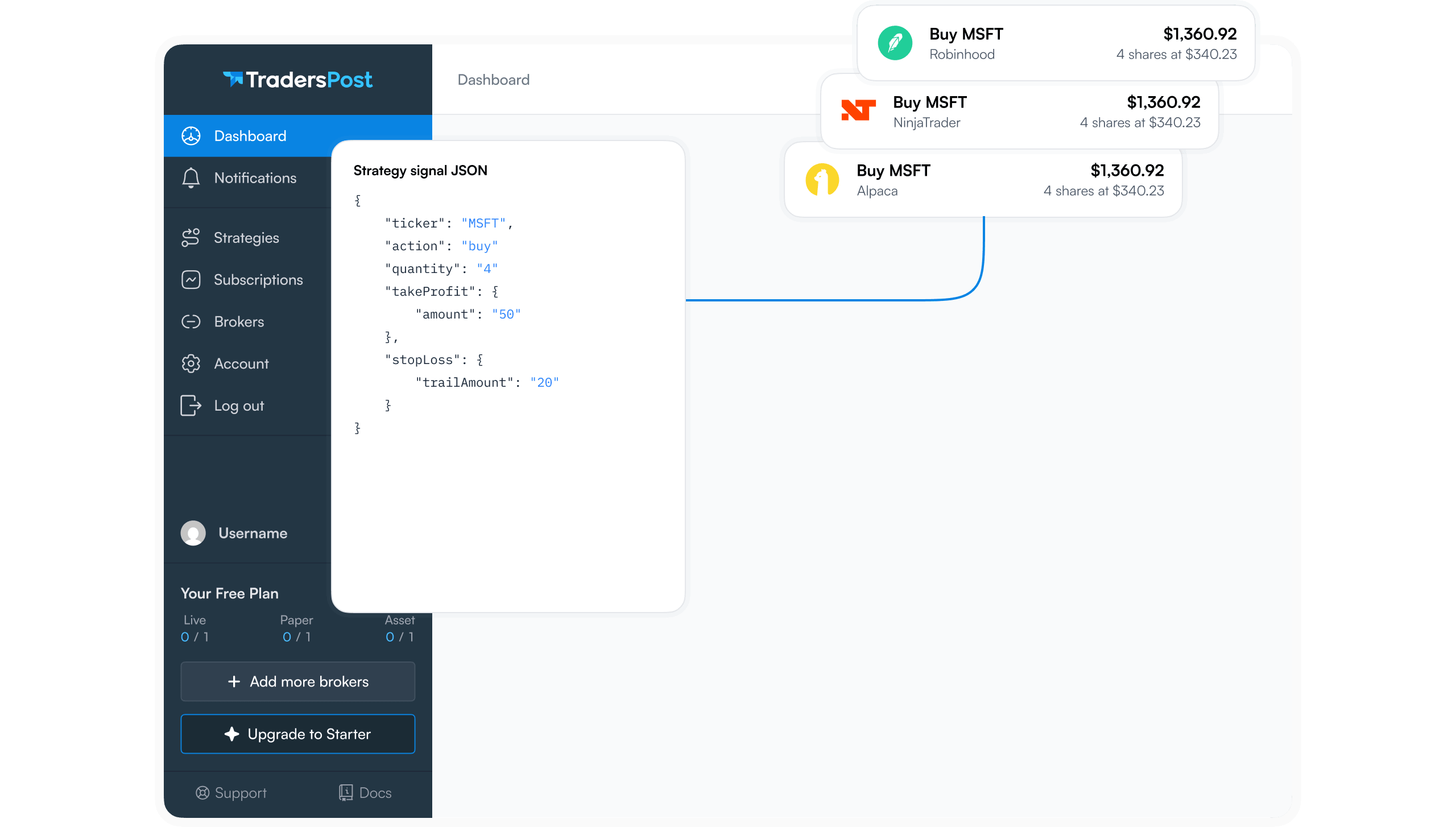
Funded Futures Family accounts trade through Tradovate, which is a supported broker connection on TradersPost, enabling webhook-driven order routing from TradingView alerts to funded accounts. Automating a Velocity account means any signal that triggers an entry also drags the intraday trailing drawdown floor upward in real time as the position runs into unrealized profit; position sizing in the webhook payload must account for this dynamic.
Using a fixed quantity in the webhook payload is the most predictable approach during the contract-scaling phase. The available contract limit changes by session, and a payload requesting more contracts than the current limit will be capped at the broker level. Because Velocity uses intraday trailing drawdown, the StopLoss.pnlAmount field lets you cap the dollar loss on a position in terms of portfolio PnL, giving a direct way to enforce a loss limit that aligns with where the drawdown floor sits at entry.
Connecting TradersPost to a Tradovate-backed funded account and routing TradingView signals through it is the fastest path to running a rules-based strategy on Velocity without discretionary order entry. Start with paper-mode testing to confirm the position sizing and stop placement match the drawdown math before going live.
Who Velocity Fits
Traders suited to Velocity
Velocity suits traders who take profit quickly and rarely hold large open gains, because the intraday trailing drawdown only bites when unrealized equity peaks pull the floor up.1 Traders who add the Daily Payout Add-On and clear the evaluation's 40% rule gain a payout structure with no consistency rule and no waiting period, which is as close as futures prop gets to trading a self-funded account at this firm.1 The plan rewards defined milestones: earn the profit target, request the payout, reset, repeat.
When another FFF plan is a better fit
Traders who let winning positions breathe, scale out slowly, or trade pullbacks should look at Prime or the EOD configuration of Premier+, both of which use end-of-day drawdown.23 Traders who want to skip the evaluation entirely and pay once rather than monthly should compare S2F Standard, which carries no evaluation at all.4 If the evaluation consistency rule is the primary obstacle, Premier+ Fast Pass removes it at the evaluation stage entirely.3
Bottom Line
- Velocity is the cheapest monthly FFF plan, but it is the only one with intraday trailing drawdown on both the evaluation and the funded account.
- The 25K evaluation profit target of $2,500 is the highest in the FFF lineup at that account size, double Prime's $1,250.
- Standard payouts run every three trading days at a 90/10 split; the Daily Add-On removes the waiting period and the funded consistency rule but lowers per-request caps and adds monthly cost.
- Traders who give back large open gains mid-session are structurally better served by Prime or the EOD configuration of Premier+.
- The S2F one-time fee can be cheaper than months of Velocity evaluation fees, so the math is worth running before committing to a monthly plan.
Frequently Asked Questions
What drawdown does Velocity use?
Velocity uses intraday trailing drawdown on both the evaluation and the funded account. The floor is monitored in real time and includes unrealized profit, ratcheting up with every new equity peak.1 This is the stricter of the two drawdown models FFF offers; the other, end-of-day drawdown, is available on Prime and the EOD configurations of Premier+ and S2F Standard.2 Touching the drawdown threshold at any point during the session breaches the account, even if the day would have closed profitable.1
Does Velocity have a consistency rule?
Yes. The evaluation carries a 40% consistency rule, and the standard funded account carries the same 40% rule for the life of the account.1 The calculation resets after every approved payout, so a large day early in a cycle does not permanently cap future requests.1 The Daily Payout Add-On removes the funded consistency rule entirely, leaving only the evaluation's 40% rule to clear.1
How often can I request a payout on Velocity?
Standard Velocity requires three trading days between payout requests, with at least three winning days of $200 or more in profit and the profit target met for that cycle.1 With the Daily Payout Add-On, payout eligibility becomes daily and the waiting period disappears, though per-payout maximums are lower than on the standard plan.1 Approvals are described as instant, with funds landing in a Rise account within hours once Rise verification is complete.1
How does Velocity's profit target compare to other FFF plans?
Velocity's 25K evaluation target is $2,500, the highest in the FFF evaluation lineup at that account size. Prime's 25K target is $1,250 and Premier+'s is $1,500.23 The higher target applies at every size: Velocity 50K requires $4,000 versus $3,000 for both Prime and Premier+ at 50K.1 The higher target is one of the trade-offs for Velocity's lower monthly price relative to Prime's EOD drawdown accounts.
Is the Daily Payout Add-On worth the extra cost?
The Add-On costs $29 to $69 per month by account size and removes both the funded consistency rule and the three-day waiting period between requests.1 Per-payout maximums drop with the Add-On: $600 on 25K versus $750 on the standard plan, so higher payout frequency comes with lower per-request ceilings.1 Whether the Add-On pays off depends on trading frequency and cycle profit: traders who hit the profit target quickly and trade every day benefit most; traders with longer cycles may not recoup the Add-On fee.
References
1 Funded Futures Family - Velocity Plan
2 Funded Futures Family - Prime Plan
3 Funded Futures Family - Premier+ Plan
4 Funded Futures Family - Straight-to-Funded