TradeDay Activation Fee and Payout Policy
TradeDay charges no activation fee when you pass its evaluation. Here is what accounts cost, how the tiered profit split works, and when you can request a payout.

Marketing

The TradeDay activation fee is simple to explain: there isn't one. TradeDay explicitly states "No activation fee" on every account tier listed on its pricing page, meaning passing the evaluation does not trigger a separate charge to switch your funded account on.1 That one policy difference changes the true cost comparison with other futures prop firms. This article covers what the evaluations actually cost, how resets are priced, when you can request a payout, and how the tiered profit split works across funded stages.
Two account types are available across four account sizes: Quick Pay and Fast Pass. They differ in evaluation requirements, payout structure, and profit split mechanics. Understanding those differences before you subscribe saves you from picking the wrong account for how you trade.
No Activation Fee at TradeDay
What the policy actually says
TradeDay lists "No activation fee" as a line item on every account card, from the 25k Intraday Quick Pay up to the 150k Fast Pass End of Day.1 Passing the evaluation does not generate a separate invoice or hold on your card before the funded account opens. The monthly subscription you pay during the evaluation is the only cost to reach funding, aside from any resets if you breach a drawdown limit.
This policy applies to both Quick Pay and Fast Pass account types across all account sizes.2 There is no premium tier that adds an activation charge, and the "make it, take it" framing on the TradeDay site reflects that: pass, get funded, get paid on day one with no additional fee in between.
Why this matters to traders
Some firms charge a one-time activation fee after passing an evaluation, which adds cost on top of the monthly subscription you have already paid. Topstep, for example, offers two paths: a Standard Path at $49 per month for the 50k account that charges a $149 activation fee per Express Funded Account earned, and a No Activation Fee Path at $95 per month with no activation fee on passing.3 Neither option is automatically cheaper; the right choice depends on how many attempts you expect to need.
Knowing whether a firm charges an activation fee is necessary to compare the true cost of getting funded. At TradeDay, the number is zero regardless of account size or account type.
What the Evaluations Cost
Monthly subscription prices by account size
TradeDay evaluation accounts are billed monthly. Current pricing (after the advertised discount) for Intraday Quick Pay accounts is: 25k at $45 per month, 50k at $59, 100k at $108, and 150k at $162.1 End of Day Quick Pay variants carry slightly higher prices: the 25k EOD is $54, 50k EOD is $79, 100k EOD is $129, and 150k EOD is $180.
Fast Pass End of Day accounts run higher still: 25k at $59, 50k at $85, 100k at $149, and 150k at $225 per month.1 The Fast Pass premium over Quick Pay reflects the shorter minimum evaluation period and the structured funded payout system that comes with it.
Profit targets and drawdown rules by tier
Each account size carries a fixed profit target and trailing max drawdown. The 25k account requires a $1,500 profit target and a $1,000 trailing max drawdown; the 50k requires $3,000 profit target and $2,000 drawdown; the 100k requires $6,000 target and $3,000 drawdown; the 150k requires $9,000 target and $4,500 drawdown.1
Intraday accounts calculate the trailing max drawdown intraday, meaning the high-water mark moves with unrealized gains during the session. This is stricter than an end-of-day calculation, where the drawdown only resets after the session closes. Quick Pay accounts require a minimum of 5 trading days and a 30 percent consistency rule to pass; Fast Pass accounts require only 3 minimum trading days with a 45 percent consistency rule.1
Position limits per account size
- 25k: 2 contracts or 20 micros
- 50k: 5 contracts or 50 micros
- 100k: 10 contracts or 50 micros
- 150k: 15 contracts or 50 micros
These limits apply in both the evaluation and the funded simulation stage for Quick Pay accounts.1
Reset Fees
Reset cost equals the monthly subscription
TradeDay prices resets at the same amount as the monthly subscription for each account type. A 25k Intraday Quick Pay reset costs $45; a 50k Intraday reset costs $59; a 100k Intraday reset costs $108; a 150k Intraday reset costs $162.1 End of Day and Fast Pass resets follow the same pattern: the reset fee equals the monthly price for that account type.
How resets compare to starting over
Because the reset price matches the monthly fee exactly, a reset costs the same as purchasing a fresh evaluation month at the same account size. There is no discount for resetting versus canceling and resubscribing. Traders who fail near the end of a billing period should weigh both options, since the price is identical. The main practical difference is continuity of account history rather than cost.
The Payout Policy
Minimum payout and processing time
The minimum payout request is $250 across all Quick Pay account sizes.1 TradeDay states that most payout requests are processed within 24 hours.2 Quick Pay accounts have no payout buffer requirement and a minimum of 1 day before the first payout can be requested, meaning you can request on the first day of funded trading.
Day-one payouts on Quick Pay
TradeDay advertises day-one payouts on Quick Pay funded accounts.2 There is no buffer to clear and no waiting period after passing the evaluation. This is notable in futures prop trading, where many firms impose a waiting period or require a trader to accumulate profit above a buffer level before the first withdrawal becomes available.
For comparison, Topstep's Express Funded Account Standard Path requires 5 winning days of $150 or more in net profit before a payout request is eligible.4 Take Profit Trader's PRO account also offers day-one withdrawals with no minimum days required,5 so TradeDay is not alone in offering this feature, but it remains far from universal across the industry.
Fast Pass payout conditions
Fast Pass accounts operate under a structured payout system rather than the open day-one model. A minimum of 5 days must pass before requesting a payout, and those 5 days must each be profitable above a per-day threshold: $100 per day for the 25k, $150 for the 50k, $200 for the 100k, and $250 for the 150k.1
Fast Pass accounts also carry a maximum payout per cycle: $750 for the 25k, $1,500 for the 50k, $1,875 for the 100k, and $2,250 for the 150k.1 TradeDay states that Fast Pass payouts process just as quickly as Quick Pay payouts.2 The tradeoff is access speed at evaluation stage (3 days versus 5) in exchange for more structured payout conditions in the funded stage.
The Tiered Profit Split
Quick Pay split structure
Quick Pay funded simulation accounts use a tiered profit split: 50/50 below $4,000 of cumulative net profit, and 80/20 above $4,000 of net profit.1 The trader keeps 80 percent once the threshold is crossed. The practical effect is that early withdrawals below $4,000 are split evenly with the firm, while trading above that level earns the trader the majority share.
This tiered structure is different from firms that offer a flat split from the first dollar. Topstep's Express Funded Account pays a 90/10 split from the start with no tiered threshold,4 and MyFundedFutures advertises a 90/10 split on its Rapid plan from the Sim Funded stage.6 Whether the 50/50 below $4,000 is a meaningful cost depends on whether you plan to take payouts early or let the balance build.
Funded Live split
Once a trader advances from Funded Sim to Funded Live, the profit split improves to 90/10, meaning the trader keeps 90 percent.1 The 90/10 split applies in Funded Live regardless of net profit level, unlike the tiered structure in Funded Sim. Fast Pass accounts use an 80/20 split in Funded Sim and a 90/10 split in Funded Live, with no tiered threshold at any profit level.1
Funded Sim and Funded Live Are Different Stages
What Funded Sim means
After passing the evaluation, traders enter a Funded Sim account. This is a simulated trading environment where profits are real in the sense that they determine payout eligibility, but orders do not go to the live market.1 Funded Sim accounts for Quick Pay have no milestones and no consistency requirement, unlike the evaluation stage. The trailing max drawdown in Funded Sim is still calculated intraday for Quick Pay accounts, matching the evaluation drawdown type.
Advancing to Funded Live
Funded Live is a separate stage beyond Funded Sim where the profit split improves to 90/10. TradeDay's pricing page shows Funded Live as the stage at which the 90/10 split applies, distinguishing it from the tiered split in Funded Sim.1 Not all traders automatically reach Funded Live; it represents a progression from the initial funded simulation stage. The distinction matters for planning: the split you see in Funded Sim is not the same as the split available once you advance.
TradeDay Compared to Other Firms
Topstep activation fee structure
Topstep offers two evaluation paths at each account size. The Standard Path costs $49 per month for the 50k account but adds a $149 activation fee charged once per Express Funded Account earned. The No Activation Fee Path costs $95 per month for the 50k account and charges nothing on passing.3 If you expect to pass in one or two attempts, the math favors the Standard Path despite the activation fee. If you expect more attempts, the higher monthly cost of the No Activation Fee Path may cost more in total.
Topstep's minimum payout is $125,4 half of TradeDay's $250 minimum. Topstep's profit split is 90/10 from the Express Funded Account stage with no tiered threshold,4 which is more favorable than TradeDay's 50/50 below $4,000 in Quick Pay Funded Sim for traders taking early, smaller payouts.
MyFundedFutures and Take Profit Trader
MyFundedFutures advertises a $0 activation fee on all plans, a 90/10 profit split on its Rapid plan, and daily payouts with more than 75 percent of payouts auto-approved in under one second.6 Take Profit Trader charges a one-time $130 fee for the PRO account rather than a recurring monthly subscription, and offers day-one payouts with an 80/20 split in the PRO account and 90/10 in PRO+.5 Each firm structures its funded stages, drawdown types, and payout timelines differently, so comparing the full cost path matters as much as the activation fee alone.
Running TradeDay With Automation
Connecting a prop firm account via TradersPost
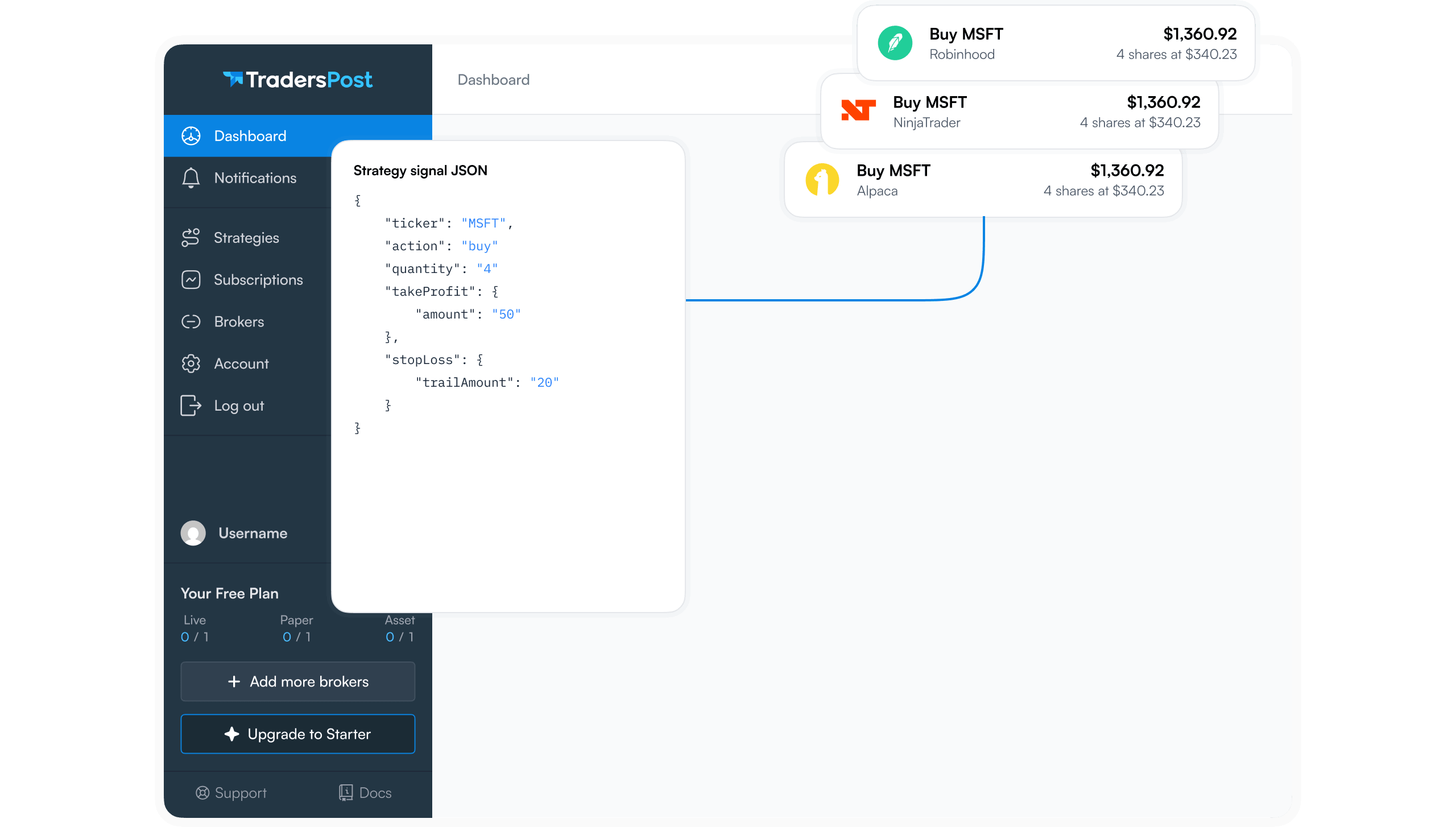
TradersPost connects TradingView or TrendSpider alerts to Tradovate or ProjectX accounts, which are the platforms TradeDay traders use.7 Automated order routing lets traders execute signals across multiple evaluation or funded accounts simultaneously without manual order entry. Before linking any automation to a prop firm account, traders must confirm that automated trading complies with that firm's rules; TradersPost accepts no liability for non-compliance.7
If you want to run the same strategy across multiple TradeDay evaluation or funded accounts at once, TradersPost routes TradingView or TrendSpider webhook signals to your Tradovate or ProjectX prop firm accounts, handling order routing and position sizing from a single strategy setup. Connect your prop firm account to TradersPost and start automating your evaluation trades today.
Consistency rules and automated strategies
TradeDay Quick Pay accounts require that no single trading day accounts for more than 30 percent of total profits during the evaluation.1 Fast Pass accounts apply a 45 percent threshold. Automated strategies that generate large single-day gains can trigger consistency violations, so traders should monitor daily profit and loss distribution against the consistency threshold when running algo strategies. The consistency rule does not apply in the Funded Sim stage for Quick Pay, but it is enforced throughout the evaluation.
Bottom Line
- TradeDay charges no activation fee on any account size or account type when you pass the evaluation.1
- Quick Pay funded accounts allow payout requests from day one with no buffer and a $250 minimum, with most requests processed within 24 hours.2
- The Quick Pay profit split starts at 50/50 below $4,000 of cumulative net profit, improves to 80/20 above that threshold in Funded Sim, and reaches 90/10 in Funded Live.1
- Reset fees match the monthly subscription cost exactly, making a reset the same price as starting a new evaluation month at the same account size.
- Fast Pass accounts pass in 3 days versus 5 for Quick Pay, but use a structured payout system with per-day profit minimums and a maximum payout per cycle.1
Frequently Asked Questions
Does TradeDay charge an activation fee when you pass?
No. TradeDay states "No activation fee" on every account tier. Passing the evaluation does not trigger a separate charge to activate the funded account.1 This applies to both Quick Pay and Fast Pass across all account sizes from 25k to 150k.
What is the minimum payout at TradeDay?
The minimum payout request is $250 across all Quick Pay account sizes.1 Quick Pay allows payout requests from day one of funded trading with no buffer to clear. Fast Pass accounts require a minimum of 5 days and 5 profitable days above a per-day threshold before requesting a payout.
How does the TradeDay profit split work?
Quick Pay funded sim accounts use a tiered split: 50/50 below $4,000 of net profit and 80/20 above $4,000.1 Once a trader advances to Funded Live, the split improves to 90/10 regardless of profit level. Fast Pass accounts use 80/20 in Funded Sim and 90/10 in Funded Live, with no tiered threshold.
What does a TradeDay reset cost?
Reset fees match the monthly subscription cost for each account type: $45 for the 25k Intraday Quick Pay, $59 for the 50k, $108 for the 100k, and $162 for the 150k.1 A reset costs the same as purchasing a new evaluation subscription at the same account size.
What is the difference between Quick Pay and Fast Pass?
Quick Pay requires a minimum of 5 trading days to pass the evaluation and offers day-one payouts with no buffer in the funded stage.2 Fast Pass requires only 3 minimum trading days to pass but uses a structured payout system with a minimum of 5 profitable days per cycle, a per-day minimum profit threshold, and a maximum payout per cycle.1 The profit split also differs: Quick Pay uses a tiered 50/50 then 80/20 in Funded Sim, while Fast Pass uses a flat 80/20 in Funded Sim for all profit levels.
References
1 TradeDay - Pricing and Account Details
2 TradeDay - Make It Take It: Day One Payouts
3 Topstep - Pricing and Payment Questions
4 Topstep - Payout Policy
5 Take Profit Trader
6 MyFundedFutures
7 TradersPost - Prop Firm Trading