Alpha Futures Zero Plan Explained
Alpha Futures Zero plan: pricing, evaluation rules, Daily Loss Guard, trailing MLL, qualified stage changes, and how it compares to Standard and Advanced.

Marketing

The Alpha Futures Zero plan is the firm's lowest-cost entry point into futures prop trading: no activation fee, no consistency rule during the evaluation, and a one-day minimum trading requirement.1 Those three removals are where the name comes from. What Zero does carry, at every stage, is a Daily Loss Guard that caps how much damage any single session can do.
This article covers every number on the Zero plan, how the evaluation rules compare to the Qualified stage, how the Maximum Loss Limit trails, and where Zero sits against Standard, Advanced, and Direct. The goal is to give you a complete picture before you spend a dollar.
All Alpha Futures accounts operate on simulated funds. Performance fees are based on simulated profits and do not represent real trading results.2
What Zero Means
Where the name comes from
Zero refers to the removal of friction points that most prop evaluations carry as standard. There is no activation fee when you move from evaluation to Qualified, no consistency rule constraining how your profits are distributed across sessions, and only one minimum trading day required to qualify.1 The plan is positioned as the cheapest, lowest-barrier option in the Alpha Futures lineup, sitting below Standard, Advanced, and Direct in terms of monthly cost and evaluation restrictions.
One-step structure
Like all Alpha Futures evaluations, Zero is a one-step path. Hit the profit target while staying inside the Maximum Loss Limit and Daily Loss Guard, and the account moves directly to Qualified Trader status. There is no second evaluation phase. Once Qualified, you become eligible to request performance fees under the published rules.2
Evaluation Numbers by Account Size
Pricing and profit targets
The 25K Zero evaluation costs $89 per month with a $1,500 profit target. The 50K costs $139 per month with a $3,000 profit target, and the 100K costs $279 per month with a $6,000 profit target.3 One detail worth noting: the monthly fee stays the same after qualifying. There is no price increase when moving from evaluation to Qualified status, which is not the case at all prop firms.
Position limits and reset fees
Maximum position size on the 25K is 1 mini or 10 micros. The 50K allows 3 minis or 30 micros, and the 100K allows 6 minis or 60 micros.3 If you breach the evaluation, reset fees are $79 for the 25K, $119 for the 50K, and $249 for the 100K.
What the evaluation does not require
The evaluation carries no consistency rule, so there is no obligation to spread profits across multiple sessions. Only one minimum trading day is required, meaning a single strong session can satisfy that condition and allow qualification.1 These two absences are the defining feature of the Zero evaluation compared to every other Alpha Futures plan.
The Daily Loss Guard
What it is
The Daily Loss Guard is a per-session loss cap that applies on both the evaluation and the Qualified account. On the 25K it is $500, on the 50K it is $1,000, and on the 100K it is $2,000.3 Breaching the Daily Loss Guard ends the trading session for that day. It is separate from the Maximum Loss Limit, so a trader faces two distinct thresholds: a daily cap and an account-level floor.
Why it exists on Zero and not Standard
The Standard evaluation carries no Daily Loss Guard during the evaluation phase, whereas Zero carries one at every stage.3 The Daily Loss Guard is the structural tradeoff for Zero's lower monthly price and the absence of a consistency rule: it limits how much a single bad session can cost. Advanced Qualified accounts have no Daily Loss Guard either, making Advanced the direct comparison point for traders who want maximum daily flexibility on a Qualified account.
How the Maximum Loss Limit Trails
End-of-day trailing mechanics
Alpha Futures uses an end-of-day trailing Maximum Loss Limit on all plans, including Zero.4 The floor updates from the end-of-day equity high rather than tick-by-tick during the session. Unrealized intraday profits do not immediately raise the drawdown threshold while a trade is open.
MLL values for Zero accounts
The Maximum Loss Limit on Zero is $1,000 for the 25K, $2,000 for the 50K, and $3,000 for the 100K.4 Breaching the MLL closes the account. On an evaluation, this requires a reset or a new evaluation purchase. Because all trading is on simulated funds, personal savings beyond the fee are not at risk.4
EOD trailing vs intraday trailing
Some prop firms use intraday trailing, which moves the drawdown floor immediately as unrealized profit rises during the session. End-of-day trailing only adjusts the floor at the session close, giving traders more room to hold an open position without raising the threshold in real time.4 For volatile instruments like NQ or ES, this difference can be significant: a position that runs up during the day and then retraces does not tighten the MLL floor until the session ends.
What Changes When You Qualify
The 40% consistency rule switches on
Once a trader becomes Qualified on Zero, a 40% consistency rule applies to performance fee requests: no single day can account for more than 40% of the total profit used to calculate the request.5 This rule does not exist during the evaluation, so the Qualified stage is structurally stricter than the test in this one respect. Zero Qualified accounts also cannot enter trades within 2 minutes before or after a high-impact news event (ForexFactory red-folder events), a restriction that does not apply during the evaluation.1
Payout caps by account size
Performance fee requests on Zero Qualified accounts are capped: $1,000 maximum on the 25K, $1,500 on the 50K, and $2,500 on the 100K per request.5 Traders can request performance fees up to 4 times per month, after every 5 winning trading days of $200 profit or more. The payout is 90% of the requested amount. The 5 winning days do not need to be consecutive, but all 5 must be accumulated between each withdrawal request.5
Qualified minimum trading days
The minimum trading day requirement rises from 1 on the evaluation to 5 on the Qualified account before a performance fee request is eligible.3 These 5 winning days do not need to be consecutive and must be accumulated fresh between each withdrawal request.
Zero vs Other Alpha Futures Plans
Zero vs Standard
Standard requires a 50% consistency rule on the evaluation; Zero has none.3 Standard carries no Daily Loss Guard during the evaluation phase, while Zero carries one throughout. On the Qualified side, Standard offers larger payout caps: up to $5,000 on the 150K vs $2,500 on the 100K Zero, and Standard goes up to a 150K account size that Zero does not offer. At the 50K tier, Standard costs $129 per month vs $139 for the 50K Zero, making Standard slightly cheaper at that size despite carrying a consistency rule on the evaluation. If payout cap and account size matter more than the consistency-rule-free evaluation, Standard is worth comparing directly.
Zero vs Advanced
Advanced Qualified accounts carry no consistency rule, no Daily Loss Guard, and a $15,000 maximum payout cap on all sizes.5 Advanced evaluations require a 40% consistency rule and 3 minimum trading days, whereas Zero requires neither during the evaluation.3 Advanced costs more per month ($209 for the 50K vs $139 for the 50K Zero) and carries a tighter Maximum Loss Limit ($1,750 on the 50K vs $2,000 on the 50K Zero). Advanced has no resets available on Qualified accounts, while Zero Qualified resets cost $399 to $799 depending on account size. The tradeoff is clear: pay more on the evaluation for significantly more freedom on the Qualified account.
Zero vs Direct
Direct skips the evaluation entirely for a one-time fee ($349 for the 25K up to $859 for the 150K) and starts the trader directly on a Qualified account.3 Direct uses a 20% consistency rule and a withdrawal profit target model rather than a winning-day counting system. Zero is the lower-cost monthly option for traders who are confident they can pass quickly; Direct suits traders who want to skip the evaluation stage entirely and accept a one-time upfront cost instead.
Running Multiple Zero Accounts
How many accounts are allowed
The Zero product page states traders can run up to 5 accounts at the same time during the evaluation phase.1 For Qualified Analyst accounts, the limit across a household is 3 accounts totalling up to $450,000 in combined allocation, and plan types can be mixed.6 Evaluation accounts have no stated maximum total allocation cap.
Rules that apply across accounts
Each account tracks its own Maximum Loss Limit, Daily Loss Guard, and rules independently. A breach on one does not affect the others.6 Copying another analyst's trades across accounts is prohibited and leads to instant termination. Copy trading is only permitted from a trader's own external account to their Alpha Futures account. Reverse trading, going long on one account and short on another, is explicitly prohibited at both the evaluation and Qualified phases.6
Automating a Zero Account
Platforms supported
Alpha Futures supports TradingView as a charting and alert platform, with connectivity powered by Plus500 available at checkout on every plan.1 AlphaTrader is the firm's own platform built for futures prop traders, with execution and depth-of-market tools. WealthCharts and Quantower are also listed as supported platforms.
Routing alerts through a webhook layer
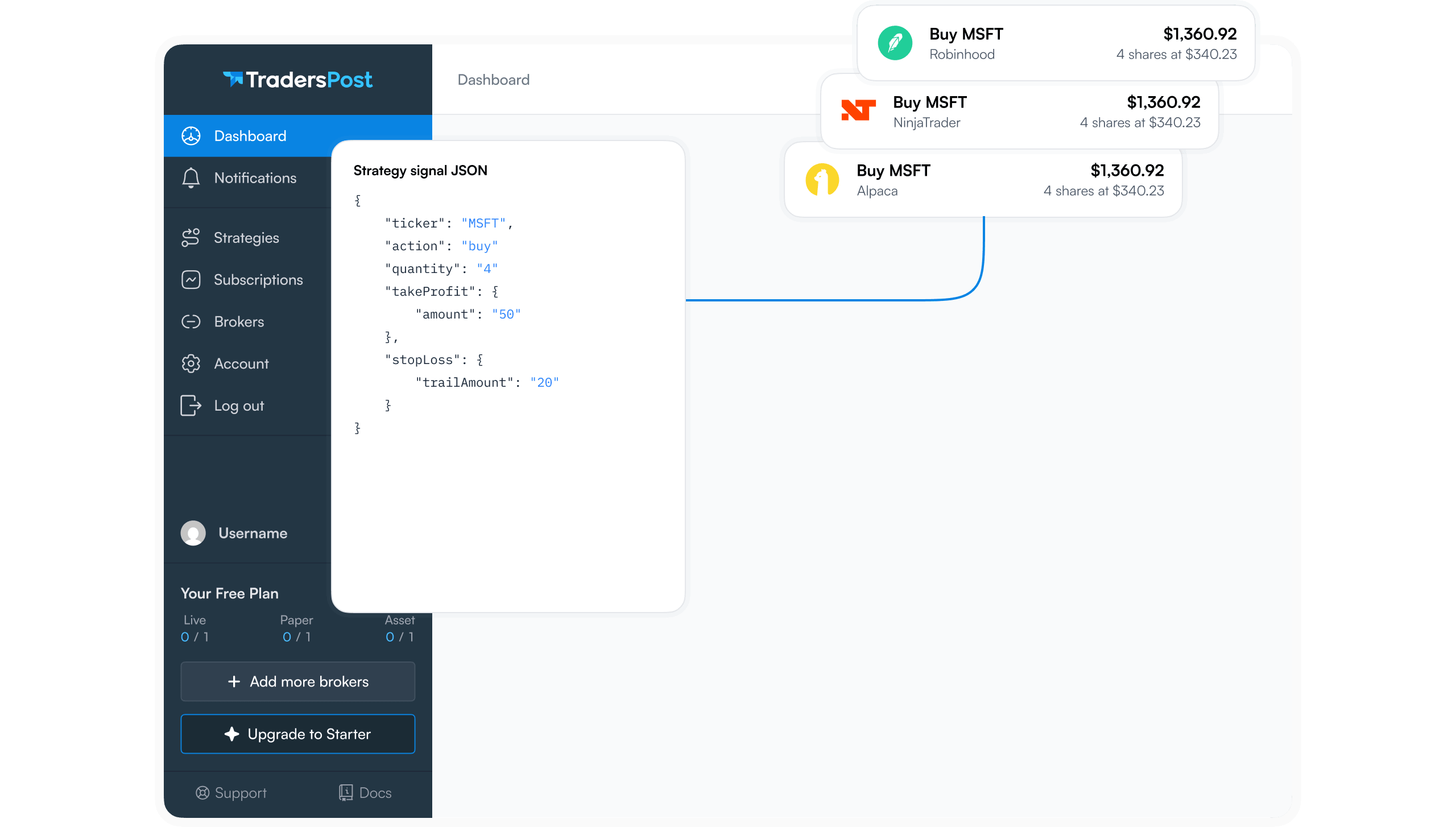
TradingView alerts can be routed through a webhook intermediary to execute orders automatically on a connected prop firm account, which is useful for traders running rule-based or Pine Script strategies. Alpha Futures' own terms permit copy trading from a trader's own external account to their Alpha Futures account, which covers the use case of mirroring a personally developed automated strategy.6 TradersPost connects TradingView alerts to Tradovate and ProjectX prop firm accounts via webhook, handling order routing and position sizing across one or multiple Zero evaluation accounts simultaneously.
Who Zero Suits
Traders it fits well
Traders with a concentrated, high-conviction strategy who want to qualify quickly will benefit most from Zero's one-day minimum and unrestricted daily profit distribution during the evaluation. A single strong session can clear the profit target and satisfy the minimum day requirement simultaneously. Budget-conscious traders starting at the $25K or $50K size will find Zero the cheapest monthly entry point with no activation fee.1 Traders who plan to run multiple simultaneous evaluations can hold up to 5 Zero accounts at the same tier, keeping monthly costs lower than equivalent Advanced evaluations.
Where Zero is the wrong fit
Traders who take large intraday positions relative to their account size may find the Daily Loss Guard constraining compared to Standard (which adds the Daily Loss Guard only at the Qualified stage, not the evaluation) or Advanced Qualified accounts, which have none. Traders who expect large individual winning days on their Qualified account will hit the payout cap faster on Zero than on Advanced, where the cap is $15,000 per request.5 Traders who prioritize maximum Qualified-stage freedom, meaning no consistency rule, no Daily Loss Guard, and a high payout cap, should compare Advanced directly and accept the higher monthly cost and tighter MLL.
Bottom Line
- The Alpha Futures Zero plan costs $89 to $279 per month depending on account size, with no activation fee and no consistency rule during the evaluation.
- The Daily Loss Guard ($500 to $2,000 depending on size) is present at every stage and is the main structural tradeoff for the lower price.
- The Maximum Loss Limit trails from the end-of-day equity high on all Alpha Futures plans, including Zero, not tick-by-tick during the session.
- Once Qualified, a 40% consistency rule and per-request payout caps switch on, making the funded stage stricter than the evaluation.
- Up to 5 Zero evaluation accounts can be run simultaneously, with a maximum of 3 Qualified Analyst accounts per household across all plan types.
If you are considering the Zero plan, verify current rules and pricing on the Alpha Futures Zero product page and the help centre before purchasing, as rules can be updated.
Frequently Asked Questions
Does the Alpha Futures Zero plan have a consistency rule?
There is no consistency rule during the Zero evaluation, so a trader can pass with a single dominant winning session.1 Once Qualified, a 40% consistency rule applies: no single day can represent more than 40% of the profit in a performance fee request.5
What is the Daily Loss Guard on Zero accounts?
The Daily Loss Guard is a per-session cap that applies to Zero accounts at both the evaluation and Qualified stages: $500 on the 25K, $1,000 on the 50K, and $2,000 on the 100K.3 Standard evaluation accounts carry no Daily Loss Guard; Advanced Qualified accounts also have none, making those plans the alternatives if daily loss flexibility is a priority.
How does the Maximum Loss Limit trail on Alpha Futures?
Alpha Futures uses end-of-day trailing on all plans, including Zero: the drawdown floor updates from the end-of-day equity high, not from intraday unrealized highs.4 This differs from intraday trailing used by some other firms, where open profits immediately raise the threshold during the session.
How many Zero accounts can I run at once?
The Zero product page states up to 5 evaluation accounts can be held at the same time.1 Up to 3 Qualified Analyst accounts per household are permitted across all plan types combined, with a total allocation cap of $450,000.6 Each account is tracked independently: a breach on one does not affect the others, and reverse trading between accounts is prohibited.
What are the payout limits on a Zero Qualified account?
Maximum performance fee per request is $1,000 on the 25K, $1,500 on the 50K, and $2,500 on the 100K.5 Requests can be made up to 4 times per month after every 5 winning trading days of $200 profit or more, with a 90% performance split on the requested amount. The 40% consistency rule must be satisfied before a request is eligible.
References
1 Alpha Futures Zero Plan
2 Alpha Futures LLMs.txt
3 Alpha Futures Home
4 Futures Prop Maximum Loss Limit Explained
5 Alpha Futures Payout Policy
6 Running Multiple Alpha Futures Accounts (2026)