Alpaca Paper Trading: What the Docs Omit
Alpaca paper trading has documented gaps most traders overlook. Here is what the fill model, data plan, short locates, and options permissions actually do.

Marketing

Alpaca paper trading is one of the more honest simulation environments available to algo traders. The documentation tells you plainly what it does and does not model, which is more than most brokers offer. The problem is that the omissions are scattered across several pages, and the combined picture only becomes clear once you read them together.
This article pulls those documented gaps into one place: how the fill engine actually works, what data your strategy sees versus what the fill engine uses, why short strategies carry hidden costs in paper, how options permissioning differs between environments, and what paper results can and cannot confirm before you go live.
Every point below is sourced directly from Alpaca's documentation. If you are running a strategy against an Alpaca paper account, or planning to, this is what you need to know before treating those results as predictive.
What Paper Trading Actually Simulates
How the fill engine works
Alpaca paper trading simulates order filling based on real-time quotes rather than routing orders to a live exchange.1 The fill logic is straightforward: orders are matched against the best available current market price (NBBO), and this applies whether the account is a paper-only account or a live brokerage account submitting paper orders.1
Fill eligibility follows marketability. A non-marketable buy limit will not fill until its limit price is equal to or greater than the best ask, and a non-marketable sell limit will not fill until its limit price is equal to or less than the best bid.1 Limit orders that are never marketable during their time-in-force will expire, just as they would in live trading.
The 10% partial-fill rule
When an order becomes eligible to fill, Alpaca issues a partial fill for a random size 10% of the time.1 If the remaining quantity is still marketable after the partial fill, it is re-evaluated for a subsequent fill. This is useful for confirming that your order handling code responds correctly to partially filled states, but the 10% figure is a simulation parameter, not a reflection of the actual partial-fill rate you would encounter for any given symbol or order size in a live market.
Liquidity Checks That Do Not Happen
Order quantity vs. available liquidity
Order quantity is not checked against the NBBO quantities in paper trading.1 You can submit an order for ten thousand shares of a thinly traded stock and receive a complete fill. A successful paper fill at a large size tells you nothing about whether that size can actually fill in a live market. This is not a bug; it is documented behavior, but it is the single most common reason paper results diverge sharply from live results for size-sensitive strategies.
What the docs say paper omits
Alpaca explicitly documents the following as things paper trading does not account for: market impact of orders, information leakage, price slippage due to latency, order queue position for non-marketable limit orders, price improvement received, regulatory fees, and dividends.1 Each of these affects live P&L in ways paper results will not reveal.
The dividend omission deserves particular attention for income-generating strategies. Alpaca explicitly states that the paper trading account does not simulate dividends.1 A covered-call or dividend-capture strategy will show materially different returns in paper compared to live, because the income leg simply does not appear.
The Data Your Strategy Sees
IEX only on the free plan
The Basic plan is the default subscription for both paper and live trading accounts and costs nothing.2 Under the Basic plan, real-time equity data covers only the IEX exchange, not the full consolidated tape.2 Alpaca's paper trading documentation states directly that paper-only account holders are entitled to receive and make use of IEX market data only.1
IEX is a real exchange and its quotes are genuine, but it represents a subset of overall market volume. Signals built on IEX quotes may trigger on prices that do not reflect the best available quote across all venues.
Full tape requires Algo Trader Plus
The Algo Trader Plus plan at $99 per month provides real-time data from all US stock exchanges rather than IEX only.2 The fill engine uses NBBO for fills in paper, but if your strategy's signal logic runs on IEX quotes, there is a mismatch: the signal sees a subset of the tape while fills are simulated against the consolidated best price. This can cause signals to trigger on prices that the fill engine would not use, making paper results look cleaner than live results will be for strategies that are sensitive to quote precision.
For options, the gap is similar. The Basic plan provides access to the indicative pricing feed only, while Algo Trader Plus provides the OPRA feed, which is the authoritative source for options quotes.2 Strategies using tight spread logic or options Greeks built on indicative quotes may behave differently when switched to OPRA data in live.
Account Resets Are Not Resets
Create and delete, not reset
Alpaca updated the dashboard so that you create and delete paper accounts rather than resetting them in place.1 To start fresh, click the paper account number in the upper left corner of the dashboard, select "Open New Paper Account," and generate new API keys for the new account. To remove an account, go to Account Settings, locate the paper account, and click "Delete Account."1
Balance and key implications
The initial paper trading account starts with a $100,000 balance by default.1 You cannot change the account balance after the account is created unless you delete it and create a new one.1 Each new paper account issues a different API key from your live account and from any prior paper accounts. Any code or webhook integration pointing at the old account's keys will stop working after a delete, so update all references before switching accounts.
Shorting: The Largest Gap
No short locate endpoint in paper
The Create Locate endpoint at POST /v1/locates is documented as not available in paper trading.3 In live trading, locates are required for short sales on hard-to-borrow securities and must be requested before the short order is submitted. Because the locate step is skipped entirely in paper, a short strategy will never encounter a hard-to-borrow refusal that would block the same trade in live. If your strategy shorts small-cap or low-float names, this gap is material.
Borrow fees not yet simulated
The paper vs. live feature comparison table shows borrow fees as not available in paper, with a note that they are coming soon.1 In live trading, borrow fees on short positions reduce net P&L and vary by symbol and availability. A short strategy that looks attractive in paper is carrying a hidden cost that only appears when the strategy goes live. For heavily borrowed securities, that cost can be significant enough to eliminate an apparent edge entirely.
Options in Paper vs. Live
Automatic enablement in paper
In the paper environment, options trading capability is enabled by default with no action required.4 In production, a separate and more robust process is required to request options trading approval.4 This means a strategy that runs cleanly in paper with options may face a permissioning step before it can run live, and the approval level you receive may be lower than the level you tested against.
Indicative pricing on the free data plan
Under the Basic plan, real-time options data is limited to the indicative pricing feed rather than the full OPRA feed.2 The Algo Trader Plus plan provides the OPRA feed, which is the authoritative source for options quotes.2 If your paper strategy relies on tight spread logic or Greeks calculated from real-time quotes, those calculations are running on indicative data in paper unless you are on the paid plan, and the results may not carry over to live on the OPRA feed.
Non-trade activities lag one day
On paper, balance and positions update instantly for options events, but non-trade activities such as exercise, assignment, and expiry are only visible in the Activities endpoint the following day.4 Options assignments are not delivered through websocket events in paper or live; polling the REST API is required.4 Expiry handling applies in paper as documented: Alpaca will automatically exercise in-the-money contracts by at least $0.01 at expiry.4
Applying Paper Results to Live
What paper results can confirm
Paper trading is effective for verifying that API connectivity, order routing logic, and partial-fill handling work as expected. It confirms that limit order fill conditions trigger correctly and that order state transitions from pending to filled to canceled are handled by the code. It is a reliable environment for catching network retry logic and error handling before real money is at risk. What it cannot do is quantify slippage, borrow costs, queue position, market impact, or any of the other live variables Alpaca documents as outside the simulation.
Routing paper signals through TradersPost
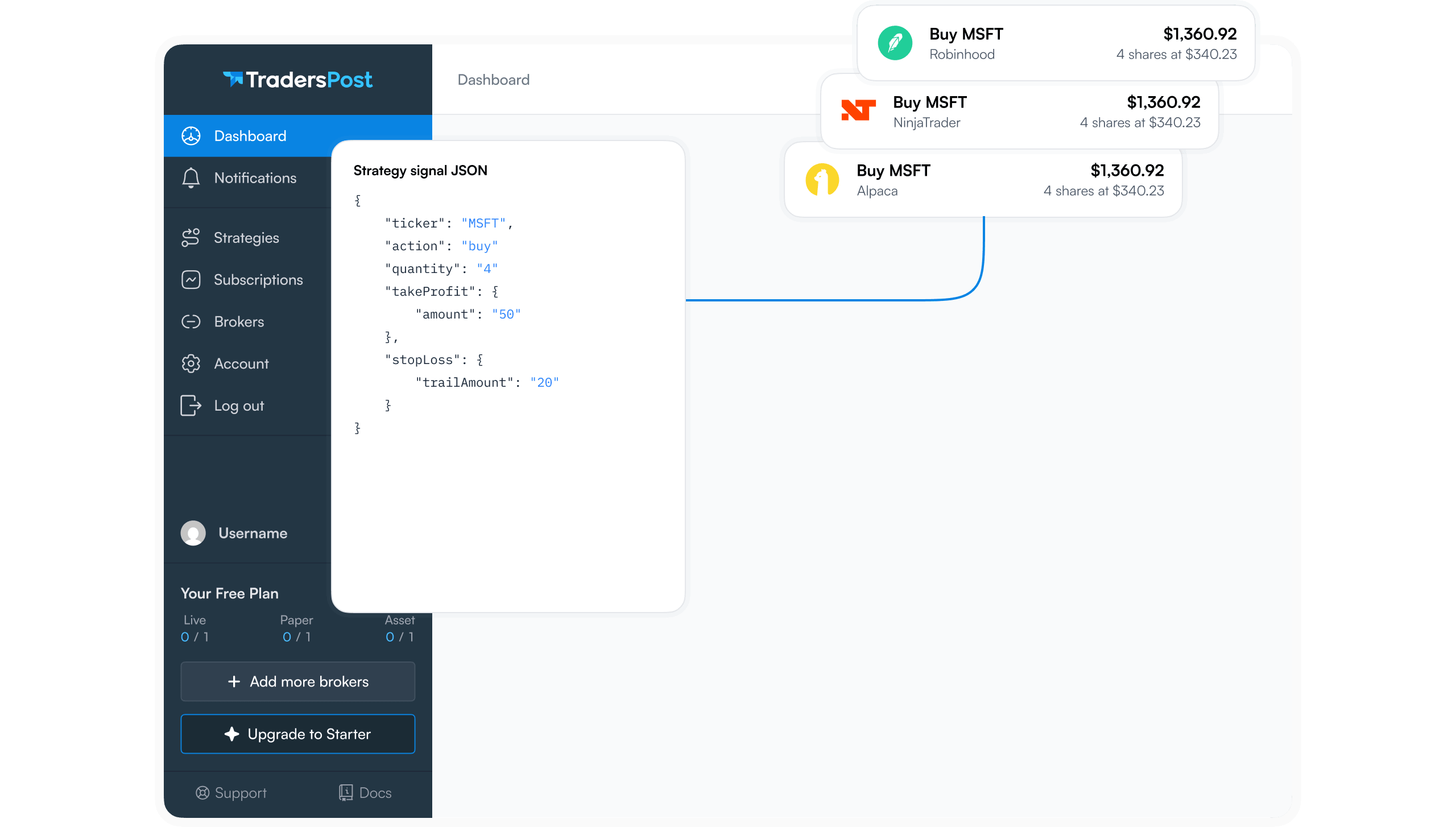
TradersPost supports Alpaca in both paper and live modes, so you can connect a paper account, point webhook signals at it, and verify that signal-to-order routing works end to end before switching to a live account. Switching from paper to live requires only updating the connected account in the strategy subscription; the same webhook payload and alert logic remain intact.
If you want to validate the full path from TradingView alert to Alpaca order before committing real capital, connecting a paper account to a TradersPost strategy subscription lets you confirm that every field in the webhook payload routes correctly and that order acknowledgment flows back as expected.
Where to stress-test before going live
Alpaca's own documentation recommends that even small amounts of real money can provide insight into issues not seen in a simulation environment.1 The documented omissions, including market impact, latency slippage, queue position, borrow fees, and locate availability, each represent a category of live risk that paper results cannot quantify. Running a strategy live at minimal size for a defined period is more informative than extending the paper trading period indefinitely. Use paper to confirm the code works; use live at small size to confirm the strategy works.
Bottom Line
- Paper fills are matched against the NBBO but order quantity is never checked against available liquidity, so a fill at any size in paper is not evidence the same size can fill live.1
- The free Basic plan delivers IEX-only equity data and indicative options data; the fill engine uses NBBO, creating a built-in mismatch between what your signals see and what drives fills.2
- Short strategies in paper skip the locate endpoint entirely and carry no borrow fees, two costs that can eliminate an apparent paper edge when the strategy goes live.13
- Options are enabled by default in paper with no approval process; live requires a separate permissioning request, and the trading level granted may differ from what paper assumed.4
- Deleting a paper account invalidates all API keys for that account; any integration pointing at old keys must be updated before creating the replacement account.
Frequently Asked Questions
Does Alpaca paper trading use real market data?
Paper trading uses real-time quotes to simulate fills, matching orders against the NBBO.1 However, your strategy's data feed under the free Basic plan is IEX only, not the full consolidated tape.2 This means the prices your signals see and the prices used for fills can diverge, particularly during fast markets where IEX and the consolidated best quote differ.
Can I test short selling strategies in Alpaca paper trading?
Short selling is available in paper, but the locate endpoint is not available, so your strategy will never be rejected for a hard-to-borrow security.3 Borrow fees are not simulated in paper either, so short P&L will differ from live results on securities with meaningful borrow costs.1
How do I reset my Alpaca paper account to start fresh?
Alpaca no longer resets accounts in place. You delete the existing paper account and create a new one from the dashboard.1 Each newly created account requires new API keys, so any code or webhook integration pointing at the old account must be updated before going live with the new account.
Are options available in Alpaca paper trading?
Options trading is enabled by default in the paper environment with no approval process required.4 In live, a separate permissioning request is needed, and the data feed for options defaults to indicative pricing rather than the full OPRA feed unless you subscribe to Algo Trader Plus.2
Why did my paper trade fill at a size that would be impossible in live?
Order quantity is not checked against NBBO quantities in paper trading, so fills can be granted for sizes far exceeding available liquidity.1 This is a documented behavior, not a bug, and it means a large-size paper fill is not evidence that the same size can fill in live markets.
References
1 Alpaca Documentation: Paper Trading
2 Alpaca Documentation: About Market Data API
3 Alpaca API Reference: Create Locate
4 Alpaca Documentation: Options Trading