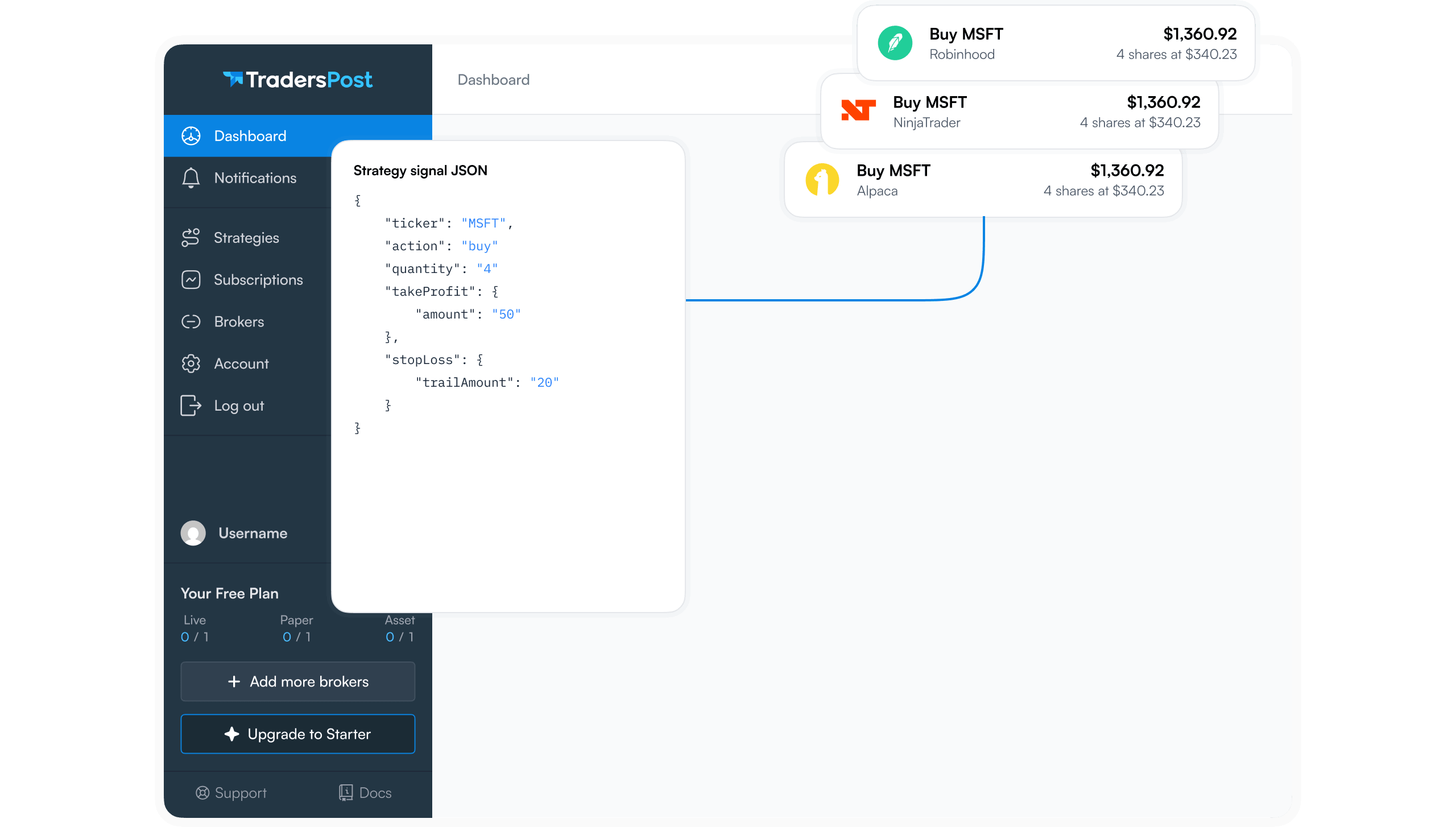
Automating Pairs Trading in PineScript
Learn how to build an automated pairs trading bot using PineScript and AI assistance, from calculating z-scores to executing dual-symbol trades with TradersPost.

Marketing

Pairs trading is one of the most fundamental quantitative trading strategies, offering a market-neutral approach to profiting from the mean-reverting relationship between two correlated assets. In this deep-dive tutorial, we'll show you how to build an automated pairs trading bot using PineScript, AI assistance, and TradersPost for execution.
Understanding Pairs Trading Fundamentals
Pairs trading operates on a simple premise: two highly correlated assets will occasionally diverge in price, creating a temporary imbalance. When this happens, you can profit by simultaneously buying the underperforming asset and shorting the outperforming one, betting they'll converge back to their normal relationship.
Unlike directional strategies that bet on price going up or down, pairs trading is market-neutral. You're not trading the absolute price of either asset—you're trading the spread between them. This makes the strategy less sensitive to overall market direction and more focused on relative value.
The Math Behind the Strategy
Traditional pairs trading relies on concepts like cointegration and stationarity to identify asset pairs that truly move together over the long term. The gold standard test is the Augmented Dickey-Fuller (ADF) test, which determines whether the spread between two assets is stationary (mean-reverting).
However, PineScript lacks access to these advanced statistical functions that are common in Python or R. You can't easily implement ADF or cointegration tests directly in TradingView. This limitation forces us to take a more practical approach: identifying pairs through correlation analysis and visual inspection.
For a pairs trading strategy to work in PineScript, focus on assets with:
- High correlation: Aim for 0.8 or higher between the two assets
- Same sector or related industries: Like Coca-Cola and PepsiCo, or SPY and QQQ
- Liquid markets: Both assets should have sufficient volume for easy execution
- Similar market cap: This helps ensure comparable volatility profiles
Building the Strategy with AI Assistance
One of the most interesting developments in 2025 is using AI to accelerate strategy development. Rather than coding everything from scratch, you can leverage tools like ChatGPT, Claude, or Grok to generate PineScript code based on educational content.
Here's the process:
Step 1: Find Quality Educational Content
Start with a well-explained video or article about pairs trading. Look for content that clearly outlines the strategy mechanics, entry conditions, and exit signals. YouTube is excellent for this—search for "pairs trading algorithm" or "mean reversion strategy."
Step 2: Extract the Transcript
Use a transcript downloading tool (like tactic.io) to capture the video content with timestamps. These timestamps are crucial—when you need to reference where specific concepts were explained, you can jump directly to that moment in the video.
Step 3: Feed It to AI
Take the transcript and provide it to your AI coding assistant with clear instructions:
` Based on this conversation about pairs trading, create a pairs trading bot indicator in PineScript version 6. Include the following:
- Input fields for Symbol 1 (chart symbol) and Symbol 2
- Calculation of ratio or spread between the two
- Z-score calculation for divergence measurement
- Visual plots showing the spread and entry/exit signals
- Alert conditions for entering and exiting trades
`
Step 4: Iterate and Debug
The first output rarely works perfectly. You'll need to:
- Fix syntax errors by feeding error messages back to the AI
- Provide PineScript documentation for reference
- Use deep research mode (in ChatGPT) to crawl documentation
- Test the code on actual charts and refine the logic
The key advantage of AI assistance isn't that it produces perfect code immediately—it's that it dramatically accelerates the iteration cycle. You can test ideas in minutes rather than hours.
The Core Calculation: Ratio vs. Spread
Your pairs trading bot needs to measure the relationship between two assets. There are two common approaches:
Ratio Method: Divide the price of Asset 1 by Asset 2 `pinescript ratio = close / security(syminfo.tickerid_2, timeframe.period, close) `
Spread Method: Subtract Asset 2 price from Asset 1 `pinescript spread = close - security(syminfo.tickerid_2, timeframe.period, close) `
Both methods work, but ratio is generally preferred for assets with different price magnitudes (like SPY at $580 and QQQ at $500). The spread method works better for similar-priced assets like futures contracts.
Calculating the Z-Score
The z-score tells you how many standard deviations the current spread is from its historical mean. This standardized metric makes it easy to identify extreme divergences.
`pinescript // Calculate mean and standard deviation over a lookback period lookback = input.int(20, "Lookback Period") mean = ta.sma(ratio, lookback) std_dev = ta.stdev(ratio, lookback)
// Calculate z-score z_score = (ratio - mean) / std_dev `
When the z-score reaches +2 or -2, the spread has moved two standard deviations from normal—a potential entry signal. When it returns to zero, the spread has reverted to the mean—your exit signal.
Implementing Entry and Exit Logic
Your strategy should track whether you're currently in a position and only enter new trades when flat:
`pinescript // Entry conditions long_entry = ta.crossunder(z_score, -2) and not in_position short_entry = ta.crossover(z_score, 2) and not in_position
// Exit condition exit_signal = ta.cross(z_score, 0) `
The logic is simple: when the z-score drops below -2, Asset 1 is undervalued relative to Asset 2, so you buy Asset 1 and sell Asset 2. When it rises above +2, the opposite is true. When it returns to zero, you close both positions.
The Challenge: Executing Two Symbols Simultaneously
Here's where pairs trading gets tricky in TradingView: You need to send two separate orders to your broker at the same time. TradingView's standard alert system only references one symbol—the chart you're viewing.
The solution involves clever alert message construction:
- Create placeholder variables in your alert message inputs
- Fire two separate alerts from a single signal event
- Replace placeholders dynamically before sending to TradersPost
`pinescript // Define alert messages in indicator settings buy_message = input.text('{"ticker":"{{ticker}}", "action":"buy", "price":"{{close}}"}') sell_message = input.text('{"ticker":"SYMBOL2", "action":"sell", "price":"PRICE2"}')
// On entry signal, replace placeholders and send both alerts if long_entry // Replace {{ticker}} with syminfo.ticker for chart symbol alert_msg_1 = str.replace(buy_message, "{{ticker}}", syminfo.ticker) alert_msg_1 := str.replace(alert_msg_1, "{{close}}", str.tostring(close)) alert(alert_msg_1, alert.freq_once_per_bar)
// Replace placeholders for second symbol alert_msg_2 = str.replace(sell_message, "SYMBOL2", symbol_2_input) alert_msg_2 := str.replace(alert_msg_2, "PRICE2", str.tostring(price_2)) alert(alert_msg_2, alert.freq_once_per_bar) `
This approach fires two webhook alerts to TradersPost, each containing the correct symbol and action. TradersPost receives both messages and executes the orders simultaneously against your connected broker account.
Tracking Performance Without Strategy Mode
Because you're using an indicator (not a strategy), you don't get automatic performance metrics from TradingView. However, you can build your own tracking system using arrays:
`pinescript // Define trade type type Trade int bar_index int time float entry_price float exit_price bool ended = false int pair // 1 or 2 to track which symbol
// Array to store all trades var array
// On entry, add new trade if long_entry array.push(trades, Trade.new(bar_index, time, close, na, false, 1))
// On exit, update last trade if exit_signal last_trade = array.get(trades, array.size(trades) - 1) last_trade.exit_price := close last_trade.ended := true `
You can then calculate win rate, profit factor, and other metrics by iterating through the trades array and displaying results in a table on your chart.
Optimizing for TradersPost Execution
When configuring your TradersPost strategy subscription for pairs trading:
Position Sizing: Use fixed contract quantities rather than percentage-based sizing. Pairs trading requires equal notional value on both sides, so calculate this beforehand.
Side Swapping: Enable this feature so your strategy can automatically reverse from long to short (or vice versa) when signals flip.
Subtract Signal Quantity: For futures, enable this to ensure proper position offsetting when reversing positions.
Auto Submit: During testing, disable auto-submit to manually approve each trade and verify both legs executed correctly.
Common Pitfalls and Solutions
Problem: The two symbols don't stay correlated over time.
Solution: Regularly monitor correlation coefficients. If correlation drops below 0.7, consider finding a new pair or pausing the strategy until conditions improve.
Problem: One leg of the trade executes but the other fails.
Solution: Implement error handling and position reconciliation. TradersPost tracks both positions, so you can manually close the orphaned leg if needed.
Problem: Spread stops mean-reverting after you enter.
Solution: Add a stop-loss based on z-score extremes. If the z-score reaches -3 or +3, exit even without mean reversion—you've encountered a regime change.
Problem: Slippage eats into profits on simultaneous execution.
Solution: Use limit orders with a small buffer from market price, or only trade highly liquid pairs where bid-ask spreads are tight.
Calculating Notional Balance
For proper risk management, both legs of your pairs trade should have equal dollar value:
` If Asset 1 trades at $100 and you want $10,000 exposure:
- Buy 100 shares of Asset 1 (100 × $100 = $10,000)
If Asset 2 trades at $80:
- Sell 125 shares of Asset 2 (125 × $80 = $10,000)
`
This dollar neutrality ensures you're truly market-neutral—gains on one leg offset losses on the other, leaving only the spread movement as your profit source.
Advanced Enhancements
Once you have a basic pairs trading bot working, consider these enhancements:
Dynamic Pair Selection: Scan multiple potential pairs and automatically trade the ones with the highest z-scores.
Multiple Timeframe Analysis: Confirm divergences across multiple timeframes before entering (e.g., signal on 1-hour, confirm on 4-hour).
Volume-Weighted Entries: Only enter when both symbols show above-average volume, ensuring liquidity for execution.
Correlation Decay Monitoring: Plot a 30-day rolling correlation and pause trading if it drops below your threshold.
Calendar Awareness: Avoid entering new pairs trades before major economic reports or earnings announcements that could disrupt correlations.
Real-World Pair Examples
Equity Pairs:
- KO (Coca-Cola) and PEP (PepsiCo)
- SPY and QQQ
- XLF (Financial ETF) and JPM (JPMorgan Chase)
Futures Pairs:
- ES and NQ (S&P 500 vs. Nasdaq)
- CL and Brent (WTI vs. Brent Crude Oil)
- GC and SI (Gold vs. Silver)
Crypto Pairs:
- BTC and ETH
- SOL and AVAX (Layer 1 competitors)
- BTC and MSTR (MicroStrategy as a leveraged Bitcoin proxy)
The Future of Pairs Trading Automation
As AI tools continue to improve, expect pairs trading development to become even more accessible. Future enhancements might include:
- Automated cointegration testing directly in TradingView through external API calls
- Machine learning models that predict optimal entry/exit z-score thresholds
- Multi-pair portfolios that automatically rebalance based on correlation matrices
- Integration with alternative data sources to predict correlation breakdowns
The barrier to entry for quantitative trading strategies like pairs trading has never been lower. With TradingView's visual tools, AI coding assistants, and execution platforms like TradersPost, retail traders can implement institutional-grade strategies that were once exclusive to hedge funds and proprietary trading firms.
Key Takeaways
- Pairs trading is market-neutral, profiting from relative price movements rather than absolute direction
- AI tools dramatically accelerate development, but you still need to understand the strategy fundamentals
- PineScript limitations require creative solutions for advanced statistics
- Simultaneous execution of both trade legs requires careful alert message construction
- Correlation monitoring is essential for long-term strategy success
- Dollar neutrality ensures true market-neutral positioning
- TradersPost handles execution complexity, letting you focus on strategy logic
Whether you're a quantitative trading novice or an experienced systematic trader, pairs trading offers a compelling risk-adjusted return profile. By automating the strategy with PineScript and TradersPost, you can capture mean reversion opportunities 24/7 without manual monitoring. Start with well-correlated pairs, test thoroughly across different market regimes, and scale slowly as you gain confidence in your system's reliability.