Best AI Trading Tools for TradingView
A comprehensive roundup of the best AI trading tools for TradingView in 2026, covering native AI features, Pine Script coding assistants, signal providers, and automation bridges with pricing and limitations.

Marketing

Bottom Line
- TradingView now offers native AI features including Chart Copilot for pattern analysis and AI-powered SEC filing summaries, both free during beta.
- Pine Script coding agents like Pineify and LuxAlgo Quant can generate and debug indicators from natural language prompts with roughly 85% success rates.
- General-purpose LLMs like Claude and ChatGPT handle Pine Script well for brainstorming and debugging, but output still requires manual verification.
- TradersPost connects the entire ecosystem by executing trades from any TradingView alert via webhooks, turning AI-generated signals into live broker orders.
- No single AI tool replaces a tested strategy — the best results come from combining AI research, AI-assisted coding, and automated execution through a platform like TradersPost.
-
Traders ask whether TradersPost offers free live automation, so the guidance now covers paid live trading, paper trading access, and broker and asset-class execution support.
The AI trading tools available for TradingView have expanded dramatically in 2026. TradingView itself has rolled out native AI features, third-party developers have launched specialized Pine Script coding agents, and general-purpose LLMs have become genuinely useful for strategy development. The question is no longer whether to use AI in your trading workflow — it is which tools deserve your time and money.
This guide covers every major AI tool that integrates with TradingView in 2026, organized by category. Each entry includes what the tool does, current pricing, strengths, limitations, and how it connects to TradingView. Where automation is involved, we explain how TradersPost webhooks bridge the gap between AI-generated signals and live broker execution.
Native TradingView AI Features
TradingView launched its first AI features in early 2026, bringing chart analysis and document summarization directly into the platform. These tools are free during beta and require no third-party subscriptions.
AI Chart Copilot
AI Chart Copilot is a Chrome extension developed by TradingView that analyzes your current chart and provides AI-generated insights about patterns, support and resistance levels, and potential trade setups1. It launched in March 2026 as a free public beta.
- Pricing: Free during beta, limited to 15 requests per day1
- What it does: Reads your active TradingView chart, identifies technical patterns, and generates natural language analysis of what it sees
- Strengths: Native integration means no data export required; useful for getting a second opinion on chart patterns you might have missed
- Limitations: Does not generate Pine Script code, cannot place trades, and the 15-request daily cap limits heavy usage3
Chart Copilot works best as a pattern-checking assistant rather than a signal generator. It cannot create alerts or automate anything, so traders who want execution still need a separate automation layer.
AI-Powered Document Summaries
TradingView added AI-generated summaries of SEC filings directly within stock symbol pages. When you view a company's filings, the platform now displays concise summaries of 10-K, 10-Q, 8-K, and other documents2.
- Pricing: Free for all TradingView users
- What it does: Summarizes lengthy SEC filings into digestible bullet points, highlighting material changes, risk factors, and financial highlights2
- Strengths: Saves hours of reading dense regulatory documents; surfaced directly alongside price charts for seamless research
- Limitations: US equities only; summaries may miss nuanced details that matter for specific investment theses
AI-Powered Corporate News
Complementing the document summaries, TradingView now provides real-time AI summaries of corporate news and filings as they are published. This feature appears in the news feed alongside traditional articles.
- Pricing: Free for all TradingView users
- What it does: Monitors new SEC filings and corporate announcements, then generates instant summaries so traders can assess material impact without reading full documents
- Strengths: Speed advantage — you see the key points within seconds of a filing, before most traders have opened the full document
- Limitations: Covers filings and official announcements only, not broader news; no alert integration
Together, these three native features transform TradingView from a pure charting platform into one with built-in AI research capabilities. However, none of them generate trading signals or write Pine Script code, which is where third-party tools come in.
AI Pine Script Coding Tools
Writing Pine Script remains the primary way to build custom indicators and strategies on TradingView. A new generation of AI coding agents specializes in generating, debugging, and optimizing Pine Script code from natural language descriptions.
Pineify
Pineify is a dedicated AI coding agent for Pine Script v6 that converts plain English strategy descriptions into working TradingView indicators and strategies3. It also includes a visual strategy builder for traders who prefer a no-code approach.
- Pricing: Free tier with limited generations; paid plans for higher usage
- What it does: Takes natural language prompts like "create an RSI divergence indicator with alerts" and outputs Pine Script v6 code ready to paste into TradingView3
- Strengths: Trained specifically on Pine Script syntax, achieving approximately 85% first-attempt success rate; visual strategy builder lets non-coders create indicators; outputs code compatible with the latest Pine Script version
- Limitations: Complex multi-indicator strategies may require manual refinement; the visual builder is less flexible than hand-coded Pine Script for advanced logic
Pineify stands out because it focuses exclusively on Pine Script rather than being a general-purpose coding assistant. That specialization means fewer syntax errors and better handling of TradingView-specific functions and conventions.
LuxAlgo Quant — AI Indicator Architect
LuxAlgo, already well known for its TradingView indicator suite, launched Quant — an AI tool that builds, reverse-engineers, and debugs Pine Script indicators4.
- Pricing: Included with LuxAlgo premium plans; free tier available with limitations
- What it does: Generates Pine Script from descriptions, explains existing indicator code line by line, debugs compilation errors, and suggests optimizations4
- Strengths: Reverse-engineering mode is unique — paste any public TradingView indicator code and get a plain English explanation of its logic; backed by the LuxAlgo team's deep Pine Script expertise
- Limitations: Best suited for indicator development rather than full strategy automation; premium features require a LuxAlgo subscription
The reverse-engineering capability makes LuxAlgo Quant particularly valuable for traders who want to understand community indicators before incorporating them into their strategies.
OctoBot
OctoBot is an AI strategy generator that creates Pine Script strategies from natural language descriptions. It positions itself as a bridge between idea and implementation for traders who think in concepts rather than code.
- Pricing: Free open-source bot with optional cloud hosting; AI generation features in premium tiers
- What it does: Converts strategy ideas described in plain English into Pine Script code, with options to backtest within the platform before exporting to TradingView
- Strengths: End-to-end workflow from idea to backtest to TradingView deployment; active open-source community
- Limitations: Strategy code may need manual adjustments for complex entry and exit logic; primarily focused on crypto markets
AI Signal and Indicator Providers
Beyond coding tools, several platforms offer AI-generated trading signals and indicators that plug directly into TradingView as overlays, screeners, or alert triggers.
LuxAlgo Indicators
LuxAlgo offers a suite of AI-enhanced indicators on TradingView that have become community favorites. Their tools include trend detection, support and resistance mapping, signal generation, and volume analysis with machine learning components.
- Pricing: Free indicators available on TradingView; premium suite starts at approximately $24.99/month
- What it does: Provides overlay indicators, oscillators, and screeners powered by algorithmic and ML-based analysis directly on TradingView charts
- Strengths: Deep TradingView integration; large user community with extensive documentation; indicators generate alerts that can trigger TradersPost webhooks for automated execution
- Limitations: Premium indicators require a separate subscription on top of TradingView; some indicators may repaint on lower timeframes
LuxAlgo indicators are particularly useful for traders who want AI-assisted analysis without writing any code. Set an alert on a LuxAlgo signal, connect it to TradersPost, and you have automated execution from an AI indicator.
AI Signals
AI Signals provides cross-asset AI-generated alerts, screeners, insider trading tracking, and earnings analysis. The platform focuses on surfacing actionable intelligence rather than chart overlays.
- Pricing: Tiered subscription plans starting around $29/month
- What it does: Uses machine learning models to generate buy and sell signals across stocks, crypto, and forex; tracks insider transactions and earnings surprises; provides TradingView-compatible alert formatting
- Strengths: Covers fundamental and alternative data sources that pure technical indicators miss; insider tracking adds an informational edge
- Limitations: Signals require interpretation — they are not one-click trade recommendations; accuracy varies by market regime
Tickeron
Tickeron uses AI pattern recognition to identify technical chart patterns across thousands of securities and generates confidence-rated trade ideas that integrate with TradingView.
- Pricing: Free basic access; premium AI features start at approximately $50/month
- What it does: Scans markets for patterns like head and shoulders, channels, triangles, and Fibonacci setups using neural network models; assigns confidence scores to each pattern
- Strengths: Removes subjectivity from pattern identification; scans far more charts simultaneously than any human trader could; confidence scoring helps filter low-probability setups
- Limitations: Pattern recognition accuracy depends on market conditions; subscriptions add up alongside TradingView costs
General-Purpose AI Coding Assistants
You do not need a Pine Script-specific tool to write Pine Script. General-purpose LLMs have become surprisingly capable at generating, debugging, and explaining TradingView code. Here is how the leading options compare for Pine Script work.
Claude (Sonnet and Opus)
Anthropic's Claude models have emerged as the most reliable general-purpose AI for Pine Script development. Claude handles Pine Script v6 syntax with strong precision and provides detailed explanations of its code.
- Pricing: Free tier available; Claude Pro at $20/month for higher usage limits
- What it does: Generates Pine Script from natural language, debugs compilation errors, explains existing code, and helps optimize strategy logic
- Strengths: Best-in-class precision for Pine Script v6 syntax; follows complex multi-step instructions well; strong at explaining why code works, not just generating it
- Limitations: No direct TradingView integration — you must copy and paste code manually; occasionally uses deprecated Pine Script v4 or v5 functions when not specifically instructed to use v6
Claude works especially well when paired with an IDE like Cursor that provides real-time code assistance. Write your Pine Script in Cursor with Claude as the backend, then paste into TradingView for testing.
ChatGPT (GPT-5)
OpenAI's GPT-5 is the most widely used LLM for coding tasks, including Pine Script. It excels at rapid brainstorming and generating initial drafts of indicators and strategies.
- Pricing: Free tier available; ChatGPT Plus at $20/month
- What it does: Generates Pine Script code, explains indicator logic, suggests strategy improvements, and helps with parameter optimization
- Strengths: Fast generation speed; strong at brainstorming multiple approaches to a strategy problem; large context window for analyzing lengthy scripts
- Limitations: Higher rate of Pine Script syntax errors compared to Claude, especially with v6-specific features; tends to hallucinate function parameters that do not exist
GPT-5 is best used for the ideation phase — generating multiple strategy concepts quickly — before refining the code with a more precise tool or manual review.
Cursor IDE
Cursor is an AI-powered code editor that provides real-time code assistance, autocomplete, and inline explanations while you write Pine Script. It supports multiple AI backends including Claude and GPT models.
- Pricing: Free tier with limited AI completions; Pro at $20/month
- What it does: Provides context-aware code suggestions as you type Pine Script, can generate functions from comments, and debugs errors inline
- Strengths: Real-time assistance reduces the copy-paste cycle between a chatbot and TradingView; supports multiple AI models so you can switch between Claude and GPT depending on the task
- Limitations: Requires some Pine Script knowledge to evaluate suggestions effectively; not integrated with TradingView's backtesting engine
The combination of Cursor for writing and TradingView for testing creates a productive workflow. Our detailed guide covers this setup for building strategies that connect to TradersPost for automated execution.
AI Trading Platforms
Some platforms offer AI-powered analysis that competes with or complements TradingView. These are standalone tools with their own charting and scanning capabilities, but they can work alongside TradingView in your workflow.
TrendSpider
TrendSpider uses AI to automatically detect trendlines, support and resistance levels, and multi-timeframe patterns. Its automated technical analysis removes the subjectivity of manual chart drawing5.
- Pricing: Approximately $52/month billed annually; higher tiers available with more features
- What it does: Automatically draws trendlines, identifies chart patterns across multiple timeframes simultaneously, runs backtests on detected patterns, and generates alerts
- Strengths: Multi-timeframe confluence analysis is unique — it identifies where patterns align across daily, weekly, and monthly charts; automated trendline detection eliminates subjective bias
- Limitations: Separate subscription from TradingView; learning curve for the automated analysis features; primarily covers stocks, ETFs, and crypto
TrendSpider's alerts can connect to TradersPost for automated execution, making it a viable alternative to TradingView-based strategies for traders who prefer AI-drawn technical levels over manual analysis.
Trade Ideas Holly AI
Trade Ideas offers Holly AI, a system that uses over 70 AI-driven algorithms to scan the market in real-time and generate trade ideas with entry, exit, and stop-loss levels.
- Pricing: Premium plan at approximately $178/month billed annually; Standard plan without Holly AI available at lower tiers
- What it does: Scans the entire US equity market in real-time using AI models trained on historical pattern data; generates specific trade setups with risk management parameters
- Strengths: Fully autonomous signal generation — Holly selects the strategy, identifies the setup, and specifies the trade parameters; extensive historical track record of AI-generated signals
- Limitations: Expensive compared to other tools on this list; US equities only; no direct TradingView integration — signals appear in Trade Ideas' own interface
Holly AI represents the premium end of AI trading tools. It is best suited for active day traders who want fully formed trade ideas rather than indicators or code assistance.
Automation Bridges
AI tools can generate signals, write code, and identify patterns — but none of them place trades on your behalf directly through a broker. That is where automation bridges connect the AI analysis layer to actual trade execution.
TradersPost
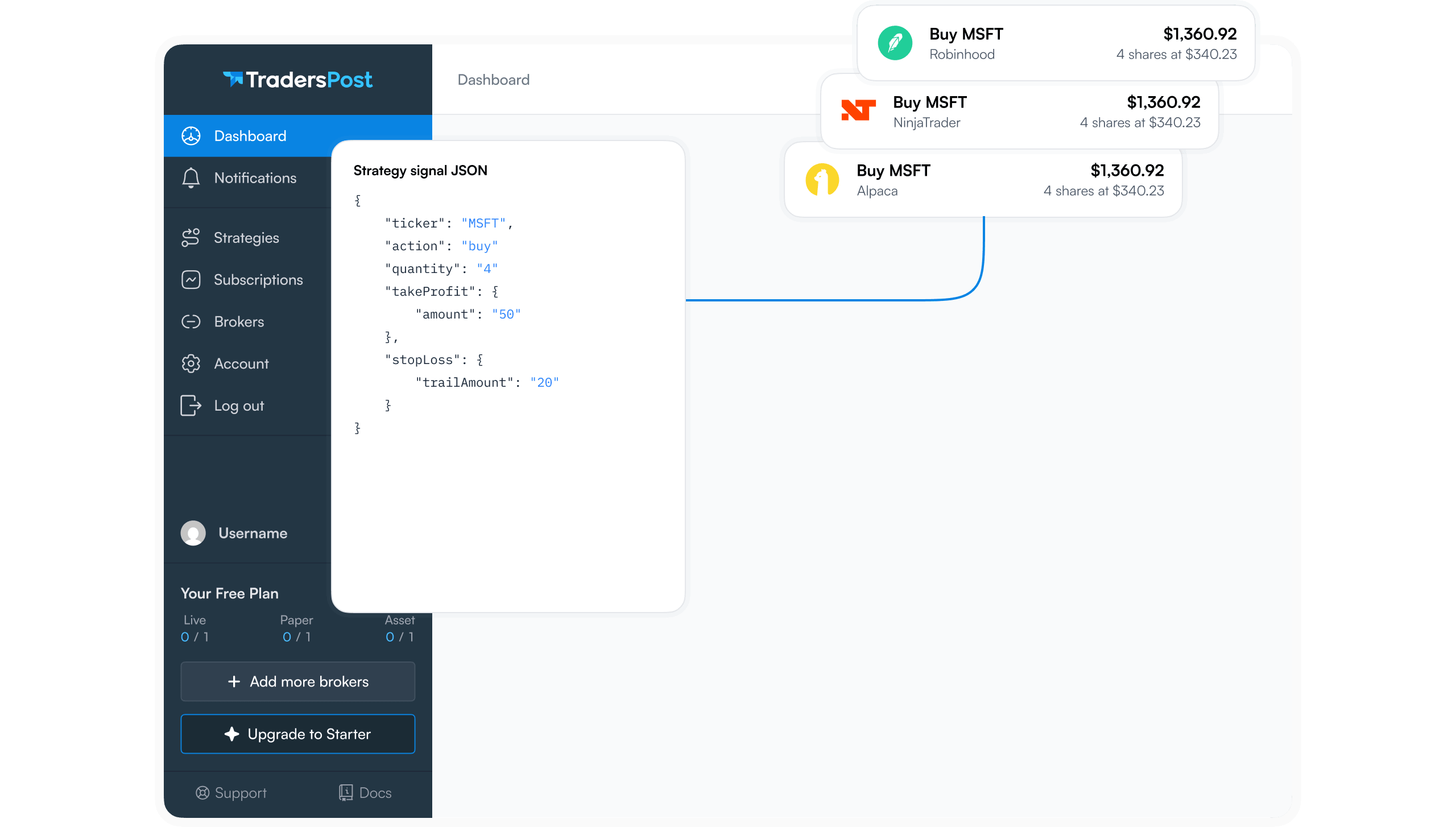
TradersPost is the most versatile automation bridge for TradingView users. It accepts webhook signals from any TradingView alert — whether that alert comes from a Pine Script strategy you wrote, an AI-generated indicator, or a LuxAlgo signal — and executes the corresponding trade through your connected broker5.
- Pricing: Live trading starts at $49/month; free access is for getting started and paper trading6
- What it does: Receives TradingView webhook alerts, parses the signal data, and routes orders to connected brokers including Alpaca, TradeStation, Interactive Brokers, Tradier, Tradovate, Robinhood, and others
- Strengths: Broker-agnostic execution means you can switch brokers without rebuilding your strategy; supports stocks, options, futures, and crypto; handles position sizing, order types, and risk management rules server-side
- Limitations: Requires a TradingView plan that supports webhook alerts (Essential tier or higher); execution speed depends on broker API responsiveness
TradersPost is the critical link that makes AI trading tools actionable. Whether you use Chart Copilot to identify a pattern, Pineify to code an indicator, or LuxAlgo signals for entries — the moment you create a TradingView alert, TradersPost can execute that trade across any supported broker.
PickMyTrade
PickMyTrade focuses specifically on futures broker automation, connecting TradingView alerts to futures execution platforms.
- Pricing: Subscription-based; pricing varies by features and broker connections
- What it does: Receives TradingView webhook alerts and executes futures trades through supported brokers
- Strengths: Specialized futures focus with features tailored to futures traders including contract rollover handling
- Limitations: Narrower broker support than TradersPost; futures-only focus means stock and options traders need a different solution
How to Build an AI Trading Stack
With this many tools available, the practical question is which ones to combine. Here are three stack configurations based on different trading styles and budgets.
Budget Stack (Free to $20/month)
- Research: TradingView native AI (Chart Copilot, document summaries) — free
- Coding: Claude free tier for Pine Script generation and debugging
- Signals: Free LuxAlgo indicators on TradingView
- Execution: TradersPost paper trading to get started; live automation starts at $49/month6
This stack costs nothing to start and covers the entire workflow from research to execution. The main constraint is usage limits on Claude and Chart Copilot.
Active Trader Stack ($50-$80/month)
- Research: TradingView native AI features — free
- Coding: Pineify paid tier or Claude Pro for unlimited Pine Script development
- Signals: LuxAlgo premium indicators for AI-enhanced signals
- Execution: TradersPost paid plan for multiple broker connections and higher alert volume
This configuration gives you professional-grade Pine Script development, AI-enhanced indicators, and robust automated execution across multiple brokers.
Premium Stack ($200+/month)
- Research: TradingView native AI plus TrendSpider for automated multi-timeframe analysis
- Coding: Cursor Pro with Claude backend for real-time Pine Script development
- Signals: Trade Ideas Holly AI for autonomous trade idea generation
- Execution: TradersPost paid plan with multiple broker connections
The premium stack is designed for active day traders who want maximum AI assistance at every stage of their workflow. Holly AI alone costs $178/month, making this the most expensive option but also the most hands-off for signal generation.
What AI Trading Tools Cannot Do
AI tools for TradingView have real limitations that every trader should understand before building a workflow around them.
No AI tool guarantees profitable trades. Chart Copilot identifies patterns, but patterns fail. LLMs write Pine Script, but the strategy logic might be fundamentally flawed. Holly AI generates trade ideas, but markets are inherently unpredictable. AI removes friction from the analysis and coding process — it does not remove risk from trading.
AI-generated Pine Script requires verification. Even the best LLMs produce code with subtle bugs — an off-by-one error in a lookback period, a misunderstood function parameter, or a repainting condition that makes backtests look better than live performance. Always backtest AI-generated code in TradingView's strategy tester and paper trade before risking real capital.
Market conditions change faster than AI models adapt. Models trained on historical data may struggle during regime changes, black swan events, or unprecedented volatility. Human oversight remains essential, especially for custom indicators and strategies that rely on pattern recognition.
Comparison Table
Here is a quick reference comparing every tool covered in this guide.
- AI Chart Copilot: Free beta, native TradingView, chart pattern analysis, 15 req/day limit, no code generation1
- AI Document Summaries: Free, native TradingView, SEC filing summaries, US equities only2
- Pineify: Free/paid tiers, Pine Script v6 code generation, ~85% success rate, visual builder included3
- LuxAlgo Quant: Free/premium, Pine Script generation and reverse-engineering, requires LuxAlgo subscription for full features4
- OctoBot: Free open-source/premium, strategy generation from natural language, primarily crypto-focused
- LuxAlgo Indicators: Free/premium from ~$25/month, AI-enhanced TradingView indicators, alerts compatible with TradersPost
- AI Signals: From ~$29/month, cross-asset AI alerts and screeners, insider tracking included
- Tickeron: Free/premium from ~$50/month, AI pattern recognition, confidence-scored trade ideas
- Claude: Free/$20/month Pro, best Pine Script precision, no direct TradingView integration
- ChatGPT: Free/$20/month Plus, fast brainstorming, higher syntax error rate than Claude
- Cursor IDE: Free/$20/month Pro, real-time code assistance, supports multiple AI backends
- TrendSpider: ~$52/month annual, automated trendlines and multi-timeframe patterns, TradersPost compatible
- Trade Ideas Holly AI: ~$178/month annual, autonomous AI trade signals, US equities only
- TradersPost: Free/paid tiers, webhook execution for any TradingView alert, multi-broker support5
- PickMyTrade: Subscription-based, futures-specific automation, TradingView webhook integration
Conclusion
The AI trading tools ecosystem for TradingView in 2026 is broad enough that every trader can find tools matching their skill level and budget. Native TradingView features handle basic research. Specialized coding agents like Pineify and LuxAlgo Quant make Pine Script development accessible to non-programmers. General-purpose LLMs like Claude handle complex strategy logic. And signal providers like Tickeron and Trade Ideas Holly AI generate trade ideas autonomously.
The common thread across all of these tools is that they generate analysis, code, or signals — but none of them execute trades. That is where TradersPost completes the workflow. TradingView alerts, whether triggered by an AI-generated indicator, a LuxAlgo signal, or a Pine Script strategy you built with Claude's help, can be routed through TradersPost webhooks for automated execution when the selected connection supports the relevant asset class7.
Start with the free tools — Chart Copilot, Claude's free tier, and TradersPost's free plan — to see how AI fits into your existing workflow. Add paid tools only when you hit the limits of what free options can do. The most important step is not choosing the perfect AI tool. It is building a tested strategy, connecting it to reliable execution, and managing risk regardless of how the signals are generated.
References
1 TradingView Blog: AI Chart Copilot Beta Launch
2 TradingView Blog: AI-Powered Document Summaries
3 Pineify Blog: TradingView AI Chart Copilot Analysis
4 LuxAlgo Blog: Code TradingView Indicators with Quant AI
5 TradersPost - Automated Trading Platform
6 traderspost.io, TradersPost Pricing
7 docs.traderspost.io, Stock Trading