Using AI to Write Pine Script
Compare ChatGPT, Claude, Pineify, and LuxAlgo Quant for writing TradingView Pine Script v6. Includes practical prompts, output quality comparisons, and a workflow for turning AI-generated strategies into automated trades.

Marketing

Bottom Line
- TradingView has no reliable built-in AI Pine Script generator, so traders use external tools like ChatGPT, Claude, Pineify, and LuxAlgo Quant to write v6 code.
- Claude produces the fewest syntax errors and hallucinations for complex Pine Script strategies, while ChatGPT is fastest for simple indicator drafts.
- Pineify is the only purpose-built AI Pine Script tool with auto-fix and a visual strategy builder, claiming roughly 85 percent first-pass success.
- Always specify Pine Script v6 in your prompts, paste compiler errors back for iterative fixing, and backtest thoroughly before live trading.
- TradersPost bridges the gap from AI-generated Pine Script to live execution by receiving webhook alerts and routing orders to your broker.
AI tools have changed how traders write TradingView Pine Script. Instead of learning the language from scratch or spending hours reading documentation, you can describe a strategy in plain English and get working v6 code in seconds. But the quality of that code varies dramatically depending on which AI tool you use and how you prompt it.
This guide compares the four most practical AI options for writing Pine Script in 2026: ChatGPT, Claude, Pineify, and LuxAlgo Quant. Each section covers output quality, v6 compatibility, and the specific strengths and weaknesses you should know before trusting AI-generated code with real money.
Why Traders Are Using AI for Pine Script
Pine Script v6 is the current version of TradingView's scripting language, released on December 10, 2024, and rolled out across the platform through 20251. The update introduced stricter type casting, new parameter handling, and several breaking changes that invalidated older scripts. For traders who already found Pine Script challenging, v6 raised the bar further.
At the same time, TradingView's own AI assistant, Chart Copilot, remains limited. Independent reviews confirm that Chart Copilot cannot reliably generate Pine Script code2. It is useful for chart analysis and answering general questions about indicators, but it is not a Pine Script code generator. This gap has pushed traders toward external AI tools that can actually produce compilable v6 scripts.
The result is a growing ecosystem of AI-assisted Pine Script development. General-purpose models like ChatGPT and Claude handle the language alongside hundreds of other programming languages, while specialized tools like Pineify and LuxAlgo Quant focus exclusively on Pine Script output.
ChatGPT for Pine Script
ChatGPT (GPT-5) is the most widely used AI for code generation, and many traders try it first for Pine Script. It works well for certain tasks but has consistent weaknesses with TradingView-specific syntax.
Strengths
- Fast generation of initial drafts and strategy brainstorming
- Good at explaining what Pine Script code does in plain language
- Free tier available, making it accessible for experimentation
- Handles simple indicators like moving averages, RSI, and MACD reliably
Weaknesses
- Produces more syntax errors with Pine-specific array functions and matrix operations
- Hallucinations are common: it invents function names that do not exist in the Pine Script standard library
- Struggles with complex multi-timeframe strategies using
request.security() - Often generates v5 syntax even when asked for v6, requiring manual corrections for type casting and parameter changes1
ChatGPT is best suited for quick prototyping of simple indicators and for getting a rough draft that you plan to refine manually. It is not the tool to trust for production-ready strategies without significant review.
Claude for Pine Script
Claude (Sonnet and Opus models) has developed a reputation among Pine Script developers for producing more accurate TradingView-specific code with fewer hallucinations than other general-purpose models.
Strengths
- Best precision for TradingView-specific function signatures and parameter handling
- Strong v6 syntax knowledge, including the stricter type system and updated function signatures1
- Excels at complex strategies involving multi-timeframe analysis, custom alert conditions, and strategy position management
- Effective at debugging: paste a compiler error and Claude typically identifies the root cause accurately
- Fewer hallucinated function names compared to ChatGPT
Weaknesses
- Requires a copy-paste workflow with no direct TradingView integration
- No free tier for the most capable models (Opus)
- Longer responses can sometimes over-engineer simple requests
Claude is the strongest choice for traders building complex strategies who need accuracy on the first pass. The trade-off is a less streamlined workflow compared to purpose-built tools.
Pineify: Purpose-Built AI
Pineify (pineify.app) is the only widely used tool built specifically for generating Pine Script. Unlike general-purpose AI models, it is designed around TradingView's language and ecosystem2.
Key Features
- Claims approximately 85 percent first-pass compilation success rate2
- Supports Pine Script v6 with automatic syntax error detection and fixing
- 149+ built-in technical indicators available as building blocks
- Visual strategy builder that lets you construct logic without writing code, then exports valid Pine Script
- Handles version upgrades, converting older Pine Script to v6 syntax
Limitations
- Paid tool with subscription pricing, less accessible for casual experimentation
- Less flexible than general-purpose AI for unconventional strategies or custom logic that falls outside standard indicator patterns
- The visual builder works best for indicator combinations, not for complex programmatic strategies with custom functions
Pineify is the fastest path from idea to working Pine Script for traders who want standard indicator-based strategies without learning the language. Its auto-fix capability means you spend less time debugging compiler errors.
LuxAlgo Quant
LuxAlgo Quant positions itself as the world's first AI Indicator Architect for Pine Script3. It goes beyond code generation to include reverse engineering and automated debugging of existing scripts.
Key Features
- Builds Pine Script indicators and strategies from natural language descriptions3
- Reverse-engineers existing indicators to explain their logic and suggest modifications
- Auto-debugs compilation errors with context-aware fixes
- Integrated with the LuxAlgo indicator ecosystem, providing access to their proprietary tools and templates
Limitations
- Tied to the LuxAlgo ecosystem, which may not suit traders using other indicator libraries
- Less documentation and community discussion compared to ChatGPT or Claude workflows
- Requires a LuxAlgo subscription for full access
LuxAlgo Quant is worth evaluating if you already use LuxAlgo indicators or want the reverse-engineering capability for understanding scripts you have found online.
Practical Comparison: EMA Crossover
To illustrate the differences between these tools, here is how you would prompt each one to build the same strategy: a simple EMA crossover system with a 9-period fast EMA and 21-period slow EMA, including alert conditions for automation.
The Prompt
Use a prompt like this for any general-purpose AI tool:
Write a Pine Script v6 strategy that enters long when the 9 EMA crosses above the 21 EMA and enters short when the 9 EMA crosses below the 21 EMA. Include alertcondition() calls for both signals with JSON messages containing ticker and action fields. Use proper v6 syntax with //@version=6.
ChatGPT Output Quality
ChatGPT typically produces a working skeleton but often makes mistakes with v6-specific syntax. Common issues include using deprecated study() instead of indicator(), incorrect alertcondition() parameter formatting, or generating v5 type handling. You should expect to paste the output into Pine Editor and fix one to three compiler errors on the first attempt.
Claude Output Quality
Claude generally produces cleaner v6 output for this type of request. The //@version=6 declaration, strategy() function parameters, and alertcondition() calls are typically correct on the first pass. The main area where you may need to adjust is the JSON message format in the alert strings, depending on your specific webhook requirements.
Pineify Output Quality
Pineify handles EMA crossover strategies particularly well because this falls squarely within its library of 149+ built-in indicators. The visual builder lets you select the two EMAs, define the crossover condition, and export the code. The auto-fix system handles any syntax issues before you even see the output.
Sample Output
Here is what clean v6 output should look like for this strategy. Use this as a reference to evaluate what your AI tool produces:
//@version=6
strategy("EMA Crossover", overlay=true)

fastLen = input.int(9, "Fast EMA Length")
slowLen = input.int(21, "Slow EMA Length")

fastEma = ta.ema(close, fastLen)
slowEma = ta.ema(close, slowLen)

longCondition = ta.crossover(fastEma, slowEma)
shortCondition = ta.crossunder(fastEma, slowEma)

if longCondition
    strategy.entry("Long", strategy.long)

if shortCondition
    strategy.entry("Short", strategy.short)

plot(fastEma, "Fast EMA", color.blue)
plot(slowEma, "Slow EMA", color.red)

alertcondition(longCondition, "EMA Long", '{"ticker":"{{ticker}}","action":"buy"}')
alertcondition(shortCondition, "EMA Short", '{"ticker":"{{ticker}}","action":"sell"}')
Pay attention to whether your AI tool uses input.int() (v6 correct) versus input() (v5 style), ta.crossover() with the ta. namespace prefix, and proper string quoting in the alertcondition() messages.
Best Practices for AI Pine Script
Regardless of which tool you choose, these practices consistently improve the quality of AI-generated Pine Script based on community experience and testing.
Always Specify the Version
Start every prompt by explicitly requesting Pine Script v6. Without this, most AI tools default to v5 or even v4 syntax, which will fail to compile or produce warnings in the Pine Editor1. Include the line //@version=6 in your prompt as a concrete anchor.
Provide Working Examples
If you have existing Pine Script that works, include it in your prompt as a reference. AI tools produce significantly better output when they can pattern-match against known-good code rather than generating from scratch. This is especially effective for custom indicator development where you want to extend an existing script.
Use Iterative Error Fixing
No AI tool produces perfect Pine Script every time. The most effective workflow is:
- Generate the initial code from your prompt
- Paste it into the TradingView Pine Editor
- Copy any compilation errors
- Paste the errors back into the AI tool with a request to fix them
- Repeat until the script compiles cleanly
Claude and ChatGPT both handle this iterative debugging loop well. Claude tends to resolve errors in fewer iterations because it makes fewer incorrect assumptions about the Pine Script API4.
Always Backtest Before Live Trading
A script that compiles is not the same as a script that works. After getting clean compilation, run the strategy tester in TradingView across multiple timeframes and instruments. Check for:
- Unrealistic win rates that suggest look-ahead bias
- Excessive trade frequency that would be eaten by commissions
- Logic errors where the strategy enters or exits at the wrong conditions
- Missing risk management like stop losses or position sizing
AI-generated strategies are particularly prone to look-ahead bias because the AI does not inherently understand the difference between data available at bar close versus data available in real time.
Review the Logic Manually
Read through the generated code even if it compiles and backtests well. Verify that the entry and exit conditions match your intent, that variables are calculated on the correct data series, and that alertcondition() messages contain the right JSON payload for your webhook receiver.
Connecting AI Pine Script to Live Trading
Writing a strategy is only half the equation. To execute trades automatically, you need to connect your Pine Script alerts to a broker through an automation platform.
The workflow looks like this:
- Use AI to generate your Pine Script strategy with
alertcondition()calls that output JSON messages - Add the strategy to TradingView and create alerts on the conditions
- Point the alert webhook URL to TradersPost
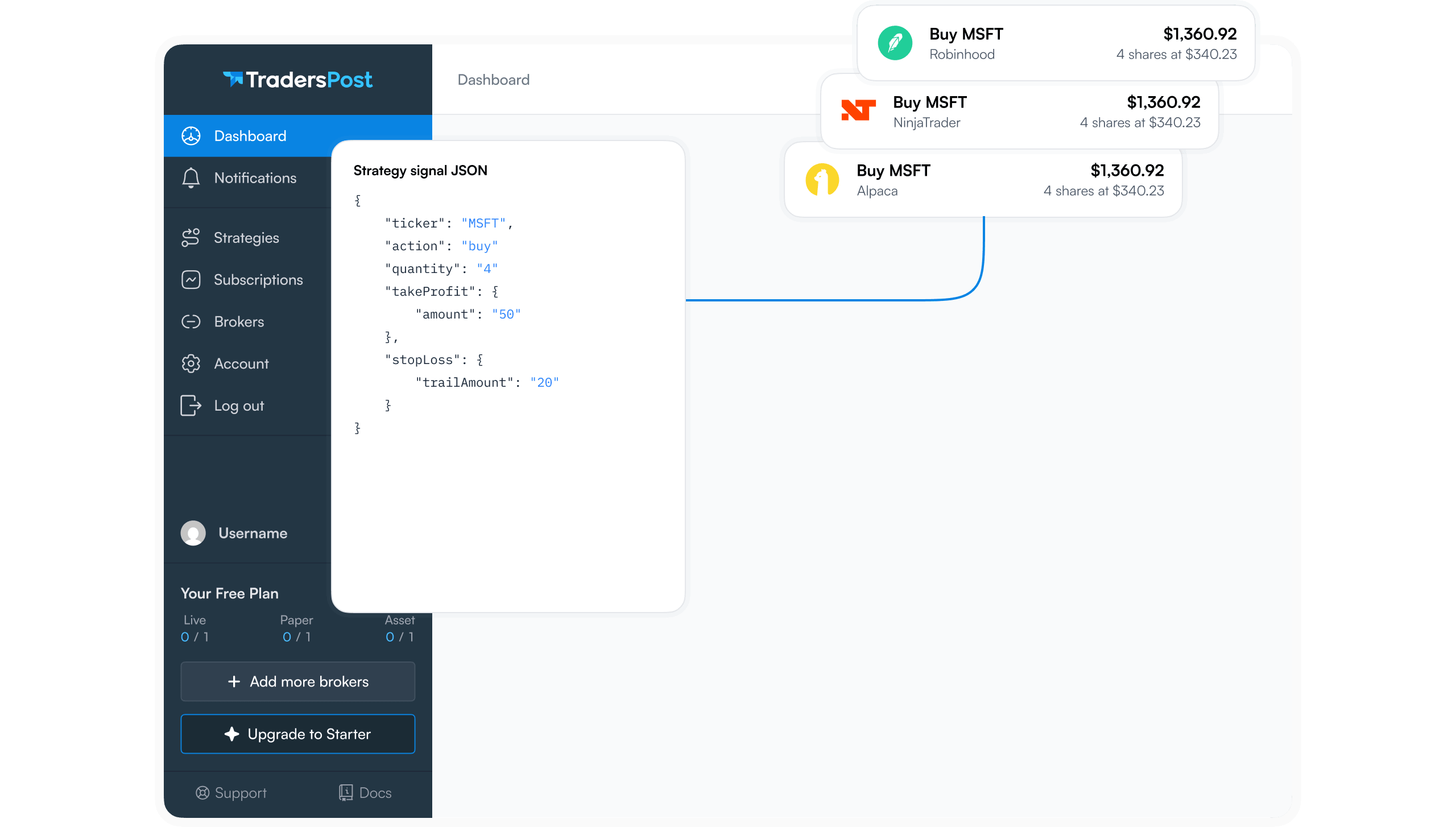
- TradersPost receives the JSON payload, validates it against your strategy rules, and routes the order to your connected broker
When prompting AI to write your strategy, include the webhook JSON format in your request. For TradersPost, the alert message should follow this pattern:
{"ticker":"{{ticker}}","action":"buy"}
Or for more advanced setups with position sizing and sentiment:
{"ticker":"{{ticker}}","action":"buy","sentiment":"bullish","quantity":1}
TradersPost supports connections to brokers including Alpaca, Tradier, TradeStation, Interactive Brokers, and Robinhood, so your AI-generated strategy can execute across multiple platforms without changing the Pine Script code.
Which AI Tool Should You Use
The right tool depends on what you are building and how much manual review you are willing to do.
Choose ChatGPT if: You want fast brainstorming, are building simple indicators, and do not mind fixing syntax errors manually. The free tier makes it the lowest-risk starting point.
Choose Claude if: You are building complex strategies with multi-timeframe logic, custom alerts, or advanced position management. Claude's accuracy advantage saves time on debugging and produces more reliable first drafts for production use.
Choose Pineify if: You want the fastest path from idea to working code without learning Pine Script syntax. The visual builder and auto-fix system minimize the technical barrier, and the built-in indicator library covers most common strategies.
Choose LuxAlgo Quant if: You work within the LuxAlgo ecosystem or need to reverse-engineer existing indicators. Its debugging and code explanation features are useful for learning as well as building3.
Many experienced traders use a combination: Claude for initial strategy generation, Pineify's auto-fix for quick syntax cleanup, and TradingView's Pine Editor for final validation and backtesting. The key is never deploying AI-generated code to live trading without thorough testing, regardless of which tool produced it.
References
1 TradingView Pine Script v6 Language Reference
2 Pineify: TradingView AI Chart Copilot Review
3 LuxAlgo: Code TradingView Indicators with Quant
4 TradingView Blog: AI Chart Copilot Beta