Best Pine Script Alternatives for Algo Trading
Compare the top Pine Script alternatives for algorithmic trading including Python frameworks, platform-specific languages, and no-code tools with pricing and features.

Marketing

Bottom Line
- Python frameworks like QuantConnect, Backtrader, and FreqTrade offer maximum flexibility but require programming experience and infrastructure setup.
- Platform-specific languages such as ThinkScript, EasyLanguage, and NinjaScript provide tighter broker integration than Pine Script but lock you into a single platform.
- No-code tools like TrendSpider let non-programmers build automated strategies without writing any code.
- TradersPost bridges the gap by accepting webhook signals from TradingView, QuantConnect, TrendSpider, and custom scripts, then executing trades across multiple brokers.
- The best alternative depends on your priorities: Python for flexibility, platform languages for broker integration, or Pine Script plus TradersPost for the easiest automation path.
Pine Script is the default language for building indicators and strategies on TradingView, but it is not the only option for algorithmic traders. Whether you need more computational power, direct broker execution, or support for asset classes that TradingView does not cover, several alternatives can fill the gap.
This guide compares the most practical Pine Script alternatives across three categories: Python-based frameworks, platform-specific scripting languages, and no-code tools. Each section covers pricing, supported brokers, and how the alternative connects to live trading through services like TradersPost.
Why Look Beyond Pine Script
Pine Script works well for rapid prototyping and visual strategy development inside TradingView. However, it has limitations that push traders toward alternatives as their needs grow.
Pine Script runs exclusively on TradingView servers, which means you cannot access external data sources, run machine learning models, or connect to databases1. The language also requires manual migration when new versions are released. Pine Script v6, released in December 2024, introduced breaking changes that required traders to update existing scripts2.
TradingView also imposes alert throttling limits and restricts webhook functionality to paid plans starting at the Essential tier1. For traders running high-frequency strategies or managing multiple signals simultaneously, these constraints can become bottlenecks.
The alternatives below address these limitations in different ways. Some offer full programming flexibility, others provide deeper broker integration, and a few eliminate coding entirely.
Python-Based Alternatives
Python is the most popular general-purpose language in quantitative finance. Its ecosystem of libraries for data analysis, machine learning, and broker connectivity makes it the go-to choice for traders who outgrow Pine Script.
QuantConnect (LEAN Engine)
QuantConnect is a cloud-based algorithmic trading platform built on the open-source LEAN engine. It supports backtesting and live trading across equities, options, futures, forex, and crypto using Python or C#3.
- Supports Interactive Brokers, TradeStation, Alpaca, Tastytrade, OANDA, Coinbase, Binance, and more for live execution3
- Free tier includes backtesting with delayed data; paid plans start at $20/month for live trading nodes3
- Event-driven architecture handles fees, slippage, and settlement realistically during backtests
- Can run locally via the open-source LEAN CLI or in the cloud
Best for: Traders who want institutional-grade backtesting with multi-asset support and direct broker connections. QuantConnect also integrates with TradersPost via webhooks, letting you use QuantConnect for signal generation while TradersPost handles execution across additional brokers.
Backtrader
Backtrader is a free, open-source Python framework focused on backtesting and strategy development. It uses an event-driven model and supports multiple data feeds, indicators, and analyzers out of the box.
- Completely free and open-source with no platform lock-in
- Supports live trading through Interactive Brokers and OANDA integrations
- Includes built-in analyzers for Sharpe ratio, drawdown, trade statistics, and returns
- Large community with extensive documentation and third-party tutorials
Best for: Traders who want full control over their backtesting environment without cloud dependencies or subscription fees. Backtrader strategies can send webhook signals to TradersPost for automated execution.
FreqTrade
FreqTrade is an open-source Python trading bot designed primarily for cryptocurrency markets. It handles the full lifecycle from strategy development through backtesting to live trading.
- Free and open-source, runs on your own hardware or a VPS
- Supports Binance, Kraken, Bybit, OKX, and other major crypto exchanges
- Includes hyperparameter optimization using machine learning techniques
- Built-in Telegram bot for monitoring and controlling live strategies remotely
Best for: Crypto traders who want a self-hosted solution with built-in exchange connectivity and strategy optimization tools.
Jesse
Jesse is a Python framework specifically designed for researching and developing crypto trading strategies. It emphasizes clean code architecture and reproducible backtesting results.
- Free and open-source with optional premium features
- Supports spot and futures trading on major crypto exchanges
- Focuses on research-grade backtesting with realistic order simulation
- Clean strategy definition syntax that separates logic from execution
Best for: Crypto-focused algorithmic traders who prioritize research quality and clean code over platform bells and whistles.
Python Advantages Over Pine Script
All Python alternatives share certain advantages over Pine Script. You can access any data source including APIs, databases, and alternative data providers. Machine learning libraries like scikit-learn, TensorFlow, and PyTorch integrate directly into your strategies. You can run strategies on your own hardware without platform restrictions, and Python skills transfer to any domain beyond trading.
The tradeoff is setup complexity. Pine Script gives you a working charting environment and backtester in seconds. Python frameworks require environment configuration, data management, and infrastructure decisions before you write your first strategy.
Platform-Specific Languages
Several trading platforms offer their own scripting languages that compete directly with Pine Script. These languages trade portability for deeper integration with their respective brokers and execution systems.
ThinkScript (thinkorswim / Schwab)
ThinkScript is the scripting language built into Schwab's thinkorswim platform. It powers custom studies, strategies, and conditional orders within the platform4.
- Free for all Schwab account holders with no additional subscription required4
- Direct broker integration allows complex alert-to-order workflows without webhooks
- Strong options analysis tools and chain integration
- Conservative update cycle with good backward compatibility4
Best for: Options traders already using Schwab who want custom indicators and conditional orders without paying for TradingView. The main limitation is that ThinkScript only runs inside thinkorswim and only works with Schwab accounts.
EasyLanguage (TradeStation)
EasyLanguage is TradeStation's proprietary scripting language, one of the oldest in retail algorithmic trading. It has been used for strategy development since the 1990s and has a large library of published strategies and indicators5.
- Included with TradeStation brokerage accounts
- Mature language with decades of community-built strategies and indicators
- Direct integration with TradeStation's execution and backtesting engine
- Supports stocks, options, futures, and crypto through TradeStation5
Best for: Traders who want a proven, mature strategy development environment with direct broker execution. TradeStation also connects to TradersPost, giving you the option to route EasyLanguage-generated signals through webhooks for multi-broker execution.
NinjaScript (NinjaTrader)
NinjaScript is NinjaTrader's C#-based scripting language. It offers the most programmatic flexibility among platform-specific languages because it inherits the full power of the C# programming language and .NET framework.
- Free for charting and backtesting; costs apply for live trading5
- C#-based syntax gives access to the full .NET ecosystem including external libraries
- Direct market data and execution access for futures trading
- Generally stable backward compatibility across platform updates
Best for: Futures traders who need low-level control over execution and want to leverage the C# ecosystem. NinjaScript is considerably more powerful than Pine Script but has a steeper learning curve.
MQL4 / MQL5 (MetaTrader)
MQL (MetaQuotes Language) powers the MetaTrader 4 and MetaTrader 5 platforms, which dominate the retail forex market. MQL5 is a C++-like language that supports indicators, Expert Advisors (automated strategies), and scripts.
- Free to use with any MetaTrader-compatible broker
- Massive marketplace of pre-built Expert Advisors and indicators
- Strong community with decades of accumulated knowledge
- Best-in-class for forex and CFD trading
Best for: Forex and CFD traders. MetaTrader's dominance in these markets means most forex brokers support MQL-based automation natively. The language is less relevant for equities or futures traders.
Platform Language Comparison
Each platform language offers tighter broker integration than Pine Script at the cost of vendor lock-in. Pine Script strategies only run on TradingView, but TradingView connects to dozens of brokers through its native integration and hundreds more through TradersPost webhooks. Platform-specific languages run on exactly one platform but execute trades directly without webhook latency.
No-Code and Low-Code Alternatives
Not every trader wants to write code. Several platforms offer visual strategy builders that let you create automated trading rules without programming.
TrendSpider
TrendSpider combines AI-powered technical analysis with a visual strategy builder and automated bot execution. It identifies chart patterns, support and resistance levels, and trendlines automatically.
- Plans range from approximately $52 to $83 per month
- Visual strategy builder with drag-and-drop condition logic
- AI-powered pattern recognition and multi-timeframe analysis
- Automated trading bots execute directly from the platform
Best for: Visual traders who want automated pattern recognition and strategy execution without writing any code. TrendSpider also integrates with TradersPost for expanded broker connectivity.
Capitalise.ai
Capitalise.ai uses natural language processing to let traders write strategies in plain English. Instead of coding syntax, you describe your strategy in words and the platform converts it to executable logic.
- Available through partner brokers including Interactive Brokers and eToro
- Write strategies in sentences like "Buy AAPL when RSI crosses above 30"
- Supports backtesting and live execution through integrated brokers
- No programming knowledge required
Best for: Complete beginners who want to automate simple rule-based strategies without learning any programming language.
Connecting Alternatives to Live Trading
The biggest challenge with most Pine Script alternatives is getting from strategy signals to executed trades. Pine Script has a natural path through TradingView alerts and webhooks, but other tools require their own execution infrastructure.
Using TradersPost as a Universal Bridge
TradersPost solves the execution problem for most alternatives. It accepts webhook signals from any source and routes them to connected brokers including Alpaca, TradeStation, Interactive Brokers, Tradier, and Tradovate6.
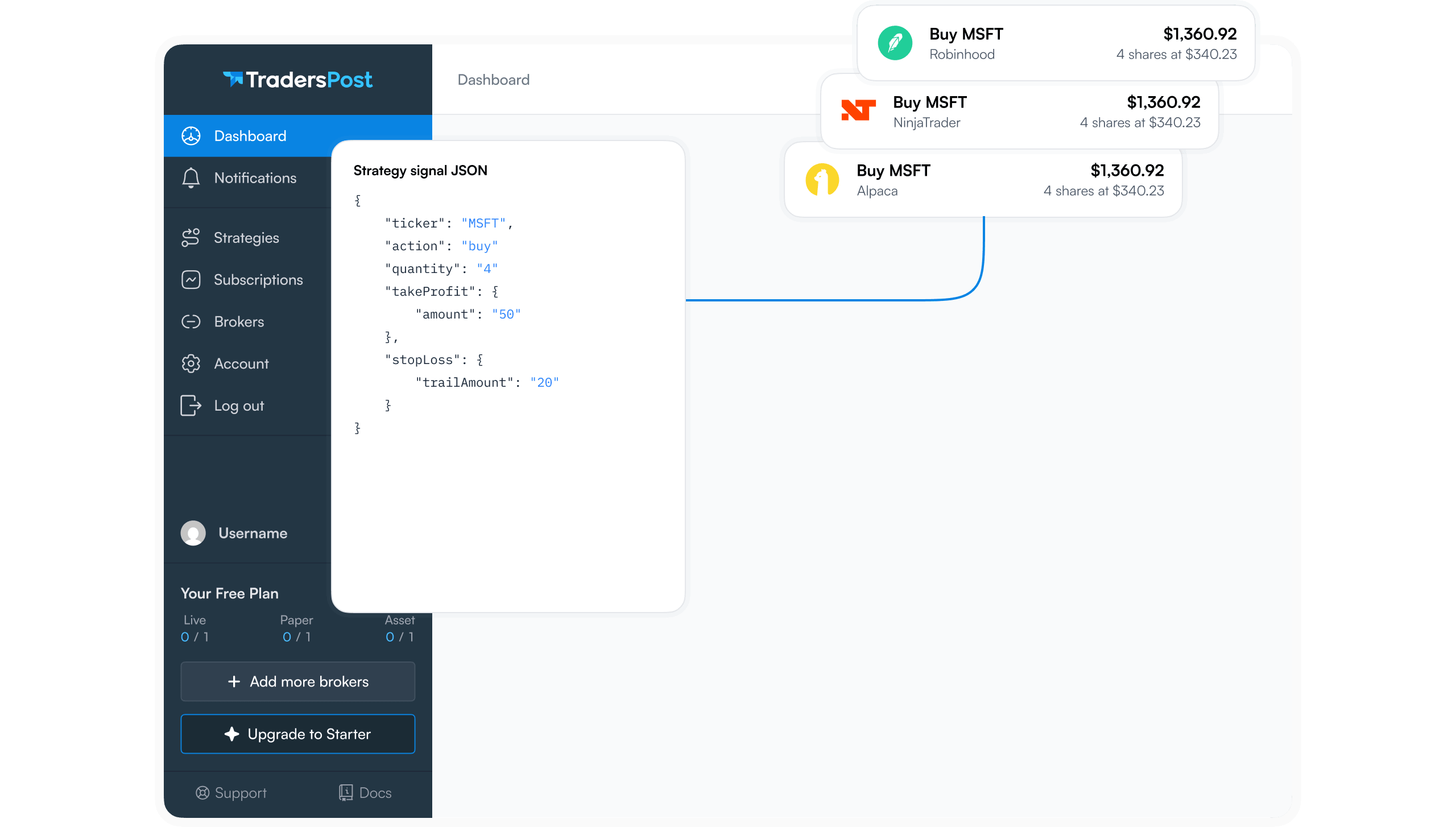
This means you can develop strategies in Python, QuantConnect, or any platform that can send an HTTP request, then use TradersPost to execute trades without building custom broker integrations. The webhook payload is straightforward:
{
    "ticker": "AAPL",
    "action": "buy",
    "sentiment": "bullish",
    "quantity": 10
}
Any system that can send this JSON payload to a URL can execute trades through TradersPost. This applies to Python scripts running on a VPS, QuantConnect algorithms, TrendSpider bots, or even Google Sheets with a custom script.
Direct Broker APIs
For traders who prefer to build their own execution layer, most brokers offer APIs for direct order placement. Alpaca provides a well-documented REST API popular with Python developers. Interactive Brokers offers the TWS API and Client Portal API for programmatic access. TradeStation provides an API for equities, options, and futures.
Building direct integrations gives you maximum control but requires handling authentication, order management, error handling, and position tracking yourself. TradersPost abstracts these complexities into a single webhook endpoint.
How to Choose the Right Alternative
The best Pine Script alternative depends on three factors: your programming skill level, your primary asset class, and how much infrastructure you want to manage.
By Programming Experience
- No coding experience: TrendSpider or Capitalise.ai for visual and natural language strategy building
- Some coding experience: Pine Script remains the easiest scripted language; ThinkScript is a close second
- Comfortable with code: Python with Backtrader or QuantConnect for full flexibility
- Professional developer: NinjaScript (C#) or raw Python with custom infrastructure
By Asset Class
- Stocks and ETFs: Pine Script, QuantConnect, ThinkScript, or EasyLanguage
- Futures: NinjaScript, EasyLanguage, or QuantConnect
- Options: ThinkScript (strongest options tools) or EasyLanguage
- Forex and CFDs: MQL4/MQL5 on MetaTrader
- Crypto: FreqTrade, Jesse, or QuantConnect
By Infrastructure Preference
- Zero infrastructure: Pine Script on TradingView with TradersPost webhooks
- Cloud-managed: QuantConnect handles servers, data, and execution
- Self-hosted: Backtrader, FreqTrade, or Jesse on your own hardware
- Broker-provided: ThinkScript, EasyLanguage, NinjaScript, or MQL within their platforms
Feature Comparison Table
The table below summarizes the key differences across all alternatives discussed in this guide:
- Pine Script: Free with TradingView, proprietary language, cloud-only, supports stocks/futures/crypto/forex, webhooks via TradersPost for execution
- QuantConnect: Free tier plus paid plans from $20/month, Python and C#, cloud or local, multi-asset, direct broker connections plus TradersPost3
- Backtrader: Free and open-source, Python, local only, multi-asset, limited native broker support
- FreqTrade: Free and open-source, Python, self-hosted, crypto only, direct exchange connections
- ThinkScript: Free with Schwab account, proprietary language, thinkorswim only, stocks/options/futures, direct Schwab execution4
- EasyLanguage: Included with TradeStation, proprietary language, TradeStation only, multi-asset, direct execution5
- NinjaScript: Free for charting, C#-based, NinjaTrader only, primarily futures, direct execution5
- MQL4/MQL5: Free with MetaTrader, C++-like, MetaTrader only, forex and CFDs, direct broker execution
- TrendSpider: $52-$83/month, no-code visual builder, cloud-based, stocks/ETFs/crypto, TradersPost integration
Conclusion
Pine Script remains an excellent starting point for algorithmic trading thanks to TradingView's charting tools and community. But when you need more computational power, different asset class coverage, or freedom from platform restrictions, the alternatives above each solve specific problems.
For most traders, the easiest path to automation still runs through TradingView and TradersPost. You develop and backtest strategies in Pine Script, then send webhook alerts to TradersPost for execution across brokers like Alpaca, Interactive Brokers, TradeStation, and Tradovate6. When that setup no longer meets your needs, QuantConnect and Python frameworks offer the next level of flexibility while still connecting to TradersPost for execution.
Whatever tool you choose, the goal remains the same: translate a tested strategy into consistent, automated execution without emotional interference.
References
1 TradingView Pine Script Language Reference Manual
2 TradingView Blog: Pine Script v6 Release
3 QuantConnect Documentation
4 thinkorswim ThinkScript Reference
5 TradeStation EasyLanguage Overview
6 TradersPost - Automated Trading Platform