Building a Crypto Dollar Cost Averaging Bot
Learn how to create an automated dollar cost averaging bot for cryptocurrency that buys during drawdowns and accumulates positions systematically over time.

Marketing

Dollar cost averaging (DCA) is an investment strategy where you purchase a fixed dollar amount of an asset at regular intervals, regardless of price. For cryptocurrency investors who believe in long-term value but want to avoid timing the market, a DCA bot automates this process and can even incorporate intelligent features like buying more during drawdowns. This guide explains how to build and deploy a cryptocurrency DCA bot.
Understanding Dollar Cost Averaging
Dollar cost averaging works by spreading purchases over time, which naturally results in buying more units when prices are low and fewer units when prices are high. This averages out your cost basis over the investment period, reducing the impact of volatility on your overall position.
For example, if you invest $100 every week for a year, some purchases will occur during price peaks and others during price valleys. Over 52 purchases, your average cost will approximate the mean price during that period, typically producing better results than trying to time a single large entry.
The psychological benefit of DCA is equally important. It removes the pressure of perfect timing and reduces the regret of buying right before a significant drop. Since you're continuing to buy during declines, drawdowns become opportunities rather than disasters.
Why Cryptocurrency Benefits from DCA
Cryptocurrency markets exhibit extreme volatility compared to traditional assets. Bitcoin can drop 20% in a week and recover it the next month. This volatility makes timing entries difficult even for experienced traders. DCA strategies remove timing risk while ensuring you participate in long-term appreciation.
Many crypto investors are building positions for multi-year holds, viewing current prices as early entry points for an emerging asset class. For this investment profile, systematic accumulation makes more sense than speculative trading. You're less concerned with short-term fluctuations and more focused on accumulating a target position size over time.
Basic DCA Bot Architecture
A simple DCA bot executes purchases on a fixed schedule: daily, weekly, or monthly. It connects to a crypto exchange via API, checks your account balance, calculates the purchase amount, and places a market buy order for your chosen cryptocurrency.
The bot needs several components: authentication to your exchange, a scheduling mechanism to trigger purchases at specified intervals, logic to calculate purchase amounts based on your DCA settings, order execution through the exchange API, and logging to track all purchases for your records.
Most crypto exchanges provide REST APIs that support programmatic trading. Popular options include Coinbase, Kraken, Binance, and Gemini. Each has documentation for authentication, placing orders, and checking account status. Your DCA bot will leverage these APIs to automate purchases.
Volatility-Based DCA Enhancements
While fixed-interval DCA is effective, you can improve returns by adjusting purchase amounts based on market conditions. A volatility-based DCA strategy increases purchase size during drawdowns and decreases it during rallies. This variation buys more when assets are "on sale" while maintaining the systematic nature of DCA.
For example, your base DCA amount might be $100 per week. If Bitcoin drops 15% from a recent high, your bot could double the purchase to $200 that week. If Bitcoin rallies 30% above its moving average, your bot might reduce the purchase to $50 or skip that week entirely.
This approach requires defining rules for when to increase or decrease purchases. Common triggers include percentage drops from recent highs, positions relative to moving averages, or technical indicators like RSI showing oversold conditions.
Implementing Drawdown-Based Buying
A drawdown-based DCA bot monitors the percentage decline from recent peak prices and increases purchase amounts proportionally. You might define thresholds: 10% drawdown triggers 1.5x normal purchase, 20% drawdown triggers 2x normal purchase, 30% drawdown triggers 3x normal purchase.
To implement this, your bot needs to track the highest price reached over a lookback period (such as 30 or 90 days) and calculate the current percentage below that peak. Based on where current price falls in your threshold ranges, the bot adjusts the purchase amount.
This strategy concentrates more capital at lower prices without abandoning the systematic approach. You still purchase every interval, but the amounts vary based on opportunity. Over a full market cycle, this tends to lower your average cost basis compared to fixed-amount DCA.
Setting Position Size and Investment Limits
Before deploying a DCA bot, define your total investment budget and timeline. If you want to accumulate $10,000 in Bitcoin over one year, a fixed weekly DCA would be approximately $192 per week. A volatility-adjusted bot would use this as the baseline but vary individual purchases up or down.
Set maximum purchase amounts to prevent overcommitting during extreme drawdowns. If your base amount is $200, you might cap any single purchase at $600 even during severe drops. This protects against deploying too much capital too quickly if the drawdown continues.
Similarly, set a maximum total investment or position size. Once you've accumulated your target amount, the bot should stop purchasing or switch to a maintenance mode with much smaller amounts. This prevents unintentional overexposure.
Selecting Intervals: Daily, Weekly, or Monthly
The interval between purchases affects both the number of data points in your average and the transaction costs you incur. Daily DCA provides the most data points, potentially yielding a closer approximation of average price, but generates more transactions and fees.
Weekly DCA strikes a balance for most investors. It provides enough data points to average out volatility while keeping transaction costs reasonable. It also aligns with how many people think about budgeting, making it easier to fund from regular income.
Monthly DCA works well for larger investment amounts or when transaction fees are high. However, it provides fewer data points, increasing the possibility that your average cost diverges from the ideal. For highly volatile assets like crypto, monthly intervals may miss important accumulation opportunities during short-lived dips.
Handling Multiple Cryptocurrencies
Many investors want exposure to several cryptocurrencies, not just Bitcoin. A multi-asset DCA bot can allocate your purchase amount across multiple coins according to your desired portfolio weightings.
For example, you might want 60% Bitcoin, 30% Ethereum, and 10% Cardano. Your bot would split each purchase accordingly. If your total DCA amount is $300 per week, it would buy $180 of Bitcoin, $90 of Ethereum, and $30 of Cardano.
The complexity increases when implementing volatility-based adjustments across multiple assets. Each asset may be in a different phase of its cycle. Your bot needs logic to handle Bitcoin being in drawdown mode (increased purchases) while Ethereum is rallying (reduced purchases) during the same week.
Exchange Selection and API Integration
Choose an exchange that supports programmatic trading via API, offers the cryptocurrencies you want to accumulate, provides competitive fees, and has strong security practices. Review the exchange's API documentation to ensure it supports the order types and account queries your bot needs.
API authentication typically involves generating API keys with specific permissions. For a DCA bot, you need permission to check account balances and place orders, but not to withdraw funds. Use the most restrictive permissions possible to limit risk if your API keys are compromised.
Test API integration thoroughly on a test account or with very small amounts before deploying with real capital. Ensure your bot handles errors gracefully, such as when the exchange is unavailable, when your account lacks sufficient funds, or when prices move rapidly during order execution.
Order Types for DCA Execution
Market orders execute immediately at the current best available price. They guarantee execution but not price. For DCA bots, market orders are usually appropriate because you're buying at regular intervals regardless of price, and immediate execution is more important than getting a perfect price.
Limit orders execute only at your specified price or better. They provide price certainty but not execution certainty. For DCA purposes, limit orders introduce the risk of missing a purchase if price doesn't reach your limit. However, you might use limit orders set slightly below market price to capture small favorable moves during execution.
Some traders split DCA purchases into multiple smaller orders executed over the course of an hour or day, essentially implementing micro-DCA within each scheduled purchase. This can reduce the impact of buying at a temporary price spike, though it adds complexity to your bot logic.
Security Considerations for Automated Trading
Security is paramount when building bots that access your exchange accounts. Store API keys in environment variables or secure key management systems, never hardcode them in your bot's source code. Use IP whitelisting if your exchange supports it, allowing API access only from your bot's server IP address.
Enable two-factor authentication on your exchange account and use API keys with withdrawal restrictions. Even if someone gains access to your bot or API keys, they shouldn't be able to withdraw funds, limiting potential damage to executed trades.
Consider running your bot on a dedicated server or cloud instance rather than your personal computer. This provides better uptime, security isolation, and ability to monitor remotely. Cloud services like AWS, Google Cloud, or DigitalOcean offer low-cost options suitable for simple trading bots.
Logging and Record Keeping
Maintain detailed logs of every purchase your bot executes. Record the timestamp, cryptocurrency, amount purchased, price paid, total cost including fees, and any errors encountered. This data is essential for calculating your cost basis for tax purposes and evaluating your DCA strategy's performance.
Store logs in a structured format like CSV or JSON that can be easily imported into spreadsheets or analysis tools. Include enough detail to recreate your complete trading history if needed. Back up logs regularly to prevent data loss.
Consider implementing notifications when purchases execute. Email or SMS alerts provide peace of mind that your bot is functioning correctly and allow you to monitor for unexpected behavior.
Monitoring and Maintenance
Even automated systems require monitoring. Check your bot's logs weekly to confirm purchases are executing as expected. Verify that your exchange account has sufficient funds for upcoming purchases and replenish as needed.
Monitor exchange API status and any deprecation notices. Exchanges periodically update APIs, and deprecated endpoints eventually stop working. Subscribe to exchange developer communications to stay informed of changes.
Review your DCA strategy quarterly. Assess whether your purchase intervals and amounts still align with your investment goals. As markets evolve or your financial situation changes, adjust parameters accordingly. The beauty of automated systems is that adjustments require only updating configuration, not changing behavior.
Backtesting DCA Strategies
Before deploying a DCA bot, backtest your strategy using historical price data. Simulate your purchase schedule and amounts over past years to see how your strategy would have performed. This reveals expected cost basis, total accumulation, and how drawdown-based adjustments would have affected results.
Backtesting tools for crypto are available through libraries like ccxt (a crypto trading library supporting multiple exchanges) combined with pandas for data analysis. Download historical price data and iterate through it, simulating your bot's logic at each interval.
Compare your enhanced DCA strategy (with drawdown-based adjustments) against simple fixed-amount DCA. If the complexity doesn't yield meaningful improvement in backtesting, stick with the simpler approach. Complexity should be justified by better results.
Tax Implications of Frequent Purchases
Frequent cryptocurrency purchases create numerous tax lots with different cost bases and acquisition dates. In jurisdictions where crypto is taxed as property, each sale or trade triggers a taxable event based on the difference between sale price and cost basis of the specific units sold.
DCA strategies generate many small purchases, complicating tax reporting. Maintain meticulous records of every purchase price and date. When you eventually sell, you'll need this information to calculate gains or losses correctly.
Consider whether your jurisdiction allows specific identification of lots (choosing which purchases to sell) versus requiring first-in-first-out (FIFO) or other methods. Specific identification provides more tax optimization opportunities but requires excellent record keeping.
Integrating with TradersPost
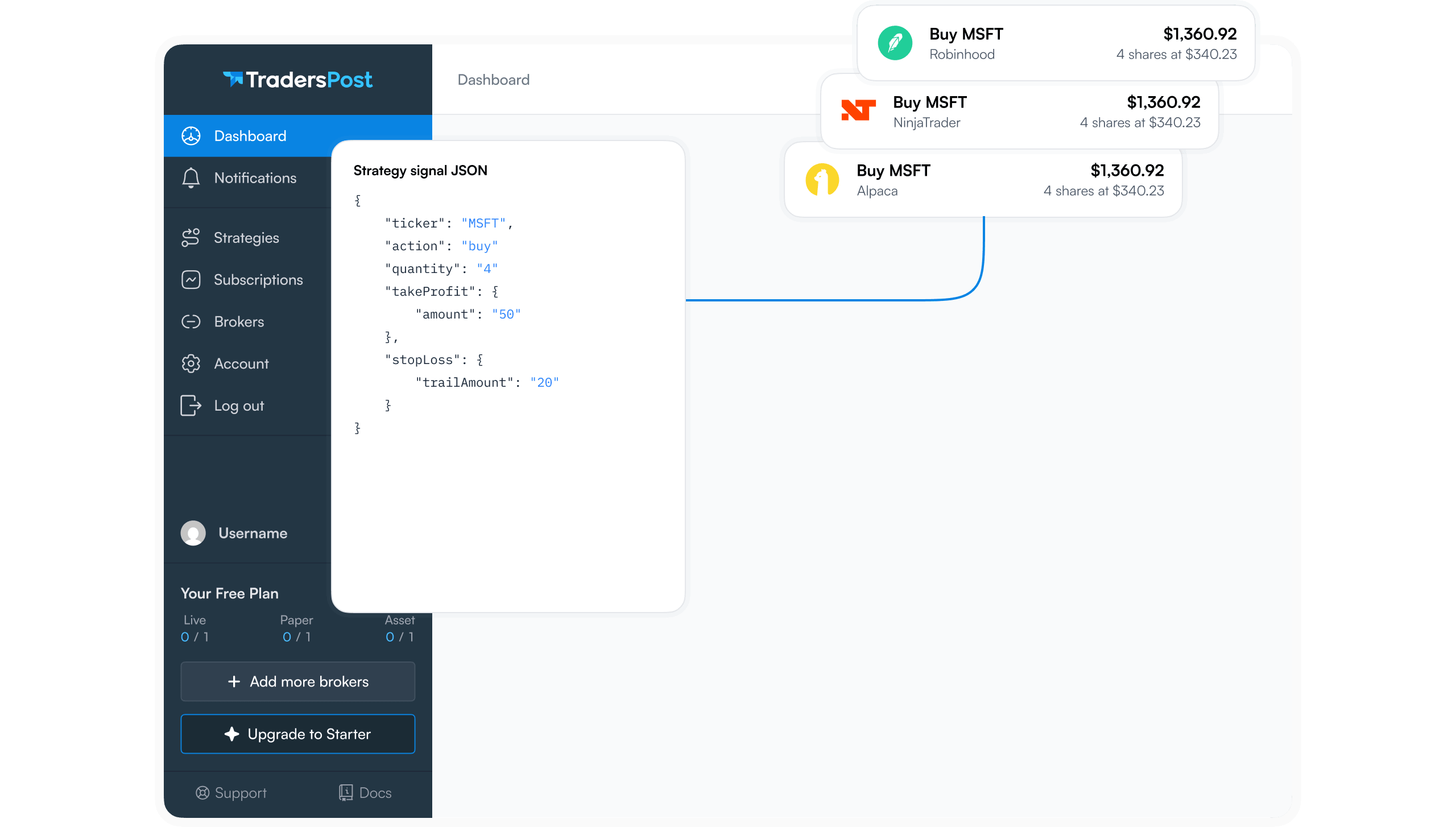
TradersPost can facilitate crypto DCA automation by connecting your DCA signals to supported crypto brokers. Instead of building direct exchange integrations, you can create a system that generates buy signals on your DCA schedule and sends them through TradersPost webhooks.
This approach separates signal generation from execution. Your DCA logic runs on your schedule, calculating when and how much to buy based on your rules. It then formats these decisions as webhook messages to TradersPost, which handles the broker execution.
The advantage is that TradersPost manages the exchange API integration, order execution, and error handling. You focus on the DCA logic—determining when to buy and how much—while the infrastructure handles the mechanics of actually placing orders.
Building Progressive DCA Algorithms
Advanced DCA strategies can incorporate multiple factors beyond simple drawdowns. You might weight decisions based on RSI readings, volume patterns, correlation with traditional markets, or on-chain metrics like miner reserves or exchange inflows.
A progressive DCA algorithm adjusts not just purchase amounts but also the decision of whether to purchase at all. During extreme overbought conditions, the bot might pause purchases entirely. During extreme oversold conditions combined with high fear sentiment, it might accelerate purchases.
The key is maintaining systematic discipline while allowing intelligence to optimize timing within that framework. You're not trying to perfectly time the market, but you are acknowledging that some intervals offer better opportunities than others.
Compound Growth Through Staking
Some cryptocurrencies offer staking rewards, where holding and "staking" your coins generates additional returns. A sophisticated DCA bot could automatically stake accumulated coins, creating a compound effect where you're DCA-ing into an asset that's simultaneously generating yields.
Staking integration requires additional exchange API calls to move coins into staking programs and track rewards. The complexity is worthwhile for assets with significant staking yields, as the compounding effect can substantially enhance long-term returns.
Calculate the total return of your DCA strategy including both price appreciation and staking rewards. Over multi-year periods, staking rewards can represent a significant portion of total returns, especially if accumulating during bear markets when prices are flat but staking continues to generate yields.
Rebalancing Multi-Asset DCA
When DCA-ing into multiple cryptocurrencies, periodic rebalancing maintains your target allocations. If you want 60/30/10 allocation across three coins but one significantly outperforms, your actual allocation will drift. Rebalancing sells a portion of outperformers to buy underperformers, returning to target weights.
A DCA bot can incorporate automatic rebalancing, checking allocations after each purchase cycle. If drift exceeds a threshold (such as 5 percentage points), the bot adjusts the next purchase amounts to move back toward targets. This implements a systematic "buy low, sell high" discipline.
Rebalancing creates tax events in many jurisdictions, so consider tax efficiency when designing rebalancing logic. You might rebalance less frequently or only through adjusting new purchases rather than selling existing holdings.
Conclusion
A cryptocurrency DCA bot automates systematic accumulation, removing emotion and timing pressure from the investment process. Whether implementing simple fixed-interval purchases or sophisticated volatility-adjusted strategies, automation ensures consistent execution according to your plan.
Start with basic DCA—fixed amounts at regular intervals—and evolve toward enhancements as you gain experience. Test thoroughly with small amounts before scaling to your full investment size. Monitor performance, maintain detailed records, and adjust parameters as your strategy evolves.
The goal isn't to maximize every single purchase but to accumulate a meaningful position over time at a reasonable average cost. DCA bots excel at this objective, providing a disciplined approach to building long-term cryptocurrency exposure while navigating the asset class's notorious volatility.