How to Code Moving Average Crossover Pine Script
Comprehensive analysis of Tradestation, Alpaca, Interactive Brokers features, automation capabilities, and integration options for traders.

Marketing

-
Current TradersPost documentation treats the listed brokers as examples rather than a complete supported set, so the automation section now qualifies the broker list while the Pine Script and crossover guidance remains accurate.
Creating a moving average crossover strategy using Pine Script in TradingView can be a game-changer for traders looking to automate their trading processes. By the end of this guide, you'll have the knowledge to code, backtest, and potentially automate a moving average crossover strategy. We'll also explore how TradersPost can facilitate this automation by connecting TradingView's signals to brokers such as Alpaca, TradeStation, Tradier, and Interactive Brokers1.
Understanding Moving Average Crossovers
Moving average crossovers are a popular technique in technical analysis used to identify potential trend reversals and entry/exit points. The strategy involves two key components:
- Golden Cross: Occurs when a faster moving average (e.g., 50-day MA) crosses above a slower moving average (e.g., 200-day MA), signaling a bullish trend.
- Death Cross: Happens when the fast MA crosses below the slow MA, indicating a bearish trend.
These crossovers are particularly effective in trending markets but can lag in volatile conditions since they rely on historical data.
Coding Your Strategy in Pine Script
Setting Up Your Environment
- Log into TradingView: Access your account or create one if you haven't already.
- Open Pine Editor: Located at the bottom of the TradingView interface.
- Create a New Script: Click "New" and select "Strategy" as the script type.
Writing the Basic Crossover Code
Here's a simple example of how you might start coding your crossover strategy:
```pinescript
//@version=5
strategy("Moving Average Crossover", overlay=true)
// Define MAs
fastLength = input(50, title="Fast MA Length")
slowLength = input(200, title="Slow MA Length")
fastMA = ta.sma(close, fastLength)
slowMA = ta.sma(close, slowLength)
// Entry Conditions
longCondition = ta.crossover(fastMA, slowMA)
shortCondition = ta.crossunder(fastMA, slowMA)
// Execute Orders
if (longCondition)
strategy.entry("Long", strategy.long)
if (shortCondition)
strategy.entry("Short", strategy.short)
```
This code sets up a basic moving average crossover system that signals long and short entries.
Enhancing Strategy Effectiveness
Adding Trend Filtering
To improve signal quality, integrate trend filters such as RSI or MACD:
```pinescript
// Add RSI filter
rsiThreshold = input(50, title="RSI Threshold")
rsiValue = ta.rsi(close, 14)
longCondition := ta.crossover(fastMA, slowMA) and rsiValue > rsiThreshold
shortCondition := ta.crossunder(fastMA, slowMA) and rsiValue < rsiThreshold
```
Implementing Session Filters
Limit trading to specific sessions to avoid low-liquidity periods:
```pinescript
// Trading sessions filter
sessionStart = timestamp(year(timenow), month(timenow), dayofmonth(timenow), 9, 30)
sessionEnd = timestamp(year(timenow), month(timenow), dayofmonth(timenow), 16, 0)
inSession = (timenow >= sessionStart and timenow <= sessionEnd)
if (longCondition and inSession)
strategy.entry("Long", strategy.long)
if (shortCondition and inSession)
strategy.entry("Short", strategy.short)
```
Backtesting and Optimization
Using TradingView's Strategy Tester
Once your script is complete, backtest it using TradingView's built-in tools:
- Profit Factor: Measures profitability by comparing gross profit to gross loss.
- Maximum Drawdown: Indicates risk by showing the largest peak-to-trough decline.
- Win Rate: Percentage of trades that were profitable.
- Average Trade Duration: Typical holding period for trades.
Testing Strategy Robustness
To prevent overfitting and ensure reliability across different market conditions:
- Conduct both in-sample optimization (historical data) and out-of-sample testing (unseen data).
- Use rolling optimizations to regularly update parameters.
- Ensure consistent performance through stability testing across various time frames.
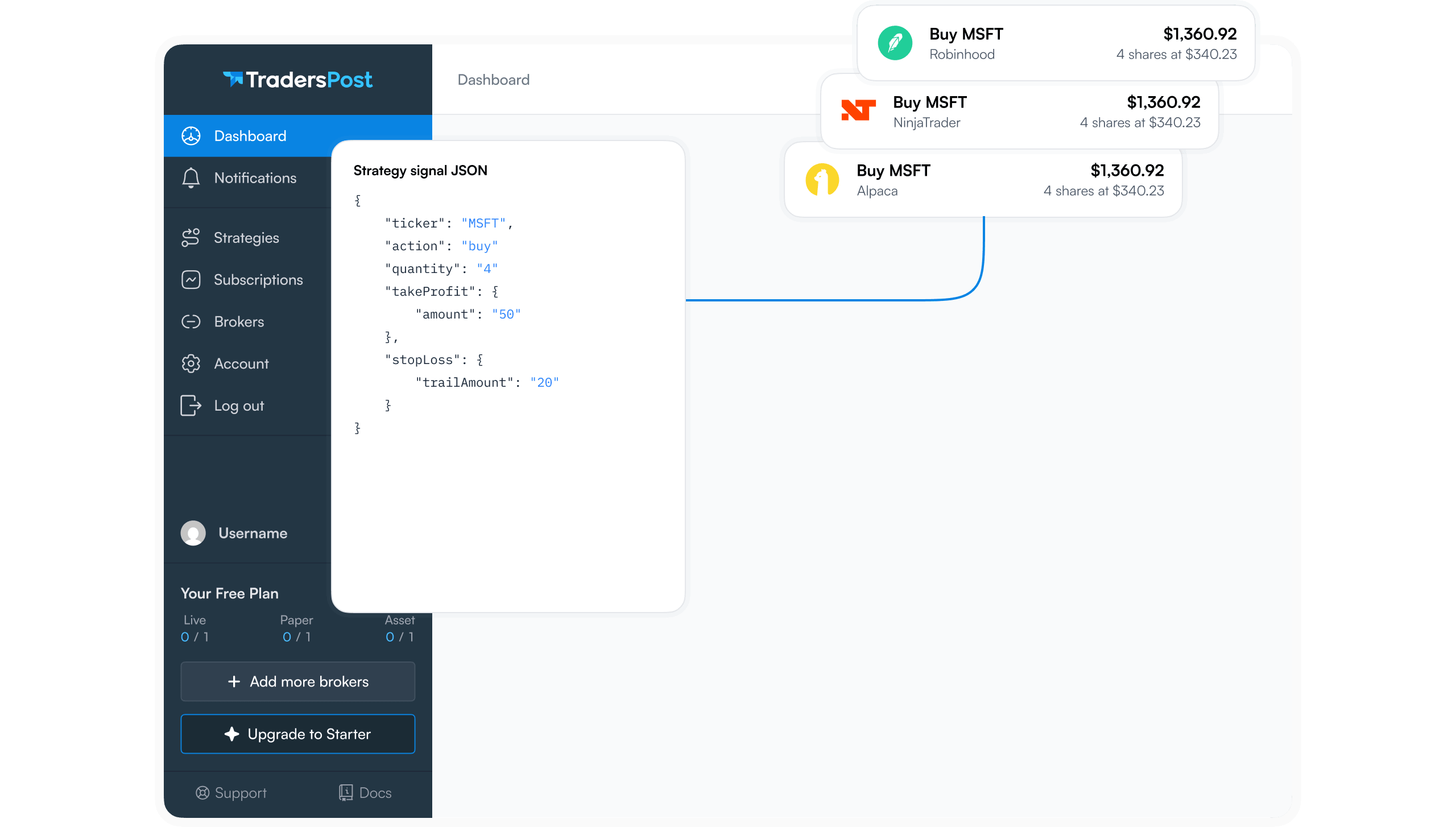
Automating with TradersPost
After refining your strategy in TradingView, leverage TradersPost for automation:
- Create a TradersPost Account: Sign up and connect with your preferred broker.
- Configure Webhook Integration: Set up alerts in TradingView with TradersPost's webhook URL for seamless execution.
- Set Position Sizing and Risk Management Rules: Define these within TradersPost for efficient capital management.
TradersPost acts as the bridge between your TradingView strategies and real-time execution with brokers like Alpaca or Interactive Brokers.
Monitoring Performance
Continuously evaluate your automated system through TradersPost’s features:
- Real-time position tracking helps you maintain oversight of active trades.
- Performance analytics give insights into trade effectiveness.
- Risk monitoring ensures adherence to predefined rules.
- Alert logs provide a history of executed trades for review.
Best Practices for Pine Script Development
- Utilize built-in functions where possible for efficiency.
- Avoid complex calculations within loops to enhance performance.
- Cache calculations that are resource-intensive to prevent lag.
- Prevent unnecessary repainting by ensuring accurate signal processing.
Conclusion
By following this guide, you've learned how to develop a moving average crossover strategy using Pine Script on TradingView. You've enhanced its effectiveness with additional filters and understand how to test its robustness. Most importantly, you've discovered how TradersPost can automate this process by linking your strategies directly with brokers like Alpaca and TradeStation. Start simple, build complexity gradually, test thoroughly before live deployment, and leverage tools like TradersPost to bring your trading strategies into action efficiently.
References
1 blog.traderspost.io, All 12 Pine Script Updates: Feb 2025 to Jan 2026 - Blog