Determining Continuous Futures Contracts on TradingView
Discover the technical solution for identifying which futures contract TradingView's continuous symbols are resolving to, solving a critical automation challenge.

Marketing

-
TradingView now shows contract switches in chart cards and documents 1! and 2! as nearest contracts, so the article now qualifies its platform limitations while its Pine Script workaround remains applicable.
If you've ever automated futures trading strategies on TradingView, you've likely encountered one of the most frustrating technical challenges: determining which specific futures contract a continuous symbol is currently resolving to. This issue affects traders who rely on automated signals, especially when sending alerts to execution platforms like TradersPost.
Continuous futures contracts like GC1! (gold front month) or ES1! (E-mini S&P 500 front month) are powerful charting tools that automatically switch from one expiration to the next. However, while TradingView doesn't expose this resolved contract information in Pine Script, it does show contract switch details on the chart, creating a significant gap for algorithmic traders who need to access this information programmatically1.
Understanding Continuous Futures Contracts
Continuous futures contracts are synthetic symbols created by charting platforms to provide seamless historical data across multiple contract expirations. When you view GC1! on TradingView, you're not looking at a single tradable contract. Instead, you're viewing a stitched-together chart that automatically transitions from one contract to the next based on TradingView's proprietary rollover algorithm.
The Three Components of Futures Contract Symbols
Futures contract symbols follow a standardized format consisting of three parts:
- Root Symbol: The base code representing the underlying asset (GC for gold, ES for S&P 500, NQ for NASDAQ)**
- Month Code: A single letter representing the expiration month (H=March, J=April, M=June, Z=December)
- Year: The two-digit year of expiration (25 for 2025)
For example, GCJ25 represents a gold futures contract expiring in April 2025.
The Contract Rollover Challenge
The primary challenge with continuous contracts stems from inconsistent rollover timing between platforms. TradersPost, for instance, automatically rolls contracts two days before the beginning of the expiry date. However, TradingView's 1! and 2! continuous symbols roll when their current nearest and second-nearest contracts expire2.
This discrepancy creates a critical problem: when your Pine Script strategy sends a signal based on GC1!, and TradersPost receives that signal, the two platforms may be operating on different underlying contracts. Your intended trade on the March contract might accidentally execute on the April contract instead, potentially resulting in unexpected slippage, pricing differences, or failed orders.
Why Historical Data Matters
Individual futures contracts have limited historical data. If you chart GCH25 (March 2025 gold), you'll only see price history from when that specific contract began trading, typically a few months prior. Once the contract expires, the chart stops updating entirely.
Continuous contracts solve this problem by providing decades of historical data, enabling traders to backtest strategies, calculate long-term moving averages, and analyze market behavior across multiple contract cycles. However, this convenience comes at the cost of knowing which specific contract you're currently trading.
The Pine Script Solution
TradingView's Pine Script language doesn't include a built-in function to retrieve the resolved contract from continuous symbols. The sym.info namespace provides extensive information about symbols, including exchange, currency, tick size, and sector, but conspicuously lacks the current contract designation.
To solve this programmatically, traders must build a custom solution that compares price and volume data across all possible contract months to identify which one matches the continuous symbol.
Building Contract Symbols Dynamically
The first step involves creating a function that generates futures contract symbols for any given month. This function combines the root symbol with the appropriate month code and year:
- Extract the root symbol from the continuous contract (GC from GC1!)
- Map month numbers to futures month codes (1=F, 2=G, 3=H, etc.)
- Use the current real-time year, not the historical candle year
- Concatenate these components into a valid contract symbol
The critical insight here is using the real-time year rather than the year of each historical candle. If you use the candle's year, Pine Script will attempt to request historical data for contracts from 1975 onward, quickly exceeding the 40 security request limit imposed by TradingView.
Comparing Price and Volume Data
Once you've generated potential contract symbols, the next step is requesting price and volume data for each one and comparing it against the continuous contract. The matching algorithm considers two factors:
- Open Price: The opening price of the candle must match exactly
- **Volume: The trading volume must match exactly
Requiring both open price and volume to match provides high confidence that you've identified the correct contract. Using close price alone could potentially result in false matches if two contracts happen to close at the same price, though this is unlikely.
Handling Back-Adjusted Charts
Many traders prefer back-adjusted continuous contracts, which smooth out price gaps that occur during rollovers. However, this creates another challenge for contract identification because adjusted prices no longer match the actual contract prices.
The solution involves requesting unadjusted price data specifically for comparison purposes, even when the visible chart displays back-adjusted data. Pine Script's ticker.modify() function allows you to override adjustment settings for specific security requests, ensuring accurate price matching regardless of chart display preferences.
Implementation Considerations
This solution successfully identifies the current front month contract (1!) and next month contract (2!) across all timeframes, from one-minute charts to daily charts. However, several important limitations exist:
Request Limit Impact
The solution requires up to 13 security requests: one for the continuous contract data and up to 12 for checking each potential month. This consumes nearly one-third of Pine Script's 40-request limit, which may constrain complex strategies that already make numerous data requests.
For strategies approaching this limit, consider consolidating requests or creating a library import that efficiently manages the contract resolution without duplicating requests across multiple script instances.
Backtesting Limitations
Because the solution uses real-time year data to avoid exceeding request limits, it cannot accurately backtest historical contract rollovers. The script will always identify the current 2025 contracts, even when viewing 2024 data.
For analyzing historical rollover behavior, you would need to manually adjust the year parameter, though this defeats the purpose of automated detection. For backtesting purposes, using TradingView's continuous contract directly is typically sufficient since you're not concerned with which specific contract was active on any given historical date.
Rollover Gaps and Display
When viewing non-adjusted continuous contracts, you'll see price gaps at each rollover point. These gaps represent the legitimate price differential between expiring and new contracts. While they may appear as chart anomalies, they reflect actual market structure and shouldn't be ignored in strategy development.
Integrating with TradersPost
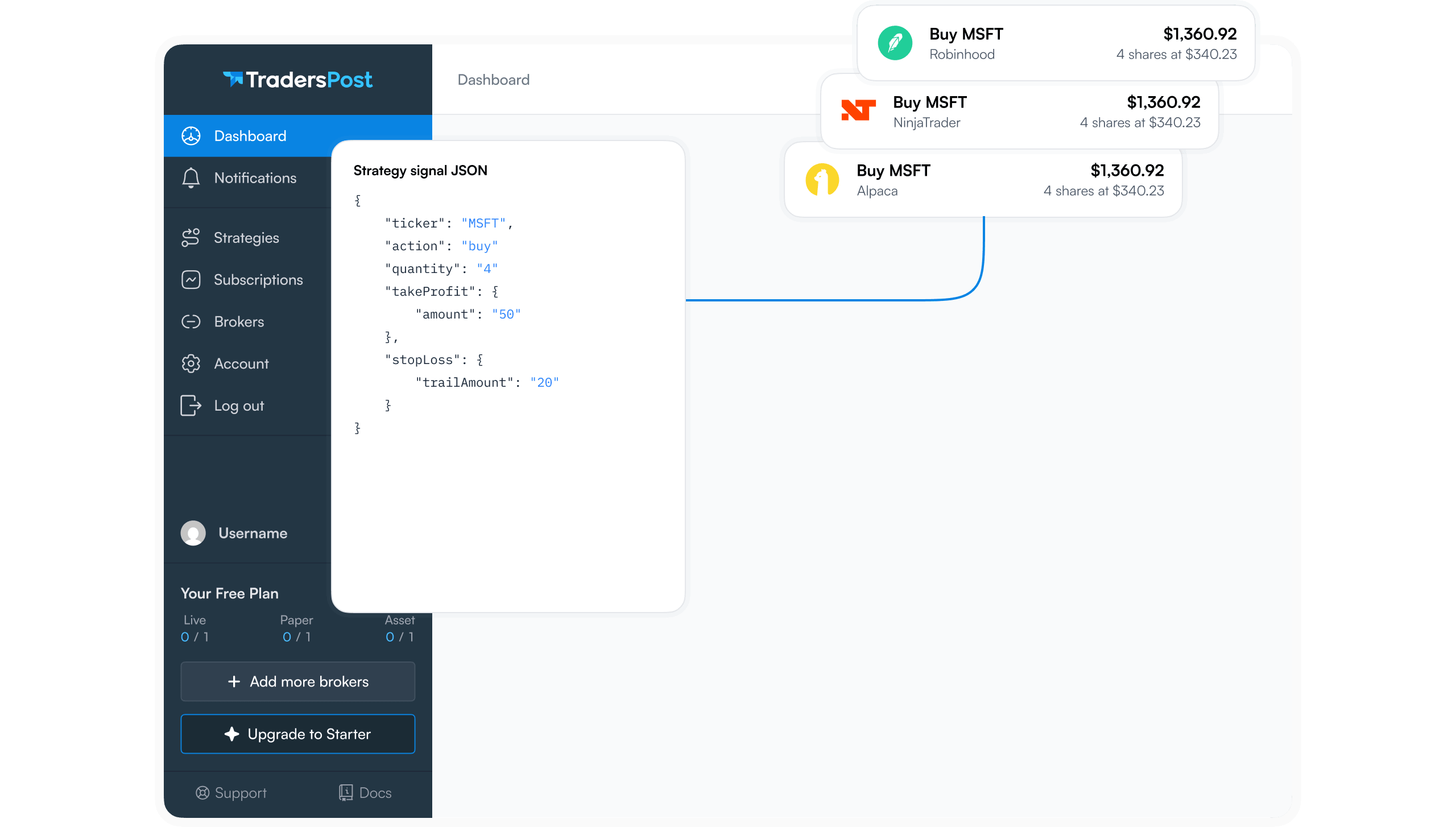
For traders using TradersPost to execute automated futures strategies, this solution enables more precise contract specification in your alert messages. Instead of sending the continuous contract symbol (which TradersPost will interpret according to its own rollover schedule), you can send the specific contract symbol that TradingView is currently tracking.
This synchronization ensures that your TradingView analysis and TradersPost execution operate on identical contracts, eliminating one of the most common sources of confusion and unexpected behavior in automated futures trading.
Alert Message Configuration
When configuring your alert messages, use the resolved contract variable in your JSON payload:
- Replace hardcoded contract symbols with the dynamic variable
- Include the contract expiration date for additional validation
- Consider sending both front month and next month for contingency
- Test thoroughly during rollover periods to verify smooth transitions
Alternative Approaches
While the Pine Script solution works effectively, traders have several alternative approaches to managing futures contract automation:
Explicitly Specify Contracts
The most straightforward approach is to manually specify the exact contract you're trading (GCJ25 instead of GC1!) and update your strategy monthly. This eliminates all ambiguity but requires regular maintenance and increases the risk of forgotten updates.
Use Platform Rollover Schedules
Understanding your execution platform's specific rollover rules allows you to anticipate when discrepancies will occur. TradersPost provides clear documentation on its two-day-before-expiry rollover policy, enabling you to time manual updates accordingly.
Monitor Contract Activity
Some traders prefer monitoring multiple contract months simultaneously and executing trades on whichever contract their strategy is actually analyzing. This approach adds complexity but provides the highest degree of control over execution.
Market Structure and Liquidity
Understanding why different contract months exist helps clarify why rollover matters. Futures contracts with nearer expiration dates typically have the highest liquidity and tightest bid-ask spreads. As contracts approach expiration, liquidity gradually migrates to the next contract.
The front month contract typically sees the most trading activity until the final weeks before expiration, when the next month contract becomes more liquid. This transition doesn't happen on a fixed date; market participants gradually shift their positions based on their own risk management and delivery intentions.
TradingView's 1! and 2! continuous symbols track the nearest and second-nearest contracts and roll when their current contracts expire. Contract Switch cards on the chart show the switch date and the contracts involved3.
Practical Testing and Validation
Before deploying any automated futures strategy in live trading, thorough testing during rollover periods is essential. The contract identification solution should be validated by:
- Comparing identified contracts against TradingView's displayed symbol
- Checking that price and volume data match across timeframes
- Verifying behavior across multiple asset classes (metals, indices, agriculture)
- Testing during actual rollover periods to observe transitions
- Monitoring Pine Logs for any identification failures or anomalies
The Future of Continuous Contract Support
The ideal solution would be for TradingView to expose the resolved contract information directly in the sym.info namespace. TradingView now shows contract switch details on the chart, but a Pine Script field would eliminate the need for complex workarounds and make futures automation significantly more accessible to retail traders1.
Until that happens, programmatic solutions like the one described here provide a functional alternative. The trading automation community continues to push for better platform integration, and increased demand for these features may eventually lead to native support.
Conclusion
Determining the current futures contract for continuous symbols represents one of automated trading's more technical challenges, but it's solvable with careful Pine Script programming. By comparing price and volume data across potential contracts, traders can reliably identify which specific contract TradingView's continuous symbols are resolving to at any given moment.
This capability enables precise synchronization between charting analysis and order execution, particularly crucial when using external execution platforms like TradersPost. While the solution has some limitations around backtesting and request consumption, it successfully addresses a real pain point that affects traders every single month during contract rollovers.
For traders serious about futures automation, investing time in understanding and implementing contract identification logic pays dividends in reduced confusion, fewer execution errors, and greater confidence in strategy performance. As the automated trading ecosystem matures, solutions like this help bridge the gap between powerful charting capabilities and reliable execution infrastructure.
Whether you trade gold, crude oil, equity indices, or agricultural futures, knowing exactly which contract you're trading isn't just a technical nicety—it's a fundamental requirement for professional-grade automation. The ability to programmatically determine this information transforms continuous contracts from a source of frustration into a truly useful tool for algorithmic trading.
References
1 How to open an expired futures contract on the chart - TradingView
2 tradingview.com, What are 1! and 2! continuous futures contracts?
3 tradingview.com, Switching continuous futures contracts