Kelly Criterion Position Sizing Explained
Discover how the Kelly Criterion can transform your position sizing strategy by dynamically adjusting trade sizes based on win rate and risk-reward ratios.

Marketing

-
Traders ask what a negative Kelly percentage means and how fixed-percentage sizing works, so the guidance now says it means no edge, adds Van Tharp's formula, and explains which sizes TradersPost calculates for stocks and futures.
Position sizing is one of the most critical yet often overlooked aspects of successful trading. While many traders focus on entry and exit signals, the Kelly Criterion offers a mathematical framework for determining exactly how much capital to risk on each trade. This systematic approach to position sizing can mean the difference between consistent growth and catastrophic losses.
The Kelly Criterion provides a formula that calculates the optimal position size based on your strategy's win rate and risk-reward ratio. Unlike fixed position sizing methods, Kelly adjusts dynamically as your trading performance evolves, increasing positions during winning streaks and reducing exposure during drawdowns.
What Is the Kelly Criterion?
The Kelly Criterion is a mathematical formula developed by John L. Kelly Jr. in 1956 at Bell Labs. Originally designed for telecommunications signal-to-noise ratios, it was quickly adopted by gamblers and investors as a method for optimal capital allocation.
The formula calculates the ideal percentage of your capital to risk on any given trade by considering two key factors: the probability of winning and the ratio of potential profit to potential loss. If the Kelly percentage comes out negative, the strategy has no edge and the formula says not to trade at all1.
The Kelly Formula
The standard Kelly Criterion formula is:
K% = W - [(1 - W) / R]
Where:
- K% = Percentage of capital to risk
- W = Win rate (probability of winning)
- R = Risk-reward ratio (average win / average loss)
For example, if your strategy has a 60% win rate and an average risk-reward ratio of 2:1, the calculation would be:
K% = 0.60 - [(1 - 0.60) / 2] = 0.60 - 0.20 = 0.40 or 40%
This means you should risk 40% of your capital on each trade. However, most professional traders use fractional Kelly, typically one-quarter to one-half of the full Kelly recommendation, to reduce volatility and account for estimation errors.
Why Kelly Criterion Matters for Traders
Traditional position sizing methods like fixed dollar amounts or fixed percentages don't adapt to your strategy's performance. A system that worked well last month might be deteriorating, but fixed sizing keeps you at the same risk level regardless.
The Kelly Criterion addresses this by incorporating real-time performance metrics. When your win rate improves or your risk-reward ratio becomes more favorable, Kelly increases position sizes to capitalize on the edge. Conversely, when performance deteriorates, it automatically reduces exposure to protect capital.
Benefits of Kelly Position Sizing
Maximizes Long-Term Growth
The Kelly Criterion is mathematically proven to maximize the geometric growth rate of capital over time. It finds the optimal balance between aggressive growth and capital preservation.
Prevents Overtrading and Revenge Trading
One of the most destructive behaviors in trading is increasing position size after losses to "make back" the money. Kelly does the opposite, automatically scaling down after losses and scaling up after wins. This counterintuitive approach aligns with mathematical reality rather than emotional impulses.
Adapts to Changing Market Conditions
Markets evolve, and strategies that performed well in one regime may struggle in another. Kelly position sizing continuously recalculates based on recent performance, providing a systematic method for adjusting exposure as conditions change.
Provides Objective Risk Management
Rather than guessing at position sizes or using arbitrary rules, Kelly gives traders a quantitative framework backed by decades of mathematical research and real-world application.
The Risks and Limitations
While the Kelly Criterion offers powerful benefits, it's not without drawbacks. Understanding these limitations is crucial for successful implementation.
Sensitivity to Input Errors
The Kelly formula is highly sensitive to the accuracy of your win rate and risk-reward ratio estimates. Overestimating your edge by even a small amount can lead to dramatically oversized positions and increased risk of ruin.
High Volatility
Full Kelly sizing can produce significant account volatility and large drawdowns, especially during losing streaks. This is why most professional traders use fractional Kelly, typically betting 25-50% of the full Kelly recommendation.
Assumes Stable Probability Distribution
Kelly assumes that past performance probabilities will continue into the future. In reality, market conditions change, and historical win rates may not reflect future probabilities.
Not Suitable for All Trading Styles
Kelly works best for strategies with clearly defined win rates and risk-reward ratios. For discretionary traders or those using complex multi-leg strategies, calculating accurate inputs becomes challenging.
Implementing Kelly in Automated Trading
Automated trading platforms like TradersPost provide the perfect environment for implementing Kelly Criterion position sizing. Unlike manual trading, automation can continuously track performance metrics and adjust position sizes in real-time without emotional interference.
Key Implementation Considerations
Calculate Win Rate Dynamically
Your Kelly calculation should use a rolling window of recent trades rather than all historical trades. This weights recent trades more heavily, which better reflects current market conditions and strategy performance.
A common approach is to use the last 20-50 trades or the trades from the past 30-90 days. This provides enough data for statistical significance while remaining responsive to changing conditions.
Use Fractional Kelly
Most professionals recommend using one-quarter to one-half Kelly to reduce volatility. If the Kelly formula suggests a 40% position size, you might actually use 10-20% instead.
This fractional approach provides a margin of safety against estimation errors while still capturing most of the optimal growth benefits.
Set Position Size Floors
In the early stages of a strategy or after a significant drawdown, Kelly might recommend position sizes less than one contract or share. You'll need to decide whether to:
- Use the minimum tradable size (1 share/contract)
- Skip the trade entirely until Kelly recommends a larger size
- Use your default position size as a floor
Monitor and Adjust Parameters
Regularly review your win rate and risk-reward ratio calculations to ensure they accurately reflect your strategy's performance. Consider implementing alerts when these metrics deviate significantly from expected ranges.
Integrating Kelly with TradersPost
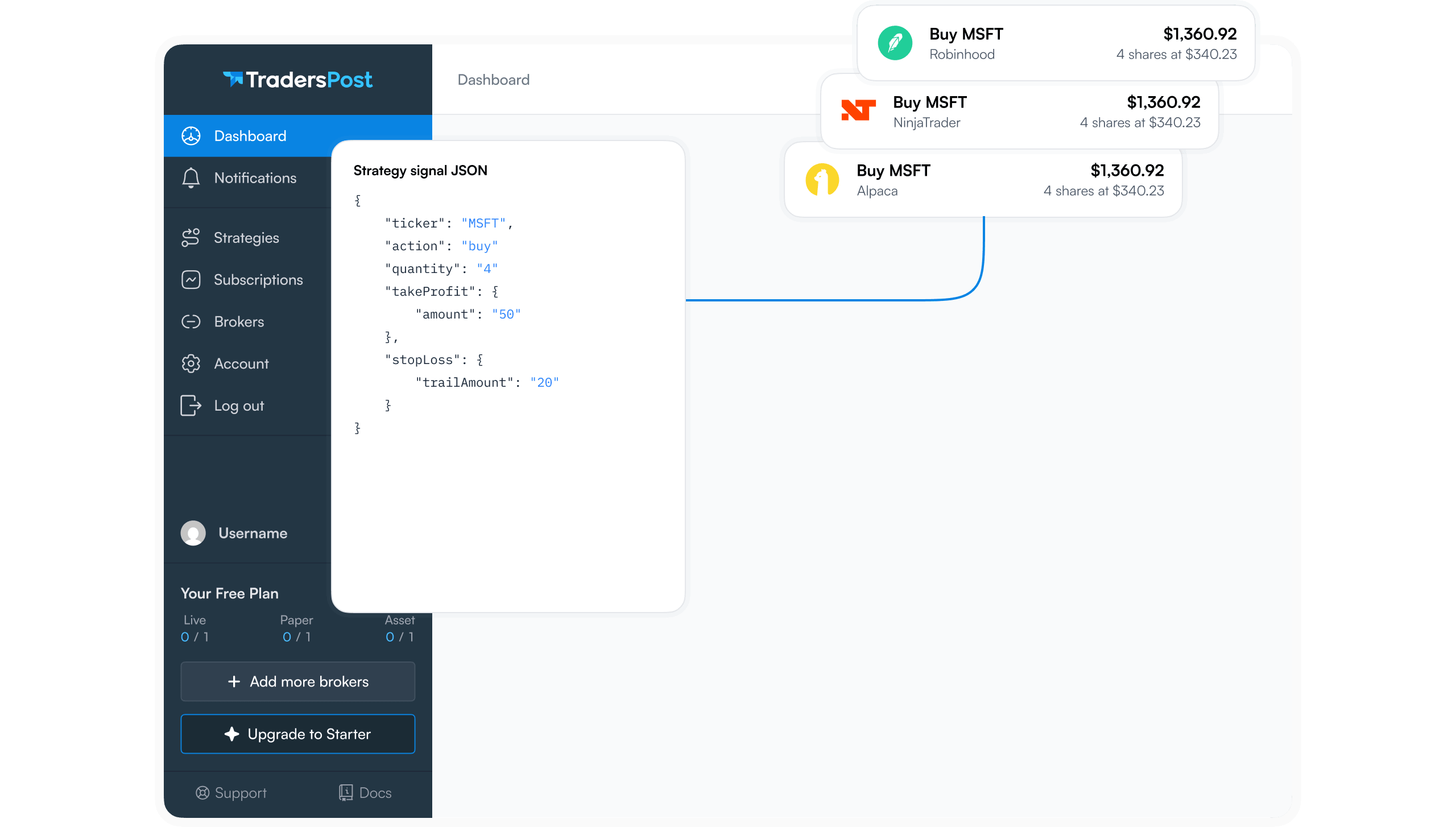
TradersPost automation capabilities make it straightforward to implement Kelly Criterion position sizing in your TradingView strategies. By calculating the Kelly percentage in your Pine Script code, you can dynamically adjust position sizes with each signal.
For stocks, TradersPost can turn a dollar amount, a dollar amount to risk (which needs a stop loss) or a percent of equity sent in your signal into a share quantity. For futures, it does not calculate size from a dollar amount, equity or risk, so your Pine Script code must send the number of contracts.
Building Kelly-Aware Strategies
When developing strategies with Kelly position sizing, consider these best practices:
Track Performance Metrics
Build systems to track your running win rate, average win size, average loss size, and other key metrics. These become inputs to your Kelly calculation.
Implement Risk Limits
Even with Kelly sizing, set maximum position size limits as a risk control. This prevents rare edge cases where calculation errors or data anomalies might suggest unreasonably large positions.
Test Thoroughly
Backtest your Kelly implementation across various market conditions and time periods. Pay special attention to how the system behaves during extended losing streaks and high volatility periods.
Start Conservatively
When first implementing Kelly sizing in live trading, start with a very conservative fractional Kelly (perhaps one-quarter or even one-eighth) until you gain confidence in the system's behavior.
Kelly vs Other Position Sizing Methods
Understanding how Kelly compares to other popular position sizing approaches helps clarify when and why to use it.
Fixed Dollar Amount
The simplest approach: risk the same dollar amount on every trade. This is easy to understand but doesn't scale with account size or adapt to performance.
Fixed Percentage
Risk a fixed percentage of account equity on each trade (commonly 1-2%). This scales with account size but doesn't adjust for strategy performance or market conditions. Van Tharp's version of this method divides cash risk by risk per unit: risking 1% of a $100,000 account ($1,000) on a trade with $10 of risk per share gives a 100-share position2.
Volatility-Based Sizing
Position sizes based on market volatility, using indicators like Average True Range (ATR). This adapts to market conditions but doesn't consider strategy win rate.
Optimal f
Similar to Kelly but uses a different mathematical approach. Generally more aggressive and less commonly used.
The Kelly Criterion stands out by incorporating both strategy performance (win rate) and trade structure (risk-reward ratio) into a single, coherent framework.
Real-World Applications
Professional traders and quantitative funds often use modified versions of Kelly Criterion for position sizing, particularly in systematic trading programs.
Hedge Fund Usage
Many quantitative hedge funds employ Kelly-based position sizing as part of their risk management framework. However, they typically use highly conservative fractional Kelly ratios and combine it with other risk controls.
Retail Trader Adoption
Kelly Criterion is gaining popularity among sophisticated retail traders, particularly those focused on systematic trading and automation. The rise of platforms like TradersPost makes it accessible to implement without requiring extensive programming knowledge.
Sports Betting and Poker
Beyond financial markets, Kelly Criterion is widely used in sports betting and poker, where win rates and payoff ratios are often more clearly defined than in trading.
Common Mistakes to Avoid
Even experienced traders make errors when implementing Kelly position sizing. Awareness of these pitfalls can save you from costly mistakes.
Using Unadjusted Full Kelly
Full Kelly is extremely aggressive and can lead to devastating drawdowns. Always use fractional Kelly unless you have extensive experience and are confident in your input parameters.
Ignoring Estimation Error
Your win rate and risk-reward calculations are estimates based on historical data. They contain uncertainty that the Kelly formula doesn't account for. Using fractional Kelly helps compensate for this uncertainty.
Not Updating Calculations
If you calculate Kelly once and then use that position size indefinitely, you're missing the entire point. Kelly should be recalculated regularly as new trade data becomes available.
Applying Kelly to Inappropriate Strategies
Kelly works best for strategies with consistent win rates and risk-reward profiles. It's less suitable for strategies with highly variable outcomes or undefined risk parameters.
Advanced Concepts
For traders ready to go deeper, several advanced variations and considerations exist.
Multiple Simultaneous Positions
When running multiple uncorrelated strategies simultaneously, you can apply Kelly to each independently. For correlated strategies, adjustments are needed to account for the combined risk.
Time-Varying Kelly
Some sophisticated implementations vary the Kelly fraction based on market regime, volatility, or other factors. This adds complexity but can improve risk-adjusted returns.
Kelly with Transaction Costs
The standard Kelly formula doesn't account for commissions and slippage. In high-frequency strategies with significant transaction costs, modifications are necessary.
Getting Started with Kelly
If you're ready to implement Kelly Criterion position sizing in your automated trading:
Start by calculating your strategy's historical win rate and average risk-reward ratio
Implement the Kelly formula using one-quarter or one-half Kelly to start conservatively
Test thoroughly in a paper trading environment using TradersPost's simulation features
Monitor performance closely and adjust your fractional Kelly multiplier as needed
Gradually increase confidence as you see the system perform as expected
Remember that Kelly Criterion is a tool, not a magic formula. It requires accurate inputs, thoughtful implementation, and ongoing monitoring to be effective.
Conclusion
The Kelly Criterion offers a mathematically rigorous approach to position sizing that addresses many weaknesses of simpler methods. By dynamically adjusting position sizes based on win rate and risk-reward ratio, it helps traders maximize long-term growth while adapting to changing market conditions.
For automated traders using platforms like TradersPost, implementing Kelly sizing becomes straightforward. The combination of TradingView's strategy development capabilities and TradersPost's execution infrastructure provides everything needed to build sophisticated Kelly-based systems.
Start conservatively with fractional Kelly, monitor your results carefully, and adjust your approach based on real-world performance. Over time, Kelly Criterion position sizing can become a powerful component of your automated trading toolkit, helping you grow capital systematically while managing risk intelligently.
References
1 corporatefinanceinstitute.com, Kelly Criterion - Overview, Formula, & Analysis of Results
2 vantharpinstitute.com, Van Tharp Teaches Position Sizing Strategies and Risk Management