Pine Script v6: Common Questions and Mistakes
Answers to the 20 most common Pine Script v6 questions about migration, new features, breaking changes, and compatibility.

Marketing

Bottom Line
- Pine Script v6 launched November 2024 and all new scripts default to v6 in the Pine Editor
- The auto-converter handles many v5 to v6 changes but boolean logic and strategy parameters need manual review
- v5 scripts continue to work on TradingView and there is no forced migration deadline
- TradersPost webhook automation works with both v5 and v6 strategy alerts
Pine Script v6 is the biggest update to TradingView's scripting language in years, and it has generated a lot of questions from traders and developers. Whether you are deciding if it is time to upgrade, troubleshooting a conversion error, or trying to understand what the new features actually do, this FAQ covers the 20 most common questions we hear about Pine Script v6.
Each answer is kept concise so you can quickly find what you need. For deeper coverage of any topic, follow the links to our dedicated guides.
General Questions
1. When was Pine Script v6 released?
Pine Script v6 was released on November 13, 20241. TradingView announced the update alongside a detailed migration guide and release notes2. Since the launch, TradingView has shipped monthly updates throughout 2025 adding features like footprint requests, dynamic for loops, active inputs, bid/ask variables, and plot linestyles to the v6 platform1.
2. Do I have to upgrade my v5 scripts?
No, upgrading is optional. Your existing v5 scripts will continue to compile and run on TradingView exactly as they do today4. However, all new scripts created in the Pine Editor default to v6, and any new language features released after November 2024 are only available in v61. If you want access to dynamic requests, enums, footprint data, or runtime logging, you need to be on v6.
3. Will v5 scripts stop working?
TradingView has not announced any plan to deprecate or disable Pine Script v5. Historically, TradingView has maintained backward compatibility across versions, and scripts written in v3 and v4 still run today. You can expect v5 scripts to continue working for the foreseeable future, though they will not receive new features.
4. What is the biggest change in v6?
The single most impactful change is dynamic requests. In v5, request.security() and other request.*() functions required compile-time constant arguments and could not be placed inside loops or conditionals2. In v6, these functions accept series string arguments by default, enabling multi-symbol scanning inside loops, conditional data fetching, and library-exported request functions1. This single change unlocks entire categories of strategies that were impossible before.
Migration Questions
5. How do I convert a v5 script to v6?
Open your script in the Pine Editor, click the "Manage script" dropdown menu, and select "Convert code to v6." The script must compile successfully in v5 before conversion4. The auto-converter handles common changes like removing the when parameter, fixing duplicate function parameters, and adding basic bool() casts2. After conversion, compile the result and fix any remaining errors manually. See our Pine Script v6 breaking changes guide for the full list of issues to check.
6. What are enums in Pine Script?
Enums (enumerations) are a new data type in v6 that define a fixed set of named values1. Instead of using input.string() with an array of options, you declare an enum with specific members and use input.enum() to create type-safe dropdown menus3. The compiler catches invalid values at compile time, eliminating an entire class of bugs caused by string typos. See our complete enums guide for detailed examples.
7. What changed about booleans in v6?
Pine Script v6 makes two major changes to boolean behavior. First, booleans can no longer hold na. They are strictly true or false, and functions like na(), nz(), and fixnan() no longer accept bool arguments2. Second, implicit casting from int and float to bool is removed2. Code like if bar_index must become if bar_index != 0. If your logic requires a third state, replace the bool with an int variable using values like -1, 0, and 1.
8. Why does "if myInt" give an error in v6?
In v5, integer and float values were implicitly cast to boolean in conditional contexts. Zero and na evaluated to false, and any nonzero value evaluated to true. V6 removes this implicit casting entirely2. You must use an explicit comparison like if myInt != 0 or wrap the value with bool(myInt)3. The auto-converter handles many of these cases, but review every conditional that tests a numeric value directly.
9. What is lazy evaluation?
In v6, the and and or operators use short-circuit (lazy) evaluation2. If the left side of and is false, the right side is never executed. If the left side of or is true, the right side is skipped. This is dangerous when the right side contains a ta.* function that depends on being called every bar to maintain its internal history. The fix is to extract the function call to a global-scope variable before using it in the conditional.
Feature Questions
10. Can I use request.security() with variables now?
Yes. In v6, all request.*() functions accept series string arguments by default1. You can pass a variable that changes value on each bar as the symbol or timeframe argument. You can also call request.security() inside for loops, if blocks, and exported library functions3. Scripts are limited to 40 dynamic request calls per execution cycle (64 on Ultimate plans)1. If you need v5 behavior for any reason, add dynamic_requests = false to your declaration.
11. What happened to the "when" parameter in strategy functions?
The when parameter was deprecated in v5 and is fully removed in v62. It previously appeared in strategy.entry(), strategy.order(), strategy.exit(), strategy.close(), strategy.close_all(), strategy.cancel(), and strategy.cancel_all()3. Replace every when = condition with a wrapping if condition block. The auto-converter handles this change automatically in most cases.
12. Why does integer division give different results in v6?
In v5, dividing two const int values used integer division: 1 / 2 returned 0 and 5 / 2 returned 2. In v6, all integer division returns the fractional result: 1 / 2 returns 0.5 and 5 / 2 returns 2.52. This change produces no compilation error, making it one of the most dangerous v6 changes because it silently alters calculations. Wrap any division where you need the old truncated result with int() or use math.floor()3. See our dedicated integer division deep dive for affected patterns.
13. What is runtime logging?
Pine Script v6 adds three logging functions: log.info(), log.warning(), and log.error()3. These send messages to the Pine Logs pane in TradingView, replacing the old workaround of using plot() or label.new() to inspect values at runtime. Log messages support string formatting, filtering by severity level, and include timestamps1. This makes debugging strategies and indicators dramatically faster and cleaner.
14. What are polylines?
Polylines are a drawing type introduced in v6 that allow you to draw connected sequences of straight and curved line segments on the chart1. Unlike line.new(), which draws a single line between two points, polylines connect multiple points in a single drawing object. They support filled regions, curve interpolation, and can be used to create custom chart shapes like channels, zones, or complex pattern visualizations that would have required dozens of individual line objects in v53.
15. What is the footprint feature?
The request.footprint() function, added in January 2026, provides native access to volume footprint data in Pine Script1. It returns a footprint object containing volume distribution data across price levels for each bar, including the Point of Control (POC), Value Area High/Low, buy and sell volume per row, and volume imbalances3. This feature requires a TradingView Premium or Ultimate plan. See our footprint requests guide for detailed examples.
Compatibility Questions
16. Do I need a premium plan for v6?
No. Pine Script v6 itself is available on all TradingView plans, including the free tier4. However, certain features introduced after the v6 launch have plan requirements. The request.footprint() function requires Premium or Ultimate1. The bid and ask variables require access to tick charts, which is available on paid plans. The number of dynamic request calls is also plan-dependent: 40 on most paid plans, 64 on Ultimate1.
17. Can v6 scripts use v5 libraries?
Yes. Pine Script v6 scripts can import and use libraries written in v54. The library functions work as expected. However, the reverse is not true: v5 scripts cannot import v6 libraries. If you maintain a library that other developers depend on, consider keeping a v5-compatible version available until the community has widely adopted v6.
18. What are the limits on dynamic requests?
Dynamic requests have a per-execution call limit. On most paid TradingView plans, a script can execute up to 40 request.*() calls per bar1. Ultimate plans allow up to 64. Each unique call inside a loop iteration or conditional branch counts against this limit. If your script exceeds the limit, TradingView raises a runtime error. Plan your loops accordingly and use early exits with break to stay within bounds.
Automation and Learning
19. Can I automate v6 strategies with TradersPost?
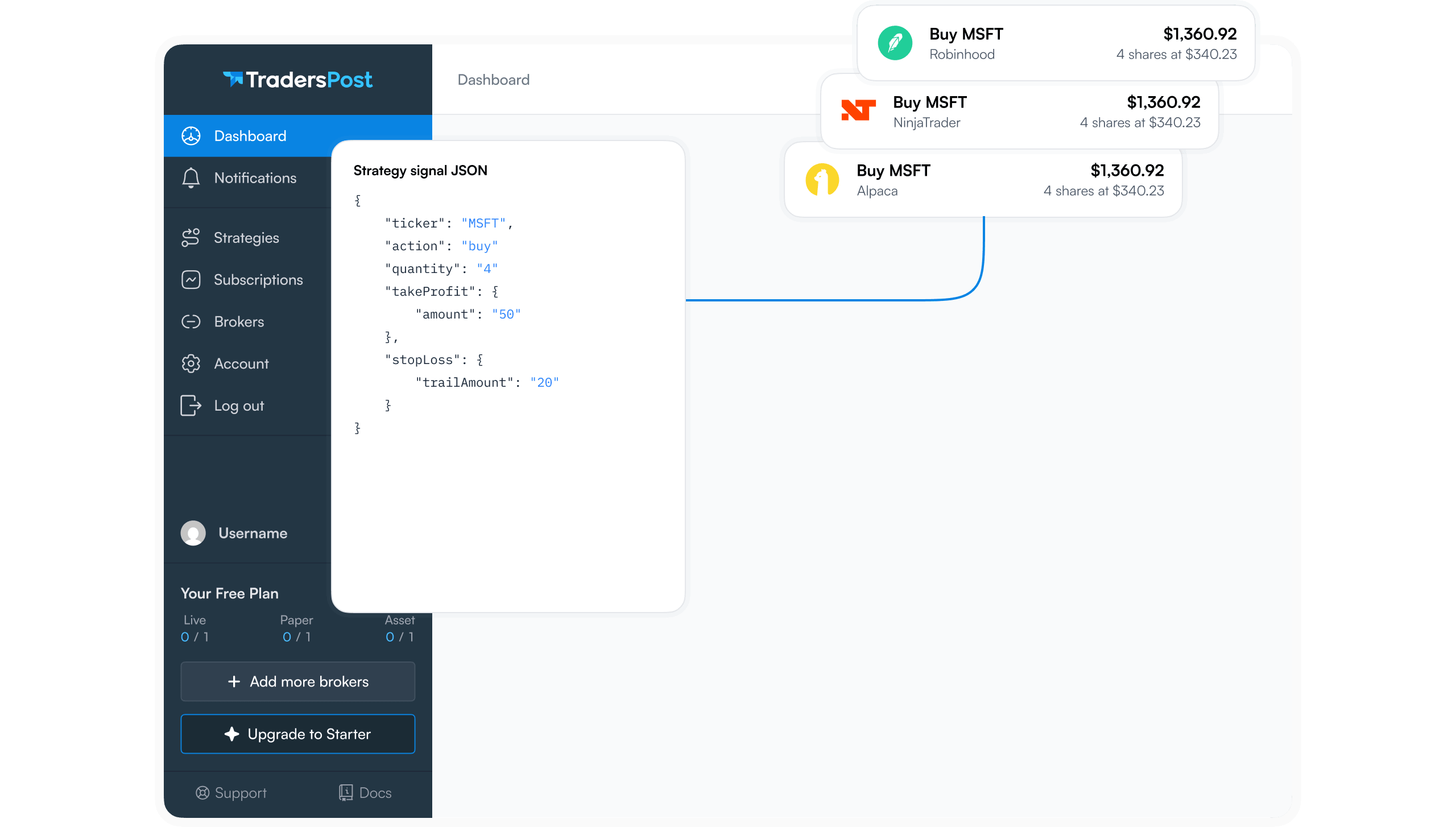
Yes. TradersPost works with TradingView webhook alerts from both v5 and v6 strategies5. The webhook payload format is identical regardless of Pine Script version. You create alerts on your v6 strategy in TradingView, configure the webhook URL to point to TradersPost, and TradersPost routes the orders to your connected broker5. All v6 features like dynamic requests, enums, and footprint analysis can generate signals that TradersPost executes automatically across stocks, options, futures, and crypto.
20. Where can I learn more about v6?
Start with TradingView's official Pine Script v6 reference manual and the v5-to-v6 migration guide. For practical guides focused on specific features and trading applications, explore our Pine Script v6 series:
- Pine Script v6: What's New and Why It Matters - overview of the v6 launch features
- Pine Script v6 Breaking Changes - every breaking change with before-and-after code
- Dynamic Requests Guide - multi-symbol loops and conditional data fetching
- Enums Guide - type-safe configuration with input.enum()
- Runtime Logging Guide - debugging with log.info(), log.warning(), and log.error()
- Pine Script Updates 2025-2026 - every monthly update ranked and explained
Quick Reference Table
Here is a summary of the key facts covered in this FAQ:
- Release date: November 13, 20241
- v5 compatibility: v5 scripts continue to work indefinitely
- Auto-converter: handles when removal, duplicate params, basic bool casts2
- Manual fixes needed: lazy evaluation, integer division, boolean na logic, strategy.exit() pairs
- Dynamic requests: enabled by default, 40-call limit (64 on Ultimate)1
- New types: enums, polylines, footprint, volume_row1
- New functions: log.info(), log.warning(), log.error(), input.enum(), request.footprint()3
- New variables: bid, ask, syminfo.isin, syminfo.current_contract1
- Plan requirements: v6 free for all, footprint Premium+, bid/ask needs tick charts
- TradersPost: works with both v5 and v6 webhook alerts5
References
1 Pine Script Release Notes
2 Pine Script v5 to v6 Migration Guide
3 Pine Script v6 Language Reference
4 Pine Script User Manual
5 TradersPost - Automated Trading Platform