Stock Market Volatility Reaches Crypto Levels
Analyzing the surge in stock market volatility in 2024-2025, where tech stocks now exhibit crypto-like price swings and trading characteristics.

Marketing

The traditional stock market has undergone a dramatic transformation in 2024-2025, with major equities now exhibiting volatility levels that rival and even exceed cryptocurrency markets. This shift has profound implications for traders, risk management strategies, and automated trading approaches.
The New Reality of Equity Volatility
In a remarkable reversal of historical patterns, Bitcoin's realized volatility has dropped to historic lows of approximately 44% annualized, while major technology stocks have surged past this threshold. Every company in the Nasdaq 100 index, with the exception of Linde, now exhibits higher volatility than Bitcoin on both 3-month and 1-year realized volatility bases.
This represents a fundamental shift in market dynamics that traders must understand and adapt to. The stocks that once represented stable, blue-chip investments now demonstrate price action more commonly associated with speculative cryptocurrency trading.
Explosive Weekly Gains in Tech Stocks
Recent market action has demonstrated the intensity of these volatility surges. Tesla recorded an 18% gain week over week, while Palantir jumped 19-20% in the same period. Robinhood surged 20% week over week, and these moves occurred during what was considered a relatively normal trading environment rather than during earnings announcements or major company-specific catalysts.
These are not isolated incidents but part of a broader pattern of heightened volatility across the technology sector and risk assets more generally. The moves represent the same liquidity dynamics that have historically driven cryptocurrency markets, now manifesting in traditional equities.
The Liquidity Trade Connection
All of these dramatic price movements can be understood as manifestations of the same liquidity trade. When markets emerged from the window of weakness that characterized March 2024 and continued into April, pent-up liquidity flooded into risk assets indiscriminately.
The rally that followed was predicted by analysts who noted that if April passed without a significant drop, a substantial rally would be the likely outcome. This is exactly what materialized, demonstrating the predictive power of understanding liquidity dynamics and their timing.
Bitcoin Liquidations Driving Price Action
Analysis of Bitcoin accumulation maps reveals important dynamics driving the cryptocurrency's price movements. Prior to recent rallies, approximately $4 billion worth of short positions existed in the Bitcoin futures market. These short positions created a massive overhang that needed to be cleared before sustained upward movement could occur.
The liquidation of these shorts provided substantial fuel for Bitcoin's rally. On Binance alone, short positions decreased from levels 40 times higher than long positions down to approximately 10 times higher. Similarly, across Binance, OKX, and Bybit, aggregate short positions decreased from much higher levels to approximately $3 billion against $500 million in long positions.
The Unhealthy Nature of Liquidation-Driven Rallies
While liquidation-driven rallies can produce impressive gains, they represent one of the most unhealthy types of price appreciation from a technical analysis perspective. Healthy rallies typically involve price retreating to key volume-weighted average price levels to consolidate before making new highs. This consolidation process confirms support and builds a foundation for sustainable upward movement.
The recent Bitcoin rally exhibited none of these characteristics. Instead of confirming support at various VWAP levels, price simply blasted through resistance on the back of forced short covering. This creates what traders call "air pockets" where there is minimal support if price begins to decline.
Price Target Implications and Risks
Despite the unhealthy technical setup, the mechanics of short liquidations suggest Bitcoin can continue higher in the near term. Price targets of $101,000 appear easily achievable simply through continued short liquidation. With additional momentum from options activity and remaining leverage in the system, extensions to $144,000 become plausible.
However, the lack of technical confirmation and the exhaustion of short positions to liquidate suggest these moves will not be sustainable. Once the shorts are cleared and no new buying pressure emerges, the rally will likely stall and reverse.
The Window of Weakness Framework
Understanding market cycles through the lens of liquidity windows provides valuable context for current price action. The relief rally observed in late April and May 2024 represented a natural response to emerging from a period of constrained liquidity.
However, this rally occurred against a backdrop of persistent headwinds. Tariffs continue to weigh on economic expectations, and broader liquidity conditions remain challenged despite the temporary surge in risk asset prices. These factors suggest the current rally represents a counter-trend bounce within a larger corrective phase rather than the resumption of a sustained bull market.
Bear Market Characteristics in Rally Mode
One of the defining characteristics of bear markets is that rallies become violent and compressed. Twenty percent bounces are common in bear market rallies, which creates a treacherous environment for traders. Those who are correctly positioned for downside but unable to manage the violent counter-trend moves can be "wrecked" repeatedly even while being directionally correct.
This stands in contrast to bull market behavior, where steady 2-5% daily gains compound over extended periods without dramatic pullbacks. The violence of recent rallies, despite their impressive magnitude, actually supports the thesis that markets are in a longer-term corrective phase rather than a sustainable uptrend.
Expert Predictions for Market Direction
Prominent market analysts including Ken Carson have provided specific frameworks for expected market behavior. Carson anticipates the current rally should peak between 5,700-6,000 on the S&P 500 before a major decline. His projections call for a pullback to 4,800 by August-October 2024, followed by a more severe decline to 3,300 by December 2024-February 2026.
These projections align with the technical picture that suggests short-term rallies will be followed by a substantial reversal to the downside. The timing and magnitude of these moves have important implications for trading strategy and risk management.
Trading Implications and Strategy
The elevated volatility environment creates both opportunities and risks for traders. Traditional buy-and-hold strategies become more challenging when 20% swings can occur within weeks. However, for traders equipped with proper tools and strategies, this environment offers substantial profit potential.
Automated Trading Advantages
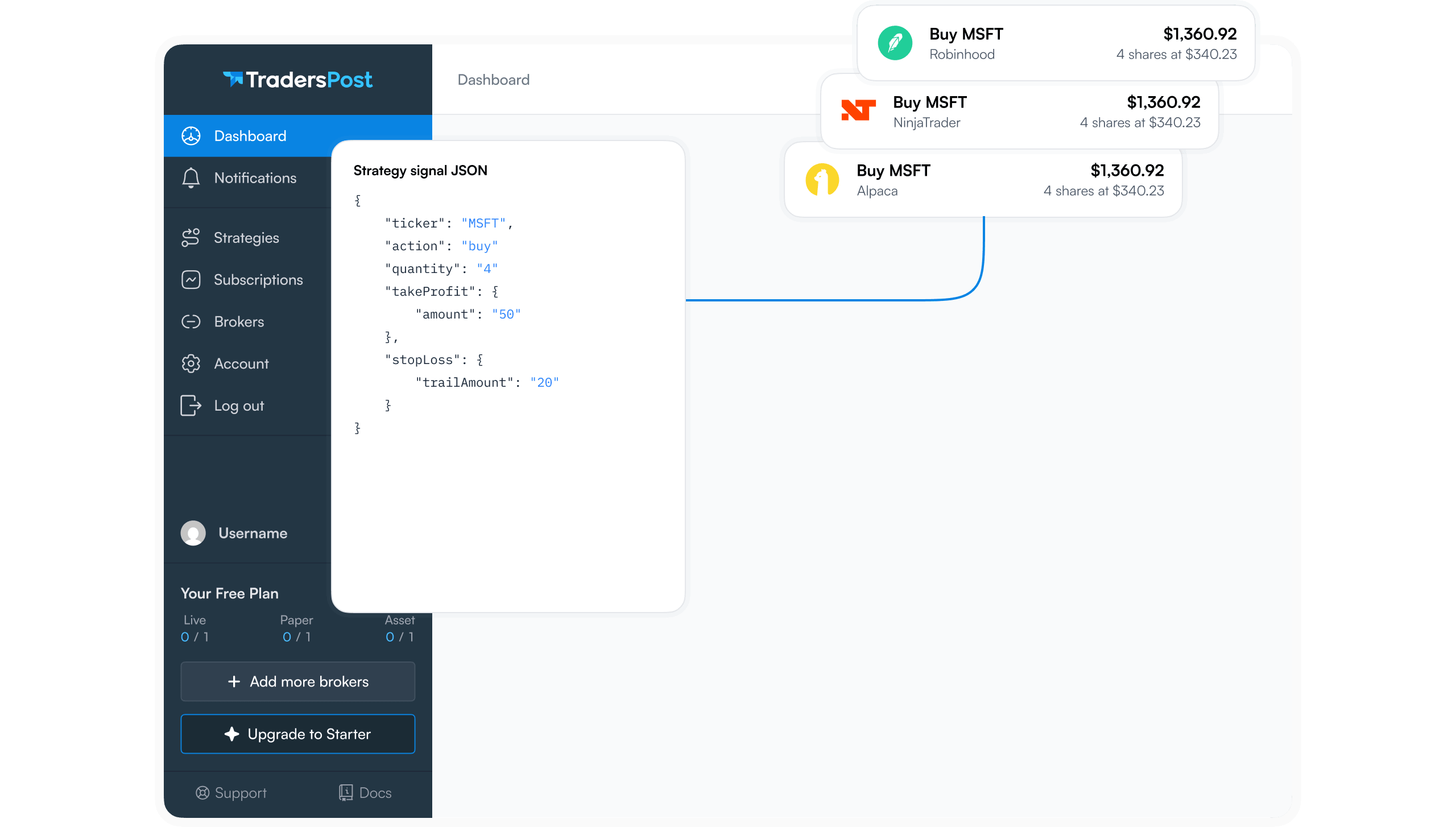
Automated trading systems through platforms like TradersPost provide significant advantages in highly volatile markets. Algorithms can execute predetermined strategies without the emotional interference that causes many traders to make poor decisions during volatile swings.
Setting up automated sell orders near resistance levels and buy orders near support allows traders to capitalize on swings without needing to monitor markets constantly. In an environment where 20% moves can occur rapidly, this automation becomes increasingly valuable.
Position Sizing in Volatile Markets
Proper position sizing becomes even more critical when volatility increases. Positions must be sized such that even a complete loss would not significantly impair overall portfolio value. This allows traders to maintain exposure to opportunities while protecting capital during adverse moves.
Rather than using tight stop losses that are likely to be hit during volatile swings, traders should focus on appropriate position sizing as the primary risk management tool. Stops should be placed at levels that would invalidate the trading thesis rather than at arbitrary percentage levels.
Leveraging Volatility for Profit
Experienced traders can use options strategies to profit from elevated volatility itself, regardless of direction. Selling premium through covered calls or cash-secured puts allows traders to collect income from implied volatility that may be elevated relative to realized volatility.
However, naked short volatility strategies carry substantial risk in the current environment. The probability of gap moves and extreme price action is higher than normal, which can cause outsized losses for those who are short volatility without proper hedging.
The Role of Options in Driving Price Action
Options activity has become an increasingly important driver of spot price movements, particularly in assets like Bitcoin that now have substantial options markets. When large options positions expire or are rolled, dealers who provide liquidity to options markets must adjust their hedges in the spot market.
This hedging activity can create feedback loops where spot price moves trigger additional hedging, which drives further spot moves. During liquidation events, this dynamic amplifies the magnitude of price swings beyond what fundamental or technical factors alone would suggest.
Comparing Stock and Crypto Volatility Metrics
While tech stocks have become more volatile than Bitcoin in recent months, it is important to maintain perspective on how these volatility levels compare to the broader cryptocurrency market. Altcoins continue to exhibit volatility that exceeds even the most volatile tech stocks.
Bitcoin's 44% annualized realized volatility represents a historic low for the asset, which has frequently exhibited volatility in the 80-100% range during more turbulent periods. The fact that major tech stocks now exceed Bitcoin's volatility says more about Bitcoin's maturation than about stocks becoming as volatile as crypto broadly.
Liquidity Conditions and Future Outlook
Current liquidity conditions present a mixed picture. Money market fund balances have tripled since 2017, indicating substantial dry powder exists on the sidelines. However, the fact that this cash remains in money markets rather than being deployed into risk assets suggests investor caution.
High money market fund yields and elevated macroeconomic uncertainty have led investors to favor low-risk holdings. While the liquidity exists to fuel further rallies, investors are waiting for clearer signals before deploying capital aggressively. This defensive positioning suggests any rallies may be met with selling rather than additional buying.
Navigating the High Volatility Environment
Success in the current market environment requires adapting strategies to account for elevated volatility and the increased correlation between traditionally distinct asset classes. Several principles can guide traders through this challenging landscape.
Diversification Limits in Correlated Markets
Traditional diversification provides less protection when correlations increase across asset classes. The same liquidity dynamics driving Bitcoin also drive tech stocks, which means portfolios constructed to be diversified may exhibit more correlated behavior than historical patterns would suggest.
Traders should focus on true diversification across liquidity regimes rather than simply across asset classes. This might involve maintaining positions in assets that benefit from liquidity contraction alongside positions that benefit from liquidity expansion.
Time Frame Considerations
Shorter-term traders can potentially profit from volatility by trading ranges and capturing swings. However, this requires significant skill and discipline to avoid being whipsawed by rapid reversals. Longer-term investors may be better served by reducing position sizes and accepting that higher volatility will result in larger drawdowns even if the ultimate direction proves correct.
Monitoring Leverage in the System
Understanding the amount and positioning of leverage in the market provides valuable insight into potential price movements. Excessive short interest creates upside potential through liquidations, while excessive long interest creates downside vulnerability.
Tools that track open interest, funding rates, and liquidation levels across major exchanges help traders anticipate potential volatility events before they occur. Incorporating this data into trading strategies, whether manually or through automated systems, can provide an informational edge.
The TradersPost Advantage
Platforms like TradersPost enable traders to create sophisticated automated strategies that respond to volatility conditions in real-time. By connecting TradingView indicators to broker accounts, traders can execute complex strategies without manual intervention.
In the current high-volatility environment, this automation becomes increasingly valuable. Strategies can be programmed to adjust position sizes based on volatility, tighten or widen stops based on market conditions, and execute at specific price levels without emotional interference.
The ability to backtest strategies against historical data and paper trade them in real market conditions allows traders to refine approaches before risking capital. This is particularly important when volatility is elevated and the cost of errors increases.
Conclusion
The convergence of stock market and cryptocurrency volatility represents a significant shift in market structure that traders must understand and adapt to. Tech stocks now exhibit price behavior historically associated with speculative crypto assets, while Bitcoin itself has matured into an asset with lower volatility than most major equities.
This environment creates opportunities for prepared traders while presenting substantial risks for those using outdated assumptions about volatility and correlation. The key to success involves proper position sizing, understanding liquidity dynamics, and utilizing automation to execute strategies consistently.
While violent rallies may continue in the near term driven by short liquidations and momentum, the underlying technical setup suggests these moves are unsustainable. Traders should approach the current environment with caution, maintaining exposure to capture potential upside while protecting capital against the inevitable reversals that occur in high-volatility markets.
By combining volatility awareness with strategic automation through platforms like TradersPost, traders can navigate this challenging environment while positioning for opportunities that arise from extreme price swings in both equities and cryptocurrencies.