What is High-Frequency Trading?
TradingView integration guide: setup, features, automation options, and broker connectivity for enhanced trading.

Marketing

High-frequency trading (HFT) is a form of automated trading that leverages advanced algorithms and technology to execute an immense number of trades at extremely high speeds, often measured in microseconds. This guide delves into the intricacies of HFT, covering its fundamentals, the technology underpinning it, strategies employed, and its impact on financial markets. We'll also illustrate how platforms like TradersPost can integrate with such technologies, offering solutions for traders using services like TradingView.
High-Frequency Trading Fundamentals
Definition and Characteristics
High-frequency trading utilizes sophisticated algorithms to place large numbers of orders at ultra-fast speeds. Key characteristics include:
- Ultra-low latency execution: Trades completed in microseconds.
- High order-to-trade ratios: Many orders result in fewer executed trades.
- Minimal overnight positions: Focus on intraday opportunities.
A typical HFT system might execute trades within 1 to 100 microseconds, handling thousands to millions of transactions daily. Such speed allows traders to capitalize on fleeting market inefficiencies.
Comparing HFT with Other Trading Types
To understand the advantages of HFT, consider the reaction times:
- Human Trader: 200,000-500,000 microseconds
- Algorithmic Retail Trader: 1,000-10,000 microseconds
- High-Frequency Trader: 1-100 microseconds
The technological superiority of HFT systems allows them to detect and act on market conditions much faster than human or slower algorithmic traders.
Technological Foundations of HFT
Ultra-Low Latency Systems
Core Components:
- Networking Infrastructure: Utilizes direct fiber connections and millimeter wave technology for real-time data transmission.
- FPGA Acceleration: Hardware acceleration significantly reduces processing times compared to software methods.
These innovations enable HFT firms to maintain competitive edges by ensuring their systems operate at peak efficiency.
Costs and Investments
Setting up an HFT operation requires significant investment:
- Initial setup costs can exceed $10 million due to hardware requirements like FPGA development and server infrastructure.
- Ongoing costs involve colocation fees and technology staff salaries, ranging from $5 million for small firms to over $200 million for large ones.
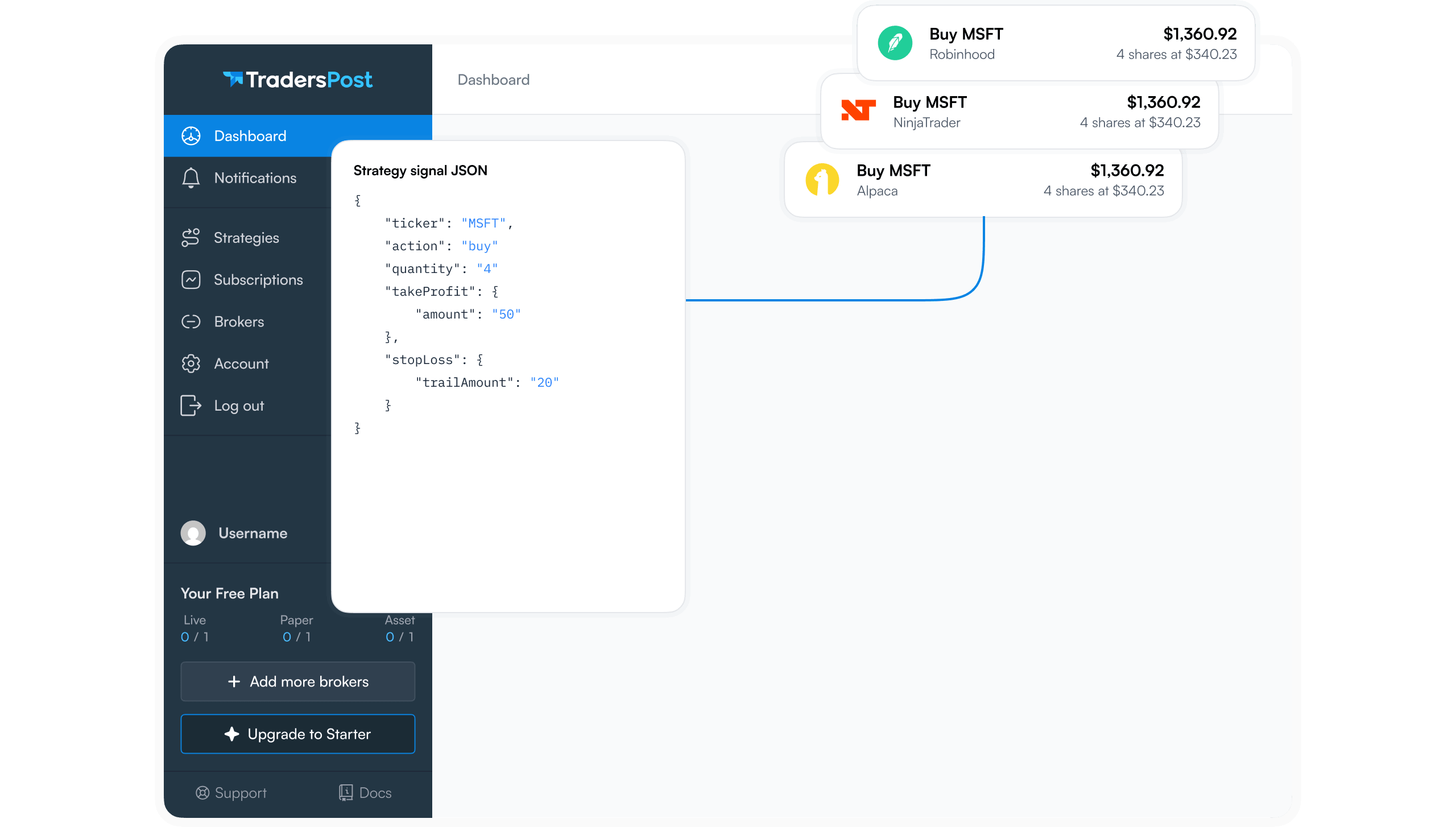
Platforms like TradersPost offer more accessible solutions for retail traders who want automation without these prohibitive costs by connecting TradingView strategies directly with brokers like Alpaca or TradeStation.
Core Strategies in High-Frequency Trading
Automated Liquidity Provision
HFT firms often employ market-making strategies by continuously quoting buy and sell prices. This involves:
- Calculating optimal prices based on market conditions.
- Managing inventory risk through dynamic adjustments.
The primary goal is capturing the bid-ask spread across numerous transactions. This approach requires constant monitoring and updating of positions, ensuring real-time responsiveness to market shifts.
Statistical Arbitrage
Statistical arbitrage involves exploiting price discrepancies between related securities by:
- Monitoring asset correlations in real time.
- Implementing rapid entry and exit strategies based on statistical signals.
Success depends heavily on the speed of signal detection and execution precision. For example, if a stock's price deviates from its expected range relative to another security, an algorithm might initiate trades to profit from this anomaly until prices converge again.
Market Impact of High-Frequency Trading
Positive Effects
HFT has profoundly influenced modern markets by enhancing liquidity provision and improving price discovery. Benefits include:
- Reduced bid-ask spreads.
- Increased market depth.
These improvements facilitate smoother transactions for all participants. Moreover, faster information processing leads to more efficient cross-market pricing mechanisms.
Concerns and Challenges
Despite its benefits, HFT raises concerns about increased volatility during stress periods and potential systemic risks such as flash crashes. Regulatory bodies across regions have responded with measures designed to mitigate these risks through enhanced oversight and reporting requirements.
For instance, US regulations like the SEC's Market Access Rule ensure pre-trade risk management while European directives under MiFID II impose stringent organizational obligations on traders. TradersPost helps traders comply with these regulations by integrating seamlessly with various brokers' compliance tools.
Conclusion
High-frequency trading represents a pinnacle achievement in financial technology but requires enormous resources for effective participation. While it offers advantages in terms of liquidity enhancement and price discovery efficiency, regulatory scrutiny remains crucial in balancing these benefits against potential risks associated with rapid technological advancements.
For retail traders unable or unwilling to meet the high-cost barriers inherent in traditional HFT setups but still interested in leveraging algorithmic trading benefits—TradersPost provides a valuable solution by bridging platforms like TradingView with brokers such as Interactive Brokers or Tradier via webhook integration—offering automated execution capabilities without massive infrastructural investments associated with high-frequency operations.
By understanding these dynamics better—and utilizing innovative solutions—traders can position themselves strategically within today's evolving financial landscape.