Automated vs Discretionary Trading: When Bots Run
Compare automated vs discretionary trading and build a hybrid plan for when to let bots run, review signals, and pause execution with confidence today.

Marketing

Bottom Line
- Automated trading executes preplanned rules immediately when a qualifying signal occurs, providing consistent execution and faster response times.
- Discretionary trading allows traders to evaluate context before acting on a signal, which can be useful in unclear market conditions or when setups are poorly positioned.
- Hybrid trading combines automation for repeatable decisions with discretionary control for context-dependent situations, allowing traders to pause automation when necessary.
- Automation candidates should have objective, testable rules such as "Enter long when the 20-period moving average is above the 50-period moving average and price closes above the prior 20-bar high."
- Strategies are more suitable for automation when trade size and exit instructions are predefined, ensuring the bot executes known decisions rather than making them.
A trading bot can execute a valid signal in milliseconds, but it cannot recognize when the market regime that made the signal profitable has changed. That tension sits at the center of automated vs discretionary trading: speed, consistency, and emotion-free execution on one side, contextual judgment, adaptability, and risk awareness on the other. The real question is not whether bots or humans trade better in every situation. It is which decisions should be systematized, which require review, and when execution should stop.
This guide breaks down the practical strengths and failure points of each approach, from rule-based entries and options risk controls to news shocks, liquidity shifts, and volatility spikes that can distort automated signals. You will learn how to evaluate a strategy before handing it to a bot, define clear override rules for discretionary intervention, and build a hybrid workflow that keeps routine execution disciplined without blindly trusting automation. By the end, you will have a framework for deciding when to let your systems run, when to inspect the signal, and when protecting capital means pausing the trade altogether.
Automated vs Discretionary Trading: The Core Difference
What automated trading does well
Automated trading executes preplanned rules when a qualifying signal occurs. The system is not making a fresh judgment about the trade at the moment of entry. It is applying instructions the trader defined in advance: what constitutes a valid signal, which instrument to trade, how much to trade, and the associated risk parameters.
This structure is valuable when the setup is objective and repeatable. Automation can provide:
- Consistent execution: the same qualifying signal receives the same treatment every time.
- Faster response: orders can be submitted immediately after a defined alert rather than waiting for manual review.
- Less hesitation: the trader does not need to overcome fear, second-guessing, or delayed reactions at the entry point.
- Better rule adherence: position sizing, stop-loss placement, and trade timing can follow written rules rather than changing with emotion.
For example, a breakout trader might define a setup as a close above a prior range high, confirmed by volume and trend conditions. Once those conditions are encoded in a TradingView or TrendSpider alert, the alert can trigger the planned entry. The automation is useful because it follows the breakout plan exactly. It does not determine whether the breakout strategy has an edge, whether the risk amount is appropriate, or whether market conditions have changed materially.
Automation executes the instructions it receives. Strategy validation, risk planning, alert design, and ongoing trader oversight remain the trader’s responsibility.
What discretionary trading does well
Discretionary trading means the trader evaluates context before deciding whether, when, or how to act on a signal. A technically valid alert is treated as information, not necessarily as an immediate order.
Discretion is often useful when chart structure is unclear, market conditions are unusual, or a valid setup is poorly positioned. For instance, a breakout signal may occur directly beneath a major weekly resistance level, after an extended intraday move, or during an abnormal volatility event. A trader may also choose discretion to reduce exposure when several correlated positions are already open.
The trade-off is behavioral risk. Discretion can add context, but it can also create inconsistency, hesitation, revenge trading, and selective rule-breaking. A trader who manually skips three valid signals after losses may miss the next signal that produces the strategy’s expected return.
Discretion should therefore be constrained by written criteria. Instead of relying on instinct alone, define conditions such as:
- Skip long breakouts when price is within a specified distance of higher-timeframe resistance.
- Reduce size after a defined daily loss threshold.
- Avoid new entries during preselected event-risk periods or outside approved Trading Windows.
Why hybrid trading is often the practical answer
Hybrid trading separates repeatable decisions from judgment-based decisions. The trader automates the parts that can be stated precisely, while retaining control over situations that require contextual assessment.
A practical workflow is to use alerts for routine, validated entries and configure the strategy for Auto Submit only when the conditions are sufficiently objective. For setups requiring a quick context check, use Manual Submit so the signal can be reviewed before an order is sent.1 The trader can also temporarily pause automation when conditions no longer match the strategy’s intended environment.
The key decision is not whether automation or discretion is universally superior. It is whether a specific decision can be expressed as a tested, repeatable rule. The framework that follows identifies when a strategy deserves Auto Submit and when the trader should step in.
Use This Framework Before Letting a Bot Run
Test Whether the Entry Rule Is Objective
Start with a simple test: if two traders viewed the same chart at the same moment, would they enter the same trade at the same price condition? If not, the rule is not yet ready for unattended execution.
Good automation candidates use conditions that can be stated without interpretation. For example: “Enter long when the 20-period moving average is above the 50-period moving average and price closes above the prior 20-bar high,” or “Buy when RSI crosses above 30 after a confirmed close.” A TradingView alert can express those conditions precisely, then send a defined action through TradersPost.
Poor candidates rely on phrases such as “price looks extended,” “the market feels choppy,” or “the candle seems weak.” Those observations may be useful, but they are discretionary inputs until converted into measurable rules.
- Document the alert condition: What exact event triggers the signal?
- Document the intended action: Buy, sell, sell short, or buy to cover.
- Define confirmation: Intrabar movement, bar close, or a specific indicator state.
Write the condition and action before automating it. If the rule cannot be written clearly, it cannot be tested consistently.
Measure How Much Context the Strategy Needs
Some strategies are designed to operate across many environments because their tested rules already include trend, volatility, time, or price filters. Those are stronger candidates for automation. Others depend on reading nearby support and resistance, judging market structure, or assessing whether a news-driven move has changed the trading environment.
For example, a breakout system may perform well only when price has consolidated beneath a clearly defined resistance level and the broader trend is intact. If the trader routinely rejects alerts because the breakout occurs directly into a higher-timeframe resistance zone, that context check belongs in the playbook.
When those contextual decisions are not yet objective, use Manual Submit rather than fully automatic execution. This preserves the alerting workflow while requiring a final discretionary review. Identify every reason you override a signal, such as “major support is within 0.5%,” “the opening range is unusually wide,” or “a scheduled catalyst is pending.” Repeated overrides reveal the filters that may need testing.
Confirm That Position and Exit Instructions Are Predefined
A strategy is more automation-ready when trade size and exit behavior are known before the alert fires. The bot should not be asked to solve decisions that the trader has not made.
- Entry trigger: The precise signal condition.
- Action: The order direction.
- Quantity: A fixed quantity, Percent of equity, or another tested sizing method.2
- Stop-loss rule: For example, a defined Stop Market level or percentage.
- Take-profit rule: A fixed target, risk multiple, or tested Trailing Stop approach.3
- Expiration rule: When an unfilled order or time-sensitive setup is no longer valid.
Undefined exits are a warning sign. If you regularly decide where to exit only after entering, the process likely needs more testing before full automation. Automate only a position size you understand and are comfortable monitoring.
Decide Whether You Can Accept Every Valid Signal
Ask a practical question: if the strategy generates three valid signals this week, can you accept all three without selectively second-guessing them? A tested system is evaluated across its full sequence of qualifying trades, not only the entries that feel most attractive in real time.
If the answer is no, identify the cause: insufficient testing, limited attention, uncertainty about current market conditions, or an incomplete playbook. Selective intervention can damage historical expectancy when it is based on untested judgment rather than repeatable filters.
Keep a log of every accepted and skipped signal. Record the setup, market context, reason for the decision, and outcome. Over time, compare skipped trades with accepted trades. This evidence will show whether discretion is adding value or merely replacing a tested process with hindsight-driven selection.
When to Use Automated Trading
Automate Repeatable Trend-Following Setups
Trend-following setups are strong automation candidates when the trader can define the signal without judgment at the moment of execution. For example, a long entry may be valid only when price closes above a predefined breakout level and remains above a selected trend filter, such as a moving average. A short entry might require the inverse condition: price closes below the level while trading below the same trend filter.
Once those conditions are tested, the trader should already know the complete instruction set: entry direction, quantity, protective stop, profit target, and, for options, expiration. The automation is not intended to predict every market move or force trades during unfavorable conditions. Its purpose is to execute the same tested process whenever the valid setup appears.
- Define the trend filter and the exact confirmation rule.
- Specify whether the order is long or short and the fixed quantity or risk-based quantity.
- Attach predefined exit instructions, such as a stop-loss and take-profit.
- Review results by setup type, market condition, and holding period.
Avoid changing the trend rule after three losing trades or expanding it after a short winning streak. A strategy should be evaluated across a meaningful sample of comparable signals, not by the emotional impact of its most recent outcomes.
Automate Time-Sensitive Breakout Entries
Breakout strategies often depend on entry timing. If a trader is away from the screen, waits for a second opinion, or hesitates after confirmation, the actual fill may occur far from the intended breakout area. That delay can materially change the trade's risk-to-reward profile.
For example, a trader may define a long breakout only when price crosses a specific threshold and an alert condition confirms that the bar has closed above it. The rule is not simply, “buy if price reaches 100.” It is, “enter long only after the tested confirmation condition occurs above 100, with a defined stop-loss and target.” Automation can improve consistency when the strategy's edge relies on acting promptly after that confirmed signal.
The alert condition must be explicit and tested. A loosely defined price level invites reinterpretation: a trader may decide that the breakout “looks weak,” wait for additional confirmation, or chase after price has already moved. If discretion is required to decide whether the alert is valid, the setup is not yet ready for full automation.
Automate Strategies With Fixed Trade Instructions
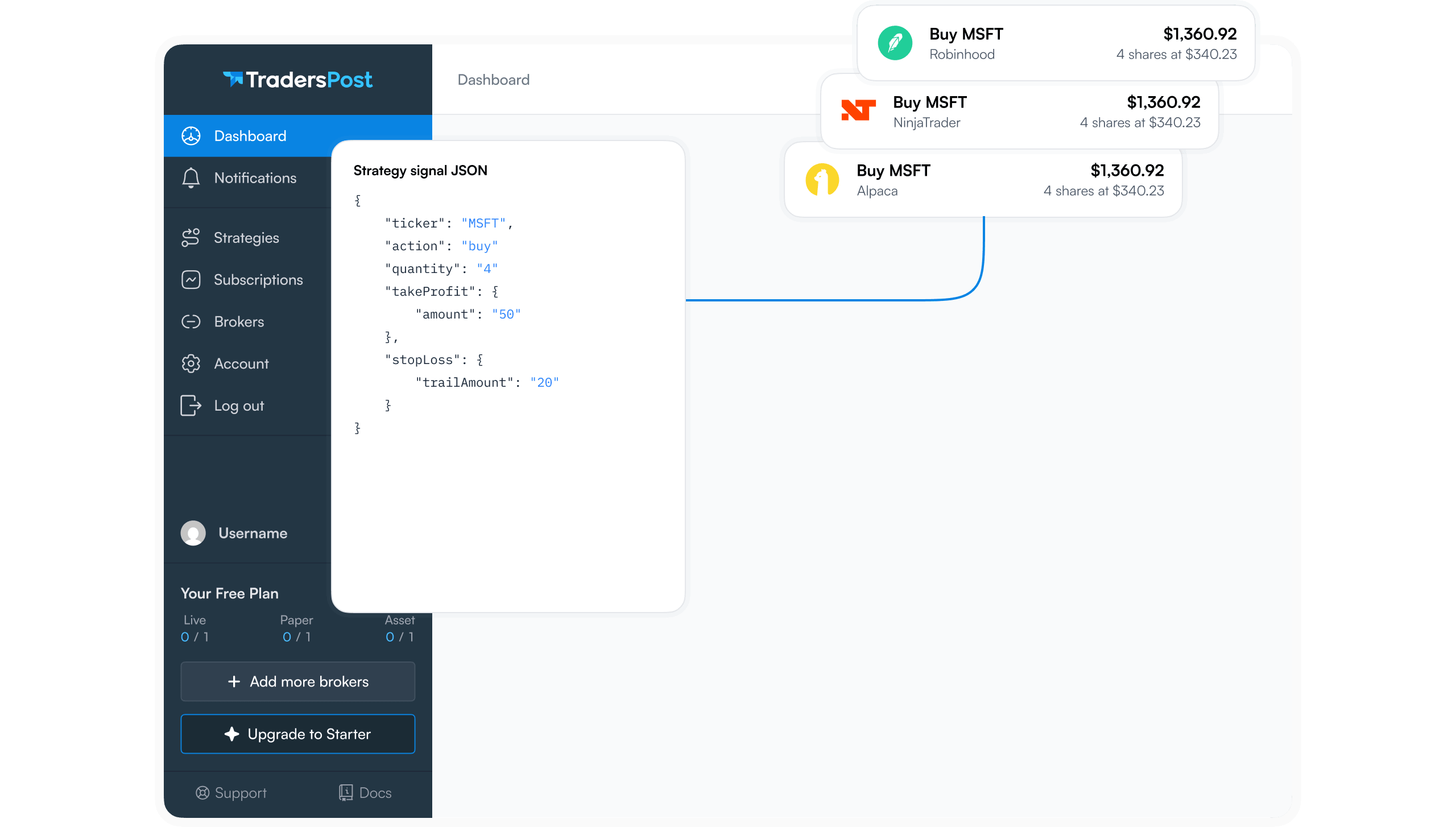
Automation is most useful when every valid trade follows the same instructions: entry direction, quantity, take-profit, stop-loss, and expiration where applicable. A complete order template might specify a ticker, action, quantity, takeProfit, stopLoss, and expiration before the signal occurs.4
Fixed instructions make post-trade analysis cleaner. When entries and exits are handled consistently, the trader can distinguish strategy performance from execution variability caused by hesitation, missed alerts, oversized positions, or improvised exits.
Create one written template for each setup rather than combining several loosely defined ideas into one workflow. A narrow strategy, such as one trend-filtered breakout with one exit structure, is usually a better first automation candidate than a complex discretionary playbook with multiple exceptions. Start with the setup that can be described in precise, testable instructions, then review whether the automated results match the intended process.
When Discretion Should Override Automation
Use Manual Review When the Signal Needs Chart Context
Automation is strongest when the entry condition is fully defined. Some setups, however, depend on chart context that may be difficult to reduce to a single indicator value. Price location, the quality of recent structure, and proximity to an obvious support or resistance area can materially affect whether an otherwise valid signal is worth taking.
For example, an indicator may trigger a long entry after momentum turns positive. Your documented rules may also require sufficient room between the entry price and a nearby resistance area. If price is entering directly beneath a prior swing high, a major daily level, or the upper boundary of a well-defined range, the long signal may have poor reward-to-risk characteristics despite satisfying the indicator condition.
- Define the context check before trading, such as “skip longs with less than 1R of room to the next resistance area.”
- Record each accepted and rejected signal, including a chart screenshot and the stated reason for the decision.
- Review the results after a meaningful sample to determine whether the discretionary filter improved expectancy or merely avoided visible losers after the fact.
Discretion should be a repeatable decision process, not a license to reject every signal that feels uncomfortable or to rewrite the rationale after a loss.
Step In When Strategy Assumptions Are No Longer Clear
Pause automation when you cannot clearly explain why the strategy should continue operating under current conditions. A strategy is built on assumptions about volatility, liquidity, trend behavior, trading hours, and the instrument being traded. When those assumptions are uncertain, continuing to submit orders automatically is a decision to accept unmeasured risk.
Examples include a major change in an instrument’s behavior, signals occurring during a trading session the strategy was never tested on, or entries appearing in market conditions outside the setup’s intended use case. The proper response is not an impulsive mid-trade adjustment to stops, targets, or position size. Reassess the written rules, define any revision precisely, and use Paper trading to evaluate the revised version before restoring live automation.5
- Document why automation was paused.
- Identify the specific assumption that appears invalid or untested.
- State the evidence required before resuming, such as a defined number of paper-traded signals across the relevant conditions.
Choose Discretion When You Are Still Learning the Setup
An unproven idea should not first be tested through automatic order submission with real money. Start by observing alerts, reviewing the relevant charts, and comparing the intended entry with the actual quality of each signal. This process often exposes ambiguous alert logic, unsuitable timing, or order instructions that need refinement.
In TradersPost, starting with Manual Submit allows you to inspect each proposed order before submission. Confirm that the ticker, action, quantity, stopLoss, takeProfit, and expiration instructions match the strategy plan. Once the signal logic and execution behavior have been validated through observation and Paper trading, moving to Auto Submit becomes an evidence-based operational choice rather than a leap of faith.
Build a Hybrid Trading Workflow in TradersPost
Assign Each Strategy an Execution Mode
Classify every strategy before it generates live decisions. A practical framework uses three execution modes:
- Fully automated: The strategy has objective triggers, unambiguous trade instructions, and predefined risk controls. For example, a signal may specify the ticker, action, quantity, stopLoss, and takeProfit with no discretionary interpretation required.
- Alert-plus-review: The alert identifies a candidate, but the trader must complete a checklist before approving it. The checklist might confirm trend conditions, avoid scheduled event risk, verify the current position, and confirm that the planned stop and target remain acceptable.
- Fully discretionary: The trader originates and evaluates the trade, but still works from a written setup definition, entry condition, invalidation level, position size, and exit plan.
This classification prevents a common operational error: treating a partially defined alert as though it were a complete trading decision.
Use Auto Submit for Rules You Have Earned the Right to Trust
Auto Submit should be reserved for strategies that meet a documented readiness standard. Signals should be objective, the strategy should show repeated evidence in Paper trading, and every order instruction should be specified in advance. The trader must also be willing to accept valid signals consistently, including signals that occur after a recent loss or during an inconvenient time of day.
Start narrowly: activate one strategy template across a limited set of instruments. This makes it easier to review whether alerts, fills, positions, stops, and targets behave as intended. After activation, monitor actual execution behavior rather than assuming that a correctly designed signal will always produce the expected position.
Moving a strategy to Auto Submit is an operational decision based on evidence. It should not be a reaction to missing a profitable trade while using manual review.
Use Manual Submit and Command Pad for Reviewed Opportunities
Manual Submit is appropriate when an alert identifies a possible trade but does not represent a complete automatic decision. Use a fixed review sequence:
- Receive the alert and identify the proposed setup.
- Check the setup against the written entry criteria.
- Confirm planned quantity, stop, target, and any existing exposure.
- Approve, reject, or defer the trade.
Use Command Pad as the execution path for discretionary signals that meet your criteria.6 Log every manual approval and rejection, including the reason. Over time, that record shows whether discretion improves outcomes or merely overrides a sound process.
Use a Timed Entry Lock to Pause New Entries Intentionally
An Entry Lock provides a controlled pause on new automated entries without requiring you to abandon the broader workflow. Use it when stepping away from the screen, reviewing unexpected signal behavior, or waiting until a planned review period is complete.
Define the pause rules in advance: identify what conditions justify an Entry Lock, how long it will remain active, and what evidence is required before resuming entries. For example, a trader may lock entries until the next scheduled review after two signals arrive outside expected Trading Windows. Treat each pause as a documented process decision, not an emotional response to the most recent trade.
A Practical Decision Matrix: Let It Run, Review It, or Pause It
Let the Bot Run When Core Conditions Are Met
Use a green-light decision only when the strategy is operating exactly as designed. Automated execution is appropriate when each of the following conditions is true:
- The signal is objective and can be identified without discretionary interpretation.
- The strategy has completed meaningful Paper trading under conditions relevant to the intended market and timeframe.
- The order instructions are predefined, including position size, protective exit, profit target, and expiration where applicable.
- The current signal fits the strategy’s intended conditions, rather than merely resembling a prior profitable setup.
- The trader is willing to take the next valid signal without changing the plan because of recent wins, losses, drawdown, or a missed trade.
For example, a verified trend-following alert arrives with a defined ticker, action, quantity, takeProfit, stopLoss, and expiration. If those instructions match the paper-traded strategy and the market regime is within the strategy’s documented scope, the correct decision is to let the bot execute rather than intervene based on a subjective market opinion.
Review the Signal When a Defined Context Filter Applies
A yellow-light signal is valid at the base-rule level, but requires a documented context check before entry. This is appropriate only when the strategy explicitly includes a chart-context, instrument, or session-specific filter that cannot be fully expressed in the alert.
The review must be quick, binary, and rule-based. If the trader is searching for reasons to avoid a trade, redrawing levels after the alert, or waiting for emotional reassurance, the process has stopped being systematic and has become indecision.
Use a short checklist such as:
- Is the trade entering directly into a predefined support, resistance, prior high, prior low, or other documented barrier?
- Is this an approved instrument for the strategy?
- Does the setup meet the required chart-structure condition, such as a confirmed breakout, pullback, or trend alignment?
- Is the signal occurring during an approved session or within the strategy’s Trading Windows?
Record the approval or rejection reason after every reviewed signal. Over time, this creates evidence for determining whether the context filter improves outcomes or merely reduces trade frequency.
Pause New Automation When the Process Needs Attention
A red-light condition means new automated entries should be paused while the workflow is reviewed. Pause when alert logic behaves unexpectedly, when a material strategy change has not been reviewed, or when you cannot actively oversee the workflow as planned.
- Alerts are arriving at unexpected times, on unexpected instruments, or with instructions that do not match the documented strategy.
- A strategy, chart alert, sizing method, or exit rule has materially changed.
- You will be unavailable to supervise alerts, review exceptions, or manage the operational process you intended to oversee.
A pause is not an unstructured response to fear after losses or frustration after missed opportunities. Its purpose is to create time for a controlled review. Before resuming automated entries, check the alert conditions, subscription settings, and trade instructions. Confirm that protective exits and sizing still reflect the approved plan. Any material strategy revision should return to Paper trading before live deployment.
Paper Trade the Hybrid Process Before Going Live
Test Alerts, Not Just the Strategy Idea
Paper trading should validate the complete execution chain, not merely whether a chart pattern appears profitable in historical testing. Run the strategy on the same instruments, chart timeframes, and market sessions it is intended to trade live. A signal that performs during regular market hours may behave differently when liquidity is thinner, spreads are wider, or a session transition changes the available setup frequency.
For every test alert, verify each operational step:
- The chart condition triggers when the written strategy says it should.
- The alert is sent at the expected time.
- The alert contains the correct instructions: ticker, action, quantity, takeProfit, stopLoss, and expiration when applicable.
- The intended action is unambiguous, such as entering long, entering short, reducing a position, or closing it.
Compare every alert against the strategy plan. For example, if the plan calls for 100 shares of a specified ETF with a 1% stop-loss and 2% take-profit, confirm that the alert communicates those exact instructions. A valid chart idea can still fail as a trading process when the alert omits a protective exit, uses an inconsistent quantity, or sends an action that conflicts with the current position state.
Compare Automatic and Manual Decisions Honestly
During the paper-trading period, record every valid alert, including alerts you would have declined manually. This creates a baseline for the automated strategy. Then separately record each discretionary override: the reason for skipping, delaying, resizing, or approving a trade, along with the resulting outcome.
Do not judge overrides only by memorable losses avoided. Compare the complete sample. If you skipped three alerts because a market looked extended, determine whether those skipped trades consistently underperformed the system baseline or whether they simply felt uncomfortable at entry. Likewise, if you manually approved only the cleanest setups, measure whether the improvement remains after accounting for all valid alerts that were rejected.
Use the results to refine the written strategy. A discretionary rule that repeatedly improves outcomes, such as avoiding entries outside defined Trading Windows, may deserve to become an explicit filter. A rule based on vague judgment, such as “the chart did not look right,” should generally be removed or converted into an objective condition before live deployment.
Create a Go-Live Checklist
Before moving beyond Paper trading, confirm that the strategy has a documented entry trigger, action, quantity method, take-profit, stop-loss, expiration approach, and review process. The plan should also state who or what makes the final submission decision.
- Use Auto Submit only when the alert instructions and strategy rules have been tested sufficiently to execute without intervention.
- Use Manual Submit when you want to review each alert before placing the order.
- Apply Entry Lock when a timed restriction is needed to prevent new entries during a defined period.
- Begin with one strategy, a small approved instrument list, and frequent review of alerts, fills, exits, and overrides.
Live trading carries risk, including losses from market movement and execution errors. Paper-trading results are useful operational evidence, but they do not guarantee live-trading results.
Frequently Asked Questions
What is the difference between automated and discretionary trading?
Automated trading executes predefined instructions when a qualifying signal occurs. Discretionary trading requires the trader to evaluate the signal, review relevant context, and decide whether to act. A hybrid approach can combine both methods by automating objective, repeatable decisions while reserving human review for documented context checks. The best choice depends on whether your entry and exit rules are specific enough to follow consistently without interpretation.
When should I use Auto Submit instead of Manual Submit?
Use Auto Submit when your strategy has objective triggers, predefined trade instructions, and sufficient paper-trading validation. Use Manual Submit when an alert is a helpful prompt, but you still need to review a written context checklist before entering. Do not select Auto Submit simply because you do not want to miss trades. Choose it when your rules, order details, and operational process are ready to be followed consistently.
Can I pause automated entries without changing my whole strategy?
Yes. A timed Entry Lock can pause new automated entries for a defined period without requiring you to change the rest of your strategy. Use the pause to review signal behavior, step away intentionally, or complete a planned process check. Document why the pause was used, how long it will remain active, and which conditions must be met before you resume automation.
How can I execute discretionary signals with TradersPost?
Use Command Pad to execute discretionary signals after they meet your written trading criteria. Keep the process structured by confirming the ticker, action, quantity, and planned exit instructions before submitting the order. Rather than relying on instinct alone, record the reason for each manual decision in a trade journal. Reviewing those decisions over time can help determine whether discretion is adding measurable value to your strategy.
Should I paper trade an automated strategy before going live?
Yes. Paper trade the complete workflow before using live automation, including alert triggers and the trade instructions sent with each signal. Validate that the ticker, action, quantity, takeProfit, stopLoss, and expiration instructions match your intended strategy plan. Review both strategy performance and operational accuracy, including how alerts and orders behave in real conditions. Only consider live automation after the full workflow has been tested and reviewed.
Conclusion
Automated and discretionary trading are not opposing philosophies, they are different tools for different decisions. Discretionary judgment can help traders interpret changing market conditions, while automation can enforce execution rules, reduce hesitation, and make repeatable strategies easier to manage. The strongest approach is often selective automation: define the conditions you trust, test them carefully, and retain oversight where context matters most.
Before committing capital, create a TradersPost account, connect your broker, and paper trade a TradingView or TrendSpider alert workflow. Review how alerts, entries, exits, and position sizing behave in real time before enabling Auto Submit. Once the process proves reliable and fits your risk plan, you can automate with greater confidence. Take the next step and build a workflow that supports disciplined, consistent trading.
References
1 TradersPost Docs, Subscriptions
2 TradersPost Docs, Position Sizing
3 TradersPost Docs, Order Classes
4 TradersPost Docs, Webhooks
5 TradersPost Docs, Paper Trading
6 TradersPost Docs, Command Pad