Sentiment Data Automated Trading: Bot Integration
Learn sentiment data automated trading using webhook payloads, technical filters, position sizing, and paper-tested TradersPost workflows for safer execution.

Marketing

Bottom Line
- Sentiment data inputs include social-media mention volume, financial-news sentiment, and unusual options activity, with scores typically ranging from 0 to 100.
- A sentiment data provider may detect a condition such as mention volume rising 200% versus its 20-day average, triggering a webhook alert.
- Example long-entry filter requires a sentiment score above 70, a score change above 15 points over 30 minutes, and mention volume at least 200% above the 20-session intraday baseline.
- For equities, a bot might require a 20-day average volume above 1 million shares, a price above $5, and a median spread below 15 basis points to consider a sentiment signal actionable.
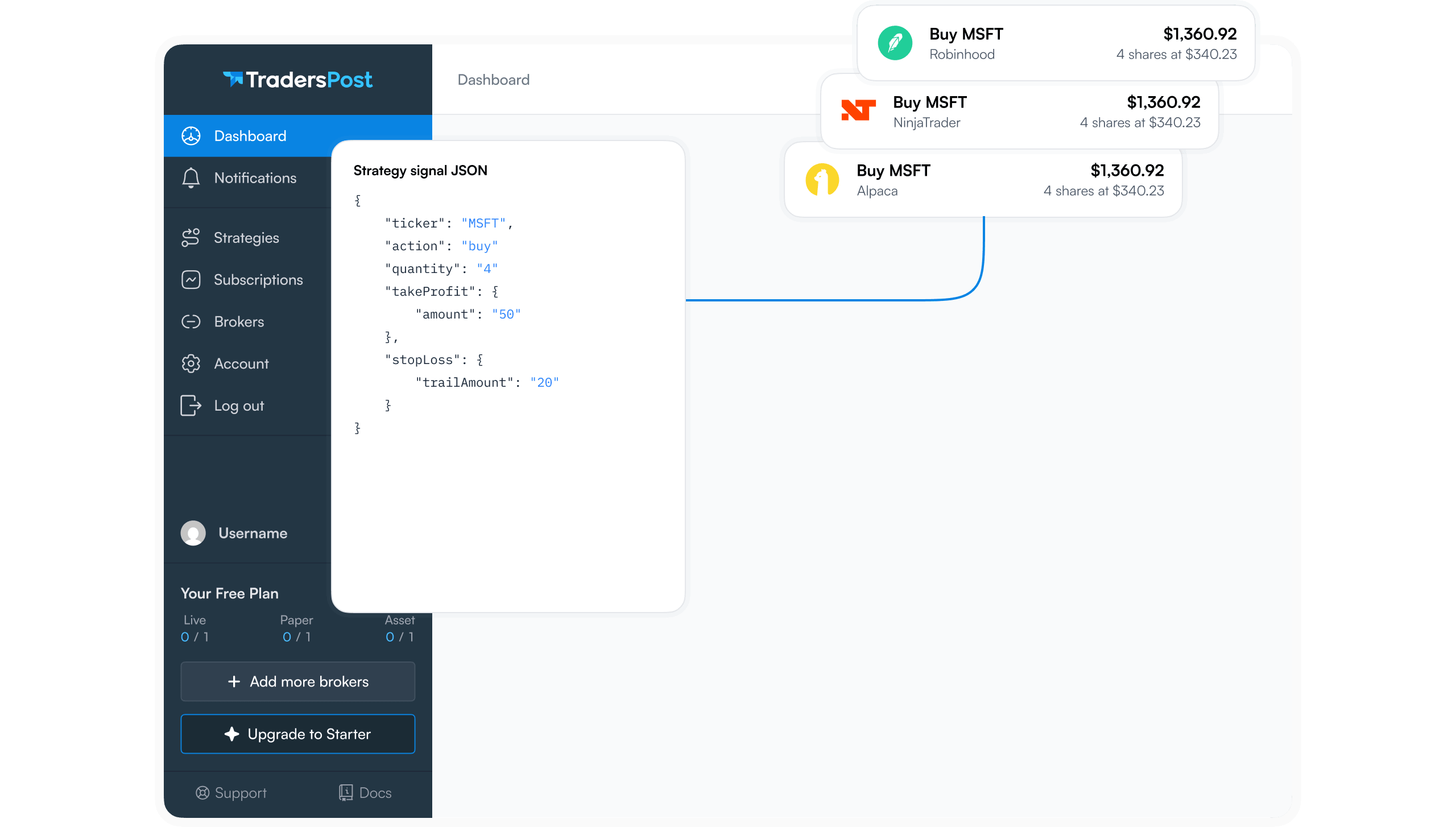
- A webhook payload should include fields like ticker, action, timestamp, sentiment score, and mention spike percentage for deterministic execution.
A sentiment score is only useful if it reaches your trading system fast enough, in a format your execution rules can trust. Sentiment data automated trading connects news, social, analyst, or proprietary market signals to a bot workflow that can evaluate a setup, apply risk controls, and send an order without requiring you to watch every alert manually.
This post explains how to turn sentiment inputs into actionable webhook payloads, then integrate them with TradersPost for automated execution. You will learn what information a signal should include, how to pair sentiment with technical confirmation filters, and why position sizing and stop-loss logic should be defined before an order reaches the broker.1 We will also cover practical safeguards, including duplicate-signal handling, market-hours rules, and paper testing.
The objective is not to let a bot blindly chase bullish or bearish headlines. It is to build a repeatable workflow in which sentiment provides the catalyst, technical conditions validate timing, and predefined risk parameters control the trade. By the end, you will have a clearer framework for testing and deploying a sentiment-driven strategy with safer, more consistent execution.
What Is Sentiment Data Automated Trading?
How Sentiment Data Becomes a Tradable Signal
Sentiment data measures market attention, opinion, and positioning outside the price chart. Common inputs include social-media mention volume, bullish and bearish post scoring, financial-news sentiment, unusual options activity, retail-trading community rankings, search trends, and custom proprietary scores built from multiple data feeds. A sentiment provider may score a ticker from 0 to 100, classify news as positive or negative, or flag when current mentions exceed a historical baseline.
Sentiment is an external input, not a complete trading strategy and not a guaranteed predictor of price direction. A surge in bullish discussion can reflect genuine accumulation, but it can also occur after a move has already become crowded. Automated systems should therefore treat sentiment as one condition within a defined decision process.
A typical automation workflow looks like this:
- A sentiment data provider, scanner, or custom script detects a condition, such as mention volume rising 200% versus its 20-day average.
- The system sends a webhook alert containing the symbol, timestamp, sentiment score, mention-volume change, and any relevant options or news data.
- A trading platform or bot validates the setup against market-data rules, such as trend direction, liquidity, spread limits, volatility, and time-of-day restrictions.
- If all conditions pass, the automation sends a defined order to the broker, with preconfigured quantity, stop-loss logic, and exit instructions.
The same sentiment signal can serve different functions. As an entry trigger, it may initiate a trade when positive sentiment confirms a technical breakout. As a trade filter, it may allow long entries only when sentiment is above a minimum threshold. As an exit signal, a sharp decline in sentiment or a reversal from bullish to bearish may reduce or close an existing position. As a position-sizing input, stronger sentiment confirmation may permit a larger allocation, subject to fixed portfolio and volatility limits.
Why Raw Social Buzz Can Create Bad Trades
Raw social buzz is particularly vulnerable to FOMO-driven errors. Traders often enter after a large price move because mention volume is highest when the story is already widely visible. Other failure modes include coordinated spam campaigns, thinly traded tickers with unreliable prints and wide spreads, short-lived hype around rumors, and abrupt sentiment reversals when early buyers begin taking profits.
An increase in mentions does not automatically create a bullish trade setup. For example, suppose a stock records a 300% jump in social mentions, but the price is already 12% above its 20-period moving average. A trend-following bot may reject the trade because the extension exceeds its maximum allowable distance from the moving average. A pullback strategy may also reject it because price has not retraced to a defined support zone. The signal identifies attention, not an acceptable risk-reward entry.
Useful validation rules include minimum average daily dollar volume, maximum bid-ask spread, confirmation above a breakout level, relative-volume requirements, sector alignment, and a cap on distance from a moving average or VWAP. For options trades, the system should also check implied volatility, open interest, and spread quality before submitting an order.2
The core principle is simple: automate confirmation and risk controls, not emotional reactions. Sentiment can help a bot identify where attention is concentrated, but price structure, liquidity, execution constraints, and predefined loss limits determine whether that attention is tradable.
Choose Sentiment Inputs That Your Bot Can Use
Use Scores, Changes, and Volume Spikes Instead of Vague Sentiment
A trading bot needs numeric, timestamped inputs, not labels such as “positive chatter.” Store structured fields for every symbol and interval: sentiment score (for example, 0 to 100), sentiment change over a defined lookback, mention count, mention-rate change, unique-author count, and source confidence. The bot should also retain the underlying timestamp, source category, and symbol-resolution confidence.
Relative changes are generally more informative than raw counts. A large-cap stock may receive hundreds of mentions in any normal hour, while a small-cap name may receive only a few. A useful trigger is not simply “100 mentions,” but “mention volume is 3x the prior 30-minute average.” Build ticker-specific baselines by time of day and day of week, since normal discussion volume differs materially across equities, ETFs, crypto assets, and thinly traded names.
- Example long-entry filter: sentiment score above 70, score change above 15 points over 30 minutes, mention volume at least 200% above the 20-session intraday baseline, and at least 25 unique authors.
- Example short filter: sentiment score below 30, negative mention rate above 250% of baseline, and no conflicting positive news event from a high-confidence provider.
Select Reliable Sources and Define Data Quality Rules
Different sources measure different forms of sentiment. Social platforms and Reddit-style communities can identify retail attention quickly, but are vulnerable to duplication and coordinated promotion. News feeds are usually more attributable and time-stable. Earnings-call analysis can capture management tone and forward guidance. Analyst revisions provide slower but often higher-conviction institutional signals. Options-flow feeds may reveal positioning, although they do not directly identify directional intent. Custom NLP models can unify these sources, provided their training data, symbol mapping, and confidence calibration are documented.
Before integrating any provider, record its latency, update frequency, symbol coverage, scoring methodology, historical availability, revisions policy, and API failure behavior. A score delivered 10 minutes after publication may be unsuitable for an intraday strategy but useful for a multi-day model.
- Ignore duplicate or near-duplicate posts, including reposts from the same account.
- Reject observations with low model confidence or uncertain ticker identification.
- Discard stale timestamps, such as social data older than five minutes for a short-horizon strategy.
- Require a minimum number of unique contributors before treating a spike as actionable.
Apply stricter thresholds to low-liquidity symbols. Ten posts from three authors can create an apparent spike in an obscure stock, but it is rarely sufficient evidence for an automated order.
Build a Sentiment Watchlist Before Generating Orders
Do not let the bot scan and trade every symbol mentioned online. Start with a predefined, liquid universe and permit sentiment signals only for eligible instruments. For equities, require minimum average daily volume, a maximum bid-ask spread, a minimum share price, and listing on approved exchanges. For example, an intraday equity bot might require 20-day average volume above 1 million shares, price above $5, and a median spread below 15 basis points.
Maintain separate watchlists for equities, ETFs, crypto, and futures. Their trading sessions, liquidity profiles, leverage conventions, and volatility behavior differ enough that one threshold set will not transfer cleanly. Finally, cap concurrent sentiment-driven positions and sector concentration. A broad social-media surge can produce highly correlated signals across semiconductor stocks, meme equities, or altcoins, creating concentrated exposure disguised as multiple independent trades.
Design Webhook Payloads for Sentiment Trading Bots
Include the fields needed for deterministic execution
A webhook payload should contain every field the execution layer needs to validate, route, and place an order without inferring intent from raw sentiment text. At minimum, standardize ticker or symbol, action, timestamp, sentiment_score, mention_spike_pct, source, strategy, and timeframe.3 A confidence_score is optional, but useful when the strategy adjusts position size or rejects marginal setups.
- ticker: Use the broker-compatible instrument identifier, such as NVDA or SPY.
- action: Define the execution instruction, such as buy, sell, exit, or reduce_position.
- timestamp: Send an ISO 8601 UTC timestamp so the receiver can enforce freshness rules.
- source: Identify the originating sentiment feed, script, or alert platform.
- strategy: Route the alert to the correct ruleset and risk configuration.
Include a globally unique alert_id for each event. The execution service should persist processed IDs and reject any repeated ID, even if the webhook provider retries a delivery after a timeout. Generate the direction only after the signal has passed the full decision process, including sentiment thresholds, liquidity filters, technical confirmation, and position-state checks. The payload should say buy only when the strategy has already decided to buy.
Use identical field names and allowed values across sentiment providers, custom scripts, TradingView alerts, TrendSpider alerts, and internal services. For example, do not use symbol in one source and ticker in another unless a normalization layer converts both before execution.
Example webhook payload for a confirmed long entry
A confirmed entry payload represents a completed strategy decision. It should not require the order-management system to parse unstructured posts, classify emoji sentiment, or determine whether a mention spike is actionable.
{
  "ticker": "NVDA",
  "action": "buy",
  "strategy": "sentiment_breakout_v1",
  "sentiment_score": 78,
  "mention_spike_pct": 240,
  "technical_confirmation": "close_above_20ema",
  "risk_profile": "medium",
  "alert_id": "NVDA-20260710-001"
}
In production, add fields such as timestamp, source, timeframe, and optionally confidence_score. The strategy identifier separates distinct workflows. For example, sentiment_breakout_v1 may enter after accelerating positive mentions and a price breakout, while sentiment_pullback_v1 may buy a retracement after sentiment remains positive, and sentiment_exit_v1 may reduce exposure when sentiment deteriorates.
Send test payloads through a paper-trading or non-live endpoint first. Validate JSON syntax, field types, authentication headers, broker symbol mapping, idempotency behavior, and rejection logging before connecting the webhook to a funded account.
Prevent duplicate, stale, and conflicting alerts
Reject stale signals. A practical rule is to ignore alerts older than five minutes for intraday breakout systems, or 15 minutes for slower timeframes. Compare the received time with the payload timestamp in UTC, not with the chart bar time alone.
- Process each alert_id once, and do not resend a buy alert on every chart update while conditions remain true.
- Check current position state before submitting an order. Do not open a new long if a short is open unless the strategy explicitly supports an exit-and-reverse sequence.
- Apply an entry cooldown, such as 30 minutes after a filled long entry, to prevent repeated sentiment spikes from continuously adding exposure.
- Allow additional entries only through explicit scaling logic, with defined maximum position size, spacing, and risk limits.
These controls belong in the execution service, not only in the alert script. The receiver must remain safe if an upstream platform retries, duplicates, delays, or reorders webhook deliveries.
Combine Sentiment With Technical Confirmation
Use Trend Filters to Avoid Buying Extended Hype
A high sentiment score is not, by itself, a long entry. Automated strategies should require price to confirm that positive attention is occurring within a tradable trend rather than at the end of an exhausted move. For long signals, require the instrument to trade above a defined trend reference, such as the 20-period EMA, 50-period SMA, session VWAP, or a higher-time-frame support level.
- Intraday trend filter: Price must be above VWAP and the 20 EMA on the five-minute chart.
- Higher-time-frame filter: Price must remain above the prior day’s low, daily 20 EMA, or a defined weekly support zone.
- Extension filter: Reject new long entries when price is more than a specified distance above VWAP or the 20 EMA, such as 2 ATRs on the five-minute chart.
- Market-regime filter: Require the relevant index or sector ETF, such as SPY, QQQ, XLK, or XBI, to trade above its intraday moving average before allowing long entries.
Trend alignment separates potential momentum continuation from isolated social-media spikes. A ticker can receive unusually positive mentions while still trading below VWAP, below resistance, and against a weak sector. In that condition, sentiment may identify attention, but price has not confirmed demand.
Confirm Sentiment With Price and Volume Behavior
Translate sentiment into an executable signal only after the market reacts. Define resistance objectively, using the premarket high, opening-range high, prior-day high, or the upper boundary of a consolidation range. Require a close-based breakout rather than triggering on an intrabar print above resistance.
- Enter only after a five-minute candle closes above the selected resistance level.
- Require relative volume of at least 1.5x to 2.0x the instrument’s average volume for the same time of day.
- Apply a minimum reaction threshold, such as price being at least 0.5% above the prior close or 0.75 ATR above the opening price.
- Retain a maximum-extension rule, such as no entry if the breakout candle closes more than 2 ATRs above VWAP.
Time-of-day volume normalization is important. Comparing 9:35 a.m. volume with an all-day average produces misleading signals because opening activity is structurally higher. The bot should compare current cumulative volume with historical cumulative volume for the same session minute.
Example: Sentiment-Confirmed Breakout Strategy
A rules-based long strategy can combine sentiment, liquidity, trend, and breakout confirmation as follows:
- Entry: Sentiment score exceeds 75, mention volume is at least 200% of its trailing 30-minute baseline, price is above VWAP, and a five-minute candle closes above the premarket high.
- Volume confirmation: Relative volume exceeds 1.8x the average cumulative volume for that time of day.
- No-trade rules: Skip the signal if the bid-ask spread exceeds the configured threshold, price is more than 2 ATRs above VWAP, the market index is below its intraday trend filter, or the strategy already holds a position.
- Exit: Place a stop below the breakout level or at a defined ATR distance. Take partial profit at 1R, then trail the remaining position below a short moving average or the prior five-minute candle low.
Every threshold must be backtested or paper tested using the specific asset class, liquidity profile, and time frame traded. A 1.8 relative-volume threshold that works for liquid large-cap equities may be unsuitable for small-cap stocks, futures, options, or digital assets.
Build Guardrails for Entries, Exits, and Position Sizing
Set Position Sizing Based on Defined Risk
Size each position from a pre-defined dollar risk, not from the sentiment score. A practical fixed-risk formula is:
Position size = maximum dollar risk ÷ (entry price − stop price)
For a long trade with a $200 maximum loss and a $2.00 stop distance, the initial size is 100 shares. The bot must then apply buying-power, liquidity, and allocation constraints before submitting the order. If the stock trades with a wide spread or average volume cannot absorb the intended order without meaningful slippage, reduce size or reject the signal.
- Set a maximum risk per trade, such as 0.25% to 1.00% of account equity.
- Cap gross allocation per position, sector, asset class, and the full sentiment-driven strategy.
- Apply tighter caps to correlated names, such as multiple semiconductor stocks responding to the same bullish news cycle.
- For options, calculate risk from the defined exit price or maximum loss for debit positions, while accounting for contract multiplier and spread width.
Do not automatically increase size because sentiment is exceptionally bullish or bearish. Confidence scores are model outputs, not guarantees. A score of 0.95 may reflect duplicated headlines, a rapidly changing social-media narrative, or a classification error. Risk constraints should remain binding regardless of signal strength.
Define Hard Stops and Non-Negotiable Exits
Every automated entry should carry an exit plan before the order is placed. Use the stop type that matches the strategy and instrument:
- Price-based stop: Exit if price breaches a defined support, resistance, or percentage level.
- ATR-based stop: Set the stop at a multiple of average true range, such as 1.5 ATR below entry, to normalize for volatility.
- Time stop: Exit if the expected sentiment-price response does not occur within a defined period, such as 30 minutes for an intraday catalyst trade.
- Thesis-invalidating stop: Exit when the market behavior contradicts the setup, such as a bullish sentiment signal followed by a failed breakout and lower low.
Use sentiment deterioration as a secondary input rather than an isolated trigger. For example, reduce a long position by 50% when the sentiment score falls from 0.80 to 0.35 and price loses VWAP on above-average volume. A sentiment reversal alone is often too noisy to justify an exit because data sources can update unevenly, react late, or overstate a transient headline.
Define end-of-day behavior explicitly. Intraday strategies should close positions before the session ends, with a cutoff such as 15:50 ET. Allow overnight holdings only if the strategy has been tested across overnight gaps, earnings periods, and premarket liquidity conditions.
Add Circuit Breakers for Abnormal Conditions
Circuit breakers prevent a flawed feed, regime shift, or execution problem from turning routine losses into uncontrolled exposure. Configure the bot to pause new entries after measurable failure conditions, while allowing existing positions to follow their predefined exits.
- Pause entries after three consecutive losses or after a daily realized drawdown of 2% of strategy capital.
- Block new trades when intraday volatility exceeds a defined threshold, such as VIX rising more than 10% from the prior close or a symbol’s ATR exceeding its normal percentile range.
- Restrict trading around earnings releases, FOMC decisions, CPI, payrolls, and other scheduled events unless the strategy was specifically tested for those windows.4
- Set a maximum trades-per-day limit, such as 10 entries per strategy, to prevent a noisy sentiment feed from repeatedly triggering marginal signals.
Implement a manual kill switch that immediately disables order submission, cancels open entry orders, and alerts the operator. Test this process during paper trading and simulated API failures. A kill switch that has not been verified under realistic conditions is not a control.
Automate the Workflow With TradingView or TrendSpider
Create a TradingView Alert Workflow
Build the TradingView workflow so sentiment is a qualifying input, not an independent trade trigger. Pine Script cannot directly call an arbitrary external sentiment API, so make the score available through a TradingView-compatible symbol or data series, or update it through a controlled input process. For example, a long setup might require a sentiment score above 65, price closing above a 20-period breakout level, relative volume above 1.5, and an ATR-based stop distance that keeps maximum account risk below 0.5%.
The alert must fire only after the complete entry or exit condition evaluates true. Do not alert when sentiment improves if the price and risk filters have not confirmed. For strategy-based automation, use separate alert conditions for each executable event and include a structured payload:
Example webhook payload:
{"strategy_id":"sent_v3","action":"BUY_TO_OPEN","symbol":"{{ticker}}","side":"long","quantity":100,"sentiment_score":72,"signal_price":"{{close}}","timestamp":"{{time}}"}
- Use {{ticker}}, {{close}}, and {{time}} placeholders where the receiving system supports them.
- Assign a stable strategy_id so the execution service can apply the correct sizing, instrument mapping, and position rules.
- Use action-specific messages rather than one generic “signal” alert.
- Create separate alerts for entry, stop or protective exit, profit-taking, and end-of-session flattening when those actions are independently executable.
Create a TrendSpider Alert Workflow
TrendSpider alerts should express the technical setup precisely: automated trendline breaks, moving-average alignment, volume confirmation, support or resistance levels, and multi-factor conditions. Sentiment can operate as an upstream qualification layer, where only symbols with a current positive or negative sentiment state are allowed into the TrendSpider alert universe. If your TrendSpider configuration supports a custom condition or imported sentiment-derived signal, require that condition to align with the technical trigger.
For example, a long alert can require a break above an automated resistance trendline, RSI above 55, volume greater than its 20-bar average, and a positive sentiment qualification. A short setup should use its own bearish technical and sentiment criteria. Each webhook should send the symbol, intended action, strategy identifier, and relevant signal metadata. Maintain separate alerts for long entries, long exits, short entries, and short covers rather than inferring direction from price movement.
Map Alerts to Clear Execution Rules
Define every action unambiguously: BUY_TO_OPEN opens a long position, SELL_TO_CLOSE exits an existing long, SELL_SHORT opens a short, BUY_TO_COVER exits a short, REDUCE_POSITION scales exposure down, and CLOSE_ALL flattens all strategy positions.
- Normalize symbols before order submission. “BTCUSDT,” “BTC/USD,” futures root symbols, option OCC symbols, and broker-specific tickers may refer to different instruments or formats.
- Reject duplicate entry alerts when already positioned, unless explicit pyramiding rules define maximum adds, spacing, and revised risk limits.
- Require the execution layer to close the current position before reversing from long to short or short to long.
- Document every alert-to-order mapping, including order type, quantity source, time-in-force, stop logic, and invalid-symbol handling.
This mapping document is the operational contract between the alert platform and broker workflow, particularly during volatile periods when multiple alerts can arrive within seconds.
Paper Test Sentiment Strategies Before Going Live
Test the Full Chain, Not Only the Trading Idea
A sentiment signal is only tradable if every component between the data source and the broker behaves correctly. Paper testing should validate the complete event path: source-data publication time, sentiment scoring, signal generation, webhook transmission, alert parsing, platform-side order creation, broker routing, simulated fills, and exit logic. A backtest that assumes an immediate fill at the signal timestamp does not test this chain.5
- Record both the source timestamp and the timestamp at which your bot received the alert. A social-post score generated at 10:00:00 but delivered at 10:03:15 may no longer be actionable.
- Test duplicate webhooks, malformed JSON, missing tickers, null sentiment scores, stale timestamps, invalid option contracts, market-closed alerts, and ticker-symbol mismatches such as BRK.B versus a broker’s required symbol format.
- Simulate partial fills, rejected orders, halted securities, insufficient buying power, and exit alerts that arrive before an entry order is fully filled.
- Compare the expected entry price in the alert with the actual paper fill. For example, a bullish sentiment signal may trigger when SPY is quoted at $520.10, but a marketable buy order may fill at $520.32 after spread and queue effects.
Maintain an immutable alert log. Each record should include strategy version, raw sentiment inputs, calculated score, threshold, source timestamp, receive timestamp, intended symbol, order payload, broker response, fill quantity, average fill price, exit reason, and realized P&L. This log is essential when diagnosing whether poor results came from the signal or from execution.
Measure Whether Sentiment Improves the Base Strategy
Sentiment should earn its place in the system by improving a defined base strategy. Run the same technical entry and exit logic with no sentiment filter, then compare it with the sentiment-enabled version. Measure changes in win rate, average win, average loss, expectancy, maximum drawdown, turnover, and the percentage of technical signals selected or rejected.
- Segment results by sentiment range, such as scores below -0.60, neutral scores between -0.20 and 0.20, and scores above 0.60.
- Break down performance by provider, ticker category, market-cap tier, sector, market regime, time of day, and holding period.
- Test whether sentiment improves entries, exits, or trade avoidance. A useful filter may reduce trade count by 40% while preserving most profitable trades and materially lowering drawdown.
Avoid tuning thresholds around a handful of highly visible events. A threshold that appears effective during one meme-stock surge may fail during ordinary earnings cycles or risk-off markets. Require a meaningful paper sample across bullish, bearish, volatile, and range-bound conditions before approving live deployment.
Move to Live Trading Gradually
After stable paper results, begin with the smallest practical live position size. The objective is to verify real execution behavior, not to maximize early returns. Increase size only after limited-live performance remains consistent with paper expectations.
- Review execution logs weekly for differences between intended signals, submitted orders, broker acknowledgements, and fills.
- Version every strategy change, including sentiment provider, scoring normalization, threshold, symbol universe, order type, and exit rule.
- Change one variable at a time. If both the sentiment threshold and stop-loss logic change simultaneously, the performance difference cannot be attributed reliably.
Reassess providers and filters on a scheduled basis. Social-platform participation changes, spam patterns evolve, language models are updated, and market participants adapt to widely used signals. A sentiment feature that improved selectivity six months ago may now add noise or introduce latency without improving expectancy.
Frequently Asked Questions
Can sentiment data be used for automated trading?
Yes. Sentiment data can support automated trading when it is converted into structured, testable rules. It may serve as an entry trigger, trade filter, exit input, or position-sizing modifier. However, sentiment should not be treated as a stand-alone buy or sell signal. Combine it with price action, volume, trend direction, liquidity requirements, and defined risk controls. TradingView or TrendSpider alerts can send qualified, rules-based signals to TradersPost for automated order execution.6
What should a sentiment trading webhook payload include?
A sentiment trading webhook payload should include the ticker, action, timestamp, unique alert ID, strategy ID, and the sentiment or confirmation values that qualified the trade. Use structured JSON instead of unstructured text so every alert produces deterministic execution behavior. Include expiration logic to prevent stale alerts from creating orders, plus duplicate-prevention logic to avoid repeated executions. Clear payload fields also make it easier to test, audit, and troubleshoot your automation.
How can traders avoid FOMO trades from social sentiment?
Require technical confirmation before acting on social sentiment. Useful filters include a close above resistance, alignment with the broader trend, relative-volume confirmation, and a maximum-extension rule that prevents chasing overextended moves. Trade only liquid symbols from a predefined watchlist, and reject stale or low-confidence sentiment readings. Keep risk controlled with fixed position sizing, hard stops, daily loss limits, and cooldown periods after entries to reduce impulsive repeat trades.
Can TradersPost automate sentiment-based TradingView alerts?
Yes. TradersPost can receive TradingView webhook alerts and route configured orders to supported broker accounts. The TradingView alert should contain a final, rules-based trading decision, not raw social-media commentary or an unfiltered sentiment score. For example, your alert might require bullish sentiment, a breakout above resistance, and above-average volume before sending a buy action. Paper test alert formatting, order mapping, sizing, and exit behavior before connecting a live brokerage account.
Should sentiment be used for entries or exits?
Sentiment can be used for both entries and exits, but it is generally strongest when paired with technical confirmation and explicit risk rules. For entries, sentiment can identify stocks receiving attention or building momentum. For exits, sentiment deterioration may be useful when it occurs alongside price weakness, fading volume, or a broken trend. Test entry and exit logic separately, since the sentiment thresholds that improve entries may not produce reliable exit signals.
Conclusion
Sentiment data can add a valuable confirmation layer to automated trading, but it works best when paired with clear technical rules, disciplined risk controls, and reliable alert logic. Rather than treating social, news, or market sentiment as a standalone buy or sell signal, use it to filter trades, validate momentum, or reduce exposure when conviction deteriorates. The quality of the data, timing of the signal, and consistency of your execution rules will determine whether sentiment improves your process.
Before committing capital, create a TradersPost paper trading workflow, connect a TradingView or TrendSpider alert, and test your sentiment-confirmed strategy across different market conditions. Review fill quality, missed signals, drawdowns, and how the bot responds when sentiment changes quickly. Once the workflow demonstrates repeatable behavior in simulation, you can make a more informed decision about live deployment. Start building and testing your automation today with confidence.
References
1 TradersPost Docs, Position Sizing
2 TradersPost Docs, Options Trading
3 TradersPost Docs, Webhooks
4 Federal Reserve, FOMC Calendars
5 TradingView, Pine Script Repainting & Backtesting
6 TradersPost Docs, TradingView Signal Source