Automate Trading Around Economic Events
Learn to automate trading around economic events with Trading Windows, TradingView alerts, and disciplined plans for FOMC, CPI, earnings, and major releases.

Marketing

Bottom Line
- The firm's automation policy emphasizes using Trading Windows to control when strategies can open new positions, particularly around economic events like FOMC and CPI releases.
- Automation is connected through platforms like TradingView or TrendSpider, which send alerts to manage open positions based on predefined conditions.
- Key compliance restrictions include avoiding new entries during high-volatility periods, such as five minutes before and after major economic announcements.
- The recommended setup involves separating entry controls from position-management decisions to ensure existing positions are managed independently of new entry restrictions.
- For the July 28-29, 2026 FOMC meeting, traders are advised to block new entries before 2:00 p.m. ET and use Trading Windows to manage post-announcement entries.
Markets can move in seconds when the FOMC releases its statement, CPI surprises expectations, or a major company reports earnings. The challenge is not knowing that these events matter, it is having a repeatable plan in place before volatility hits. This guide shows you how to automate trading around economic events without relying on last-minute decisions, emotional entries, or constant screen-watching.
You will learn how to define event-specific trading windows, build disciplined rules for pre-event and post-release setups, and use TradingView alerts to trigger timely notifications or actions. We will cover practical approaches for FOMC meetings, inflation data, earnings releases, and other market-moving reports, including how to account for liquidity shifts, wider spreads, and sudden price reversals.
The goal is not to blindly automate every trade. It is to automate the preparation, timing, and risk controls that make your event-driven process more consistent. With clear conditions, alerts, and position-management rules, you can respond to economic releases with a structured plan rather than a rushed reaction.
Why Economic Events Need a Different Automation Plan
Understand the Risks of Trading Event-Driven Volatility
FOMC rate decisions, CPI releases, employment reports, and earnings announcements can change market pricing within seconds. The initial move may be large, but it is not always durable. A stock can gap above a breakout level on an earnings headline, reverse when guidance is discussed, then reclaim the level later in the session. Index futures can surge immediately after a CPI release, only to reverse as traders reassess the underlying details.
These conditions create execution risks that are materially different from ordinary intraday trading:
- Price gaps: A market can move through a planned entry, stop, or target level without trading at every price in between.
- Wider spreads: Bid-ask spreads can expand around scheduled releases, increasing the difference between the expected price and the available execution price.
- Rapid reversals: The first reaction to a headline may reverse before a strategy has time to confirm the move.
- False breakouts: Price may briefly clear a technical level, trigger a signal, and quickly return inside the prior range.
Automation does not eliminate these market risks. Its value is consistency: it can apply predefined entry rules without hesitation, discretionary chasing, or a last-second change in process. The trader still decides whether an event window is suitable for the strategy, how much risk is acceptable, and what conditions must be met before a new position is allowed.
It is also important to distinguish between two separate decisions. Avoiding a new position five minutes before an FOMC announcement is an entry-control decision. Deciding whether to hold, reduce, close, or reverse a position that is already open when the announcement occurs is a position-management decision. They require different automation instructions.
Separate Entry Controls From Position-Management Decisions
Use Trading Windows to control when a strategy may open new positions.1 For example, if CPI is released at 8:30 a.m. Eastern Time, a trader might configure Trading Windows so new entries are permitted before 8:20 a.m. and resume only after 8:40 a.m., once the initial volatility has had time to develop. This approach prevents qualifying entry signals from opening fresh positions during the restricted interval.
Trading Windows are entry controls. They do not automatically close, reduce, flatten, or reverse an existing position. If a strategy entered before the event and remains open at the release time, that position will remain subject to its existing order logic and market movement unless a separate alert instructs otherwise.
To manage an open position around an event, configure the strategy in TradingView or TrendSpider to send the appropriate webhook alert. For example:
- Send an alert to close a long position before an earnings release.
- Send an alert to reduce exposure when an event-driven volatility threshold is reached.
- Send a reversal alert only when the post-event strategy rules explicitly confirm a change in direction.
A practical event plan therefore has two layers: Trading Windows determine when new entries are allowed, while TradingView or TrendSpider alerts determine what happens to positions already open. Keeping those layers separate prevents a common automation error, assuming that blocking entries also manages existing exposure.
Key 2026 Dates: FOMC, CPI, and Earnings Events
Plan Around the Next FOMC Decision
The next scheduled Federal Open Market Committee meeting is July 28-29, 2026, with the policy statement expected at 2:00 p.m. ET on July 29.2 The June 2026 meeting maintained the federal funds target range at 3.50% to 3.75%, and it was the first meeting chaired by Kevin Warsh.3 More importantly for automated traders, the median policy-rate projection moved to 3.8%, placing a potential rate hike firmly in the decision set.
That setup argues for an event-specific plan rather than allowing a normal intraday strategy to trade through the announcement without constraints. For example, a trader running index ETF signals may use Trading Windows to block new entries before 2:00 p.m. ET, then permit entries only after a defined post-announcement interval. The delay should be long enough to avoid the initial statement-driven repricing, but short enough to participate if a directional trend becomes established.
- Define whether existing positions remain open through the decision or are reduced before the event.
- Use pre-defined Stop Market or Trailing Stop protection appropriate for potentially wider spreads and faster price movement.
- Test a separate rule set for the 2:00 p.m. statement, the 2:30 p.m. press conference, and the final hour of trading.
Confirm meeting dates directly on the Federal Reserve FOMC calendar. For context on the June decision and projections, review CNBC's June 2026 FOMC coverage.
Plan Around the Next CPI Release
The next Consumer Price Index release is scheduled for July 14, 2026, at 8:30 a.m. ET. May 2026 CPI rose 4.2% year over year following an energy shock4, making the release especially consequential for Treasury yields, index futures, rate-sensitive equities, banks, homebuilders, technology shares, and broad-market ETFs.
Because CPI is released before the cash equity open, the market can reprice materially during premarket trading. A large move in futures may establish a gap at 9:30 a.m. ET, but the opening range can either extend that move or reverse it quickly as cash-market liquidity arrives. Automation should therefore distinguish between a premarket indication and a confirmed regular-session signal.
- Do not assume that a higher or lower premarket gap is an entry signal by itself.
- Require a defined opening-range breakout, reversal, or volume confirmation after the regular session begins.
- Use a dedicated Trading Window for post-release entries rather than allowing signals immediately before the 8:30 a.m. ET release.
Verify release timing through the official Bureau of Labor Statistics CPI release schedule.5
Treat Earnings as Company-Specific Economic Events
Earnings reports are economic events at the company level. A large constituent's results can gap its shares sharply and affect related stocks, sector ETFs, and major indexes. Before enabling an automated strategy, check whether each relevant company reports before the market opens or after the market closes, then create separate rules for each condition.
For a premarket report, require regular-session confirmation before entering. For an after-hours report, avoid assuming that the initial reaction will persist at the next opening. Guidance, analyst revisions, overnight futures, and broader market conditions can all alter the next-session move. A robust automation plan treats the next day's open as a new decision point, with its own entry, stop-loss, and position-sizing rules.
Use Trading Windows to Avoid New Entries at Release Time
Build a Pre-Event No-Entry Window
Use Trading Windows to define when a strategy is permitted to open new positions. For scheduled economic releases, the objective is usually straightforward: allow the strategy to trade during normal conditions, then prevent fresh entries as liquidity changes and price positioning intensifies ahead of the announcement.
For an FOMC statement scheduled for 2:00 p.m. ET, a trader might permit normal entries during the morning and early afternoon, then configure Trading Windows so no new entries are accepted during the period leading into the release. For example, a strategy could remain eligible to enter until 1:30 p.m. ET and block entries from 1:30 p.m. through the initial announcement period. This prevents a technically valid signal at 1:47 p.m. ET from opening a new position immediately before a potentially market-moving statement.
For CPI, which is commonly released at 8:30 a.m. ET, a trader may block new entries before the release and delay the strategy's permitted start time until after a chosen confirmation period. A premarket or opening strategy might be unavailable until 8:45 a.m. ET, 9:00 a.m. ET, or later, depending on how long the trader wants to avoid the first reaction.
- Use a shorter buffer when the strategy is designed for highly liquid, fast-moving instruments and has been tested through event sessions.
- Use a wider buffer when the strategy is vulnerable to opening gaps, widened spreads, or rapid reversals.
- Test the buffer against historical event dates. A 15-minute or 30-minute window should be a strategy decision supported by results, not a schedule copied from another trader.
Create a Post-Event Re-Entry Window
A post-event Trading Window can make a strategy eligible to resume entries after the initial reaction has had time to develop. The appropriate restart time depends on the strategy logic. Some traders wait for a defined opening range to form, while others wait for a trend-confirmation condition on the chart.
The time window alone does not create a trade. Trading Windows only determine whether new entries are allowed. The TradingView or TrendSpider strategy must still generate a valid entry signal after the permitted window opens.
For example, a CPI strategy may become eligible to enter at 9:00 a.m. ET, after the release and initial price discovery period. However, it should enter only if its chart logic confirms the setup, such as price closing above a defined intraday level. If price remains below that level, no entry occurs, even though the Trading Window is open.
Avoid Common Trading Window Misunderstandings
Trading Windows restrict entries. They are not a scheduled auto-close feature. Blocking new entries before FOMC, CPI, or earnings does not automatically close, reduce, or otherwise modify an existing position.
If a position is already open before an event, it remains open unless the charting strategy sends a separate exit signal. Traders who want to exit before a scheduled release need explicit exit logic based on event timing, price action, or another tested condition in the TradingView or TrendSpider strategy.
For example, a strategy may use Trading Windows to stop new entries before 2:00 p.m. ET, while separately generating an exit signal if price breaks below an intraday support level before the FOMC statement. Treat entry restrictions and position exits as distinct automation decisions.
Automate Event-Based Signals From TradingView or TrendSpider
Design Chart Conditions for a Post-Release Trade
Economic releases can produce rapid price movement in both directions, so a reliable automated strategy should not assume the first move is the durable move. Build the chart logic around confirmation after the scheduled release rather than attempting to predict the number or trade immediately at the release time.
For a post-CPI momentum setup, define a release-time filter, then require price to establish direction. For example, a strategy could wait until after the CPI release, require a five-minute candle to close above the pre-release range high, and enter only when a subsequent bar breaks that confirmation candle's high. A bearish version could require a close below the pre-release range low followed by a break of the confirmation candle's low.
A post-FOMC setup can use the same discipline. Wait for the initial statement reaction, then evaluate whether the technical setup remains valid. For instance, a long signal might require price to remain above a moving average after the first reaction swing, form a higher low, and break the statement-reaction high. If price instead breaks below the defined higher-low level, the long thesis is invalidated and no entry alert should be sent.
- Entry: Define the exact breakout, close, trend, or retest condition that creates the alert.
- Invalidation: Define the price level or technical condition that cancels the setup before entry.
- Exit: Define the profit target, protective stop, or chart condition that ends the trade.
Send Entry Instructions With Documented Webhook Fields
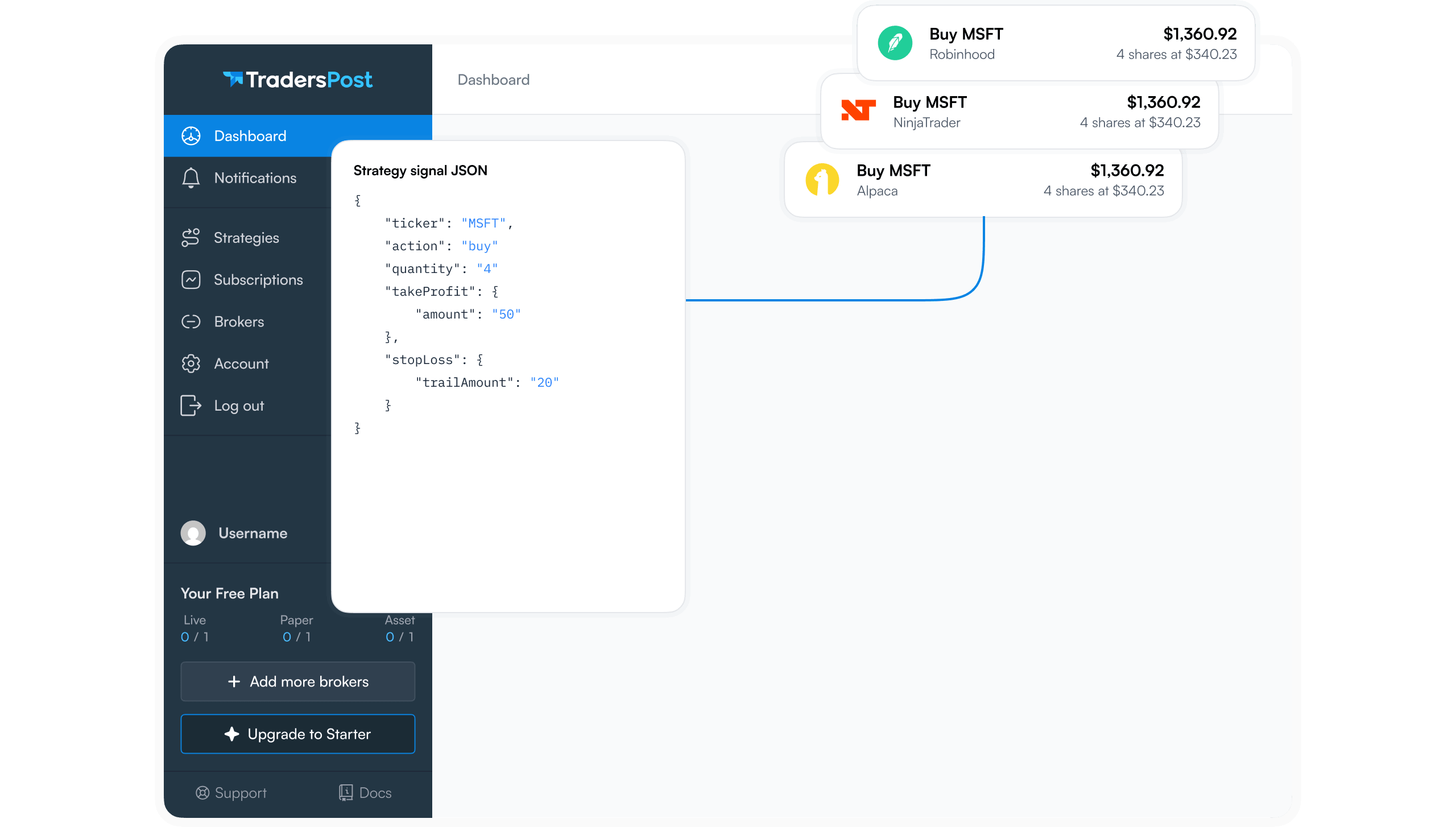
When the chart condition is confirmed, the TradingView or TrendSpider alert can send a webhook instruction containing the core trade details: ticker, action, and quantity. The ticker identifies the instrument to trade, action communicates the intended instruction, and quantity defines the planned order size.
For example, a confirmed bullish breakout alert might send a ticker for the index ETF or futures contract being traded, an action for the intended long-side entry, and a quantity matching the strategy's approved size. A bearish setup should send its corresponding short-side instruction only after its own confirmation conditions have occurred.
Keep symbol naming consistent across the charting platform, the TradersPost automation, and the connected broker. A mismatch between the chart symbol and the instrument recognized by the broker can prevent an otherwise valid event-driven signal from producing the intended trade.
Attach Defined Exits to Event-Driven Entries
If the trade plan uses fixed protective and profit levels, include takeProfit and stopLoss values with the entry alert. This is particularly useful for event trades, where a valid breakout can reverse quickly once the initial liquidity surge subsides. The levels should reflect the chart structure used to qualify the entry, such as the opposite side of a post-release consolidation or a predefined multiple of the initial risk.
When an order instruction needs a defined expiration, the documented expiration webhook field is also available. This can help ensure the instruction is limited to the intended event-trading window.
Do not assume a scheduled flattening process will close an event trade at a particular time. Any exit based on elapsed time, a technical reversal, loss of momentum, or a later event deadline must originate from TradingView or TrendSpider signals. Encode those conditions in the chart strategy and send the appropriate exit instruction when the condition occurs.
Three Practical Automation Playbooks for High-Impact Events
FOMC Statement: Avoid the Release, Trade the Confirmation
For the July 29, 2026, Federal Reserve statement at 2:00 p.m. ET, configure Trading Windows so your strategy cannot open new positions before the scheduled release. The objective is not to predict the initial move. It is to avoid entering during the period when spreads, volatility, and rapid reversals can make preplanned signals unreliable.
Allow entries only after a trader-defined delay, such as 15 to 30 minutes, and require technical confirmation before an alert is sent. A practical confirmation sequence might be:
- Price breaks above or below the pre-statement range.
- A subsequent bar closes outside that range, validating the breakout direction.
- TradingView or TrendSpider sends an alert containing the required ticker, action, and quantity.
Use a separate chart-based exit rule for a failed breakout. For example, a long entry triggered after an upside breakout can exit if price closes back inside the pre-statement range or breaks the low of the confirmation bar. The entry thesis and exit thesis should be explicit, rather than relying on the event itself to define risk.
CPI Release: Wait for the Opening Reaction
Use the July 14, 2026, CPI release at 8:30 a.m. ET as a planning model. Block pre-release entries with Trading Windows, then activate a later window for regular-session setups after the market has had time to process the data. This approach is particularly useful when index futures react sharply at 8:30 a.m. ET but cash-market participation changes the move after the 9:30 a.m. ET open.
Build the automation around a chart condition, not the CPI number. Suitable conditions include an opening-range breakout, continuation above a defined intraday trend level, or a failed breakout reversal after price re-enters the opening range. For example, a strategy could wait for the first 15-minute regular-session range, then send an entry alert only when a bar closes beyond that range with the direction confirmed by the strategy's trend filter.
Do not assume that higher CPI is automatically bearish or lower CPI is automatically bullish. Market reaction depends on expectations, positioning, revisions, interest-rate expectations, and the details within the report. Automation should respond to observable price behavior.
Earnings: Isolate Company-Specific Risk
For a stock reporting earnings, use Trading Windows to prevent new entries near the scheduled report when the strategy is not designed to hold gap risk. This is relevant for both after-close and before-open reports, where the next tradable price may be materially different from the prior session's close.
If the strategy trades the post-earnings reaction, require a chart-based condition after regular trading begins. For example, wait for a breakout above the first 15-minute high, a reclaim of a key moving average, or a failed opening gap that reverses through the opening-range low. Do not enter solely because the earnings headline appears positive or negative.
Broad-market strategies should also account for major reports from heavily weighted companies. When a large index constituent reports, a more conservative entry schedule may be appropriate even if the strategy trades an index ETF rather than the reporting stock.
Manage Open Positions Before and After an Event
Decide in Advance Whether to Hold Through the Release
Treat every scheduled economic release as a defined position-management decision, not a last-minute judgment. Avoiding new entries before CPI, an FOMC statement, Nonfarm Payrolls, or an earnings report does not eliminate risk from positions opened earlier that session or held from prior days. A position can still gap through a stop level, experience rapid spread changes, or move sharply before an exit-oriented signal is generated.
A practical framework is simple: hold through an event only when the strategy has been tested across comparable releases and the trader accepts the potential for discontinuous pricing and unusually fast moves. If the strategy has not been evaluated through similar conditions, the default rule should generally be to reduce exposure or close the position before the event.
- Hold: Only if historical testing includes comparable event sessions and the strategy's risk limits remain acceptable.
- Reduce: Use a predefined partial-exit rule when the strategy may benefit from post-event continuation but full exposure is not justified.
- Exit: Close exposure before the release when the strategy is designed for normal intraday conditions rather than event volatility.
Document this decision separately for each strategy. For example, a mean-reversion strategy might be prohibited from carrying positions into CPI or FOMC, while a breakout strategy may be allowed to hold through earnings only after testing shows acceptable performance across prior earnings gaps.
Use Chart-Generated Exit or Reduction Signals
Your TradingView or TrendSpider strategy can generate an exit-oriented action when its predefined technical or time-based condition is met before or after an event. This keeps the decision inside the charting logic where the strategy's entries, exits, and filters can be tested consistently.
For example, assume a long position remains open before a scheduled CPI release at 8:30 a.m. ET. The charting strategy could generate an exit signal if price closes below a defined support level before the release, if volatility exceeds a specified threshold, or if a time-based rule is reached shortly before the announcement. After the release, the same strategy could issue an exit or reduction signal if the initial move reverses through a technical level.
The important distinction is that the charting strategy generates the action when its condition occurs. TradersPost receives and processes the strategy's signal; it is not performing a scheduled exit solely because an economic event is approaching.
Keep Event Rules Separate From Emotional Decisions
Write event rules before the trading session begins. Specify the conditions that permit holding, exiting, reducing, or entering after the release. Include the event type, the affected instruments, the maximum permitted exposure, and the technical confirmation required for post-event entries.
Changing rules while prices are moving can produce inconsistent execution and makes backtesting difficult. A discretionary exception may feel reasonable during a volatile release, but it prevents a trader from determining whether the underlying strategy or the intervention produced the result.
After each major release, review filled trades and missed signals. Compare the chart conditions, the signals generated, and the resulting fills against the written event plan. Use that review to refine future rules, rather than rewriting them during the next CPI or FOMC reaction.
Paper Trade Event Automation Before Going Live
Test the Complete Alert-to-Broker Workflow
Use Paper trading to test the entire workflow before exposing capital to event-driven volatility.6 Economic releases can produce price gaps, rapid reversals, and wider spreads that do not resemble ordinary market sessions. A strategy that appears reliable during a routine afternoon may behave very differently around a CPI release or an FOMC statement.
Test each component as a connected process, not as isolated settings:
- Confirm that Trading Windows allow entries only during the intended event-related period. For example, if the strategy should begin evaluating signals 10 minutes after a 10:00 a.m. release and stop accepting new entries at 11:30 a.m., send alerts before, during, and after that range to verify the expected behavior.
- Confirm that TradingView or TrendSpider alerts reach the automation as expected, including during the high-alert-volume periods that can occur near scheduled releases.
- Validate the webhook fields used by the strategy: ticker, action, and quantity should match the intended instrument, direction, and position size.7 Use takeProfit, stopLoss, and expiration only when those fields are part of the strategy design.
For example, a post-CPI breakout strategy may use an alert only after a five-minute bar closes above the initial reaction range. Paper trade that exact alert logic, then verify that an alert received before the Trading Window is blocked while an alert received after confirmation is accepted.
Evaluate Results Across Multiple Event Types
Do not combine all event-day results into one performance number. Maintain separate records for FOMC days, CPI days, earnings days, and normal sessions. Each event type has distinct timing, liquidity, and reversal characteristics.
- Compare entries taken immediately before or near a release with entries taken after a defined confirmation condition, such as a bar close beyond a range or a retest of the initial move.
- Measure whether confirmation reduces poor-quality entries, even if it occasionally sacrifices the first portion of a large move.
- Review operational results alongside market results: alert timestamp, Trading Window status, whether the alert contained the expected fields, and whether the order flow followed the intended sequence.
A trade can be directionally correct yet still reveal an automation problem if the alert arrived late, the Trading Window permitted an unintended entry, or the order instructions did not match the strategy specification. Treat these as separate findings.
Move to Live Trading Gradually
Once the paper-trading workflow is stable across several relevant event types, begin live trading with a small, predefined quantity. Do not increase size simply because paper results were favorable. Live event sessions introduce real execution conditions and the psychological pressure of managing actual capital.
Monitor the first live event sessions closely. Check alert delivery, Trading Windows, entry timing, and whether the submitted order behavior matches the paper-tested plan. Economic releases can create fast, uncertain price movements, so preserve the ability to pause, review, and adjust the process before scaling exposure.
Frequently Asked Questions
Can TradersPost automatically stop new trades during FOMC or CPI?
Yes. TradersPost Trading Windows can restrict new entries during the days and times you choose, including a pre-release buffer and the immediate period after an FOMC or CPI announcement. Configure your Trading Window so the strategy cannot open new positions during your selected blackout period. Keep in mind that Trading Windows restrict new entries only; they do not automatically close positions that were already open before the window begins.
Can TradersPost automatically close my position before an economic release?
Position exits or reductions must come from signals sent by your TradingView or TrendSpider strategy. If your plan calls for closing a trade before an economic release, create a chart-based condition that sends the appropriate exit action ahead of the event. Do not use Trading Windows as a scheduled auto-close tool. They can prevent new entries, but they do not automatically liquidate or reduce existing positions.
What webhook fields can I use for an event-driven TradersPost alert?
Use TradersPost’s documented webhook fields, including ticker, action, quantity, takeProfit, stopLoss, and expiration. For a basic entry workflow, you will commonly need at least ticker, action, and quantity. Before using an alert during a high-impact event, test the complete webhook configuration in paper trading to confirm the order behavior matches your strategy rules.
Should I trade immediately after a CPI or FOMC release?
That depends on your strategy, but the first minutes after a CPI or FOMC release can be highly volatile and prone to sharp reversals. A common rules-based approach is to use Trading Windows to avoid the initial release period, then require a TradingView or TrendSpider confirmation signal before entering. Paper trade your timing, confirmation, and risk-management rules across multiple releases before using the approach with live capital.
How should I automate trading around earnings?
First, identify whether earnings are scheduled before market open or after market close, then define whether your strategy is allowed to hold positions or enter trades around the report. If the strategy is not designed for earnings volatility, use Trading Windows to block new entries near the event. For post-earnings trades or planned exits, use TradingView or TrendSpider webhook alerts that trigger from actual chart conditions rather than assumptions about the report.
Conclusion
Economic events can create opportunity, but only when execution is governed by a repeatable process rather than a last-minute reaction. A well-designed automation should define when trading is permitted, what alert confirms the setup, how position size and exits are controlled, and when the strategy stands aside. Trading Windows help isolate the periods around releases such as CPI and FOMC decisions, while TradingView or TrendSpider alerts can provide the objective triggers needed to act consistently.
Before committing capital, validate the entire workflow in paper trading, including alert delivery, order routing, timing rules, and risk controls. Then create a TradersPost automation, set Trading Windows for the next FOMC or CPI release, connect your preferred alerts, and paper trade the complete process before going live. Build confidence through testing, then approach event-driven trading with disciplined, automated execution.
References
1 TradersPost Docs, Webhooks & Signals
2 Federal Reserve, FOMC Calendar
3 CNBC, Fed decision June 2026
4 CNBC, CPI report May 2026
5 BLS, CPI Release Schedule
6 TradersPost Docs, Paper Trading
7 TradersPost Docs, Position Sizing