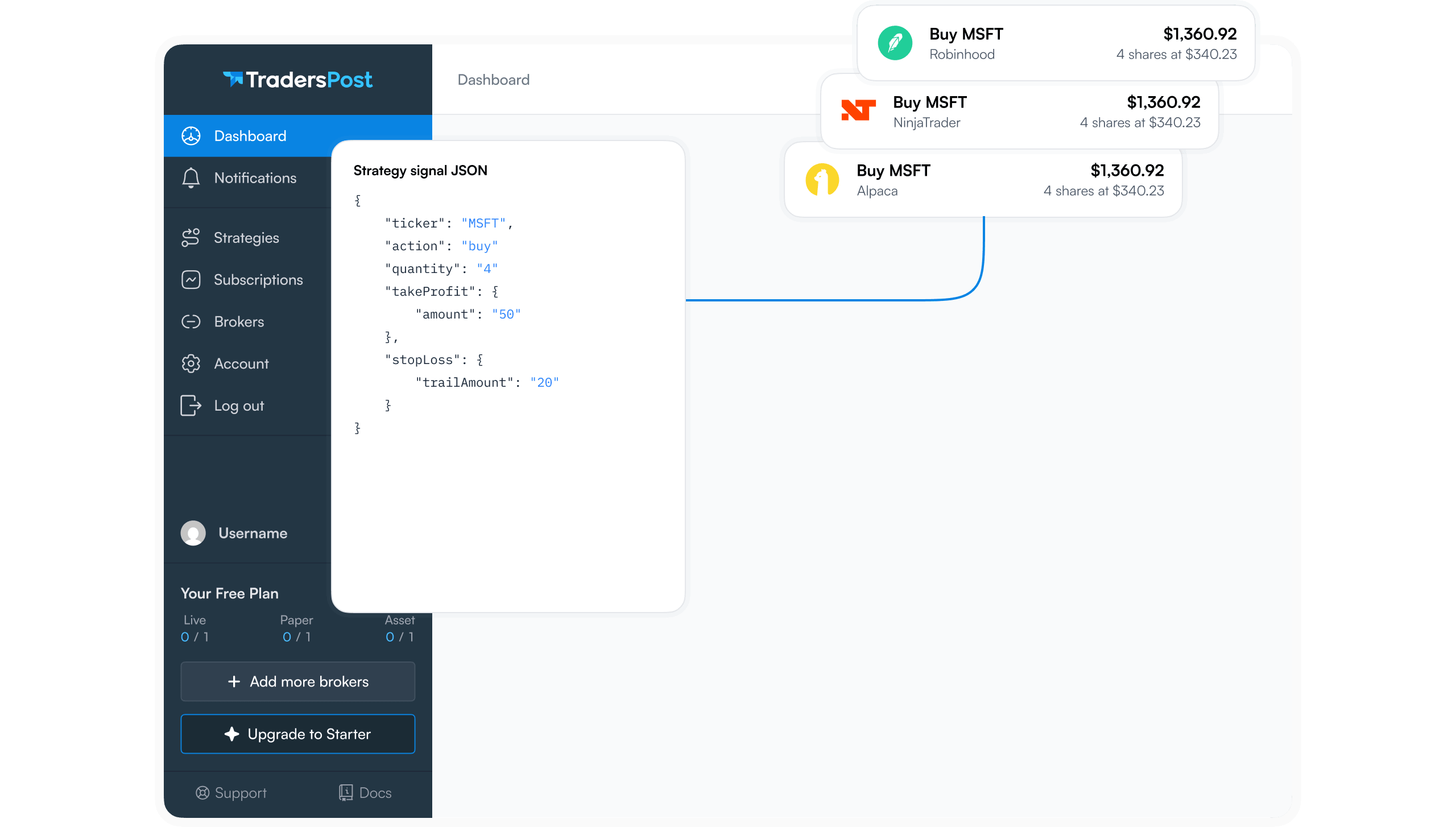
TradersPost Paper Trading Validation Guide
Learn TradersPost paper trading validation: route real TradingView or TrendSpider alerts, review fills and risk orders, then safely prepare for live trading.

Marketing

Bottom Line
- TradersPost paper trading allows real-time alert testing from TradingView or TrendSpider without risking capital, ensuring the automation workflow functions correctly.
- Paper trading validates the entire operational path, including signal creation, alert delivery, order creation, and exit behavior, rather than just the strategy concept.
- TradersPost Paper trading fills orders around the clock, which may differ from live trading conditions, especially during non-market hours.
- Default fills in TradersPost Paper trading use the bid-ask midpoint, which may not reflect the actual price received in live trading, particularly in volatile or thinly traded markets.
- Simulated positions in TradersPost Paper trading do not expire automatically, requiring manual review and closure to ensure accurate validation.
A strategy can look flawless in a chart replay and still fail when alerts arrive late, orders route differently than expected, or stops behave poorly in fast markets. TradersPost paper trading validation closes that gap by letting you send real-time TradingView or TrendSpider alerts through your intended automation workflow without putting capital at risk.1
This guide shows you how to build a meaningful validation process rather than simply watching simulated profit and loss. You will learn how to connect and route alerts, confirm that entries and exits match your strategy rules, inspect paper fills for slippage assumptions, and verify protective orders such as stop losses, profit targets, and trailing stops. You will also learn what to document during testing, including missed signals, duplicate orders, position-sizing errors, and broker-specific order behavior.
The goal is not to prove that a strategy can generate attractive backtest results. It is to establish that your alerts, automation logic, risk controls, and execution workflow operate reliably under live market conditions. By the end, you will have a practical checklist for deciding whether your setup is ready for a carefully controlled move to live trading.
Why Validate Automation With Paper Trading First
Paper Trading Tests the Automation, Not Just the Strategy Idea
A chart-based backtest can show that a signal concept has merit, but it does not prove that the automated workflow will place and manage trades as intended. Paper trading validates the complete operational path: signal creation, webhook alert delivery, TradersPost processing, paper order creation, position tracking, and exit behavior.
For example, a breakout strategy may produce a valid long signal on the chart, yet the resulting automation can still fail if the alert sends the wrong ticker, uses an incorrect action, submits an unexpected quantity, or omits the stopLoss and takeProfit instructions.2 The strategy idea may be correct while the implementation is not.
Use Paper trading to determine whether every alert produces exactly the trade you intended. Review the paper trade immediately after each signal: confirm the symbol, direction, size, entry instruction, protective exits, and the eventual position close. The objective is not merely to see simulated profit and loss. It is to confirm that the automation behaves consistently and predictably from entry through exit.
Separate Signal Quality From Execution Workflow Quality
Evaluate strategy performance and automation reliability as separate questions. Signal quality asks whether the trading rules identify worthwhile opportunities. Execution workflow quality asks whether TradersPost receives and processes each instruction correctly.
Maintain an expected-trade record before an alert fires. For each planned setup, document the intended details:
- Expected ticker and trade direction
- Expected quantity or position-sizing method
- Expected entry timing and order instruction
- Expected stopLoss and takeProfit values
- Expected exit condition, including any expiration instruction
Then compare that record with the paper trade created in TradersPost. Investigate every mismatch, even if the trade was profitable. A trade that entered with twice the intended quantity, used the wrong ticker, or lacked an exit instruction is an automation defect, not a successful validation result.
Set a Clear Validation Goal Before Starting
Define the validation criteria before enabling Paper trading. A practical checklist should verify:
- Entries occur only when the intended signals fire.
- Exits close the intended position and occur under the intended conditions.
- Position sizing matches the configured quantity, Percent of equity, or Risk percent approach.3
- Stop-loss and take-profit instructions are attached and behave as expected.
- Automation behaves correctly across multiple sessions and changing market conditions.
Set a predefined sample size. Validate a meaningful set of signals across several market sessions, rather than drawing conclusions from one or two trades. Include quiet periods, volatile sessions, consecutive signals, and situations where exits occur shortly after entry.
Do not move to live trading because the first few paper trades were profitable. Profitability can occur despite an incorrect workflow. Move forward only after the paper-trading record shows that entries, sizing, protective exits, and position tracking repeatedly match the documented expectation on every signal.
Understand TradersPost Paper Trading Behavior
Paper Fills Can Occur Around the Clock
TradersPost Paper trading can fill orders around the clock. This behavior is important when validating an automated strategy because a paper fill may be recorded at a time when the corresponding live market is closed, illiquid, or not accepting the same type of order activity.
A live order depends on the trading hours, available liquidity, and execution conditions of its market and instrument. For example, an alert received at 2:00 a.m. may produce a Paper trading fill even though the underlying equity market is closed. Similarly, an alert generated before the regular session or after the close may encounter materially different spreads and available liquidity in live trading than it does in a simulation.
Review every paper fill with its timestamp and market context. During validation, determine whether the alert was intended to trigger during regular market hours, extended hours, or any time of day. If your automation can send alerts outside normal trading hours, include those alerts in your review rather than evaluating performance solely from the reported entry and exit prices.
- Compare the fill timestamp with the intended trading session for the instrument.
- Check whether the strategy generated an alert during a period when live liquidity would likely be limited.
- Flag overnight, pre-market, and post-market fills for separate review.
Default Fills Use the Bid-Ask Midpoint
TradersPost Paper trading uses bid-ask midpoint fills by default.4 The midpoint is the price halfway between the bid and ask, which provides a neutral simulated reference point but may not fully represent the price received by a live market order.
This distinction becomes more important when spreads are wide or prices are moving quickly. A live buy order generally must interact with available offers, while a live sell order generally must interact with available bids. If an instrument has a bid of $49.80 and an ask of $50.20, the midpoint is $50.00. A paper entry at $50.00 may therefore be more favorable than a live buy that executes closer to $50.20, particularly if the market moves before the order can be filled.
Treat Paper trading results as operational validation, not as a guarantee of live execution quality. Use the simulation to confirm that alerts arrive correctly, actions are interpreted as intended, quantities are appropriate, and exits are generated when expected. Do not assume that paper profit, loss, or fill quality will transfer directly to live execution in wide-spread, volatile, or thinly traded conditions.
Simulated Positions Do Not Expire
Simulated positions in TradersPost Paper trading do not expire. An open paper position remains open until an action closes or reduces it. Do not assume that an unclosed simulated position will disappear because a trading session ends, a new day begins, or the original signal is no longer relevant.
Include an open-position review in the daily validation routine. Confirm the current position direction, quantity, entry context, and whether the strategy should still consider that position active. For example, if an entry alert opens a paper position but the expected exit alert never arrives, the position can remain open and affect subsequent validation of later alerts.
- Review all open Paper trading positions before evaluating the next session's signals.
- Investigate positions that remain open longer than the strategy's intended holding period.
- Verify that exit logic produces the expected closing action before relying on unattended automation.
Set Up a Paper Subscription for End-to-End Testing
Select a Paper Account for the Subscription
Create a new subscription, or update an existing one, so the selected account is a Paper account before sending any automated alerts.5 This establishes a zero-capital-risk environment while preserving the workflow you intend to use later.
Build the paper subscription to resemble the planned live automation as closely as practical. Use the same symbols, entry logic, position-sizing approach, order instructions, and protective exit values you expect to send in production. For example, if the eventual strategy will send a ticker, action, quantity, stopLoss, and takeProfit, validate that exact alert structure through the Paper account rather than testing only a market entry.
- Use a clear subscription name such as Paper - ES Breakout Validation or Paper - TrendSpider Swing Test.
- Avoid names that could be mistaken for a live workflow, particularly when multiple subscriptions use similar symbols or strategies.
- Keep the paper subscription separate from the future live subscription, even if both will ultimately receive alerts from the same strategy.
The goal is not merely to see whether a trade appears. The goal is to verify that the complete subscription configuration interprets the intended alerts correctly before any live account is connected.
Connect the Same Alert Source You Plan to Automate
Use the actual TradingView or TrendSpider strategy alerts intended for live automation. Do not manually recreate signals unless you are isolating a specific troubleshooting question. A manually constructed alert can confirm that a basic order instruction works, but it may not expose differences in the real strategy alert message, symbol formatting, timing, or exit instructions.
Confirm that each TradingView or TrendSpider alert source is connected to the correct TradersPost webhook configuration. Check this before evaluating results, especially if you operate multiple strategies, chart timeframes, or paper subscriptions. An alert from a 15-minute breakout strategy should not be routed through the webhook configuration intended for a daily swing system.
- Trigger alerts from the same chart, strategy, and timeframe planned for automation.
- Verify that the alert message contains the intended instructions, such as
ticker,action,quantity,stopLoss, ortakeProfit. - Test entries and exits, not just the first opening trade.
This approach validates the real path from strategy signal to webhook configuration to Paper trading subscription, which is the path that matters when evaluating automation readiness.
Start With a Controlled Test Environment
Begin with a small, easily monitored watchlist and straightforward rules. A controlled initial test might use one or two liquid symbols and a simple long-entry, exit, and protective-stop workflow. Avoid validating a new automation across dozens of symbols, multiple simultaneous positions, and complex conditional behavior before confirming basic alert handling.
Run initial tests during periods when you can review alerts and Paper trading activity shortly after each event. Prompt observation makes it easier to distinguish a strategy issue from an alert-routing or subscription-configuration issue.
Maintain a simple validation log for every test signal:
- Alert time: When the source strategy generated the signal.
- Expected outcome: For example, buy 10 shares of the intended symbol with the expected stop and target.
- Actual paper outcome: What the Paper account recorded after the alert.
- Discrepancy: Any difference in symbol, direction, quantity, protective exits, or timing that requires investigation.
Repeat this process across representative entry and exit scenarios before treating the paper workflow as validated.
Validate Webhook Alerts and Trade Instructions
Confirm the Essential Webhook Fields on Every Trade
Paper trading validation should begin with a field-by-field comparison between the strategy’s intended instruction and the paper trade created by TradersPost. For every entry, exit, or reversal test, confirm that the webhook alert contains the correct ticker, action, and quantity.
Before allowing a planned strategy signal to trigger, record the expected values in a validation log. For example, if the strategy is intended to open a 100-share long position in SPY, document:
- ticker: SPY
- action: buy
- quantity: 100
After the alert is processed in Paper trading, compare the resulting paper trade and position with those expectations. A correct result is not merely a trade in the right general direction. The symbol, trade instruction, and position size must all match the strategy’s rules. Repeat this process for short entries, exits, and any signals that change an existing position. This identifies formatting, symbol-selection, and sizing errors before they can affect a live account.
Test Protective and Profit-Taking Instructions
Validate alerts that include takeProfit and stopLoss instructions under market conditions that intentionally exercise each rule. A single successful entry test is insufficient, because the strategy’s risk controls must also produce the expected position behavior after entry.
Run at least two separate Paper trading tests:
- A trade that reaches the intended profit-taking condition, allowing you to confirm that the paper position behavior matches the takeProfit instruction and the strategy’s profit-taking rule.
- A trade that reaches the intended loss-control condition, allowing you to confirm that the paper position behavior matches the stopLoss instruction and the strategy’s stop-loss rule.
For each test, preserve the original alert payload or a written record of its instructions. Then compare the resulting paper position outcome against both the alert and the strategy specification. If the trade remains open, closes unexpectedly, or produces a position state inconsistent with the strategy rules, treat the workflow as unvalidated and investigate before enabling live automation.
Test Time-Sensitive Instructions Intentionally
Traders who use the expiration field should validate its timing behavior in Paper trading before using it with live capital. Document the expected timing before the alert is sent, including when the instruction should no longer be valid and what paper order or position state you expect to observe afterward.
Monitor the paper trade through the relevant time window and record the resulting state. This test should confirm that the timing defined in the alert aligns with the strategy’s operational rules, particularly when signals are only valid for a limited period.
Continue monitoring all open paper positions during this process. Simulated positions do not expire, so an open position can remain present even after the intended timing window has passed. Paper trading validation therefore requires both testing the expiration instruction and actively reviewing open-position state until the strategy’s intended trade lifecycle is complete.
Create a Repeatable Paper Trading Test Plan
Test the Complete Trade Lifecycle
Paper trading should validate the entire automation sequence, not only whether an entry alert creates a position. Create a checklist and run each item through a controlled test using the same alert source, ticker format, and quantity instructions you expect to use in production.
- Entry: Confirm that the alert source sends the intended ticker, action, and quantity, and that the Paper trading account opens the expected long or short position.
- Position monitoring: Confirm that the open position remains consistent with your strategy’s expected state while subsequent alerts are received.
- Exit signal handling: Send the planned exit alert and verify that the position closes as intended. Check that an exit signal does not create an unintended new position.
- takeProfit and stopLoss behavior: Where these instructions are part of the strategy, test them individually and together. Record the price levels specified in the alert and the resulting paper trade behavior.6
- Position reconciliation: Compare the strategy’s assumed position state with the position displayed in Paper trading after every entry, exit, and protective instruction.
Test both long and short scenarios only if your intended automation will trade both directions. For example, a long-only system does not need a short-entry test merely for completeness. If the strategy can re-enter after a prior trade closes, explicitly test that sequence: open a position, close it through the normal exit path, then send the next valid entry signal. Confirm that the second signal produces the expected new position rather than being ignored or treated as an exit instruction.
Include Normal, Fast, and Ambiguous Market Conditions
Observe the automation during more than one market environment. Run tests during a quiet period, an active period with frequent price changes, and a period where the bid-ask spread is visibly wider. The objective is to identify whether the strategy’s outcome depends on a narrow range of entry or exit prices.
Paper trading fills use the bid-ask midpoint by default. Treat paper results as validation of alert handling, position flow, and instruction sequencing, not as proof that every live fill will have identical price quality. A strategy that requires fills within a few cents of a signal price, particularly around rapid moves or wide spreads, deserves additional scrutiny. Record whether a small difference between the expected price and the paper fill would materially change the trade, such as causing a takeProfit or stopLoss level to be reached sooner or later than expected.
Use a Validation Log That Makes Errors Visible
Maintain a simple validation log for every test. A spreadsheet is sufficient when each row represents one alert or one completed trade lifecycle.
- Date and time
- Alert source
- Ticker
- Action
- Quantity
- Expected result
- Actual paper result
- Follow-up action
Add takeProfit, stopLoss, and expiration columns when those instructions are used. Categorize every discrepancy before changing the strategy or automation: alert logic issue when the strategy generated the wrong signal, webhook instruction issue when the alert contents were incomplete or incorrect, or execution expectation issue when the assumed paper outcome did not account for pricing or order behavior. This classification prevents unrelated changes from masking the original failure.
Review Paper Fills, Slippage Expectations, and Open Positions
Compare Expected Prices With Simulated Fills
Validate each paper trade against the market context that existed when the alert was sent. Open the chart, identify the alert candle or bar, and compare its bid, ask, last price, and spread conditions with the fill reported in Paper trading. A fill that appears reasonable on a liquid instrument during regular trading hours may be unrealistic for a wide-spread option, a thinly traded stock, or an alert triggered during a rapid move.
Default midpoint fills are simulated execution assumptions, not a promise that the same order would receive that price in a live account. For example, if an option showed a $2.00 bid and $2.40 ask when the alert fired, a simulated fill near $2.20 may be useful for testing strategy behavior, but live execution could require paying closer to $2.40 for a buy or accepting closer to $2.00 for a sell.
- Record the expected price range at the alert time, not only the chart’s closing price.
- Note spread width, volatility, and whether the market was moving through the intended entry level.
- Recalculate the trade outcome using less favorable entry and exit assumptions.
- Confirm that the strategy remains viable if live fills are consistently worse than the paper result.
Watch for Duplicate, Missed, or Unintended Trade Actions
Reconcile every planned alert with every paper trade created during the test window. The objective is not simply to confirm that trades occurred, but to confirm that exactly the intended action occurred once, on the intended instrument, at the intended size.
Build a simple validation log with the alert timestamp, ticker, intended action, intended quantity, and resulting paper trade. Review it after each session. Investigate duplicate entries, missing entries, unexpected reversals, incorrect quantities, and activity on an unintended ticker. For example, a planned buy alert for 100 shares of XYZ should not result in two entries, a sell action, 10 shares, or a trade in a similarly named symbol.
- Verify that the alert’s ticker, action, and quantity match the paper trade.
- Check whether entry and exit alerts occurred in the expected sequence.
- Review whether a stop loss, take profit, or expiration instruction created an outcome consistent with the strategy rules.
If any mismatch appears, pause further testing. Correct the alert configuration or strategy logic first, then restart validation with a clean, documented test period. Continuing to collect results after an execution mismatch can conceal the source of the problem.
Reconcile Open Positions Every Day
Simulated positions do not expire. At the end of each trading day, review every open paper position and determine whether it is still expected under the strategy’s rules. Do not assume an open position is valid merely because it remains visible in Paper trading.
Document why each position remains open: for example, the strategy is designed to hold overnight, its exit condition has not occurred, or an intended exit alert was not generated. Also note whether the open position should affect the next validation test. A remaining position can change subsequent entries, exits, or position sizing assumptions, so it must be accounted for before evaluating the next session.
Reset, Retest, and Graduate to Live Trading Carefully
Reset the Paper Account When the Test Is No Longer Relevant
Paper trading results are useful only when they represent the automation you intend to deploy. Reset the Paper trading account after a meaningful change to strategy rules, webhook instructions, quantities, or subscription setup. Otherwise, older simulated positions and trades can obscure whether the current version is behaving correctly.
For example, if an alert previously sent quantity: 1 and now uses a larger quantity, or if you add takeProfit and stopLoss instructions to an existing entry alert, prior results are not a valid sample for the revised configuration. Resetting gives the new test a clean starting point: no inherited positions, no prior exit orders, and no ambiguity about which alerts produced which trades.
- Reset after changing alert logic, including ticker, action, quantity, takeProfit, stopLoss, or expiration.
- Reset after changing the subscription configuration that delivers alerts to TradersPost.
- Reset when open simulated positions or an accumulated trade history make the current test difficult to evaluate.
- Record the reset date, strategy version, and key settings in your validation log.
A simple record such as “Reset July 10, strategy v3.2, revised stopLoss instructions, quantity 2” makes later comparisons meaningful. It also prevents a favorable result from an earlier configuration from being incorrectly attributed to the current automation.
Define Graduation Criteria Before Switching to Live
Set objective graduation criteria before enabling live automation. Do not treat a few successful Paper trading entries as sufficient evidence that the full workflow is ready. Your criteria should include a documented sample of correctly processed alerts, with each alert compared against the expected position and exit behavior.
- A validation log showing a representative sample of entry and exit alerts processed as intended.
- No unexplained discrepancies between the alert instructions and the resulting Paper trading positions.
- Confirmed takeProfit and stopLoss behavior for every exit instruction your strategy uses.
- A clear understanding that Paper trading is simulated and does not establish what live-market fills will be.
- A practical plan to monitor live automation, including alerts, positions, and exits while markets are open.
If a discrepancy occurs, resolve it before graduating. For instance, if an alert should close a position but the simulated position remains open, document the alert, the expected result, and the observed result. Retest after correcting the relevant strategy or webhook instruction.
Repeat Paper trading validation after any meaningful change to alert logic, symbols, quantities, or exit instructions. A strategy that passed validation for one symbol or position size has not automatically passed for another.
Start Live With Controlled Expectations
When moving to live trading, begin with an approach you can closely monitor. Review every live trade against the same validation log used during Paper trading: alert time, symbol, action, quantity, expected entry or exit, resulting position, and any takeProfit or stopLoss behavior.
Expect live results to differ from Paper trading. Paper trading is simulated and uses midpoint fills by default. Live fills can vary because actual execution occurs in a real market, where the available price at the time of execution may differ from the midpoint.
Graduation is not the end of validation. Continue reviewing alerts, positions, and exit behavior after going live, particularly during the first sessions and after any strategy adjustment. If the live workflow produces an unexplained result, pause expansion, document the event, and return to Paper trading to retest the affected scenario.
Frequently Asked Questions
What does TradersPost Paper trading validate?
TradersPost Paper trading helps validate the complete automation path from a TradingView or TrendSpider webhook alert to a simulated trade. It can uncover mismatches in important instructions, including ticker symbols, buy or sell actions, quantities, take-profit levels, stop-loss levels, and expiration settings. Use it to confirm that your alerts and automation behave as intended before risking real capital in a live brokerage account.
How are fills handled in TradersPost Paper trading?
TradersPost Paper trading can fill simulated orders around the clock and uses bid-ask midpoint fills by default. This makes it useful for testing whether alerts are received, interpreted, and processed correctly. However, simulated fills are not a guarantee of live-market execution quality. Real trades may experience wider spreads, delayed fills, partial fills, price movement, and slippage that are not reflected in paper trading results.
Do simulated positions expire in TradersPost Paper trading?
No. Simulated positions in TradersPost Paper trading do not expire automatically. Review open positions regularly and compare them with your intended strategy state, especially after alerts, strategy changes, or testing interruptions. If old positions make it difficult to assess current results, consider resetting the Paper account. A clean paper environment can make it easier to identify whether new alerts and exit instructions are working properly.
When should I reset my TradersPost Paper account?
Reset your TradersPost Paper account when previous simulated trades and open positions make it hard to evaluate your current automation setup. A reset is particularly helpful after meaningful changes to strategy alerts, order quantities, symbols, entry logic, take-profit instructions, or stop-loss instructions. Document the reset date and the changes you made so the next testing period has clear, comparable results and you can accurately assess performance.
When is it appropriate to move from Paper trading to live trading?
Move to live trading only after a meaningful number of alerts have processed as expected and every discrepancy has been explained or corrected. Test the full webhook workflow using the exact TradingView or TrendSpider alerts you plan to use for live automation. Continue monitoring closely after going live, since paper trading's midpoint fills do not guarantee live fill quality, spreads, slippage, or execution outcomes.
Conclusion
Paper trading validation is where an automated strategy proves whether it can operate reliably beyond a backtest. By connecting real TradingView or TrendSpider alerts, confirming symbol mappings and order settings, monitoring fills, and reviewing position and exit behavior, you can identify operational issues before they affect live capital. The goal is not simply to see hypothetical profits, but to verify that every alert produces the intended action under realistic market conditions.
Use a TradersPost Paper subscription to test your complete workflow from webhook signal to simulated execution. Run it long enough to observe different sessions, volatility conditions, and edge cases, then refine your automation based on what the data shows. Validate with Paper trading first, and move to live capital only when your strategy and execution process have earned that confidence. Start building a more dependable automated trading workflow with TradersPost today.
References
1 TradersPost Docs, Paper Trading
2 TradersPost Docs, Webhooks
3 TradersPost Docs, Position Sizing
4 TradersPost Docs, Order Behavior
5 TradersPost Docs, Subscriptions
6 TradersPost Docs, Order Classes