Alert Fatigue and Overtrading Automation
Reduce alert fatigue and overtrading automation with simpler signals, session limits, Trading Windows, and disciplined paper testing before live trades.

Marketing

Bottom Line
- Alert fatigue occurs when traders receive too many similar or conflicting signals, leading to overtrading and reduced clarity in decision-making.
- Automation can exacerbate overtrading by executing multiple trades on the same market move if alerts are not properly filtered and prioritized.
- Common signs of automation-driven overtrading include repeated entries in the same direction and trades executed outside the intended session.
- Before automating alerts, traders should create an inventory of all active alerts to identify and manage overlapping or conflicting signals.
- Each automated strategy should focus on a single, defined market condition to reduce signal noise and prevent multiple alerts from triggering the same trade.
A trading system can send a flawless alert and still produce a bad trade. When notifications stack up across indicators, symbols, and timeframes, alert fatigue overtrading automation becomes a costly feedback loop: more signals create more urgency, urgency weakens judgment, and automation turns marginal setups into repeated exposure.
This post explains how to break that loop without abandoning the speed and structure automation can provide. You will learn how to reduce duplicate or low-quality alerts, define session limits that prevent impulsive re-entry, use Trading Windows to focus execution on the market conditions your strategy was built for, and separate actionable signals from informational noise.
We will also cover why disciplined paper testing matters before any live deployment. The goal is not to build an alert system that fires constantly. It is to build one that protects attention, enforces selectivity, and places fewer trades with clearer statistical purpose.
What Alert Fatigue Looks Like in Trading Automation
How Too Many Alerts Turn Into Too Many Trades
Alert fatigue is the loss of clarity and discipline that occurs when a trader receives too many similar, conflicting, or low-quality signals. At first, each alert appears actionable. Over time, the alerts become difficult to distinguish, and the trader stops asking whether a new signal adds information or merely repeats an existing view.
Automation can magnify this problem. A discretionary trader might see a marginal long alert and ignore it because they are already long, the market has extended, or the signal arrives outside their preferred conditions. When that same alert is connected to an automated execution workflow, it can become another executed order unless the signal process contains explicit limits.
Consider a 15-minute period in which a trend indicator, a moving-average crossover, and a momentum oscillator each issue a long entry on the same chart. All three may be reacting to the same upward price move. If each alert can open a position independently, the result may be three long entries, greater exposure, and a larger loss if the move reverses. The trader has not necessarily found three opportunities. They may have acted three times on one thesis.
The Warning Signs of Automation-Driven Overtrading
Automation-driven overtrading is usually visible in the trade record before it is obvious in performance statistics. Common warning signs include:
- Repeated entries in the same direction: multiple long or short orders triggered during one market move without a deliberate plan to scale in.
- Strategy overlap: separate strategies trade the same ticker, direction, and timeframe using closely related conditions.
- Frequent reversals: a long entry is quickly followed by a short entry, then another long entry, as competing alerts react to ordinary price noise.
- Trades outside the intended session: alerts execute before the open, after the close, or during periods the strategy was not designed to trade.
- Unexplainable positions: the trader cannot identify which alert or strategy opened a position and what specific condition justified it.
A rising trade count is not evidence of improved opportunity capture. It may instead indicate duplicated logic, weak filters, or several strategies competing for the same exposure. Review a recent session trade by trade. Label every entry with the alert or strategy that triggered it, the ticker, direction, timeframe, and market condition. If several trades receive nearly identical labels, the process is likely generating redundant exposure.
Why More Signals Do Not Necessarily Mean More Edge
Multiple signals are not automatically independent confirmations. Alerts are often highly correlated when they use the same price action, the same timeframe, or indicators from the same family. A breakout alert, a moving-average signal, and a momentum threshold may all be different expressions of one underlying observation: price has recently risen.
This creates an illusion of confirmation. Three alerts can feel more convincing than one, yet each may depend on the same candle sequence and the same short-term trend. The apparent consensus does not diversify the thesis, it repeats it.
The core design principle is simple: restraint must be built into the signal process before automation is activated. Define which alert has priority, which signals are allowed to add exposure, and which signals should be ignored when a position already exists. Use Trading Windows to limit when entries may occur, and use Entry Lock where appropriate to prevent repeated entries from turning one market idea into a sequence of unintended trades.
Audit Your Alerts Before You Automate Them
Create an Alert Inventory
Before connecting alerts to automated execution, document every active alert in one inventory. Include the strategy name, market, symbol, timeframe, entry condition, direction, expected holding period, and intended session. The objective is to expose how many alerts are competing to express the same trading idea.
For example, a trader may have a 15-minute opening-range breakout alert for ES, a 5-minute high-of-day breakout alert for ES, and a moving-average trend continuation alert for ES. These may have different names and calculations, but all can produce a long entry during the same early-session expansion. List them side by side rather than treating them as independent strategies.
- Do two breakout alerts monitor the same symbol and session?
- Do multiple trend-following alerts use closely related inputs, such as price above a moving average and a moving-average crossover?
- Does one alert target an intraday move while another is intended for a multi-day position?
Apply one audit question to every overlapping group: If these two alerts trigger at the same time, would I want one trade, two trades, or no trade? If the answer is one trade, designate the preferred alert and disable, revise, or manually review the secondary signal before automation.
Find Conflicting and Duplicate Entry Conditions
Conflicts often arise when alerts use different timeframes or opposing indicator logic. A 5-minute momentum alert may issue a long signal after a sharp rally while a 1-hour mean-reversion alert issues a short signal because price is extended from its average. Both signals can be valid within their own rules, but automated execution needs a deliberate decision about which setup has priority.
Also identify duplicate conditions that repeatedly fire during a sustained move. For instance, an alert based on price closing above a prior high may trigger on several consecutive bars as new highs are made. If every trigger is treated as a new entry, one trend can create multiple positions that were never intended in the original risk plan.
- Review alert histories for repeated signals in the same direction within a single move.
- Compare long and short alerts on the same symbol across all active timeframes.
- Choose one primary alert for each setup, such as one breakout alert, one pullback alert, or one reversal alert per market.
Variations of a setup should not all execute merely because they are individually plausible. Automation requires a hierarchy: identify the alert that represents the trade you actually want, then prevent related alerts from independently creating additional entries.
Separate Entry Alerts From Position Management Alerts
New-entry alerts require different treatment from alerts intended to manage an existing position. An entry alert initiates risk. An exit or reversal alert responds to risk already on the books. Combining those purposes under vague names such as “ES signal” makes errors more likely when reviewing an alert list or assigning automation.
Define the intended action for every alert before enabling it. For each one, state whether it is meant to open a long position, open a short position, exit a long position, exit a short position, or reverse an existing position. If an alert is intended only to close a trade, it should not be evaluated as a fresh entry opportunity.
Review alert names and descriptions so the action is unmistakable. Names such as ES 15m ORB Long Entry, ES Trend Long Exit, and ES Mean-Reversion Short Entry communicate strategy, direction, and purpose. Clear labeling reduces the chance that an exit signal is mistaken for a new setup, or that multiple entry alerts are activated without recognizing their overlap.
Simplify Alert Logic to Reduce Signal Noise
Use One Clear Setup Per Strategy
Each automated strategy should trade a single, defined market condition. If a strategy cannot answer the question, “What specific market condition is this designed to trade?”, its alerts are likely too broad, overlapping, or difficult to evaluate.
A common source of signal noise is treating every indicator event as a separate trade opportunity. For example, a trader may create individual alerts for a 20/50 moving-average cross, an RSI threshold, a new intraday high, a volatility expansion, and a volume spike. During a strong trend, several of those alerts can occur within minutes of one another, even though they are all describing the same underlying move.
A cleaner design is one breakout strategy with explicit criteria:
- Price is above a defined trend measure.
- Price breaks above the prior 20-bar high.
- Current volume exceeds a specified threshold relative to average volume.
That strategy is not trading “momentum” in general. It is trading a trend-aligned breakout supported by volume. The narrower definition makes it easier to test, monitor, and improve. It also prevents multiple loosely related alerts from competing to enter the same position.
Add Confirmation Without Creating Duplicate Signals
Confirmation should strengthen one entry decision, not generate several independent orders. A trend filter, breakout condition, and volume condition can all be necessary, but they should normally resolve into one final entry alert.
For example, avoid sending one long-entry alert when the trend turns positive, another when price exceeds resistance, and a third when volume expands. If all three conditions are intended to validate the same trade, combine them so the entry alert fires only when:
- The broader trend is bullish.
- Price closes above the defined breakout level.
- Volume is above the required confirmation threshold.
This structure produces one actionable instruction rather than three partially redundant instructions. It also creates cleaner trade records because every entry represents the same fully qualified setup. If the conditions are not all required, separate them into genuinely distinct strategies with different entry logic, risk assumptions, and expected holding periods.
Prevent Repeated Entries During the Same Move
An indicator can remain true for many bars after the initial signal. Price may stay above a breakout level, volume may remain elevated, and a trend filter may remain bullish throughout the move. Without explicit entry controls, that persistent condition can repeatedly trigger alerts and create unintended additions.
Decide in advance how often each setup is permitted to enter:
- One entry per move: Enter on the initial qualified breakout, then require a reset before another signal is eligible.
- One entry per session: Allow the setup to trade once during the trading day, regardless of how often conditions recur.
- Multiple entries: Permit additional entries only when a separately defined event occurs, such as a new consolidation breakout or a pullback-and-reclaim pattern.
Position context matters. A strategy should distinguish between being flat, already holding a position, and intentionally scaling into a position. Use Entry Lock when the goal is to prevent additional entries while an existing entry is active. Repeated alerts should represent a deliberate scaling or re-entry rule, not merely the fact that an indicator has stayed true across successive bars.
Use Command Pad to Cap Session Activity
Set a Session Max Signals Limit
Use Session Max Signals in Command Pad to define the maximum number of signals that can be accepted during a trading session.1 This control creates a hard ceiling on session activity, which is especially useful when a strategy generates repeated alerts during volatile, range-bound, or news-driven conditions.
Set the limit from the strategy’s tested behavior, not from the maximum number of trades you think you can tolerate emotionally. A limit based on frustration, recent missed opportunities, or a desire to recover a loss is unlikely to remain consistent when market conditions become stressful.
For example, if paper-trading records show that a strategy performs best when it takes only one or two high-conviction entries per session, begin with Session Max Signals set to 2 while using Paper trading. Review whether those two accepted signals represent the same setups that produced the strategy’s historical results. If the strategy routinely needs more opportunities to express its edge, the data should show that clearly before the limit is increased.
- Use a lower limit for selective breakout, reversal, or opening-range strategies.
- Use the strategy’s historical signal count by session, not its best single day, as the starting reference.
- Track accepted signals, skipped signals, and outcomes before changing the cap.
Use Auto Lockout as a Deliberate Stop Point
Auto Lockout can stop additional session activity after the defined signal limit is reached. Its value is not merely that it blocks another alert. It creates a predetermined end point for the strategy’s session, reducing the temptation to keep accepting signals after a busy sequence, a choppy market, or several rapid-fire alerts.
Treat a lockout as a process-control event. Once the session limit has been reached, do not use the remaining market movement as evidence that the limit was wrong. A market can continue moving after your strategy has completed its planned activity. That does not mean additional signals would have met the same entry criteria, risk assumptions, or expected-value profile.
Before beginning a new session after a lockout, document what you will review:
- Whether accepted signals matched the strategy’s defined setup conditions.
- Whether the signal count was unusual relative to prior sessions.
- Whether execution, stops, and exits behaved as intended.
- Whether any proposed setting change is supported by a meaningful paper-trading sample.
Choose a Limit That Matches the Strategy, Not the Market Hype
Do not raise Session Max Signals because the market is moving quickly, social channels are focused on a ticker, or recent trades were missed. Those conditions often increase alert volume and emotional urgency at the same time, precisely when session controls are most valuable.
Start conservatively, collect Paper trading results, and adjust only when the data supports a change. For instance, if a strategy is capped at two signals but repeated testing shows a third qualifying signal improves results without materially changing drawdown or execution quality, test a higher cap in paper trading before relying on it in a live workflow.
Session controls should enforce a predefined trading plan. They should never become a convenient setting to loosen whenever the market appears to offer more action.
Use Trading Windows to Stop Late or Low-Quality Entries
Define the Hours When New Entries Are Allowed
Alert fatigue becomes expensive when an otherwise valid alert arrives outside the period in which the strategy has demonstrated an edge. A Trading Window sets a clear boundary: the automation may accept new entries only during the hours you have selected.2 This converts a discretionary judgment, such as “this setup is usually best early,” into an enforceable rule.
Select entry hours from evidence, not preference. Review backtests by time of day, then confirm the result through forward testing or Paper trading. The window should reflect the strategy’s intended market behavior. An opening-range breakout strategy may depend on concentrated volume, expanding ranges, and price discovery shortly after the regular session opens. A midday trend strategy may instead require the market to establish direction before it can produce higher-quality continuation signals.
- Example: If an opening-range setup has been validated only during the first 90 minutes of the regular session, configure Trading Windows to allow new entries from the open through that 90-minute period.
- Do not extend the window simply because an alert occurred later and would have been profitable in isolation.
- Evaluate missed alerts as a group. A valid window should improve the distribution of accepted trades, not capture every possible move.
Prevent End-of-Session Alert Chasing
Late-session alerts often create the exact conditions that lead to automation overtrading: urgency after a missed move, thinner liquidity in some instruments, sharp reversals as participants rebalance risk, and an attempt to recover earlier missed opportunities before the session ends. Even when the signal logic is unchanged, the execution environment and remaining time available for the trade may be materially different.
Set the end of new-entry eligibility before the final portion of the session you trade. For example, a strategy designed for regular-session momentum might stop accepting new entries 30 to 60 minutes before the close, provided testing supports that cutoff. This prevents a stream of late alerts from becoming a sequence of lower-quality entries.
Important: Ending a Trading Window for new entries is not the same as automatically closing open positions. A cutoff controls whether new trades may be initiated. Position exits should remain governed by the strategy’s separate exit logic, such as its stop-loss, profit target, or other planned risk management rules.
Match Trading Windows to Each Strategy’s Purpose
Use separate Trading Windows when strategies have genuinely different roles. An opening-range setup can have an early-session window because it is designed to trade initial range expansion. A trend-continuation setup may use a later window because it requires an established intraday trend, a pullback, and renewed participation. Treat these as distinct hypotheses with distinct validation records.
Do not create numerous overlapping windows to accommodate every alert pattern. That often masks a larger problem: too many strategies, too many exceptions, or insufficient selectivity in the underlying signals. Each additional window should correspond to a defined market condition and a tested strategy purpose.
- Keep a window when its trades have a measurable, repeatable rationale.
- Review windows that produce frequent alerts but weak expectancy after costs and slippage.
- Remove a window if its main purpose is to justify marginal trades that fall outside the strategy’s original design.
Consolidate Overlapping Strategies and Webhook Alerts
Decide Which Strategy Owns Each Market Condition
Assign one primary strategy to each market condition before alerts reach execution. A breakout strategy should own expansion through a defined range or prior high. A pullback strategy should own retracements into trend support. A mean-reversion strategy should own statistically stretched moves back toward a reference level. If multiple strategies can claim the same setup, the automation is likely to produce duplicate entries rather than independent trades.
Two strategies should trade the same condition only when their roles, timing, and risk are demonstrably different. For example, one strategy may enter on the initial breakout with a defined stopLoss, while another enters only after a confirmed retest and uses a separate Trading Window. Those are distinct opportunities if their entry criteria, expected holding period, and maximum exposure have been tested separately. Two alerts that both buy the same breakout within seconds of each other are not diversification.
Consolidate similar logic whenever possible. If one momentum strategy buys when price crosses a session high and another buys when a momentum indicator confirms the same move, combine them into one strategy with one final entry signal. The consolidated strategy can require both conditions, send one action, and apply one position-sizing rule. This reduces alert volume and makes post-trade review much clearer.
- Breakouts: assign one strategy to initial range expansion.
- Pullbacks: assign a separate strategy only if it enters after a defined retracement.
- Mean reversion: prevent it from entering against a breakout unless that conflict is intentional and tested.
Keep Webhook Instructions Consistent
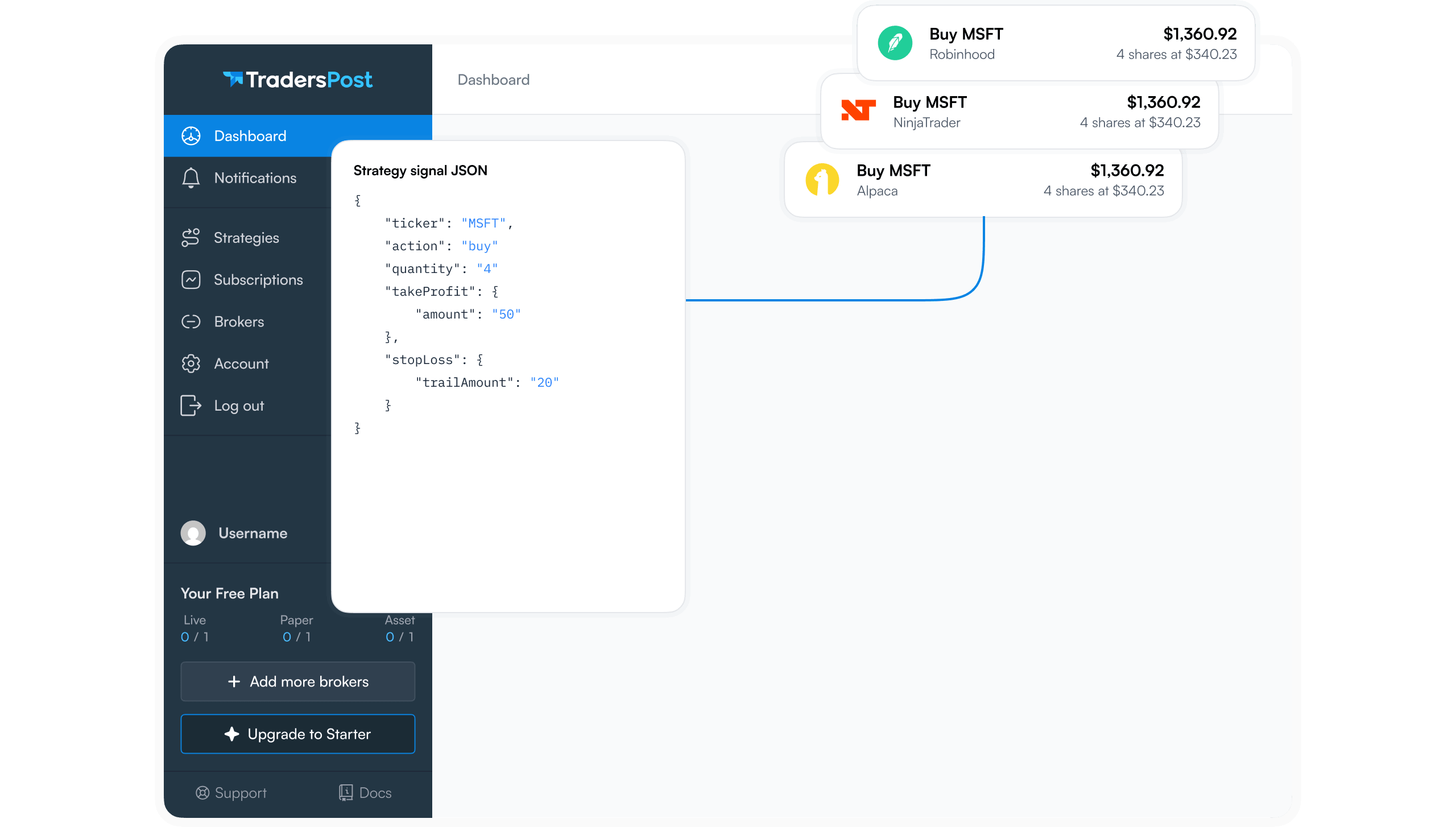
Standardize the instructions sent by every alert. Each webhook should use the same clear structure for ticker, action, quantity, takeProfit, stopLoss, and expiration when those fields apply to the strategy.3 Consistency makes alerts readable, comparable, and easier to audit during Paper trading.
For example, if two strategies both intend to buy the same ticker, their alerts should make any difference explicit. One might send a smaller quantity with a tighter stopLoss for a breakout entry, while another sends a different quantity only for a later pullback entry. If the alerts contain inconsistent quantities, omitted protective levels, or conflicting expiration instructions without a documented reason, they may be expressing the same trade idea differently.
Review webhook instructions side by side before a session. Look for duplicate ticker and action combinations, especially when alerts can occur during the same Trading Windows. This review often exposes overlapping strategies before they compound exposure in live execution.
Use Different Quantities Only When the Reason Is Tested
Do not increase quantity merely because several alerts point in the same direction. Multiple bullish alerts may reflect the same underlying price move, not multiple independent sources of edge. Treat correlated alerts as one exposure decision unless testing proves that separate entries improve risk-adjusted results.
Define quantity rules before the session begins. A strategy might use a fixed quantity, Percent of equity, or Risk percent, but the rule should be established in advance and applied consistently during Paper trading.4 Document when a strategy is permitted to use a different quantity, such as a lower size for countertrend mean reversion or a reduced size after an extended breakout.
Overlapping signals should never silently compound exposure. If two alerts can create a larger combined position, that outcome should be intentional, documented in the strategy plan, and supported by testing rather than created accidentally by alert frequency.
Paper Trade the New Rules Before Going Live
Test the Entire Automation Workflow
Use Paper trading to validate the complete automation path, not merely the chart condition that produces an alert.5 A strategy can look selective on a chart yet still create excessive trade activity if alerts arrive unexpectedly, overlap, or occur outside the intended session. Test alert generation, webhook delivery, session controls, Trading Windows, and the resulting trade behavior as one connected workflow.
Run the strategy through active market periods and deliberately choppy conditions. Record whether Session Max Signals stops additional signals at the intended threshold and whether Auto Lockout engages when the strategy reaches its defined limit. For example, if a mean-reversion system permits three signals per session, verify that a fourth alert does not produce another trade after the session limit has been reached.
- Send or simulate multiple alerts within a short interval to see how the automation handles clustered setups.
- Observe signals that occur just before a Trading Window closes, especially when an alert is generated near the end of the permitted entry period.
- Confirm that signals outside the intended session are blocked rather than creating trades after hours.
- Review whether repeated alerts from the same market condition create unnecessary activity or are appropriately prevented by your rules.
Measure Trade Quality, Not Just Trade Count
A lower number of trades is not automatically better, but a high number of alerts is not evidence of opportunity. Maintain a test log that separates total signals, accepted signals, blocked signals, and duplicate setups avoided. Then assess the quality of the trades actually taken: entry context, follow-through, adverse movement, and whether the trade matched the strategy's stated conditions.
Compare two paper-trading versions over the same market conditions: a high-alert version that accepts most qualifying triggers and a simplified version with tighter filters, narrower Trading Windows, or lower session limits. If the simplified version produces fewer but more consistent entries, the removed alerts may have been noise rather than missed opportunity.
Review each blocked alert individually. Ask whether it would have been a genuinely distinct setup with positive expectancy, or whether it was another expression of the same weak, crowded, or late-session condition. This distinction matters because alert fatigue often arises from treating repeated information as new information.
Move to Live Trading Gradually
After the rules perform as intended in Paper trading, move to live trading with conservative quantities and keep the same controls that were validated during testing. Do not assume that a few profitable sessions justify raising trade frequency, expanding trading hours, or removing session limits. Those changes create a new strategy and should be tested separately.
Avoid disabling Session Max Signals, Auto Lockout, or Trading Windows because recent conditions appear unusually favorable. Increasing activity in response to fear of missing out is precisely the behavior these controls are designed to prevent. Automation should enforce discipline, not automate impulsive behavior.
Frequently Asked Questions
What is alert fatigue in automated trading?
Alert fatigue happens when you receive so many similar, conflicting, or low-quality trading alerts that it becomes difficult to recognize which setups actually matter. In automated trading, this can quickly turn into overtrading because signals may be sent and executed without the manual pause that normally prompts review. The result can be unnecessary entries, duplicated positions, and trades that do not align with your broader strategy.
How can I stop my trading automation from overtrading?
Start by auditing your alerts and removing duplicate, conflicting, or low-conviction signals. Consolidate overlapping strategies into a smaller set of clearly defined setups. In TradersPost, use Session Max Signals and Auto Lockout in the Command Pad to create session-level guardrails. Trading Windows can also restrict when new entries are accepted. Before going live, paper trade the revised workflow to confirm that alert frequency and execution behavior match your plan.
Does TradersPost have a daily trade cap?
TradersPost does not have a built-in daily trade cap. That makes it important to build restraint into your alert logic and automation workflow rather than relying on a platform-wide limit. Review how often each strategy can trigger, eliminate redundant alerts, and use Command Pad session controls such as Session Max Signals and Auto Lockout. You can also use Trading Windows to limit when new entries are accepted during the day.
Can Trading Windows automatically close open positions?
Trading Windows can be used to prevent new entries from being accepted during specified times, helping you avoid trading outside your preferred sessions. However, they should not be treated as an automated end-of-day close or position-flattening tool. If you need to close positions before a market close, overnight session, or news event, your automation should include explicit exit logic or a separate closing instruction designed for that purpose.
Which alert platforms can send automated signals to TradersPost?
Traders can connect webhook alerts from TradingView or TrendSpider to TradersPost.6 Before using either platform for live automation, paper test your alerts and verify that every instruction is formatted correctly. This includes fields such as ticker, action, quantity, takeProfit, stopLoss, and expiration when applicable. Clear, consistent alert messages reduce execution errors and make it easier to identify whether an unexpected trade came from your strategy logic or alert configuration.
Conclusion
Alert fatigue is rarely solved by adding more indicators, notifications, or automated entries. It is solved by reducing decisions to a small set of high-conviction conditions, defining when a strategy should remain inactive, and treating automation as disciplined execution rather than a source of constant action. The strongest workflows prioritize signal quality, position limits, and clear risk controls over trade frequency.
Before committing capital, simplify one strategy and map every alert to a specific action, including entry, exit, sizing, and stop conditions. Then connect your TradingView or TrendSpider webhook alerts to TradersPost and validate the complete workflow in paper trading. Review fills, duplicate-alert handling, timing, and risk behavior under realistic market conditions before going live.
Take the next step with a cleaner automation process: build fewer, better signals, test them thoroughly, and let TradersPost help execute your plan with consistency. Start refining your workflow today.
References
1 TradersPost Docs, Command Pad
2 TradersPost Docs, Order Behavior
3 TradersPost Docs, Webhooks
4 TradersPost Docs, Position Sizing
5 TradersPost Docs, Paper Trading
6 TradersPost Docs, TradingView Signal Source