Automated Trading Bot Failures: Prevent Them
Learn why automated trading bot failures happen—from fast-market fills to option errors and conflicting signals—and build tested alert workflows before live use.

Marketing

Bottom Line
- Automated trading bot failures often begin with small issues like stale quotes or conflicting orders, which can lead to costly mistakes in fast markets.
- Common failure patterns include fast-market orders not filling as expected, option alerts targeting the wrong contract, and repeated or opposing alerts creating unintended exposure.
- To prevent failures, implement safeguards such as pre-trade validations, position and order reconciliation, the ability to quickly disable a strategy or lock new entries, and controlled paper-trading workflows.
- Fast-market conditions can cause significant price discrepancies, with expected entry prices differing by $0.05 to $0.20 during rapid moves.
- Ensure option contract details are correct by verifying the underlying symbol, option ticker, action, quantity, and expiration before live trading.
Automated trading bot failures rarely begin with a dramatic system crash. More often, they start with a stale quote, an unexpected partial fill, a misread options contract, or two strategies sending opposing orders at the same time. In fast markets, those small gaps can turn a well-designed ruleset into an expensive live-trading mistake before anyone notices the alert.
This post breaks down the operational weaknesses that cause bots to behave differently in production than they did in backtests. You will learn how fast-market execution, option-chain data errors, position-state mismatches, conflicting signals, broker API limits, and weak notification logic can undermine an otherwise sound strategy. More importantly, you will see how to build practical safeguards: pre-trade validations, position and order reconciliation, the ability to quickly disable a strategy or lock new entries, escalation alerts, and controlled paper-trading workflows.
The goal is not to eliminate every loss. It is to prevent avoidable errors from becoming uncontrolled exposures, so your automation can fail safely, surface problems quickly, and earn the right to trade live capital.
Why Automated Trading Bot Failures Happen
Automation Follows Instructions, Including Flawed Ones
Most automated trading failures are traceable, not mysterious. A bot can act exactly as instructed and still produce an undesirable result when the instruction was ambiguous, the selected option contract was incorrect, the strategy contained conflicting conditions, or the trader expected execution that the market could not provide.
It is important to separate four distinct events:
- Signal generated: Your charting or strategy logic identifies a condition, such as a moving-average crossover or breakout.
- Webhook alert sent: The alerting platform sends the configured message to TradersPost.
- Order submitted: TradersPost sends the requested order to the connected broker.
- Order filled: The broker executes some or all of the order against available market liquidity at an executable price.
Each step can succeed while the next produces a different outcome than expected. For example, a valid signal may generate a webhook alert, the alert may submit a marketable order, and the order may still fill at a worse price during a rapid move. Likewise, an option alert may be delivered correctly but reference an expiration or strike that does not match the intended position.
Automation improves consistency by removing hesitation and applying the same rules repeatedly. It does not guarantee fills, eliminate slippage, resolve contradictory strategy logic, or transform an untested entry rule into a reliable trading system. Test alert content, contract-selection rules, sizing assumptions, and exit behavior in Paper trading before risking capital.
The Three High-Impact Failure Patterns to Plan For
Three scenarios account for a large share of preventable automation problems. They should be treated as design and operating risks, not automatically as platform failures.
- A fast-market order does not fill as expected: During a sharp move, available liquidity can disappear, spreads can widen, and the execution price can differ materially from the chart price that triggered the alert. A Stop Market order can become a market order once triggered, so its fill price is not fixed.1 Define the acceptable execution risk before deployment and document what you will do if an entry fills late, partially, or at an unfavorable price.
- An option alert targets the wrong contract: A payload can identify the wrong ticker, expiration, strike, or option type. A call intended for the next weekly expiration can become a trade in a different expiration if the alert logic is not explicit. Validate the alert payload, including ticker, action, quantity, and expiration, against a known test case before enabling live automation.
- Repeated or opposing alerts create unintended exposure: A repeated entry alert can increase position size, while a close or reversal alert arriving near a new entry can produce a position that differs from the strategy’s intended state. Use clear, mutually exclusive signal conditions, test alert sequencing in Paper trading, and consider Entry Lock where it fits the strategy’s operating rules.
Build a response plan for each scenario: pause the affected automation, verify the broker position and working orders, compare the received alert with the intended signal, and correct the logic before resuming. Market conditions, broker execution behavior, and alert design all influence results. Clear alert logic, payload checks, Paper trading, and documented intervention procedures reduce the chance that a small configuration error becomes a large trading error.
Scenario 1: Missed Fills in a Fast Market
What a fast-market failure can look like
Consider an anonymized breakout strategy trading a liquid stock shortly after the opening bell. A price alert triggers when the stock clears a defined resistance level, and the trader expects an entry near $50.00. By the time the alert is delivered and the order reaches the market, the stock may be trading at $50.35, $50.60, or lower after an immediate reversal. The signal was valid according to the strategy rules, but the expected fill price and timing were no longer available.
A valid alert is not a guarantee of execution at a particular price. During sharp moves, displayed prices can change several times in a second, liquidity at the current bid or ask can disappear, and a move through a breakout level can be brief. This matters especially for strategies designed to capture a few cents or a narrow intraday range.
Backtests and chart markers can make this sequence appear cleaner than it is.2 A chart may show an entry precisely at the breakout bar or at a selected historical price, while live execution must occur after the alert is generated and market conditions continue to change. Historical bars also cannot fully show how much liquidity was available at a given price when the signal occurred.
Separate signal quality from execution reality
When a trade does not fill as expected, evaluate the signal and the execution as separate events. Start by reviewing:
- The alert timestamp.
- The intended ticker.
- The requested action.
- The market price and price movement around the time the alert occurred.
- Whether the order was submitted as intended.
Document the outcome precisely. Did the alert arrive after the breakout had already extended? Did the order reflect the intended ticker, action, and quantity? Did the market move materially before a fill could occur? These questions distinguish a strategy signal issue from a real-world execution issue.
Strategies dependent on narrow intraday moves are generally more sensitive to these differences. A strategy seeking a $0.10 continuation after a breakout may be materially affected by a $0.05 to $0.20 execution difference. A slower, higher-timeframe strategy that targets a multi-day move may still require disciplined execution, but a small delay or modest price variation is less likely to invalidate the trade thesis.
Prevent fast-market surprises before they matter
Use Paper trading to test the exact alert-to-order workflow during the same sessions and instruments planned for live trading. If the strategy trades opening breakouts, test it during the open. If it operates near the close, test it during the close. Quiet midday conditions are not an adequate substitute for the market environment the strategy is designed to trade.
- Track how often alerts occur during volatile periods.
- Compare the chart-assumed entry with the observed market price when the alert fires.
- Record whether the strategy remains viable when fills differ from the idealized chart entry.
- Test multiple market conditions, including ordinary sessions, high-volume opens, reversals, and busy closing periods.
After Paper trading validates the alert workflow, begin live trading with a deliberately small quantity.3 Do not treat one clean test or one successful live trade as evidence that the process is robust. A reliable automation workflow must remain understandable and acceptable when prices move quickly, liquidity changes, and the market does not offer the entry shown on a historical chart.
Scenario 2: The Wrong Option Expiration or Strike
How One Contract-Detail Mistake Changes the Trade
An options automation can receive a correct directional signal and still open the wrong position. For example, a trader intends to automate a near-term call on an underlying trading at $100, targeting the $102 call expiring this Friday. The alert instead references a call with the same underlying but a later expiration, or a higher strike left over from a prior test. The resulting order may still be a call, but it has materially different delta, theta exposure, premium, liquidity, and probability of expiring in the money.
This mistake is easy to miss because option contracts often look nearly identical at a glance. A one-week expiration versus a one-month expiration can produce very different risk characteristics.4 Likewise, selecting a $105 call instead of a $102 call may turn a moderately directional position into a lower-delta, more speculative contract. Automation will act on the contract information it receives. It does not infer the trader's intended expiration, strike, or moneyness from a bullish or bearish signal.
Contract selection must therefore be deliberate. Treat the option ticker and expiration in every alert as trade instructions, not as minor implementation details.
Build a Contract-Validation Checklist
Before creating or enabling a live alert, validate the complete contract instruction:
- Verify the underlying symbol matches the intended asset.
- Verify the option ticker identifies the intended call or put, strike, and contract series.
- Confirm the intended action, such as buying to open or closing an existing position, and verify the quantity.
- Confirm the expiration in the alert matches the trading plan. Do not assume it is correct because the strategy logic is correct.
- Check that no expiration, strike, or ticker value was carried over from a prior test, copied alert, or strategy template.
Use a repeatable naming convention in the originating strategy or alert message. For example, a label such as SPY_CALL_102_WEEKLY_BREAKOUT makes it easier to identify the intended setup than a generic name such as “Call Entry.” The label should let a trader quickly distinguish the underlying, direction, strike concept, and expiration type during review.
Also review every change made to a TradingView or TrendSpider strategy. A revised symbol, updated contract selection, or copied script can leave an existing alert pointing to an earlier option contract. Never assume an alert remains correct after modifying the strategy that generated it.
Paper Trade Contract Selection, Not Just Strategy Direction
A Paper trading test should validate more than whether a bullish signal produces a call order or a bearish signal produces a put order. Test whether the alert references the exact contract intended for that setup.
Run Paper trading scenarios that deliberately vary expiration and strike selection. For example, test a near-term at-the-money call, a later-dated call, and an out-of-the-money call on the same underlying. Review the alert details for each case and confirm that the option ticker, expiration, action, and quantity reflect the intended contract.
Require a manual review whenever the strategy, ticker, strike selection, or expiration changes. Only allow live automation after the revised alert has been checked in Paper trading and the contract details have been confirmed. A correct signal is not sufficient if it routes to the wrong option exposure.
Scenario 3: A Runaway Bot From Conflicting Signals
How Conflicting Alerts Create Unintended Exposure
A runaway sequence can occur when multiple alerts are individually valid but collectively uncoordinated. For example, a trend-following strategy may send a buy alert for a ticker after a breakout, while a reversal strategy monitoring the same ticker sends a sell or short alert when an overbought condition appears. As price moves rapidly, the two alerts can produce repeated entries, exits, or opposing actions that create exposure the trader never intended.
The automation may be functioning exactly as instructed. The problem is not necessarily a faulty bot, it is that each active alert is acting independently without regard for the other strategy's objective, current position, or priority. Common causes include:
- Duplicate alerts firing from the same market condition.
- Overlapping strategies that trade the same ticker using different entry logic.
- Alerts left active after a strategy revision or replacement.
- A Paper trading alert and a live alert that were both retained during testing.
- Separate chart layouts, platforms, or strategy versions sending signals to the same automation.
Consider a trader running a breakout strategy and a mean-reversion strategy on the same ticker. The breakout alert sends a buy action with a quantity of 100 shares. Minutes later, the mean-reversion alert interprets the extension as a reversal setup and sends an opposing action. If both remain active, subsequent price movement can trigger a sequence of competing orders rather than a single, deliberate trade plan.
Audit Every Active Alert Before Live Deployment
Before enabling live automation, create an alert inventory. Do not rely on memory, chart labels, or strategy names alone. List every alert that can reach a trading workflow, including alerts created for prior testing.
- Originating platform: Identify where the alert was created.
- Ticker: Record the instrument each alert can trade.
- Strategy purpose: Classify it as trend-following, reversal, breakout, hedging, or another defined role.
- Action and quantity: Document the intended action and order size.
- Environment: Mark whether it is intended for Paper trading or live trading.
Review the inventory for duplicates, outdated alerts from earlier strategy versions, and separate strategies trading the same ticker without coordination. Where two valid strategies can disagree, define the priority in advance. For example, a trader may decide that a reversal signal cannot open a new position while a trend-following position remains active, or that only one strategy is authorized to initiate entries for a specific ticker.
Make one change at a time. If you revise an alert, disable or remove the superseded version before evaluating the replacement. Multiple simultaneous changes make it difficult to determine which change caused a behavior shift.
Contain an Unexpected Sequence Immediately
When alerts begin producing unexpected actions, stop new exposure first. Do not attempt to diagnose a rapidly changing sequence while alerts remain capable of sending additional instructions.
Use Disable when automation should be stopped while you investigate the alert source and trade history. Use an Entry Lock when the objective is temporary protection from new entries during a known high-risk period or while reviewing a signal conflict. A timed Entry Lock is particularly useful around scheduled events or during a controlled review window.
After containment, trace the sequence precisely: identify which alert fired, the ticker, action, and quantity it sent, then determine whether another active alert could repeat or oppose that behavior. Do not restore automation until the conflicting alert is disabled, revised, or assigned a clear priority within the overall trading plan.
Design Webhook Alerts That Are Easier to Verify
Keep Each Alert Payload Clear and Purposeful
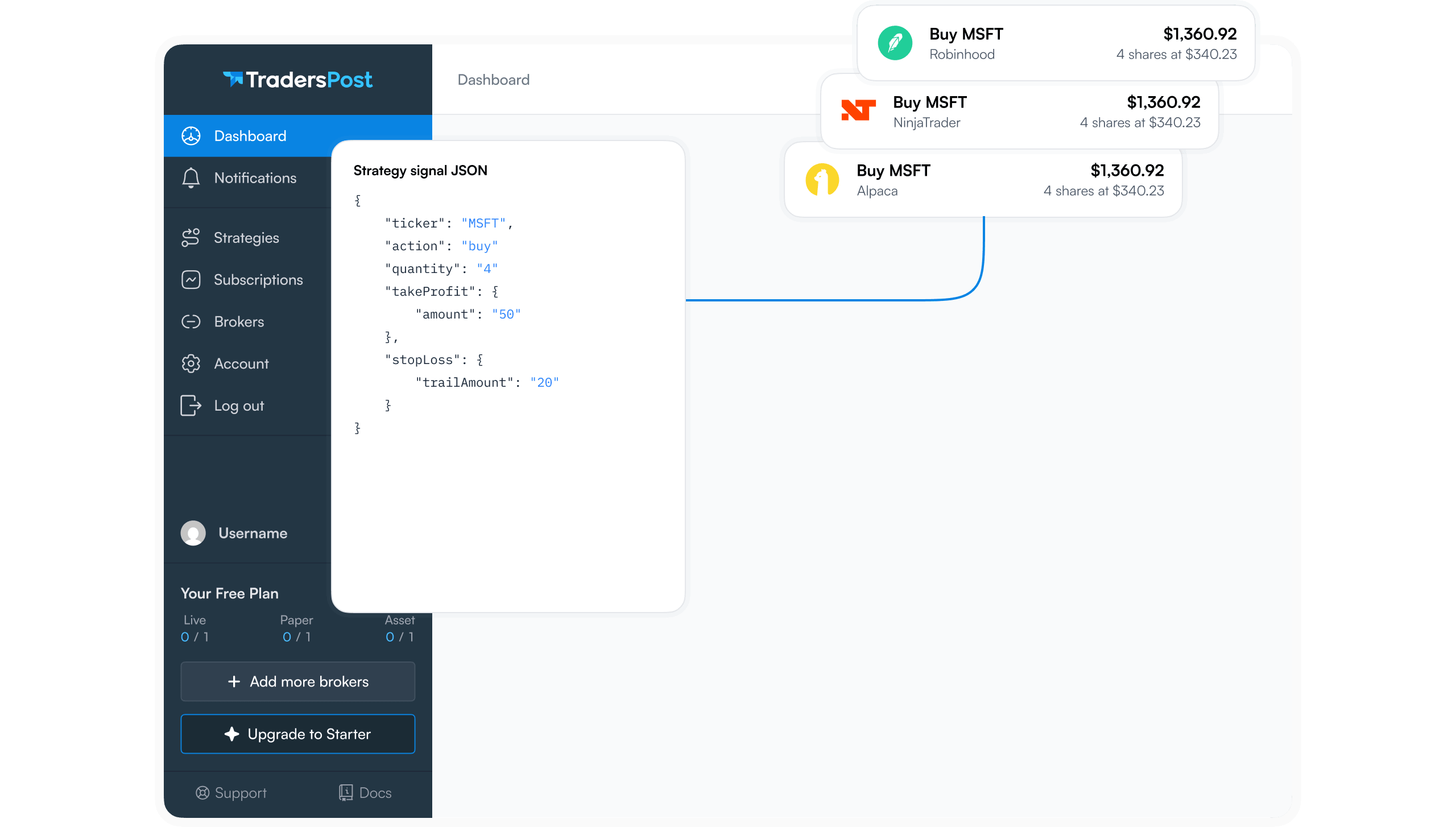
A webhook alert should contain only the instructions required to express one intended trade.5 Excess fields make review harder and increase the chance that a copied value conflicts with the current strategy. Before enabling live automation, validate every value against the chart, the written strategy rules, and the instrument being traded.
- ticker: Confirm that it identifies the exact instrument intended for the trade. A similar-looking symbol, an ETF instead of an individual stock, or an outdated futures contract can produce a materially different position.
- action: Verify that the instruction matches the signal direction and the existing-position logic. A long-entry condition should not produce an unintended exit or opposing order.
- quantity: Check that the size reflects the current account allocation and strategy risk limit, not the quantity used during an earlier test.
- takeProfit and stopLoss: Ensure these values correspond to the planned exit levels for this specific entry, instrument, and timeframe.
- expiration: For options strategies, confirm that the expiration matches the contract cycle specified in the trade plan. Do not assume a previously used expiration remains appropriate.
For example, an alert for a short-dated options setup may have been built around a particular expiration and quantity. Reusing that payload for a later signal without reviewing the ticker, expiration, and exit levels can turn a valid alert format into the wrong trade. Treat every copied payload as a new order instruction that requires a fresh check.
Use Take-Profit and Stop-Loss Instructions Consistently
takeProfit and stopLoss should be defined by the strategy before the alert is placed into live use. They are not fields to add hastily after a signal has already been automated. A predefined exit plan makes the alert easier to audit because entry, target, and invalidation level can be reviewed together.
Test the alert instructions against the written trading rules. If the strategy calls for a profit target at two times initial risk and a stop at the level where the setup is invalidated, the payload should reflect those rules exactly. If the strategy uses fixed percentage exits, verify that the resulting price levels are sensible for the current instrument.
Exit instructions do not eliminate gap risk, liquidity risk, or the possibility of execution at a price different from the intended level. They do, however, reduce the need to improvise after an entry has been submitted. Consistency is especially important when several alerts can trigger across different symbols or timeframes.
Change Control Prevents Accidental Regressions
Save a record of a working alert configuration before making edits. Preserve the alert text and note the associated strategy condition, ticker, quantity, expiration, take-profit level, and stop-loss level. This creates a reliable comparison point when a later change produces unexpected behavior.
After changing a ticker, quantity, expiration, or strategy condition, return the automation to Paper trading before re-enabling live trading. Review the resulting intended trade, not just whether an alert was received. A payload can be syntactically valid while still carrying an outdated quantity or incorrect contract detail.
For traders working with partners, educators, or signal providers, use a simple two-person review:
- One person makes the alert change.
- A second person checks the ticker, action, quantity, takeProfit, stopLoss, expiration, and triggering condition against the documented trade plan.
This separation helps catch small edits that can create large position-level errors.
Test in Paper Trading Before Going Live
Test the full workflow, not only the strategy idea
A profitable backtest or a valid chart signal is not sufficient evidence that an automated bot will behave correctly. Paper trading should verify the complete execution chain: the signal condition in your charting platform, alert creation, webhook payload, automated order intent, and the planned exit instructions.
Test using the same market hours, symbols, and order scenarios you intend to trade live. A signal that works during regular equity hours may behave differently when tested on an option contract, a thinly traded instrument, or near the market close. If your bot trades options, include an expiration workflow in the test rather than assuming the underlying ticker logic will translate correctly.
- Trigger a long entry and confirm the intended ticker, action, and quantity.
- Trigger a short entry, if your strategy uses short positions.
- Trigger an exit signal and verify that it closes the intended position.
- Send a take-profit instruction and confirm the takeProfit value matches the trading plan.
- Send a stop-loss instruction and confirm the stopLoss value matches the trading plan.
- For options, test the intended expiration workflow before relying on it in live trading.
For example, if the plan is to buy 2 contracts of an option expiring on a specific date with a defined profit target and stop loss, the Paper trading test should produce that exact order intent, not merely an order in the correct underlying symbol.
Define what passing a Paper trading test means
Paper trading should have measurable acceptance criteria. A test passes only when the correct ticker appears, the intended action is used, the quantity is correct, and any included takeProfit, stopLoss, or expiration details match the trading plan.
Do not promote a strategy to live trading after one successful alert. Run multiple examples across the conditions the strategy is expected to encounter, including entries, exits, and any alternative sizing or option-selection logic. Record the expected order intent before each test, then compare it with what the Paper trading workflow produced.
Also test failure handling deliberately. Disable an alert and confirm that no unintended order is created. Revise a quantity and verify that the new instruction is reflected as expected. Apply a temporary Entry Lock and observe how the workflow behaves when new entries are restricted. These tests turn operational controls into familiar tools rather than last-minute decisions during a live incident.
Understand when retries are and are not relevant
TradersPost retries only when a temporary server error occurs.6 That behavior can help when a temporary delivery or service issue interrupts an otherwise valid request, but it cannot repair trading instructions that were wrong when sent.
A retry will not correct a flawed ticker, an incorrect quantity, an unintended expiration, or conflicting signal logic. If an alert says to buy the wrong instrument or sends an oversized quantity, repeating the same alert repeats the same configuration mistake.
Treat alert validation and Paper trading as the primary safeguards. Confirm the webhook payload and resulting order intent before going live, then use controls such as Entry Lock as part of an intentional operating procedure, not as a substitute for testing.
Create a Bot Failure Response Plan
Use a Simple First-Five-Minutes Checklist
When a bot behaves unexpectedly, the priority is containment, not diagnosis. Follow a fixed sequence so a stressful event does not become a larger exposure problem:
- Prevent additional unintended entries. Use Disable or apply a timed Entry Lock immediately. This stops new automation-driven entries while preserving time to assess the situation.
- Review current exposure. Check every open position, pending order, and option contract affected. Decide whether manual action is required under your pre-defined risk plan. For example, if an alert opened twice the intended option quantity, determine whether reducing the excess position is required before investigating why it occurred.
- Capture the alert details. Identify the originating TradingView or TrendSpider alert and record the ticker, action, quantity, and any takeProfit, stopLoss, or expiration details sent with it. Do this before editing alerts or strategy settings.
- Do not restore automation prematurely. Keep the bot disabled until the cause is identified, corrected, and retested in Paper trading.
Investigate the Root Cause Without Guessing
A bad fill is not necessarily a bad alert, and a bad alert is not necessarily a bot configuration problem. Categorize the failure before making changes. Common categories include market execution conditions, contract-selection errors, payload errors, duplicate alerts, and conflicting strategy logic.
For example, a market execution issue may occur when a thinly traded options contract fills at a materially different price than expected. A contract-selection error may involve an alert that correctly identifies the underlying ticker but uses an unintended expiration. A duplicate-alert problem may result from two active TradingView alerts firing from the same strategy condition. Conflicting logic can occur when one alert attempts to enter while another valid alert attempts to close or reverse the position.
Compare the originating TradingView or TrendSpider alert against the documented intended trade. Verify the symbol, direction, quantity, and exit instructions line by line. Record the date, exact time, market context, alert details, observed result, and corrective action. A short incident log is valuable because recurring failures often reveal a pattern, such as alerts firing outside intended trading hours or quantities differing between strategy revisions.
Re-Enable Only After a Controlled Retest
Correct one issue at a time. If you change alert logic, quantity handling, and trade timing simultaneously, a successful retest will not identify which correction solved the problem. Make the smallest necessary adjustment, then validate that specific change in Paper trading.
Use a test case that resembles the failed event. If the failure involved a stop instruction, confirm the alert includes the intended stopLoss detail. If the issue involved duplicate entries, test one signal and verify that only one intended order is generated. If contract selection was wrong, validate the intended expiration and quantity before returning live.
After a material correction, resume live automation with a small quantity rather than immediately restoring normal size. Robust automation is built through repeatable testing, clear alert ownership, and prepared containment actions, not through blind trust in a bot.
Frequently Asked Questions
What causes automated trading bot failures?
Common causes include unclear or outdated alerts, incorrect ticker symbols or expiration details, duplicate signals, and conflicting strategies. Fast-moving markets can also create execution differences between the intended trade and the order outcome. In many cases, a bot is behaving exactly as instructed, but the instructions themselves are incomplete or incorrect. Carefully design alerts, review every order field, and test the full workflow in Paper trading before using real capital.
Can an automated trading bot guarantee order fills?
No. An alert may trigger and an order may be submitted without receiving a fill exactly as expected, especially in rapidly moving or low-liquidity markets. Prices can change between the signal and execution, spreads can widen, and limit orders may not be reached. Paper trade the complete alert workflow first, then account for real-time market conditions, liquidity, order type, and potential slippage before relying on a strategy in a live account.
How do I prevent an automated options trading error?
Validate the option ticker, buy or sell action, quantity, strike, and expiration before enabling an alert. Options contracts can change quickly, and a small mistake in expiration or symbol formatting can send an unintended order or cause rejection. Retest in Paper trading whenever you change the contract selection, expiration, position size, or originating strategy. Confirm that the alert payload matches the exact options contract and trade action you expect.
What should I do if my automated trading alerts conflict?
Use Disable or a timed Entry Lock to prevent additional unintended entries while you investigate the issue. Then audit all active TradingView or TrendSpider alerts to identify duplicate signals, overlapping strategies, or alerts using different rules for the same symbol. Remove or revise the conflicting alerts, confirm your intended position-management logic, and Paper trade the corrected workflow. Do not resume live automation until you have verified that alerts trigger only the intended actions.
Does TradersPost retry failed automated trading alerts?
TradersPost retries alerts only when a temporary server error occurs. Retries cannot fix invalid tickers, incorrect quantities, unintended expirations, rejected option contracts, or conflicting alert logic. If an alert fails, review the submitted order details and the originating alert configuration before trying again. Validate the ticker, action, quantity, and expiration, then test the corrected alert in Paper trading to confirm the workflow behaves as expected before returning to live trading.
Conclusion
Most automated trading bot failures are not caused by a single bad signal. They emerge from weak strategy assumptions, unreliable data, execution gaps, inadequate position controls, or changes in market conditions that invalidate prior results. The practical defense is a disciplined process: define risk limits before deployment, monitor every integration, maintain detailed logs, and pause automation when performance deviates from expectations.
After making any change, use a controlled retest to confirm that alerts, order routing, sizing, and exits behave exactly as intended. Connect a TradingView or TrendSpider alert to TradersPost Paper trading to validate your complete workflow before enabling live automation. Taking this step helps expose operational issues while capital is protected, so you can move to live trading with greater confidence and control. Start testing your automation workflow today.
References
1 TradersPost Docs, Order Classes
2 TradingView, Pine Script Repainting
3 TradersPost Docs, Paper Trading
4 TradersPost Docs, Options Trading
5 TradersPost Docs, Webhooks
6 TradersPost Docs, Order Behavior