Psychology of Automated Trading: Trust vs Overtrust
Learn the psychology of automated trading: build trust, prevent emotional overrides, manage alert fatigue, and set disciplined rules before trading live.

Marketing

Bottom Line
- Automated trading can reduce execution errors such as hesitation and missed signals, but it does not eliminate emotional responses like fear and impatience.
- Trust in an automated system should be based on a repeatable process with evidence, including defined entry and exit rules, realistic testing assumptions, and position-risk limits.
- Overtrust occurs when traders ignore evidence that assumptions or risk limits are no longer valid, leading to potential strategy failures.
- Before deploying real capital, traders should paper trade to test the entire workflow, ensuring alerts and actions align with the strategy's rules.
- A written intervention policy should define specific conditions for manual intervention, such as incorrect settings or unexpected market conditions, to prevent emotional overrides.
An automated strategy can execute every signal exactly as designed, yet still fail because the trader intervenes at the worst possible moment. The psychology of automated trading begins with a difficult question: when your system takes a loss, do you trust the process, or do you override it before the edge has time to work?
Automation removes the need to click buy or sell, but it does not remove fear, impatience, regret, or the urge to “fix” a trade in real time. In fact, dashboards, notifications, and rapid execution can create new behavioral risks, including alert fatigue, blind confidence in backtests, and impulsive pauses after a normal drawdown. The result is often a strategy that is technically sound but behaviorally unmanaged.
This article explains how to build earned trust in an automated trading system without slipping into overtrust. You will learn how to define intervention rules, set meaningful performance thresholds, manage alerts, and prepare for losing streaks before capital is at risk. The goal is not to hand control to an algorithm blindly, but to create a disciplined decision framework that protects both the strategy and the trader operating it.
Why Automated Trading Creates a Trust Problem
Automation Removes Execution Stress, Not Trading Risk
Automated trading can reduce several real execution problems: hesitation at the moment of entry, missed signals while away from the screen, inconsistent position sizing, and manual order-entry mistakes. If a strategy specifies an entry, stop, and profit target, automation can apply those instructions more consistently than a trader reacting under pressure.
That consistency does not establish that the strategy has an edge. A bot can execute an untested breakout rule perfectly and still lose money in a choppy market. It can follow a stop-loss rule without hesitation and still encounter a sequence of losses, gaps, slippage, or conditions the original test did not adequately represent.
The appropriate object of trust is not “the bot” in the abstract. It is a repeatable process supported by evidence: defined entry and exit rules, realistic testing assumptions, position-risk limits, and a documented review routine. For example, a trader who uses a 1% stop and risks a fixed portion of equity per trade should know how that approach behaved across losing streaks before assigning real capital. Automation carries out the rules. It does not validate them or protect the trader from every market regime.
Trust and Overtrust Are Not the Same Thing
Trust means following a tested plan through normal short-term uncertainty. A strategy with a historically expected drawdown will have losing trades, and sometimes several in succession. Trusting the system means not overriding a valid signal merely because the previous two trades lost.
Overtrust means treating automation as a reason to ignore evidence that assumptions, operations, or risk limits may no longer be valid. A strategy may require intervention if fills materially differ from assumptions, a market changes character, position exposure exceeds the intended limit, or the strategy produces behavior outside its documented rules.
A trusted system is monitored against its plan. An overtrusted system is left unattended without defined intervention criteria. Before enabling automation, write down:
- The maximum acceptable drawdown or losing streak before review.
- The expected number of trades, average holding period, and typical risk per position.
- The conditions that require pausing the strategy, such as unexpected order behavior or trading outside the intended session.
- Who will review fills, open positions, and performance, and how often.
The Emotional Paradox of Hands-Off Trading
Automation often makes traders calmer before a trade because the decision process is already defined. The emotional pressure can return once real money is exposed. Instead of struggling to click the buy or sell button, the trader may repeatedly check fills, question every signal, manually close a position before its planned exit, or disable the strategy after a small losing streak.
These reactions are understandable, but they can invalidate the evidence being collected. If a trader manually exits the first two losing trades and disables the system before the next valid setup, the resulting performance no longer reflects either discretionary trading or the automated strategy.
The practical response is to define the trader’s role before trading begins. Decide which events are normal and require no action, which events require review, and which require an immediate pause. Automation changes where emotions appear, from order entry to monitoring and intervention. It does not eliminate them.
Build Trust Before You Automate Real Money
Start With a Strategy Hypothesis, Not a Belief
Automation should begin with a testable hypothesis: a precise statement of when the market condition exists, what action follows, how much capital is committed, and what proves the trade wrong. “Buy strong breakouts” is a belief, not an executable rule. What qualifies as strong? Which price level defines the breakout? Does volume matter? Is the trade valid if the breakout occurs late in the session or after an extended move?
Write the strategy in operational terms before creating alerts. At minimum, specify:
- Market setup: the instrument, timeframe, trend filter, and required conditions.
- Entry trigger: the exact event that produces a long or short signal.
- Exit condition: the profit target, stop-loss condition, trailing rule, time exit, or reversal signal.
- Position size: a fixed quantity, Percent of equity, or Risk percent method.1
- Invalidation logic: the condition under which no entry should occur or an open position must be closed.
For example, a trend-following strategy might use TradingView or TrendSpider to define a long entry as: price closes above the 20-period high while the 50-period moving average is rising. The alert is sent only at the close of the qualifying bar. The exit might be a close below the 10-period low, with a predefined stopLoss. That creates a signal that can be evaluated consistently, unlike a discretionary instruction to buy when the chart “looks constructive.”
Paper Trade the Complete Workflow First
Historical testing evaluates the strategy logic under assumed conditions. It does not prove that the real-time workflow will behave as expected.2 Before risking capital, use Paper trading to test the entire sequence: alert generation, alert delivery, order sizing, entries, exits, and your own reaction to gains, losses, and missed trades.3
A strategy can produce attractive historical results yet fail operationally because alerts arrive at an unexpected point in the bar, an order quantity differs from the intended risk, or exit instructions do not match the written plan. A paper-trading period exposes these problems without turning configuration errors into financial losses.
Maintain a paper-trading log for every expected signal. Record the timestamp, symbol, intended action, intended quantity, expected entry or exit logic, and the actual automated action. Review exceptions immediately. If an alert was expected but no action occurred, or an action occurred without a valid signal, resolve the discrepancy before proceeding.
Define What Evidence Earns Your Confidence
Confidence should be earned through reviewable evidence, not a short sequence of profitable trades. Decide in advance what must be true before live deployment. Your criteria might include:
- A meaningful sample of paper trades across favorable, unfavorable, and range-bound conditions.
- Consistent alert behavior with no unexplained missed, duplicated, or late signals.
- Documented entry, exit, sizing, and invalidation rules.
- A maximum loss and position size you can tolerate without overriding the system emotionally.
Set a planned review period and evaluate three separate dimensions: rule adherence, execution quality, and results. A profitable period with poor rule adherence is not evidence that the process is trustworthy. Conversely, a losing but correctly executed sample may provide useful evidence about the strategy’s expected variability. Trust grows when the system does what the rules say it should do, and when you can explain the outcome without rewriting the rules after the fact.
Prevent Emotional Overrides From Breaking Your Plan
Recognize the Most Common Override Impulses
Automation does not eliminate emotion, it changes when emotion appears. Instead of reacting while placing every order, traders may react by canceling alerts, closing automated positions, changing quantity, or disabling a strategy after an uncomfortable result.
Fear-based overrides often follow a recent loss. A trader may cancel the next valid entry because the prior trade stopped out, close a position before its planned exit because ordinary intraday volatility feels threatening, or disable a strategy during a normal drawdown. These actions can damage expectancy when the original system was designed to absorb losses and volatility across a larger sample of trades.
Greed-based overrides are equally destructive. Common examples include increasing quantity after a winning trade, taking a discretionary entry that does not meet the system’s conditions, or refusing a planned exit because the trader wants to capture additional profit. A profitable trade does not prove that the next signal deserves more risk, and an unrealized gain is not evidence that a planned exit is wrong.
An override is not automatically a mistake. It may be appropriate when new information shows that the automated process is operating outside its intended design. The standard is not whether the position feels uncomfortable. The standard is whether the intervention meets a condition defined before the trade.
Create a Written Intervention Policy
Define the small set of circumstances in which manual intervention is allowed. Keep the policy operational and testable. For example:
- An incorrect strategy setting is discovered, such as an unintended quantity or an incorrect Stop Market configuration.
- A duplicate alert setup could submit the same intended trade more than once.
- The strategy receives a market condition it was not designed to trade, based on criteria documented before deployment.
For every intervention, write a short record containing:
- What happened: the observed issue and relevant time.
- What action was taken: for example, disabled the strategy, canceled a pending entry, or closed a position.
- Why it was permitted: the specific intervention-policy condition that applied.
Do not create a new exception while a position is moving against you or while a winning position is tempting you to abandon its exit. If the situation is not already in the policy, treat it as a review item after the trading session. This separation prevents a temporary emotional state from being recast as risk management.
Use a Cooling-Off Period After Intervention
After a manual intervention, impose a defined pause before re-enabling automation. The pause can be one trading session, the remainder of the day, or another fixed interval appropriate to the strategy’s timeframe. Its purpose is verification, not catching the next signal.
Use the time to review the strategy settings, confirm that alerts are not duplicated, and assess whether market context remains consistent with the strategy’s documented design. If settings or alerts were changed, use Paper trading again before returning the strategy to live execution.
For example, if you disable a strategy after an unexpected alert issue, do not immediately turn it back on because the next setup looks attractive. First identify the alert problem, verify the corrected setup, and paper trade the revised process if a change was made. A cooling-off period turns an emotional interruption into a controlled operational review.
Manage Alert Fatigue Without Ignoring Important Signals
What alert fatigue looks like in automated trading
Alert fatigue occurs when frequent notifications, trade confirmations, and market messages become so routine that the trader stops distinguishing important information from ordinary system activity. A notification that initially prompted careful review becomes background noise, even when it reports an execution issue, an unexpected position, or a signal that requires intervention.
In automated trading, the usual responses to alert overload are opposite but equally damaging:
- Micromanagement: The trader checks every entry, exit, fill, and routine confirmation, then overrides a system that was intended to operate under defined rules.
- Disengagement: The trader mutes notifications or stops reviewing execution activity altogether, including information that could reveal a mismatch between the strategy’s intended behavior and actual orders.
This is usually a workflow-design problem rather than a pure discipline problem. If a strategy generates twenty routine messages for every event that requires a decision, the workflow has trained the trader to ignore messages. The goal is not constant awareness. The goal is reliable attention when a predefined intervention decision is needed.
Separate actionable alerts from informational noise
Classify every notification before deploying a strategy live. A useful structure has three categories:
- Actionable alerts: Events that require a decision under the trader’s intervention policy, such as a condition that requires pausing the strategy, checking an unexpected position, or evaluating whether a manual response is permitted.
- Trade confirmations: Routine evidence that an entry, exit, or protective order instruction was submitted as designed. These are useful for auditability, but usually do not require an immediate response.
- Periodic review information: Daily or weekly summaries used to assess signal frequency, execution patterns, position behavior, and adherence to the strategy plan.
For example, a breakout strategy may generate an entry confirmation, a stop-loss instruction, and an exit confirmation during a normal trade. Treating each as an urgent event encourages needless chart watching. By contrast, an alert indicating that the trader’s documented intervention policy calls for review should receive immediate attention.
Before live deployment, reduce redundant strategy alerts. Ask of each message: What specific decision does this enable, and when must that decision be made? If there is no clear answer, move it to periodic review or remove it. Paper trading is an appropriate environment for measuring how many messages a strategy produces during normal conditions before those messages reach a live-trading workflow.
Use expiration to avoid acting on stale trade instructions
Time-sensitive strategies should explicitly define how long an entry instruction remains valid. A momentum entry may be valid for only a few minutes after the triggering condition, while a slower swing strategy may permit a longer window. Without a defined validity period, an instruction can remain operational after the market context that justified it has changed.
When a strategy needs a limited validity window, include an expiration value in the webhook alert design. This makes the time limit part of the trade instruction rather than an assumption the trader must remember while managing notifications.
Document the reason for each expiration rule. For example: “This opening-range breakout entry expires 10 minutes after the signal because volume confirmation and price location are no longer valid after that interval.” The expiration should reflect the strategy thesis, not an arbitrary attempt to reduce alerts. A clear validity window reduces both stale instructions and the psychological pressure to react to an old signal simply because it was received.
Know When to Step In, and When to Stay Out
Valid Reasons to Pause Automated Execution
Pause automation when there is a specific operational or strategy-design reason to do so, not because the next trade feels uncomfortable. A pause should be linked to facts that can be verified and corrected. Appropriate reasons include:
- A confirmed alert configuration error: for example, an alert is sending the wrong action, ticker, or quantity.
- A strategy rule no longer reflects the intended design: for example, a revised entry condition was added to the chart logic but the live alert still follows the prior condition.
- Duplicate signal behavior: for example, one market event produces multiple entry alerts when the strategy is intended to enter only once.
- A planned strategy review: for example, a scheduled review after a defined sample of trades, a major market-regime change identified in the strategy plan, or a deliberate revision to risk rules.
A normal losing trade is not, by itself, a valid reason to stop execution. If the loss occurred within the strategy's expected risk limits and followed its rules, pausing immediately afterward is usually a discretionary reaction, not a process improvement.
When pausing, record the trigger, the time of the decision, the affected strategy, and the exact criteria for resuming. A useful resumption rule might be: “Resume only after the alert has been corrected, tested in Paper trading, and produces one expected signal per qualifying setup.” This prevents a temporary pause from becoming an undefined abandonment of the system.
Use Entry Lock to Create Intentional Distance
Entry Lock is a practical guardrail when you need time to review conditions without allowing immediate new entries. A timed Entry Lock creates separation between the impulse to intervene and the decision to alter live execution. Rather than repeatedly turning automation on and off after each market move, define a review period and let that boundary hold.
For example, after a major strategy adjustment, apply a timed Entry Lock while validating the revised workflow in Paper trading. Review whether alerts arrive as expected, whether the intended entry logic is being followed, and whether position-management assumptions remain consistent with the revised design. At the end of the defined period, either resume based on documented criteria or extend the review for a stated operational reason.
The objective is not to avoid uncertainty. It is to make a pause intentional, time-bounded, and reviewable.
Reasons Not to Intervene
Normal drawdowns, a single loss, a missed opportunity, and discomfort with an open position are not automatic evidence that an automated strategy has failed. Before changing anything, compare current conditions with the assumptions that justified the strategy: expected drawdown, trade frequency, holding period, market conditions, position sizing, and the role of stops or profit targets.
If the current behavior remains inside those assumptions, intervening can distort the very results you need to evaluate. Closing one uncomfortable position manually, skipping the next valid signal, or pausing after a loss changes the realized trade sequence. After enough exceptions, it becomes impossible to determine whether the automated strategy itself is working or whether discretionary overrides produced the outcome.
Trust does not mean ignoring defects. It means distinguishing a verified defect from the ordinary variance the strategy was designed to absorb.
Design Webhook Alerts That Support Disciplined Execution
Keep Every Alert Instruction Explicit
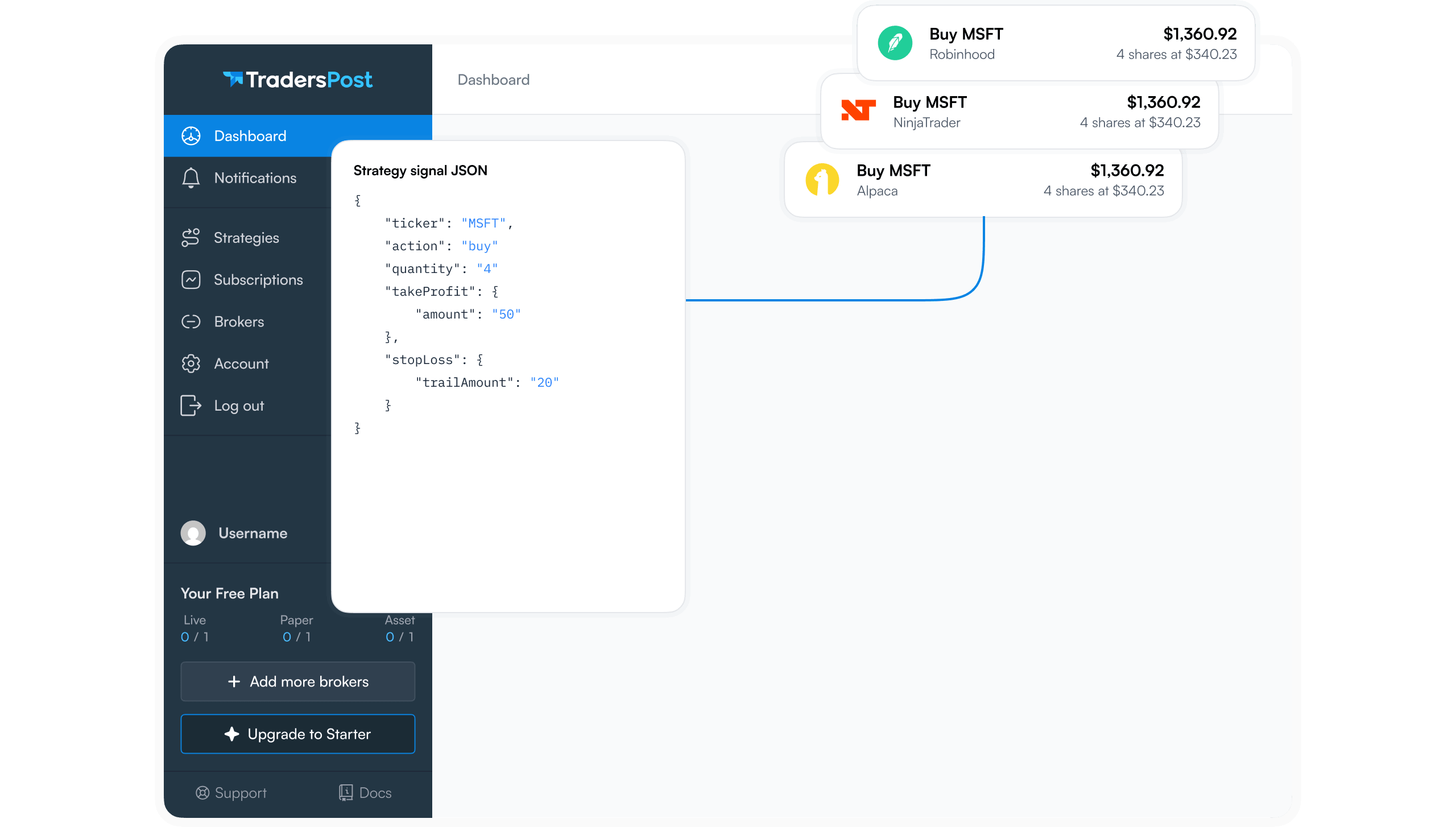
An automated alert should state exactly what the system is expected to do. At minimum, the webhook payload should identify the ticker, the intended action, and the quantity. If a strategy is designed to buy 100 shares of a specific symbol, the alert should communicate that instruction directly rather than relying on assumptions made during a volatile market move.4
Ambiguous alerts create a psychological trap. When an order does not match the trader’s expectation, the urge to intervene manually can become stronger than the original trading plan. Clear inputs reduce avoidable setup errors and reduce the temptation to “fix” a position in the moment because an instruction was incomplete, unclear, or inconsistent with the automation configuration.
- Test long entries, short entries where applicable, exits, and reversal scenarios.
- Test protective instructions, including takeProfit and stopLoss values.
- Use Paper trading to confirm that alerts produce the intended order behavior before enabling live automation.
- Verify quantity handling for each trade type, especially when the strategy can scale in, scale out, or close a position.
A disciplined trader treats alert construction as part of the trading system, not as an administrative detail after the strategy logic is finished.
Predefine Exits Before the Trade Becomes Emotional
Exit decisions are usually easier before entry, when the trader is evaluating probabilities and risk objectively. Once a position is open, real-time price movement can introduce loss aversion, fear of missing a larger move, and the impulse to move a stop or cancel a planned profit target.
For example, a trader can send a planned entry alert with defined takeProfit and stopLoss values. That establishes the intended reward and risk boundaries before the position exists. The trader is no longer required to decide, while watching every price change, whether a losing trade should be closed or whether a profitable trade should be taken.
Planned exits do not guarantee fills at a particular price or guarantee a favorable outcome. They do, however, reduce decision pressure at the point where emotions are most likely to override the original plan. If the strategy uses a Trailing Stop or Stop Market approach, define and test those rules before relying on them during live conditions.5
Review the System as a Chain, Not Just a Strategy
A valid strategy condition is only one link in an automated trade. Review the complete chain: the strategy condition, the TradingView or TrendSpider alert, the webhook details, the TradersPost automation settings, and the brokerage execution. An unexpected result can originate at any stage, so reviewing only the chart logic can lead to misplaced confidence or incorrect conclusions.
When revising a system, change one component at a time. For example, do not simultaneously change the alert message, quantity method, and exit logic. Test each revision in Paper trading, then compare the alert instruction with the resulting automated action. This makes it possible to identify the actual cause of a discrepancy.
- Confirm the ticker, action, quantity, takeProfit, stopLoss, and expiration values.
- Review relevant TradersPost automation settings, including Trading Windows and Entry Lock when used.
- Confirm the strategy has been tested across entries, exits, and protective-order scenarios.
- Use a written checklist before enabling a revised strategy.
Create a Sustainable Review Routine for Automated Trading
Review on a Schedule, Not After Every Trade
Set a review cadence before trading begins. The right interval depends on the strategy’s frequency and holding period: a high-frequency intraday strategy may warrant a weekly review after 20 to 50 completed trades, while a swing strategy may be better reviewed every two weeks or after 10 completed positions. The important point is that the schedule is predetermined, not triggered by a large win, a loss streak, or an uncomfortable alert.
Watching every fill can invite emotional interference. A trader may override a valid exit because a position briefly moves against them, or disable a strategy immediately after two losses that were well within the tested distribution. The opposite mistake is never reviewing at all, which turns automation into overtrust. A scheduled review creates distance without neglect.
- Did alerts arrive when the strategy’s conditions were expected to occur?
- Were there unexpected alerts, duplicate signals, missed opportunities, or alerts outside the intended Trading Windows?
- Did every order follow the intended quantity, entry, and exit logic?
- Were any manual interventions made through Manual Submit or another workflow, and were they justified by a documented exception?
- Does the strategy still operate in the market conditions it was designed for, such as trending, range-bound, high-volatility, or low-volatility conditions?
Measure Process Quality Alongside Profit and Loss
Profit and loss is an outcome, not a complete evaluation. A profitable week can conceal poor discipline if the trader increased quantity after a win, ignored an intended stop, or manually exited positions that should have remained open. Conversely, an unprofitable period can demonstrate excellent execution if alerts matched the strategy, orders used the planned quantity, and exits followed the tested stop-loss or take-profit rules.
Maintain a short review log for each period. Record the number of alerts, completed trades, manual actions, exceptions, and whether each exception was planned or emotional. For example, if a strategy was configured to use a fixed quantity and a Stop Market exit, note any trade where quantity was changed or the stop was canceled. If the system was tested using a specific takeProfit and stopLoss structure, compare actual execution against that structure rather than judging the trade solely by its result.
Use one direct question at every review: “Did I follow the system I tested, or did I trade my emotions around the system?”
Decide How Changes Will Be Introduced
After a difficult period, do not change strategy rules, quantity, and alert logic simultaneously. Doing so makes it impossible to determine which change improved or damaged performance. Treat each adjustment as a testable hypothesis.
- State the hypothesis clearly: “Reducing the entry window may avoid low-liquidity signals,” rather than “The strategy needs fixing.”
- Change one meaningful element at a time, such as Trading Windows, quantity, or exit logic.
- Document the expected effect and the conditions that would invalidate the idea.
- Use Paper trading to test the revised workflow before live deployment.
- Keep the prior version documented so the change remains reversible.
Confidence in automated trading should come from deliberate evidence, not from recent profits or a desire to recover losses. A controlled review routine makes strategy changes measurable and prevents emotional discomfort from becoming an untested system rewrite.
Frequently Asked Questions
Can automated trading eliminate emotions?
No. Automation can reduce the pressure of manually placing, managing, and exiting trades, but it does not eliminate emotions. Traders may still feel fear during drawdowns, greed after winning streaks, impatience when signals are slow, or an urge to override the strategy. The goal is to build and test clear rules that define when to stay hands-off and when to pause, review, or intervene.
When should I disable an automated trading strategy?
Disable automation for predefined, objective reasons, such as a confirmed configuration problem, duplicate alert behavior, unexpected order activity, or a scheduled strategy review. Avoid turning it off simply because of one normal losing trade or short-term discomfort, unless that scenario is specifically included in your written intervention policy. Consistent rules help prevent emotional decisions from disrupting an otherwise valid trading process.
What is Entry Lock in TradersPost?
Entry Lock in TradersPost is a timed guardrail that can prevent new positions from being opened during a planned pause or review period. It can be useful when you need time to verify strategy settings, webhook alerts, position sizing, or market assumptions before allowing additional entries. Using Entry Lock deliberately helps create space for review without immediately changing the entire automated workflow.
Should I paper trade an automated strategy before going live?
Yes. Paper trade the complete automated workflow before risking real capital. This includes testing TradingView or TrendSpider alerts, webhook instructions, TradersPost settings, broker connections, order sizing, and expected trade behavior. Paper trading can reveal strategy logic problems, alert timing issues, duplicate signals, and configuration mistakes. Treat it as an operational test, not just a test of whether the underlying trading idea appears profitable.
What webhook fields can I use for TradersPost alerts?
You can use documented webhook fields such as ticker, action, quantity, takeProfit, stopLoss, and expiration when they fit your strategy design. Keep each alert instruction clear, specific, and aligned with your intended order behavior. Before using webhook automation with live funds, test the exact alert payloads in paper trading to confirm they create the expected orders and risk controls.
Conclusion
Automated trading does not remove psychology, it relocates it. The critical decisions happen before an order is placed: defining rules, choosing risk limits, evaluating strategy behavior across market conditions, and deciding when not to intervene. Trust in automation should be earned through evidence, while overtrust begins when traders assume a script can compensate for vague logic, poor position sizing, or changing market regimes.
Paper trading is the practical bridge between conviction and live capital. Use it to test whether your TradingView or TrendSpider alerts execute as intended, expose operational gaps, and build confidence in following a documented process. Before enabling real orders, connect your alert workflow to TradersPost and validate each step in a simulated environment.
When your rules, alerts, and risk controls have proven reliable, you can move toward live automation with greater discipline and clarity. Start paper trading your TradersPost workflow today, then let performance, not emotion, guide your next step.
References
1 TradersPost Docs, Position Sizing
2 TradingView Pine Script Docs, Repainting
3 TradersPost Docs, Paper Trading
4 TradersPost Docs, Webhooks
5 TradersPost Docs, Order Classes