Automating Trading Strategies with AI Coding
AI coding tools can transform YouTube trading strategies into functional PineScript indicators in hours instead of weeks. Discover the vibe coding approach.

Marketing

-
AI coding tools still require testing, debugging, and platform-specific constraints rather than guaranteeing one-shot automation, so the guidance now qualifies claims about unlimited strategies and immediate deployment while the workflow remains accurate.
Can an AI coding assistant convert a YouTube trading strategy video into a fully functional automated trading system? The answer is yes—and it's revolutionizing how retail traders develop custom indicators and strategies. This guide shows you how to leverage AI coding tools to transform trading ideas into working code without writing it manually.
The Traditional Coding Challenge
Creating custom trading indicators traditionally required:
- Weeks or months learning programming languages
- Understanding platform-specific syntax and limitations
- Debugging errors through trial and error
- Iterating through multiple versions to refine logic
- Maintaining code as platform versions update
For traders with strategy ideas but limited coding experience, this barrier prevented automation. You either hired developers (expensive and time-consuming) or abandoned automation altogether.
AI coding assistants eliminate this barrier. Now you can describe what you want, provide examples, and let AI handle implementation details.
What Is Vibe Coding?
"Vibe coding" describes the development approach where you communicate what you want in natural language and iteratively guide an AI assistant to build it. Rather than writing code line-by-line, you're essentially having a conversation with an AI developer.
The process looks like:
- Describe your strategy or indicator requirements
- AI generates initial code implementation
- You test the code and identify issues
- AI fixes problems and adds refinements
- Repeat until you have working code
As one developer described it: "Those of us who are on the leading edge—if you're interested in automated trading, if you're in the TradersPost ecosystem, you're a forward thinker. I believe that automated trading is the way that all trading will happen in the future."
Vibe coding represents the next evolution. Just as charting software automated manual chart drawing, AI coding automates code writing.
Introducing Cursor AI
Cursor AI is an AI-powered code editor built on Visual Studio Code that integrates advanced language models directly into your development environment. Key features include:
AI Code Autocomplete
As you type, Cursor predicts what you're trying to write and suggests multi-line completions. This happens in under a second, feeling instantaneous.
The system encrypts your code locally, sends small context snippets to cloud servers, generates suggestions using large language models, and returns completions to display inline. Importantly, Cursor doesn't persistently store your code—it uses it for inference then discards it.
Context-Aware Chat Assistant
Cursor includes a chat panel where you can ask questions, request code generation, or debug issues in natural language. The assistant understands your entire codebase and can reference specific files or code sections.
You can even upload screenshots of errors or UI mockups to provide visual context.
Code Reference and Documentation
Cursor integrates documentation directly, allowing the AI to reference official docs when generating code. This ensures generated code follows current best practices and uses up-to-date syntax.
Custom Rules and Instructions
You can set custom rules that guide AI behavior. For example, you might instruct it to always use specific code patterns or avoid certain approaches.
Using Cursor for PineScript Development
PineScript is TradingView's proprietary language for creating indicators and strategies. PineScript v6 is the current version, offering enhanced features over v5 including:
- Dynamic data requests that adapt based on conditions
- Advanced text formatting capabilities
- Improved backtesting with better conditional logic
- Enhanced runtime efficiency
Cursor AI can generate PineScript code when properly instructed, but you need to guide it toward PineScript-specific requirements.
Converting Trading Videos to Code
Here's the step-by-step process for converting a YouTube trading strategy video into working PineScript:
Step 1: Extract the Video Transcript
Use transcript extraction tools to capture the video's spoken content:
- Tactic.io: Simple YouTube transcript generator with timestamps**
- Downey: Downloads videos with subtitle files if available
- **11 Labs: Transcribes audio files using speech-to-text
Transcripts with timestamps are valuable—they let you reference specific sections when the AI needs clarification.
Step 2: Set Up Cursor Instructions
Create a custom instruction file in Cursor that establishes two roles:
Planner Role
The planner analyzes requirements and creates a structured task list without modifying code. It breaks down the project into manageable steps.
Executor Role
The executor follows the plan and implements each task sequentially. It creates a "scratchpad" file to track progress and remember important details.
This separation prevents the AI from trying to do everything at once, which often creates tangled code that's hard to debug.
Step 3: Provide PineScript Documentation
Give Cursor links to official PineScript resources:
- PineScript v6 Documentation
- TradingView Function Reference
- Version Release Notes
- Relevant blog posts explaining specific features
The AI uses these as references when generating code, ensuring it uses correct syntax and follows platform conventions.
Step 4: Submit the Transcript with Instructions
Paste the transcript and instruct the AI:
"I want to create an indicator in TradingView. I'll provide you with a transcript of a YouTube video that describes the strategy. As planner, plan out how this indicator should be created."
The AI will analyze the transcript, identify key strategy elements, and create a structured plan showing:
- Required data inputs and calculations
- Visual elements to plot on charts
- Potential challenges and solutions
- Task breakdown with completion criteria
Step 5: Implement Step-by-Step
Once the plan looks good, instruct: "As executor, begin with task one."
The executor will:
- Create the basic PineScript file structure
- Show you the code
- Mark the task complete
- Wait for your feedback before continuing
This incremental approach is crucial. If you let the AI build everything at once and there's an error, you're left debugging a complex mess. Building step-by-step lets you validate each piece works before adding more.
Step 6: Test and Iterate
After each step:
- Copy the generated code
- Paste it into TradingView's Pine Editor
- Add it to a chart to see visual results
- Take screenshots of any errors or unexpected behavior
- Send screenshots back to Cursor with descriptions
- Let the AI fix issues
The AI can analyze error messages, understand what went wrong, and correct the code. Sometimes you'll go back and forth multiple times on a single task, which is normal.
Step 7: Version Control
Use TradingView's built-in version history to save working versions after completing each major task. Name them "Task 1 Complete," "Task 2 Complete," etc.
This gives you rollback points if later changes break something. You can also load multiple versions on the same chart to compare behavior.
Common PineScript Challenges
Certain PineScript quirks trip up AI coding assistants:
Line Continuation Formatting
When breaking long lines across multiple lines, PineScript requires specific formatting. Continuation lines must start with a tab followed by a space.
AI assistants often generate incorrect formatting here, causing syntax errors. When you see "line without continuation" errors, remind the AI: "When you break up a line in PineScript, the following line must start with a tab, followed by a space. Remember this."
Function Parameter Types
PineScript v6 infers parameter types automatically—you don't declare them in function signatures. AI trained on other languages might try to add type declarations, causing errors.
Plot and Label Limitations
PineScript has specific restrictions on plotting and labeling that vary between versions. Referencing the official docs helps the AI avoid these pitfalls.
Historical Bar Limitations
Some calculations can't reference future bars or modify historical values. These restrictions aren't obvious, so the AI might generate conceptually correct code that PineScript rejects.
The Scratchpad Advantage
The "scratchpad" file Cursor creates becomes an invaluable project management tool. It contains:
Task Checklist
All planned tasks with completion status. You see what's done, what's in progress, and what's next.
Known Issues
Problems the AI encountered and solutions it implemented. This prevents repeating mistakes.
Lessons Learned
Important discoveries about platform limitations or effective approaches. The AI references these in future tasks.
Feedback Loop
Notes on what worked well or poorly. This refines the AI's approach for your specific use case.
One developer noted: "The scratchpad is extremely useful. It's almost an extra feature in Cursor. You can see what the agents have done, they cross it out, they check it out, and it just gives you oversight as to what's going on."
When AI Gets Stuck
Sometimes the AI repeatedly makes the same error or can't figure out a solution. Strategies for handling this:
Switch Models
Cursor supports multiple AI models (GPT-4, Claude, Gemini). Different models have different strengths. If one model keeps failing on a specific task, try another.
Start Fresh
Close Cursor and reopen it. This clears the context window. Sometimes the AI gets confused by accumulated conversation history, and starting over helps.
Provide Examples
Instead of describing what you want, show an example of working code that does something similar. The AI can pattern-match better from examples.
Break Down Further
If a task is too complex, break it into smaller sub-tasks. The AI might handle "draw a horizontal line at the high" but struggle with "create dynamic support/resistance lines."
Consult Documentation
Sometimes you need to read the official docs yourself to understand the limitation, then explain it clearly to the AI.
From PineScript to TradersPost Automation
Once you have a working PineScript indicator or strategy in TradingView, connecting it to TradersPost for live trading is straightforward:
Add Alert Conditions
In your PineScript code, define alert conditions for entry and exit signals. These trigger when your strategy identifies trading opportunities.
Create TradingView Alerts
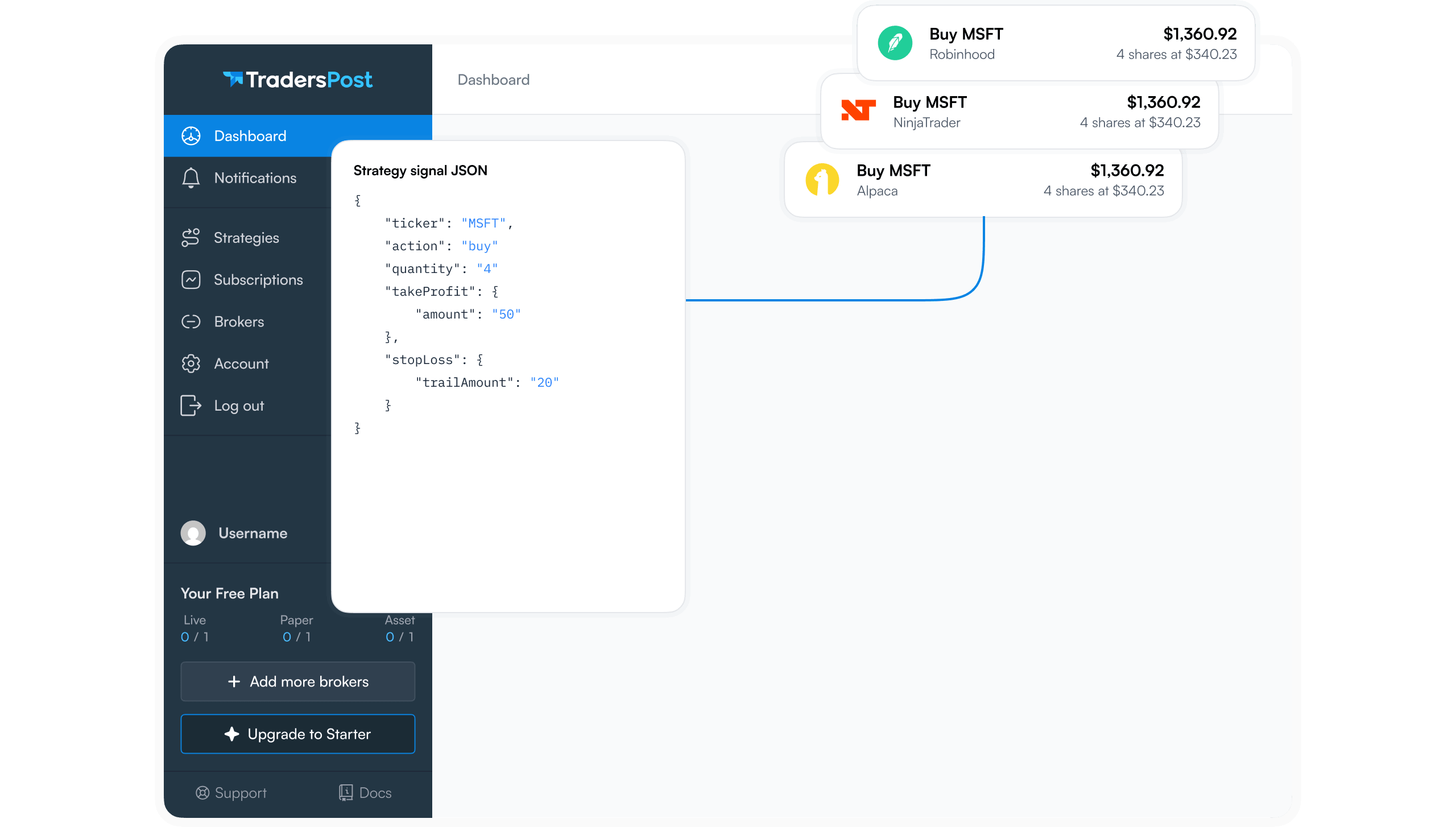
Set up alerts in TradingView that execute when your conditions are met. Configure the alert message to use TradersPost's JSON format.
Configure TradersPost Webhook
In TradersPost, create a webhook URL for your strategy. This receives alerts from TradingView and executes trades through your connected broker.
Connect Your Broker
TradersPost integrates with numerous brokers including TradeStation, TradeZero, Coinbase, and many others. Connect your preferred broker account.
Deploy the Strategy
Once connected, your PineScript strategy automatically sends signals to TradersPost, which executes trades in your broker account based on your configuration.
This transforms your custom indicator from visual analysis tool to fully automated trading system.
Real-World Development Timeline
How long does AI-assisted strategy development actually take?
Traditional Manual Coding
- Simple indicator: 2-4 hours for experienced developers
- Complex strategy: 1-2 weeks including debugging
- Learning from scratch: 3-6 months before building anything substantial
AI-Assisted Vibe Coding
- Simple indicator: 30-60 minutes including iterations
- Complex strategy: 2-4 hours with proper planning
- Learning curve: Functional within days, proficient within weeks
One developer's experience: "I've been able to code scripts that would have taken me months to do in a weekend. Something that would have taken me four to six months, I did in a weekend."
The time savings are substantial, but don't expect instant results. You'll still iterate, debug, and refine. The difference is the AI handles implementation details while you focus on strategy logic.
Cost Considerations
Cursor AI operates on a subscription model:
Free Tier
Limited AI requests per month. Sufficient for occasional use but restrictive for intensive development.
Pro Tier
Approximately $20/month for substantially increased request limits. Covers most individual developer needs.
Advanced Usage
Heavy users leveraging max-context models like Gemini 2.5 Pro might spend $80-100/month on API costs beyond base subscription.
For the time saved versus hiring developers (typically $50-150/hour), the investment pays off quickly if you're building multiple custom strategies.
Learning Resources
To accelerate your AI-assisted trading development:
Cursor Documentation
Official guides on setting up custom instructions, using different models, and optimizing your workflow.
PineScript Reference
TradingView's complete documentation with examples for every function and feature.
Trading Strategy Videos
YouTube channels like "The Rumors" that break down specific strategies you can convert to code.
TradersPost Tutorials
Integration guides showing how to connect your custom indicators to live trading.
AI Coding Communities
Forums and Discord servers where developers share prompts, instructions, and solutions to common problems.
Best Practices for AI Coding Success
Maximize your effectiveness with AI coding assistants:
Start Simple
Build basic versions first, then add complexity. Don't try to implement everything at once.
Test Continuously
Validate each step before proceeding. Catching errors early saves hours later.
Document Your Process
Keep notes on what works and what doesn't for your specific strategies. Build a personal knowledge base.
Version Everything
Use version control religiously. Always have a working version to roll back to.
Learn the Basics
Understanding PineScript fundamentals helps you guide the AI better and debug more effectively.
Be Specific
Vague instructions produce vague results. The more precisely you describe requirements, the better the output.
The Future of Strategy Development
AI coding represents a fundamental shift in how retail traders approach automation. Just as TradingView democratized charting that once required expensive Bloomberg terminals, AI coding democratizes strategy development that once required computer science degrees.
The trend will only accelerate. As language models improve, they'll:
- Generate more complex strategies with less guidance
- Better understand trading concepts and market dynamics
- Optimize strategies automatically based on backtest results
- Suggest improvements to existing code
- Handle platform migrations and version updates automatically
Traders who adopt these tools now gain experience and advantage before the playing field becomes crowded.
Conclusion
Converting trading strategy videos into automated systems using AI coding tools like Cursor represents a massive productivity multiplier for retail traders. What once took months now takes hours. What once required expensive developers now requires clear communication with AI assistants.
The key steps are:
- Extract strategy descriptions via video transcripts
- Set up Cursor with custom instructions and documentation
- Guide the AI through step-by-step implementation
- Test and iterate until you have working code
- Connect to TradersPost for live trading
This approach—"vibe coding"—will become standard practice as AI capabilities expand. Rather than manual coding becoming obsolete, it evolves into a collaborative process where humans provide strategy insight and AI handles implementation details.
For TradersPost users, this means far greater custom strategy potential1. You're less constrained by coding ability and development budget, though testing and platform limitations still apply1. Many strategies you can describe can be automated with testing, debugging, and platform-specific constraint handling1.
Start with simple indicators to build familiarity with the process. As you gain confidence, tackle more complex multi-condition strategies. Document what works in your custom Cursor instructions to make future projects faster.
The combination of AI-assisted PineScript development and TradersPost automation creates a powerful toolchain for retail traders. You can rapidly prototype ideas, backtest them thoroughly, and deploy them live with minimal coding experience.
The future of trading automation is here—and it's surprisingly accessible to anyone willing to learn the vibe coding approach.