Automating Trading Strategies With Ai Coding Tools

Marketing

YouTube Link: https://www.youtube.com/watch?v=yujroadUYtE
Published: June 20, 2025
Duration: 1:05:25
---
Automated trading has evolved dramatically with the emergence of AI-powered coding assistants. What once required extensive programming knowledge can now be accomplished through natural language instructions and AI-guided development. This guide explores how traders can leverage modern AI tools to build, test, and deploy automated trading strategies without deep technical expertise.
Understanding AI-Assisted Strategy Development
The landscape of strategy development has shifted from manual coding to AI-assisted creation. Tools like Claude Code, Cursor, and other AI coding assistants enable traders to convert trading ideas into working strategies through conversational interfaces. This democratization of algo trading removes traditional barriers to entry while maintaining the precision needed for live trading.
The key advantage lies in the AI's ability to understand trading concepts and translate them into executable code. Rather than learning syntax and programming paradigms, traders can focus on strategy logic and risk management while the AI handles implementation details.
Choosing the Right AI Coding Environment
Different AI coding tools offer distinct advantages for strategy development. Claude Code operates as a terminal-based assistant with deep context awareness, allowing it to understand your entire codebase and make intelligent modifications. It excels at complex refactoring and maintains consistency across large projects.
Cursor provides an IDE-integrated experience where AI suggestions appear directly in your code editor. This visual approach helps beginners understand code structure while maintaining productivity. The trade-off comes in cost management, as intensive usage can become expensive with premium AI models.
Cost considerations matter significantly when developing strategies. Premium models like Claude Opus deliver superior reasoning for complex trading logic but consume more tokens. For routine tasks, more economical models like Gemini 2.5 Pro provide adequate performance at lower cost. Strategic model selection based on task complexity optimizes both results and budget.
Converting Trading Concepts to Working Code
The process begins with clearly articulating your trading strategy. AI assistants perform best when given detailed context about indicators, entry conditions, exit rules, and risk parameters. Instead of vague requests, provide specific criteria: "Enter long when price closes above VWAP and RSI crosses above 30, with stop loss 1% below entry."
Documentation feeds significantly improve AI output quality. Before requesting code generation, provide the AI with relevant documentation for your trading platform. For PineScript development, sharing the style guide, debugging documentation, and release notes helps the AI generate code that follows best practices and avoids common pitfalls.
Breaking complex strategies into components yields better results than requesting everything at once. Start with basic entry logic, verify it works, then add exit conditions, position sizing, and risk management incrementally. This modular approach makes debugging easier and helps you understand each component.
Managing Code Quality and Organization
Well-organized code becomes crucial as strategies grow in complexity. Use input groups to categorize settings logically—separate MACD parameters from strategy settings and risk management controls. This organization makes strategies easier to configure and maintain over time.
Variable naming conventions matter for code maintainability. Descriptive names like stopLossPrice and takeProfitPrice make your intention clear, while cryptic abbreviations create confusion later. AI assistants can help refactor code for better readability, but establishing good naming from the start saves time.
Comment your strategy logic thoroughly. While AI can infer functionality from code, human-readable explanations help when revisiting strategies months later. Document why specific values were chosen, what market conditions the strategy targets, and any known limitations or edge cases.
Testing and Validation Strategies
Backtesting reveals how strategies perform on historical data, but requires proper setup to generate meaningful results. Configure realistic slippage and commission costs that reflect actual trading expenses. Overly optimistic assumptions during testing lead to disappointing live results.
Walk-forward testing provides more robust validation than simple backtesting. This technique trains strategies on one time period and tests on subsequent unseen data, revealing whether the strategy generalizes or simply overfit to historical patterns. Multiple walk-forward periods build confidence in strategy robustness.
Bar magnifier functionality improves backtest accuracy by examining intrabar price action. Instead of assuming orders filled at bar close prices, bar magnifier looks at 1-minute data to determine realistic fill prices. This feature produces more accurate historical results, though it requires higher-tier TradingView subscriptions.
Integrating Strategies with Trading Platforms
Connecting strategy signals to broker execution requires careful alert setup. The strategy.order.alert_message placeholder enables dynamic alert content that changes based on trade conditions. This flexibility allows single alerts to handle multiple scenarios—entries, exits, stops, and profit targets—all with appropriate context.
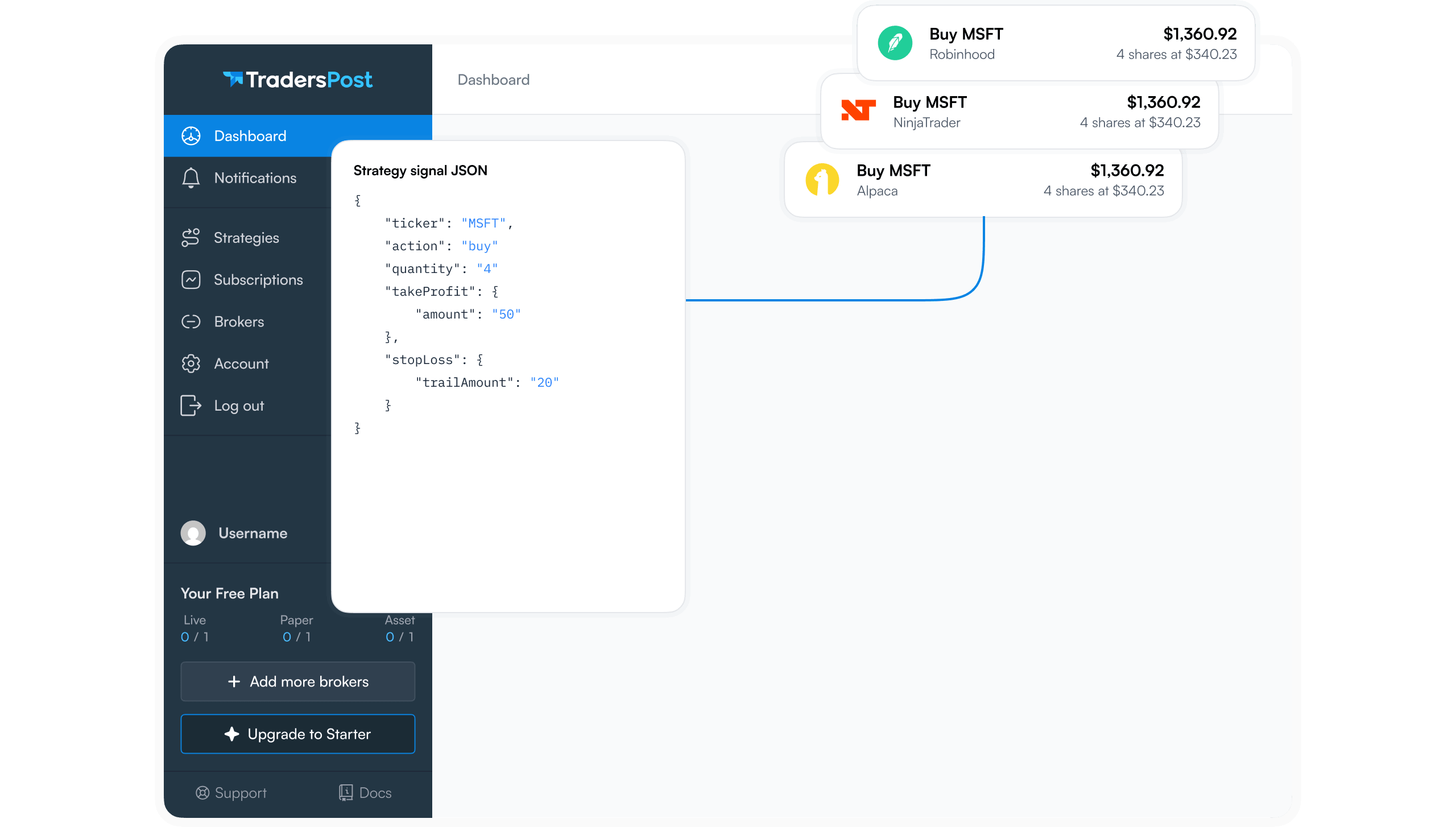
JSON message formatting standardizes communication between your strategy and broker automation platforms. Properly structured payloads include ticker symbols, action types (buy/sell/exit), quantities, and order types. Testing message formatting in a paper trading environment prevents costly errors in live execution.
Webhook URLs create the bridge between signal generation and order execution. These unique URLs route your strategy alerts to the correct destination, whether that's a paper account for testing or a live brokerage connection. Never share webhook URLs publicly, as they provide direct access to place trades in your accounts.
Common Pitfalls and Solutions
Over-optimization represents the most common trap in algorithmic trading. When strategies work perfectly on historical data but fail in live trading, curve-fitting is usually the culprit. Resist the temptation to tweak parameters until backtest results look perfect—this destroys future performance.
Context window management becomes important when working with AI coding assistants. These tools have limits on how much code they can analyze at once. If responses become degraded or inconsistent, reduce context by focusing on specific functions rather than entire codebases. Clear, focused requests produce better results than overwhelming the AI with information.
Error handling in production strategies prevents small issues from becoming disasters. Strategies should gracefully handle missing data, connection interruptions, and unexpected market conditions. AI assistants can help implement robust error handling, but you must explicitly request these safeguards.
Cost Management for AI Development
Token usage escalates quickly during intensive development sessions. Track spending by periodically checking consumption dashboards provided by your AI service. If costs concern you, use premium models only for complex problems and economical alternatives for routine tasks.
Cloud Code's subscription model provides predictable costs compared to per-token pricing. For $20-200 monthly, you gain extensive usage limits that enable sustained development without constant cost monitoring. This pricing structure suits traders building multiple strategies or iterating rapidly.
Caching strategies reduce redundant processing. When repeatedly providing the same documentation or context, create instruction files that the AI can reference instead of reprocessing everything each session. This optimization saves tokens while maintaining response quality.
Building Sustainable Development Practices
Version control through Git preserves strategy evolution over time. Commit working versions before making significant changes, enabling easy rollback if modifications don't work out. This practice becomes essential when managing multiple strategy variations or collaborating with others.
Documentation beyond code comments captures strategic decisions and lessons learned. Maintain notes about what market conditions favor each strategy, why specific parameters were chosen, and results from different testing periods. This knowledge base accelerates future development and helps avoid repeating mistakes.
Continuous learning through experimentation drives improvement. Set aside time to explore new indicators, test different timeframes, or investigate alternative entry triggers. Not every experiment succeeds, but systematic exploration uncovers insights that manual trading often misses.
Real-World Application Workflow
Successful strategy automation follows a systematic workflow. Begin by clearly defining your trading hypothesis and edge. What market inefficiency will you exploit? Document this foundation before writing code, as it guides all subsequent decisions.
Next, implement the core strategy logic without worrying about polish. Get basic entries and exits working in a simplified form. Once the skeleton functions, add complexity gradually—position sizing, multiple exit conditions, filters, and safeguards.
Paper trading bridges the gap between backtesting and live execution. Run your strategy with real-time data but without capital at risk. This phase reveals timing issues, signal delays, and execution quirks that backtests often miss. Only after successful paper trading should you consider live deployment.
Live trading begins with minimal position sizes. Even thoroughly tested strategies behave differently with real money at stake. Start small, verify everything works as expected, and scale up gradually as confidence builds. This conservative approach protects capital during the inevitable adjustment period.
Conclusion
AI-assisted trading strategy development makes algorithmic trading accessible to a broader range of traders. By leveraging tools like Claude Code and Cursor, you can focus on trading logic and risk management while AI handles implementation complexity. Success requires clear communication with your AI assistant, systematic testing, and careful transition from development to live trading.
The future of retail algo trading lies in the democratization these tools provide. What once required computer science degrees now demands only trading knowledge and willingness to learn new workflows. As AI coding assistants continue improving, the gap between professional and retail algorithmic trading will narrow further, creating opportunities for disciplined traders willing to embrace automation.