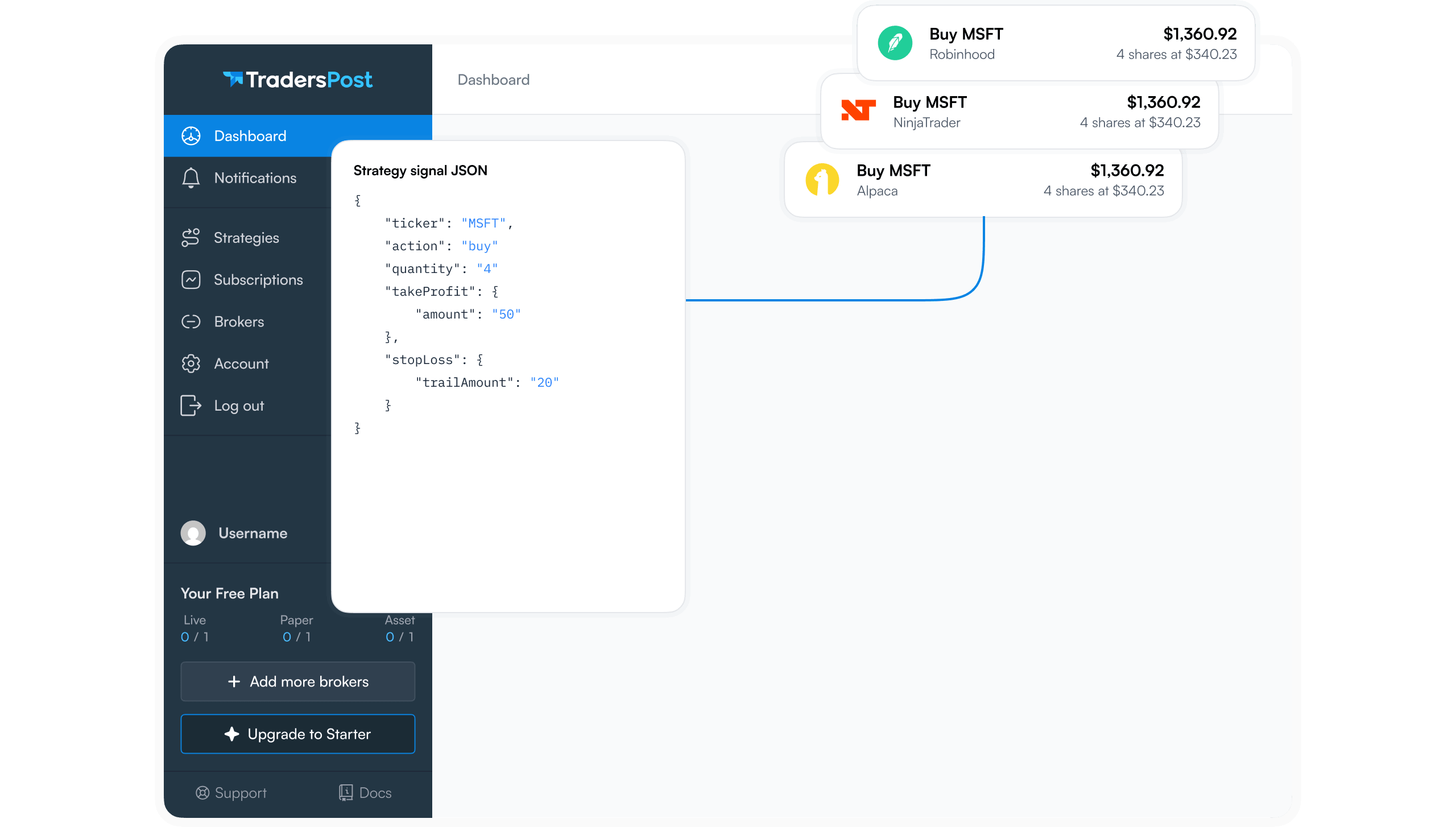
Building Trading Communities Automated Strategies

Marketing

YouTube Source: https://www.youtube.com/watch?v=PwEuJvd6nOI
Published: April 11, 2025
Duration: 2:34
Introduction
The dream of working from anywhere while generating income has driven countless traders to explore automated trading strategies. However, the journey from manual trading to full automation involves not just technical challenges but also strategic decisions about how to structure and share your trading systems.
Building a trading community around automated strategies represents an evolution from trading solely for yourself to creating systems that can benefit others. This approach offers multiple advantages: it provides additional income streams, forces discipline in strategy development, and creates feedback loops that improve your trading.
This guide explores how to transform individual trading strategies into shareable automated systems, build communities around those strategies, and leverage modern platforms to distribute your trading insights at scale. Whether you're a successful discretionary trader looking to systematize your approach or an algorithmic trader seeking to monetize your research, these principles apply.
From Manual Trading to Automation
The transition from discretionary trading to automated systems requires a fundamental shift in thinking. Manual trading relies on intuition, pattern recognition, and real-time decision-making. Automation demands that every aspect of your edge be codified into explicit rules that a computer can execute.
Many traders discover automation when they realize that manual execution becomes a bottleneck. Sitting in front of charts for hours each day limits your ability to scale, take time off, or explore other opportunities. Automation solves this by executing your strategies 24/7 without human intervention.
However, automation isn't simply about convenience. It forces clarity in your trading rules. When you must write down exactly when to enter, where to place stops, and how to exit, you confront aspects of your trading that may have been instinctive or inconsistent. This process often improves discretionary trading even if you never fully automate.
The emotional benefits of automation are significant. Removing yourself from trade-by-trade execution eliminates many of the psychological challenges that plague traders. Fear, greed, and impatience affect discretionary traders differently than automated systems that execute without emotion.
Yet automation also introduces new challenges. Systems can't adapt to unusual market conditions the way experienced traders can. They follow their rules regardless of context, which is both their strength and potential weakness. Successful automation requires careful strategy design that accounts for this limitation.
Creating Indicator-Based Systems
Indicators form the building blocks of most automated trading strategies. These mathematical calculations transform raw price data into signals that trigger trades. Understanding how to design and combine indicators is fundamental to building effective automated systems.
The goal of indicator development is not complexity but consistency. Simple indicators that capture a genuine edge often outperform elaborate systems that look impressive but are overfit to historical data. The key is identifying what aspect of market behavior you're trying to capture and designing the simplest indicator that accomplishes this.
Common indicator categories include trend-following tools like moving averages, momentum oscillators like RSI or stochastic, volatility measures like Bollinger Bands or ATR, and volume-based indicators. Each category captures different market characteristics, and most successful systems combine indicators from multiple categories.
Custom indicators often provide more edge than standard tools available to everyone. If you've identified a specific pattern or relationship in market data, creating a unique indicator to detect it gives you an advantage. This doesn't require advanced programming skills—most trading platforms offer tools for building custom indicators with relatively simple code.
The testing phase is critical for indicator-based systems. What looks promising on a chart may not hold up under systematic testing across different time periods and market conditions. Rigorous backtesting helps separate robust indicators from curve-fit systems that worked accidentally in specific historical scenarios.
Sharing Strategies at Scale
Once you've developed successful automated strategies, sharing them with others creates opportunities for both income and impact. However, distributing trading systems at scale presents technical and logistical challenges that require careful planning.
The traditional model of selling courses or signals to individuals doesn't scale well. Each new subscriber requires manual setup, individual support, and custom configuration. This approach quickly becomes unmanageable as your community grows, tying you to a desk instead of freeing you to work from anywhere.
Modern trading platforms offer infrastructure that solves these scaling challenges. Rather than managing individual installations, you can share a Strategy Template so each user creates an independent strategy in their own account and connects their own broker. The platform handles execution, monitoring, and technical maintenance while you focus on strategy development and community support.
A shared template keeps everyone's starting configuration the same, even though the trading is not. Fills differ from account to account because each member is executing on their own broker with their own sizing. What you gain is a common baseline: when someone asks a question, you are looking at the same settings they are.
Template distribution scales without a matching increase in operational work. Whether you have ten users or ten thousand, you are sharing a starting point rather than operating a live copy-trading feed.
However, centralized systems introduce dependency on the platform provider. Evaluating platforms for reliability, uptime, security, and longevity becomes essential. The best platforms have track records of stability, transparent communication, and alignment of interests between platform operators and strategy developers.
Platform Selection for Strategy Templates
Choosing the right platform for distributing your automated strategies is one of the most important decisions you'll make. The platform becomes the infrastructure on which your community is built, affecting everything from user experience to your ability to scale.
Several factors should guide your platform selection. First, consider which brokers the platform supports. If your target audience uses specific brokers, ensure the platform integrates with them. The broader the broker coverage, the larger your potential addressable market.
Execution quality matters significantly. Look for platforms with proven track records of reliable order execution, minimal slippage, and quick response times. Poor execution can turn a winning strategy into a losing one, damaging your reputation even if the strategy logic is sound.
The ability to share strategies with end users is critical for community building. Some platforms primarily serve individual traders automating their own strategies. Others are built specifically for strategy developers who want to offer their systems to subscribers. Choose one aligned with your goals.
Transparency in operation builds trust with your community. Platforms that provide clear performance tracking, execution logs, and system status information help subscribers understand exactly what's happening with their accounts. This transparency reduces support burden and increases confidence.
Cost structure affects both your profitability and subscribers' total expenses. Evaluate platform fees, per-trade costs, and any subscription charges. Some platforms offer favorable terms to strategy developers with large followings, so negotiation may be possible as you grow.
Building Your Trading Community
A successful trading strategy is only half the equation. Building a community around that strategy involves marketing, support, education, and ongoing communication with subscribers. These non-technical aspects often determine long-term success more than the strategy itself.
Start by defining your value proposition clearly. What specific problem does your strategy solve? Who is your ideal subscriber? Understanding and articulating this helps attract the right people and sets appropriate expectations about what your strategy does and doesn't do.
Transparency about strategy performance is essential for credibility. Share both wins and losses, drawdowns and recoveries. Communities built on realistic expectations survive difficult periods better than those sold with hype and promises of perfection.
Education plays a crucial role in community retention. Subscribers who understand the logic behind your strategy, the market conditions where it works best, and what to expect during various market regimes are less likely to abandon ship during inevitable drawdown periods.
Regular communication keeps your community engaged and informed. Whether through newsletters, Discord channels, Twitter updates, or video calls, maintaining connection with subscribers builds loyalty and provides valuable feedback about their experiences and concerns.
Governance of expectations may be your most important task. New subscribers often have unrealistic hopes about trading returns and underestimate the emotional difficulty of following any strategy through losses. Setting proper expectations upfront prevents disappointment and churn.
Managing the Business of Trading Strategies
Transforming from individual trader to strategy provider involves building a business. This shift brings new responsibilities, revenue models, and operational considerations beyond simply developing winning strategies.
Subscription pricing requires careful consideration. Price too low and you undervalue your service while attracting subscribers who may not be committed to following your strategy through difficult periods. Price too high and you limit your addressable market. Testing different price points and models helps find the sweet spot.
Customer support becomes a significant time commitment as your community grows. Anticipate common questions and create documentation, FAQs, and onboarding materials that handle routine inquiries. This allows you to focus support time on complex issues and community interaction rather than repetitive basic questions.
Legal and compliance considerations vary by jurisdiction but shouldn't be ignored. Depending on how you structure your service, you may need specific registrations or disclaimers. Consulting with professionals familiar with trading service regulations in your location is advisable.
Risk management extends beyond strategy design to business risk. What happens if your platform experiences an outage? What if broker APIs change? What if regulations shift? Having contingency plans and alternative options protects your business from single points of failure.
The psychological shift from trading for yourself to trading for others can be challenging. You feel responsible for subscribers' results in ways you didn't when trading your own account. Maintaining boundaries and perspective about this responsibility is important for longevity in the strategy provider role.
The Role of Paper Trading and Testing
Before anyone uses a template in a live account, extensive testing in simulated environments is essential. Paper trading allows you to validate that your strategy works as intended without risking real capital.
Paper trading serves multiple purposes. It verifies that your code executes correctly, confirms that broker integrations work as expected, and provides performance data that approximates live trading results. This testing phase often reveals issues that weren't apparent during backtesting.
The difference between backtesting and paper trading is significant. Backtests use historical data to simulate how your strategy would have performed. Paper trading executes in real-time with live market data but simulated fills. This real-time aspect exposes latency issues, data feed problems, and other technical challenges that historical testing can't replicate.
Paper trading also provides the psychological preparation for live deployment. Watching your strategy execute in real-time, even with play money, gives you confidence in the system and familiarity with its behavior. This comfort becomes important when transitioning to live trading.
However, paper trading has limitations. Fills in simulation may be more favorable than in live trading due to lack of slippage, guaranteed liquidity, and instant execution. Results in paper trading typically represent best-case scenarios, so tempering expectations before going live is important.
The duration of paper trading depends on your strategy's trading frequency and your confidence in the system. High-frequency strategies might need only a few days to execute enough trades for validation. Longer-term strategies might require weeks or months to observe enough signals.
Scaling from Personal to Community Trading
The transition from trading your own account to managing a community of subscribers following your strategies involves careful planning and staged growth. Rushing this process often leads to problems that damage your reputation and business.
Start with a small group of beta testers who understand they're participating in an early-stage offering. These initial subscribers help identify issues, provide feedback, and validate that your infrastructure works before wider release. Consider offering discounted rates to these early supporters.
Monitor performance closely during initial rollout. Any discrepancies between expected and actual results need immediate investigation. Small problems can cascade in community settings where multiple people experience the same issue simultaneously.
Gradually increase subscriber counts rather than opening to unlimited signups immediately. This controlled growth allows you to scale support capabilities, refine documentation, and ensure that execution quality remains consistent as order sizes increase with more participants.
Communication becomes more structured as you scale. What worked for personal messages to a handful of beta testers doesn't work for hundreds of subscribers. Establish channels for different types of communication: urgent strategy updates, routine performance reporting, educational content, and community discussion.
Technical infrastructure requirements grow with your community. More subscribers mean more concurrent executions, higher API call volumes, and greater data processing needs. Work with your platform provider to ensure infrastructure scales smoothly before subscriber counts outgrow system capacity.
Long-Term Strategy Maintenance
Launching your strategy to subscribers is just the beginning. Ongoing maintenance, monitoring, and periodic updates keep strategies performing optimally and adapt to changing market conditions.
Performance tracking across all subscriber accounts provides valuable feedback about how your strategy performs in diverse real-world conditions. Patterns in execution quality, slippage, or results across different brokers can reveal improvement opportunities.
Market conditions evolve over time, and strategies that work well in one regime may struggle in another. Monitoring broader market environment alongside strategy performance helps you recognize when temporary underperformance is normal drawdown versus when market structure has changed in ways that affect your edge.
Strategy updates require careful consideration. Too frequent changes suggest the strategy wasn't properly tested initially and erode subscriber confidence. Too infrequent updates when market conditions clearly warrant adjustment can lead to prolonged underperformance. Finding the right balance is part of mature strategy management.
Communication about updates is as important as the updates themselves. Subscribers need to understand why changes are being made, what the expected impact is, and whether they need to take any action. Transparency about your reasoning builds trust even when updates don't immediately improve results.
Retirement of strategies is sometimes necessary. If a strategy's edge has eroded beyond recovery, continuing to offer it damages your reputation. Having a clear process for sunsetting underperforming strategies while taking care of existing subscribers demonstrates professional management.
Conclusion
Building trading communities around automated strategies represents an evolution from individual trading to scalable, location-independent business models. This transition offers significant opportunities but requires new skills beyond strategy development.
The key to success lies in creating robust, well-tested strategies, selecting reliable infrastructure for execution and distribution, and building communities through transparency and education rather than hype.
Modern platforms have solved many technical challenges that previously made strategy distribution difficult. This infrastructure enables strategy developers to focus on what they do best—identifying and capturing market edges—while platforms handle execution and technical operations.
The dream of working from anywhere becomes reality when automated strategies execute independently and communities largely self-manage through good documentation and communication systems. However, reaching this point requires significant upfront investment in strategy development, testing, and community building.
For successful traders, sharing strategies creates multiple benefits: additional revenue streams, forced discipline in strategy development, and the satisfaction of helping others achieve trading success. The path from individual trader to strategy provider is challenging but increasingly accessible with modern tools and platforms designed specifically for this purpose.