Understanding Immediate or Cancel Orders
Immediate or Cancel orders allow partial fills while canceling unfilled portions instantly. Master this essential order type for precise trade execution.

Marketing

Immediate or Cancel (IOC) orders are a critical execution tool for traders who need flexibility with order fills. Unlike more rigid order types, IOC orders allow you to get partial fills while automatically canceling any unfilled portion of your order. This makes them particularly valuable for automated trading strategies where precision and speed matter.
What Is an Immediate or Cancel Order?
An Immediate or Cancel order is a time-in-force instruction that requires your order to execute as much as possible immediately, then automatically cancels any remaining unfilled portion. If you place an IOC order to buy 100 shares and only 60 shares are available at your specified price, you'll receive those 60 shares and the remaining 40 will be canceled rather than waiting in the order book.
This differs fundamentally from standard limit orders that remain active until filled or manually canceled. IOC orders prioritize speed and certainty over waiting for complete fills.
IOC vs Fill or Kill Orders
The key distinction between IOC and Fill or Kill (FOK) orders comes down to partial fills:
Immediate or Cancel Characteristics
- Allows partial position fills
- Executes whatever quantity is available immediately
- Cancels unfilled portion automatically
- More flexible for varying liquidity conditions
Fill or Kill Characteristics
- Requires complete fill of entire order
- All-or-nothing execution
- Cancels immediately if full quantity unavailable
- Stricter execution requirements
As one trader explained: "Immediate or Cancel will even allow you to have a partial position open. So it'll fill as much as it can. But if it can't get the whole order filled, you'll still have whatever you were able to fill. Whereas Fill or Kill means I want this whole trade to be filled—100 shares I want to buy. I got to get them all right now or forget it."
When to Use IOC Orders
IOC orders excel in specific trading scenarios:
High-Frequency Trading Strategies
When executing multiple rapid trades, IOC orders prevent your orders from lingering in the market and creating unintended exposure. You get immediate execution feedback and can move on to the next trade.
Fast-Moving Markets
During volatile periods or news events, prices can shift rapidly. IOC orders ensure you capture available liquidity at your target price without risking slippage from waiting orders.
Large Position Sizing
When entering large positions, IOC orders let you accumulate shares gradually across multiple price levels without committing to a full fill at potentially worse prices.
Liquidity Testing
IOC orders allow you to test market depth without commitment. You can gauge how much size is available at specific price points.
Broker Support for IOC Orders
Not all brokers support every order type variation. Broker capabilities vary based on their routing infrastructure and supported exchanges. Major brokers typically offering IOC orders include:
- Interactive Brokers
- Fidelity Investments
- SoFi
- FXCM
- TradeStation
To determine what your broker allows, check their documentation or contact customer support directly. As noted in the trading community: "They don't have documentation that's very clear. You're always able to reach out to customer support with the broker to answer those types of questions."
IOC Orders in Paper Trading
An important consideration for strategy development is that IOC orders may not work identically in paper trading environments versus live accounts. Paper trading systems often lack the granular order type support found in production environments.
When testing strategies with specialized order types like IOC, connect your paper trading account with the actual broker you plan to use live. This simulates more realistic execution behavior and helps identify any order type limitations before committing real capital.
Implementing IOC Orders with TradersPost
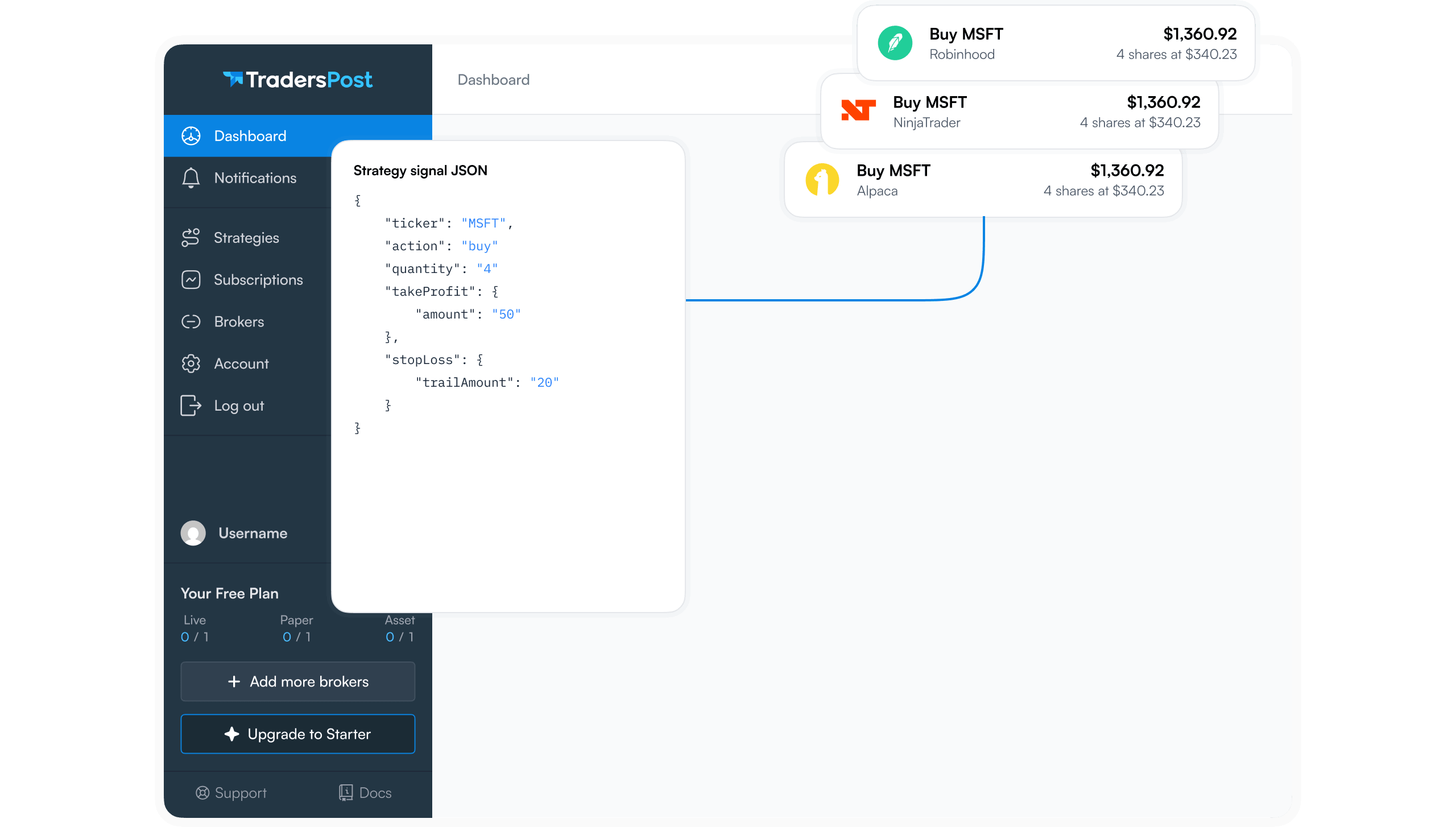
TradersPost supports advanced order types including IOC orders across multiple broker integrations. When building automated strategies, you can specify IOC time-in-force parameters to ensure your strategy executes with the precise behavior you need.
This is particularly valuable when automating signals from TradingView or other platforms where execution speed and partial fill handling matter. You can design strategies that take advantage of IOC order characteristics to improve fill rates and reduce market impact.
Entry Price Granularity
Beyond time-in-force specifications, you can also control price execution through bid-ask spread positioning. Rather than using the last traded price, you can specify:
- Ask Price: Guarantees immediate buy execution at current offer
- Bid Price: Guarantees immediate sell execution at current bid
- Mid Price: Splits the bid-ask spread for potential price improvement
- Last Price: Uses most recent transaction price as reference
Combining IOC time-in-force with strategic price selection gives you precise control over execution characteristics. For example, using ask price with IOC ensures immediate fill of available quantity for buy orders.
Testing Your Order Type Configuration
Before deploying any strategy using IOC orders, follow this testing sequence:
Step 1: Verify Broker Support
Confirm your broker explicitly supports IOC orders for your target instruments. Some brokers only support IOC for certain asset classes.
Step 2: Paper Test with Live Broker Connection
Use your broker's paper trading environment rather than generic simulators. This reveals actual order type handling.
Step 3: Start with Small Live Positions
Execute test trades with minimal size to validate real-world execution behavior matches expectations.
Step 4: Monitor Fill Rates
Track what percentage of your IOC orders achieve full versus partial fills. This informs position sizing decisions.
Common IOC Order Mistakes
Traders frequently encounter these issues when implementing IOC orders:
Expecting Complete Fills
IOC orders are designed for partial fills. If your strategy requires full position entry, FOK orders are more appropriate.
Ignoring Fill Reports
Always check execution reports after IOC orders. You need to know exactly what quantity filled to manage position sizing accurately.
Using IOC for Illiquid Instruments
IOC orders work best with sufficient liquidity. In thin markets, you'll likely get minimal partial fills.
Neglecting Price Impact
Rapidly executing multiple IOC orders can move prices against you. Space out executions or use limit prices further from market.
Automating IOC Order Strategies
Automated trading platforms like TradersPost excel at managing IOC order complexity. You can program conditional logic such as:
- If IOC order fills less than 50% of target size, cancel strategy entry
- Scale into positions across multiple IOC orders at different price levels
- Switch from IOC to standard limit orders after certain time periods
- Adjust position sizing based on initial IOC fill rates
This level of execution control transforms IOC orders from simple tools into sophisticated strategy components.
IOC Orders Across Asset Classes
While we've focused primarily on equities, IOC orders function similarly across markets:
Stocks and ETFs
Most equity brokers support IOC for listed securities. Execution is typically fast with good fill rates for liquid names.
Futures
Futures markets often have excellent IOC support given the prevalence of algorithmic trading. Partial fills are common.
Forex
Currency pairs with deep liquidity work well with IOC orders. Be aware of spread costs with partial fills.
Cryptocurrency
Crypto exchange support varies widely. Check specific exchange order type documentation before implementing IOC strategies.
Advanced IOC Tactics
Experienced traders leverage IOC orders in sophisticated ways:
Iceberg Order Simulation
Submit sequential small IOC orders rather than displaying full size. This mimics iceberg order behavior without requiring special order types.
Spread Scalping
Use simultaneous IOC orders on bid and ask to capture spread. Partial fills on either side still generate profit.
Momentum Confirmation
IOC orders can validate breakout strength. If an IOC order above resistance fills completely, it confirms buying pressure.
Risk Management
IOC exit orders ensure you capture available liquidity during adverse moves without waiting for complete fills.
Conclusion
Immediate or Cancel orders provide the flexibility needed for modern trading strategies. By allowing partial fills while canceling unfilled portions instantly, IOC orders give you control over execution without lingering market exposure.
Whether you're implementing high-frequency strategies, trading volatile markets, or building position size gradually, IOC orders offer valuable execution characteristics. The key is understanding when they're appropriate versus other order types like Fill or Kill or standard limits.
For automated traders using platforms like TradersPost, IOC orders become even more powerful. You can program sophisticated execution logic that adapts to market conditions while maintaining precise control over fill behavior. Test thoroughly with your specific broker, understand the limitations, and incorporate IOC orders into your trading toolkit for improved execution quality.