IPO Volatility Automation: Trading Mega-IPOs
Automate IPO volatility trading with breakout and mean-reversion rules, alert-driven entries, position sizing, and paper testing for volatile new listings.

Marketing

Bottom Line
- Mega-IPOs can experience price movements of 20% to 40% or more in a single session, with potential reversals occurring quickly due to initial excitement and subsequent real order flow.
- Newly listed mega-IPOs often have wide bid-ask spreads, abrupt repricing, and exceptional volume due to limited public price history and uncertain institutional positioning.
- Automation strategies for trading mega-IPOs should include entry triggers based on opening-range breaks, VWAP recaptures, and volume confirmation, along with stop-loss placement and bracket orders.
- Traders should confirm the final ticker, exchange, broker access, and order constraints before enabling an IPO strategy, as many platforms may not publish intraday data until the listing session begins.
- To avoid false breakouts, automation systems should require a candle close beyond the opening-range boundary and apply volume thresholds to breakout bars.
Mega-IPOs can move 20%, 40%, or more in a single session, then reverse just as quickly once opening-day excitement meets real order flow. That makes IPO volatility automation less about predicting the first trade and more about building rules that react to price, volume, liquidity, and momentum without emotional hesitation. A disciplined automated framework can help traders avoid chasing headline-driven spikes while still participating when a new listing establishes a tradable trend.
This post breaks down how to structure breakout and mean-reversion rules for volatile IPOs, from defining opening-range triggers and volume confirmation to setting alert-driven entries and exits. You will learn how to adapt position sizing for wide spreads and abrupt intraday swings, when to stand aside during unstable price discovery, and how to use paper testing before committing capital. The goal is practical: turn the chaos surrounding mega-IPOs into a repeatable decision process with clear triggers, controlled risk, and measurable performance.
Why Mega-IPO Volatility Requires an Automated Plan
What makes newly listed mega-IPOs different
A newly listed mega-IPO is not simply an established large-cap stock with a new ticker. It begins trading with limited public price history, uncertain institutional positioning, and a market still determining a workable valuation. That combination can produce wide bid-ask spreads, abrupt repricing, exceptional volume, and moves driven by headlines rather than familiar technical reference levels.
Low effective float can amplify these conditions. Even when the headline market capitalization is large, the shares immediately available for trading may be relatively constrained by insider holdings, cornerstone allocations, and lockup restrictions. Traders should also account for opening-auction uncertainty, exchange volatility pauses, delayed quote dissemination, and sharp first-hour reversals as liquidity providers adjust inventories.
For example, a breakout above the opening range may appear valid on a one-minute chart, then fail within seconds as the spread widens and the order book thins. Volatility creates tradable movement, but it does not make a strategy profitable by itself. During chaotic price discovery, fill quality, slippage controls, position sizing, and hard loss limits often matter more than the signal that initiated the trade.
Use the SpaceX June 2026 debut as a planning example
A potential SpaceX June 2026 debut can serve as a useful mega-IPO automation case study, not as a forecast of its price path.1 The objective is to build a workflow that can be reused whenever a widely anticipated issuer begins public trading. The strategy should respond to verified market data and pre-defined conditions, rather than assumptions about demand, valuation, or media attention.
- Pre-listing: Monitor exchange notices, final ticker confirmation, broker availability, short-sale status, and material headlines that may alter expected participation.
- Opening auction: Record the official opening print, opening imbalance data where available, initial spread, and the first executable quotes.
- First-hour range: Define an opening range, such as the first 5, 15, or 30 minutes, then measure volume, VWAP location, and spread stability before allowing entries.
- Midday: Detect consolidation, declining volume, and range compression, which may require reduced size or a complete pause in automated entries.
- Subsequent sessions: Reassess liquidity, borrow availability, options listing status, and whether the initial price-discovery regime has transitioned into more stable trading.
The same process can be applied to any anticipated mega-IPO. The ticker changes, but the operational questions remain consistent.
Define the automation boundary before the opening bell
Keep market-access decisions discretionary. A trader should confirm that the symbol is tradable at the broker, real-time market data is reliable, order routing supports the intended order types, and bid-ask spreads are within pre-set limits. For instance, a strategy may be disabled if the spread exceeds 0.50% of the reference price or if quote updates become stale.
Once those checks pass, automation can manage repeatable execution rules:
- Entry triggers based on opening-range breaks, VWAP recaptures, or volume confirmation.
- Stop-loss placement and bracket orders submitted immediately after entry.
- Profit targets, trailing exits, and time-based exits.
- Position sizing based on fixed dollar risk and current stop distance.
- Daily loss limits that disable new orders after a defined drawdown.
Avoid fully automated live trading until the symbol mapping, market data, routing behavior, and strategy logic have been validated in paper trading or a controlled simulation. IPO-day conditions can expose assumptions that were invisible in backtests built on established stocks.2
Prepare an IPO Volatility Trading Checklist
Confirm Ticker Availability, Broker Access, and Order Constraints
Do not enable an IPO strategy until the production trading symbol is confirmed from the exchange, issuer, or broker. A pre-IPO placeholder, an OTC symbol, a similarly named foreign listing, or a charting-platform entry may not match the final U.S. listed security. Many platforms do not publish intraday data for a new ticker until the listing session begins. Treat the symbol as unverified until the broker’s order ticket, market-data feed, and account permissions all recognize it.
- Confirm the final ticker, exchange, primary listing venue, and whether the broker routes orders to that venue.
- Verify that the API exposes real-time last sale, bid, ask, quote sizes, and one-minute bars for the new listing.
- Check fractional-share eligibility. If fractional orders are unavailable, convert dollar-based sizing into whole-share quantities before submission.3
- Confirm short-sale availability, locate requirements, borrow cost, and whether the broker blocks opening short positions in newly listed securities.
- Verify supported order types. Some brokers restrict market, stop, or stop-limit orders during IPO opens, while others impose limit-only rules or price collars.
Program a preflight check that rejects orders if the instrument is not tradeable, the market-data timestamp is stale, short inventory is unavailable, or the requested order type is disallowed. Also confirm whether the broker applies special controls to IPO opening trades, recent listings, or securities classified as unusually volatile.
Set Tradeability Filters for the First Session
The opening print is an auction outcome, not a reliable signal of continuous market structure. A robust IPO automation system should have explicit no-trade conditions before it evaluates entries. For example, prohibit all new positions during the first five minutes after the first eligible trade, then require at least 15 consecutive one-minute bars before activating the strategy.
- Require the opening auction to complete and continuous quotes to be available.
- Require at least 15 one-minute bars with no data gaps longer than one bar.
- Reject entries when the quoted spread exceeds a defined threshold, such as 0.50% of the mid-price for liquid mega-IPOs, or a tighter threshold appropriate to the strategy.
- Require minimum relative volume, such as cumulative volume exceeding 1.5 times the expected volume for the same elapsed session time, using a comparable-listing model if no historical profile exists.
- Pause trading after a halt, reopening auction, crossed market, locked market, or quote feed interruption.
A simple control might state: enter only after 15 minutes of continuous data, with a spread below 0.35% of price, displayed bid and ask sizes above the minimum liquidity threshold, and one-minute volume above the 10-bar median. In a disorderly open, a no-trade rule protects capital and prevents the model from treating auction noise, sparse quotes, or forced price discovery as momentum.
Build a News and Sentiment Monitoring Workflow
Use news as a context layer, not an autonomous execution trigger. Monitor IPO pricing revisions, valuation commentary, analyst initiation notes, executive interviews, regulatory disclosures, trading halts, exchange notices, lock-up details, and reports of institutional demand. Classify each item as risk-on, risk-off, or no-trade, then let price, volume, and liquidity rules determine whether an order can be placed.
For example, a report that demand materially exceeded allocation may support a risk-on context, but a long entry should still require the configured spread, volume, and breakout conditions. Conversely, an SEC inquiry, adverse regulatory headline, or volatility halt should force a no-trade state until the system receives validated updates and normal two-sided trading resumes.
Do not automate orders from a single social-media post, an unverified headline, or raw sentiment scores. Require source validation, duplicate-headline detection, timestamp normalization, and human-review escalation for material regulatory, halt, or executive statements. Sentiment can adjust exposure limits or disable a strategy, but it should not replace executable market data.
Automate an Opening-Range Breakout Strategy
Define the Opening Range and Breakout Trigger
Build the strategy around a fixed opening range measured from the start of continuous trading, not from the opening auction print. For a liquid mega-IPO, common choices are the first 15, 30, or 60 minutes. Select one range length during research and keep it unchanged in live execution. Changing from a 30-minute range to a 15-minute range after seeing early price action creates discretionary bias and invalidates the automated rules.
A 30-minute long breakout rule could be defined as follows:
- The opening range is the high and low of the first 30 one-minute bars after continuous trading begins.
- Enter long only after a completed one-minute bar closes above the opening-range high.
- The breakout bar must close above session VWAP.
- Relative volume must exceed a defined threshold, such as 1.5 times the expected volume for that bar interval. Because a new IPO has no trading history, calculate expected volume from a basket of comparable recent IPOs or use an intraday volume-rate threshold based on float and shares traded.
For a bearish setup, enter only after a completed bar closes below the opening-range low and below VWAP. Automating short entries in IPOs requires additional controls: confirm that the broker permits short sales in the symbol, confirm locate or borrow availability before the signal is eligible, and reject the order if the borrow status changes. A valid technical breakdown is not tradable if shares cannot be borrowed.
Add Confirmation Rules to Reduce False Breakouts
IPO order books can produce brief price spikes through obvious levels. Require a candle close beyond the opening-range boundary rather than treating an intrabar wick as a breakout. This prevents the system from reacting to a temporary quote imbalance or a single aggressive market order.
Add confirmation conservatively. Suitable single-layer filters include:
- A breakout bar volume threshold, such as volume greater than 1.5 times the median volume of the prior five one-minute bars.
- A VWAP filter, requiring long entries above VWAP and short entries below VWAP.
- A hold rule, requiring price to remain above the opening-range high for two completed bars before entry.
Test one confirmation layer at a time. Combining volume, VWAP, multi-bar holds, spread limits, and multiple momentum indicators can leave too few trades and produce rules fitted to one exceptional IPO chart. Record the effect of each filter on win rate, average adverse excursion, fill quality, and trade frequency across multiple offerings.
Plan Exits Before Automating the Entry
Every entry rule needs a predefined invalidation point. For a long breakout, an initial stop can sit below the low of the breakout bar, below VWAP, or at a fixed fraction of the opening-range width. For example, if a 30-minute range is $4 wide, the strategy may risk 0.25R of range width, or $1 per share, subject to a maximum dollar-risk limit.
Define the profit process before deployment:
- Take full profit at 1R or 2R.
- Scale out, for example sell 50% at 1R and trail the remainder below the prior two-bar low.
- Apply a time stop, such as exit if price has not reached 0.5R within five one-minute bars after entry.
Order selection matters materially in IPOs. Market orders can fill far from the displayed quote when spreads widen or liquidity disappears during a momentum burst. Test marketable limit orders with a maximum acceptable slippage amount, and include partial-fill, cancel-replace, and stale-quote handling in the automation logic. A strategy with attractive chart-level results can fail in production if its assumed fills are not achievable.
Automate a Mean-Reversion Strategy After the First Move
Identify Exhaustion Instead of Guessing a Top or Bottom
Mean reversion in a newly listed stock should not be implemented as a mechanical attempt to fade every strong rally or sharp decline. IPOs can remain detached from conventional valuation anchors while price discovery, index inclusion flows, institutional allocation adjustments, and retail participation continue to push the opening-day range. An automated system should require measurable exhaustion and reversal evidence before taking a countertrend position.
Useful exhaustion inputs include an extreme displacement from VWAP, decelerating momentum after a large volume spike, a breakout that fails to hold above an opening-range high, or a reclaim or loss of a defined intraday pivot. For example, a long mean-reversion rule after a sharp selloff could require all of the following:
- Price trades materially below VWAP and below the opening-range low.
- Downside volume peaks, then declines over subsequent bars.
- A reversal bar closes back above a defined pivot, such as the prior five-minute bar high.
- Price reclaims VWAP or holds above the reclaimed pivot for a specified confirmation period.
A bearish version can be applied after an extended upside move, but only where shorting is available, borrow is confirmed, and the rule set has been tested using comparable IPO sessions. A failed breakout above the opening high followed by a close back below that level is a more defensible short signal than simply selling because the stock is “up too much.”
Use VWAP and Volatility Bands as Rule Inputs
VWAP provides an intraday reference for where volume-weighted participation has occurred. For automated mean-reversion logic, VWAP is not a prediction line. It is a measurable reference point that can define extension, confirmation, profit targets, and invalidation levels.
Combine VWAP with a volatility threshold so the system does not trade routine noise. Suitable measures include intraday ATR, rolling standard-deviation bands around VWAP, or percentage distance from VWAP. A concrete filter might allow a setup only when price is at least 2 ATRs from VWAP or more than 5% away from VWAP, with the exact threshold calibrated by IPO liquidity and bar interval. Entry should still require reversal confirmation, such as a close back inside the volatility band, a VWAP reclaim, or a momentum reversal confirmed by improving relative volume.
For example, if a stock is 6% below VWAP after a high-volume liquidation move, the algorithm should not buy immediately. It can wait for price to reclaim a five-minute pivot, then enter only if the next bar holds above that pivot with volume greater than the prior three-bar average.
Keep Mean-Reversion Risk Smaller Than Breakout Risk
Countertrend trades can fail quickly when IPO price discovery continues in one direction. Allocate less risk to mean-reversion entries than to tested breakout setups, use a nearby technical invalidation level, and prohibit averaging down. If a long entry follows a VWAP reclaim, a close back below the reclaim pivot or a new session low can serve as the exit trigger. The system should flatten immediately rather than adding exposure at lower prices.
- Risk a smaller fixed percentage of daily loss capacity per mean-reversion trade.
- Use hard stops or automated marketable exits when invalidation occurs.
- Set a daily limit, such as two failed fades or a predetermined loss threshold.
- Disable new mean-reversion entries once a trend-day condition is detected, such as persistent price acceptance on one side of VWAP.
This structure prevents repeated failed fades from compounding losses during the sessions when an IPO continues trending without offering a durable reversal.
Set Strict Risk Parameters for Low-Float IPO Names
Size Positions From Dollar Risk, Not Excitement
Low-float IPOs can move several dollars in seconds, so position size should be derived from a predefined dollar loss limit rather than a fixed share count or a percentage allocation. Use:
Position size = maximum dollar risk / stop distance per share
For example, if the maximum permitted loss is $200 and the planned stop is $4 below the entry, the maximum theoretical size is 50 shares:
$200 / $4 = 50 shares
That figure is only a starting point. An automation system should reduce the size for expected slippage, commissions, wide bid-ask spreads, uncertain opening-auction fills, and abnormal realized volatility. If a $4 stop could realistically become a $4.75 loss after slippage, sizing should use $4.75 of risk per share, not the chart-based stop distance. In that case, the size falls to 42 shares, rounded down.
A small equity percentage can still represent excessive risk. A trader with a $100,000 account may consider 0.5% risk conservative, but a $500 risk limit is inappropriate if the name can gap $10 to $20 through a stop or be halted during a sharp reversal. The system should cap both the calculated share quantity and the maximum notional exposure.
Use Hard Limits for Loss, Exposure, and Trade Frequency
IPO automation needs account-level controls that remain active even when individual entry signals are valid. Define limits before the session and enforce them at the order-management layer, not merely in strategy logic.
- Maximum loss per trade: Risk no more than 0.25% to 0.50% of account equity on one new listing.
- Maximum daily loss: Disable new entries after a fixed daily drawdown, such as 1% of equity or two full-risk losses.
- Maximum concurrent exposure: Cap aggregate dollar risk and gross notional across all IPO-related positions.
- Maximum trades per day: Limit repeated attempts, for example, no more than two failed setups in the same IPO.
- Cooldown period: Require a 15 to 30 minute pause after a stopped-out trade, or until a new volatility regime and setup condition are confirmed.
Avoid holding overnight unless overnight behavior has been separately tested with realistic gap assumptions. Also measure correlated exposure. Long an IPO, long its sector ETF, short a competitor, or holding related call options may create concentrated exposure to the same news, sector rotation, or risk-off move. The risk engine should aggregate these positions rather than treating each order as independent.
Plan for Slippage, Halts, and Gaps
Stops are risk-management instructions, not guaranteed exit prices. During a rapid selloff, a stop-market order prioritizes execution but can fill materially below its trigger. A stop-limit order controls the worst acceptable price, but it may not fill at all if the stock gaps through the limit or trading resumes below it after a halt.
For automated IPO strategies, model both outcomes. Backtests and paper-trading reports should apply adverse slippage assumptions, especially near the open, after volatility halts, and when quoted spreads expand.4 Test scenarios such as a stop triggered at $40 but filled at $38.50, or a stop-limit remaining unfilled while the stock trades lower. A strategy that only works with ideal midpoint fills is not ready for live IPO volatility.
Connect TradingView or TrendSpider Alerts to TradersPost
Turn a Written Playbook Into Objective Alert Conditions
IPO trading plans often begin with discretionary language, but alert-driven execution requires conditions that can be evaluated identically on every bar. Replace subjective phrases with explicit thresholds tied to the opening range, VWAP, volume, and session time.
- “Strong volume” becomes: 1-minute volume is at least 2.5 times the average volume of the prior 20 one-minute bars.
- “Breaks the opening-range high” becomes: a 1-minute candle closes above the first 15-minute high by at least $0.05.
- “Holds the level” becomes: two consecutive 1-minute closes remain above the opening-range high, with neither close below VWAP.
- “Reclaims VWAP” becomes: price closes above VWAP after at least one prior close below VWAP, while relative volume exceeds 1.5.
Create separate alerts for each strategy action rather than using one broad buy or sell alert. A breakout-entry alert, mean-reversion-entry alert, stop-adjustment alert, profit-taking alert, and end-of-day exit alert should each have their own conditions and TradersPost automation. This separation makes order behavior auditable and prevents a profit target signal from being interpreted as a new short entry.
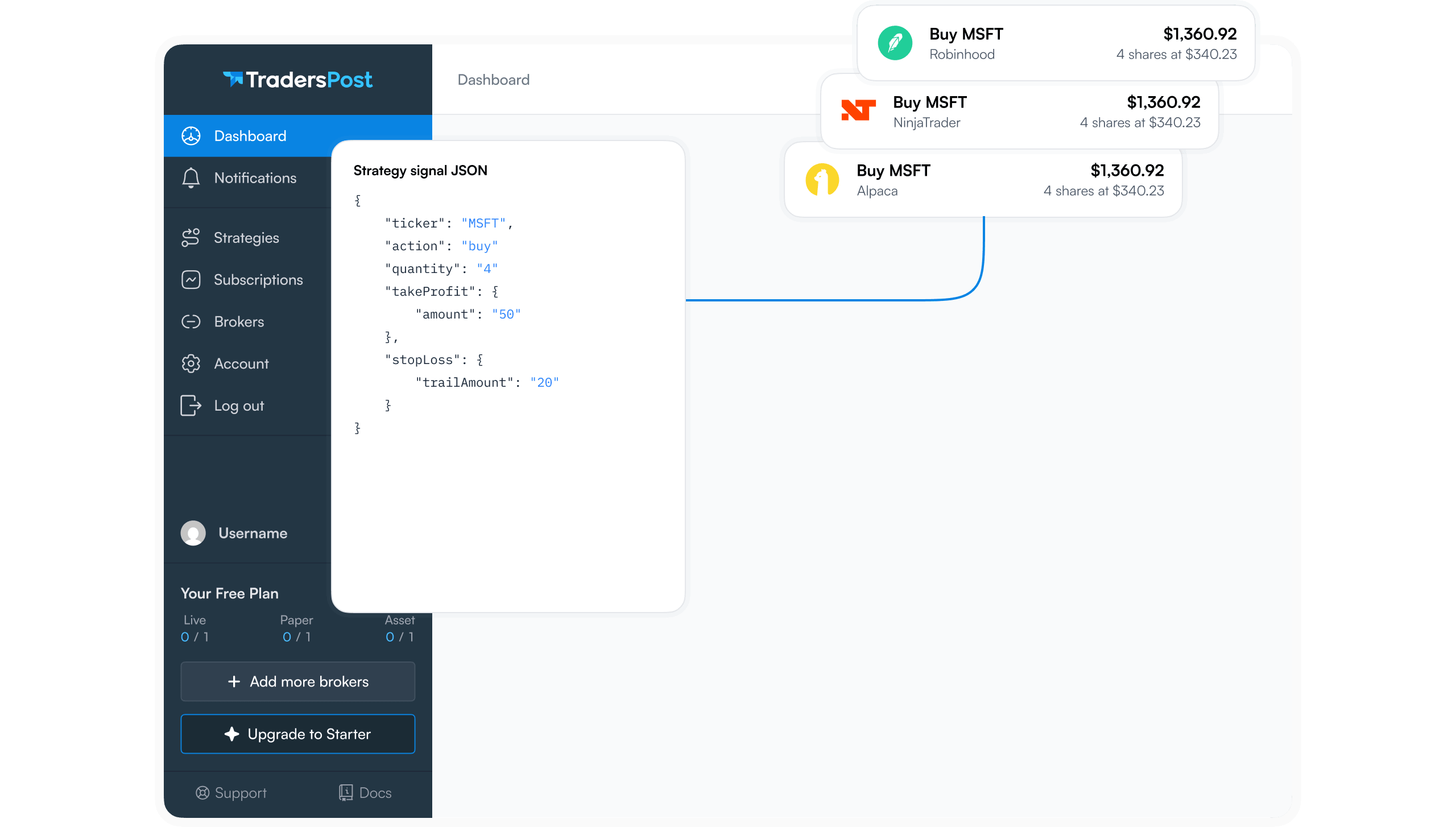
Name alerts so their function is obvious in both the charting platform and TradersPost logs. For example: IPO_ORB_Long_NVDA_BUY, IPO_VWAP_Reclaim_Long_NVDA_BUY, IPO_ORB_Long_NVDA_StopToBE, and IPO_AllPositions_NVDA_EOD_Exit. The alert message should identify the strategy, direction, ticker, and intended action. A structured message such as {"strategy":"IPO_ORB","symbol":"NVDA","side":"buy","action":"entry","signal_id":"NVDA_ORB_20260710_0946"} is easier to validate than free-form text.
Configure Rule-Based Execution Safeguards
Before enabling an automation, verify the symbol mapping between TradingView or TrendSpider, TradersPost, and the broker. IPO symbols can change, trade with temporary suffixes, or be delayed before their first eligible session. Confirm the connected brokerage account, buy or sell action, quantity method, order type, time-in-force, and whether the automation is in simulated or live mode.
Use a unique signal_id in each alert payload and configure the workflow to treat repeated messages with the same identifier as duplicates where supported. This is particularly important when an alert condition remains true across multiple bars or when a charting platform retries a webhook after a delivery issue.
- Set a maximum of one breakout entry per symbol per session.
- Require a flat position before accepting a new entry alert.
- Cap total shares and total dollar exposure for the IPO strategy.
- Separate long and short automations so an exit signal cannot reverse a position unintentionally.
- Use strategy-specific entry limits, not only account-level buying-power controls.
Create a Manual Emergency Procedure
Keep the broker platform open throughout the trade. Monitor working orders, partial fills, position size, realized and unrealized P&L, buying power, and exchange or broker notices. IPOs can experience opening delays, volatility pauses, wide spreads, and thin displayed liquidity, conditions that can make an otherwise valid alert unsuitable for execution.
Define explicit disable conditions before the session begins: data-feed discrepancies, repeated or malformed alerts, abnormal bid-ask spreads, unexpected symbol mapping, rejected orders, exchange halt notices, or breach of the strategy’s daily-loss limit. Disable the TradersPost automation first, then cancel open orders and reconcile the broker position against the intended strategy state.
Automation standardizes execution logic, but it does not remove the need for active supervision, especially during an IPO’s first sessions.
Paper Test the IPO Playbook Before Going Live
Test the Full Alert-to-Order Workflow
Paper testing should validate the entire execution chain, not just the chart signal. Run simulated IPO alerts from the charting platform through the webhook endpoint, TradersPost automation, and the selected broker or paper account. Treat each test as if it were occurring during the opening session, when price changes, spreads, and order-book conditions can change materially within seconds.
- Confirm the symbol format used by every system. A charting platform may reference a newly listed stock differently from the broker's tradable symbol during the first minutes of trading.
- Verify that a long breakout alert sends a buy order and that a short or mean-reversion alert sends the intended sell-short or buy-to-cover instruction, where supported.
- Check quantity calculation against the written risk model. For example, if the plan risks $250 with a $2.50 stop distance, the automation should calculate 100 shares, not use a fixed default quantity.
- Validate stop-loss, profit target, trailing-stop, time exit, and end-of-day flattening behavior. Confirm whether protective orders are submitted immediately after entry or only after a fill confirmation.
Deliberately test failure cases. Send duplicate webhook alerts and confirm idempotency rules prevent double entries. Test delayed alerts, rejected orders, missing symbols, insufficient buying power, partial fills, disconnected broker sessions, and automation-disabled states. The correct response to a rejected entry should be a logged failure and no orphaned stop or exit order. The correct response to a partial fill should match the actual filled quantity, not the originally requested quantity.
Evaluate Performance With Realistic Assumptions
Analyze paper results using execution assumptions appropriate for newly listed, highly watched names. Report win rate, average win, average loss, expectancy per trade, maximum drawdown, profit factor, and sample size.5 A 70% win rate is not useful if losses are several times larger than wins, and ten favorable trades are not enough to establish a reliable edge.
Model conservative slippage rather than assuming fills at the alert price. For a breakout above $50.00, test entries at $50.10 or worse when the spread is wide. Include partial fills, missed limit orders, and exits that occur below a stop level during rapid downside movement. If the strategy uses marketable limit orders, measure how often the limit price prevents participation versus how often it controls adverse fills.
- Breakout trades: Evaluate opening-range breaks, volume confirmation, and continuation behavior separately.
- Mean-reversion trades: Evaluate failed extensions, VWAP reversion, and liquidity stabilization separately.
Do not combine these results into one equity curve if they operate in different regimes. Breakouts may benefit from sustained institutional demand, while mean reversion may perform only after the opening imbalance has normalized. Their drawdown patterns, holding times, and stop requirements can differ substantially.
Scale From Paper Trading to Limited Live Exposure
Successful paper testing is a prerequisite for live deployment, not proof of production readiness. Begin with reduced size and a limited trade count, such as one setup per IPO and 25% of the intended risk allocation. This phase tests real order routing, actual queue position, broker handling, and the psychological tendency to override automation after a volatile fill.
Use a post-trade checklist for every live attempt:
- Did the alert fire at the expected time and price?
- Was the order accepted, filled, modified, and exited according to the strategy rules?
- What was the realized slippage versus the modeled assumption?
- Did the trade meet the defined setup criteria and market-regime filter?
- Were there manual interventions, platform errors, or discrepancies between intended and executed position size?
No automation should be considered validated because it handled one prominent IPO well. Build evidence across multiple listings, different opening volatility profiles, broad-market conditions, and liquidity environments before increasing risk limits.
Frequently Asked Questions
Can you automate trading on an IPO's first day?
Yes, provided the IPO ticker is available through your charting platform and supported by your connected broker. Your strategy alerts, webhook settings, order rules, and execution workflow must also be configured correctly. However, first-day IPOs carry elevated risks, including wide spreads, slippage, volatility halts, and limited price history. Paper test the workflow first, use small initial risk, and remember that automation only follows pre-defined rules, it does not make an untested IPO strategy safe.
What is the best strategy for IPO volatility automation?
There is no universal best strategy because IPO behavior can vary significantly based on liquidity, float size, market conditions, and news flow. A rules-based opening-range breakout may fit strong momentum conditions, while a confirmed VWAP mean-reversion setup may work better after exhaustion or during range-bound trading. Test each approach independently rather than combining assumptions, and use strict tradeability filters, position limits, and daily loss controls before automating live orders.
How can TradersPost automate IPO trading alerts?
TradingView or TrendSpider can generate alerts when objective chart conditions occur, such as an opening-range breakout, volume confirmation, or a VWAP reclaim. TradersPost can receive those alerts through webhooks and send rule-based orders to a connected supported broker.6 Before enabling live automation, verify that the ticker is eligible, the broker supports trading it, the position size and order type are correct, and the automation status is active and behaving as expected.
How should I size a trade on a volatile new IPO?
Start by setting a fixed maximum dollar loss per trade, then divide that amount by the distance between your planned entry and stop price. For example, if you risk $100 and your stop is $2 away, the maximum position would be 50 shares before adjustments. Reduce size further for expected slippage, wide spreads, and the possibility that stops fill worse than planned. Many traders use lower risk for newly listed, low-float, or headline-sensitive IPOs.
Should I automate trades based on IPO news or social sentiment?
Use IPO news and social sentiment as context or a tradeability filter, not as the sole trigger for an automated order. A more controlled workflow requires confirmation from price action, volume, and volatility before an alert can execute a trade. For example, news may identify a stock to watch, while an opening-range breakout with volume confirmation supplies the entry signal. Unverified headlines and social posts can change quickly, making sentiment-only automation especially risky.
Conclusion
Mega-IPO volatility can create opportunity, but the first days of trading are often shaped by wide spreads, incomplete price discovery, abrupt reversals, and rapidly changing liquidity. Automation does not remove those risks, it helps traders apply predefined rules consistently when emotions and market speed can otherwise interfere. The strongest IPO-volatility workflows combine objective entry signals, position sizing limits, stop logic, time-based exits, and safeguards for halts or abnormal spreads.
Before risking capital, connect TradingView or TrendSpider to TradersPost and build a simulated IPO-volatility workflow. Paper test your alerts, order timing, risk controls, and exit rules across different opening conditions, then review whether execution assumptions hold up before enabling live broker execution.
Use the data from each test to refine your process, not chase every headline. Build the discipline first, then let automation support more confident, repeatable decisions. Start paper testing with TradersPost today.
References
1 TechCrunch, SpaceX IPO Closes Up 19% (June 2026)
2 TradersPost Docs, Paper Trading
3 TradersPost Docs, Position Sizing
4 TradingView, Strategy Properties (Slippage & Commission)
5 Monster Trading Systems, Trading System Performance Metrics
6 TradersPost Docs, Webhooks