Lowest Commissions for High-Volume Traders
Volume tiers, per-side quoting, and subscription plans determine what high-volume futures and stock trading actually costs. Here is the arithmetic.

Marketing

Finding the lowest commissions for high-volume traders is not as simple as comparing the headline number on a broker's pricing page. The rate you see depends on how the tier structure works, whether the figure is quoted per side or per round turn, and what fees sit on top of the broker commission entirely. Getting any one of those wrong can make a cheaper broker look more expensive, or worse, lead you to choose a plan that costs more than the alternative at your actual volume.
This article walks through how earned tiers and subscription plans differ, how Interactive Brokers applies its marginal structure, why per-side quoting doubles the apparent cost, and how to build a total cost number that includes exchange and regulatory fees. The arithmetic in the final section gives you a template you can fill in with your own monthly volume to find which plan actually wins.
Two Ways Volume Pricing Works
Tiers You Earn by Trading
Some brokers automatically move you into a lower commission bracket as your monthly volume accumulates, with no upfront commitment required. Interactive Brokers works this way: as you trade more contracts or shares within a calendar month, your rate on contracts above each threshold drops automatically.1 The key detail is that the lower rate applies only to contracts above the threshold, not to the entire month's volume retroactively. A trader who crosses from the first tier into the second does not get a retroactive discount on contracts already traded that month.
Tiers You Buy as a Subscription
Tradovate takes a different approach. Instead of earning a lower rate through volume, you buy it upfront as a plan. The Free plan charges $0.39 per side for micro futures with no monthly fee. The Monthly plan costs $99 per month and drops the micro futures rate to $0.29 per side. The Lifetime plan requires a one-time payment of $1,499 and sets the micro futures rate at $0.09 per side.2
Under a subscription model, the reduced rate applies to every contract from the first trade of the month. That is structurally different from a marginal tier system, where early-month contracts trade at the higher rate until a volume threshold is crossed. Whether a subscription plan ends up cheaper depends entirely on how many contracts you actually trade, which means the break-even calculation has to come before the plan decision.
How IBKR Tiered Pricing Actually Works
Marginal, Not Retroactive
Interactive Brokers applies US futures tiers on a marginal basis. The first 1,000 contracts in a month cost $0.85 per contract. Contracts 1,001 through 10,000 cost $0.65. Contracts 10,001 through 20,000 cost $0.45. Contracts above 20,000 cost $0.25.1 Crossing a tier boundary does not reprice contracts already traded that month.
The practical example: a trader who executes 1,500 US futures contracts in a month pays $0.85 on the first 1,000 and $0.65 on the remaining 500. The blended cost is not $0.65 on all 1,500. This distinction matters most when a trader is near a threshold, because the savings from crossing it are smaller than they first appear.
Fixed vs. Tiered on Stocks
For US stocks under IBKR Pro, Interactive Brokers offers two structures. Under Tiered, the rate starts at $0.0035 per share for up to 300,000 monthly shares and falls to $0.0005 per share above 100 million shares.3 Under Fixed, the rate is $0.005 per share regardless of volume.3
The difference is not just the rate. Under Tiered, third-party fees including exchange, clearing, and regulatory fees are passed through separately, so the headline rate is not the all-in cost.3 Under Fixed, IBKR absorbs most of those third-party fees into the single per-share rate, which simplifies cost forecasting but can be more expensive for certain order types and routing scenarios. The right choice between the two depends on your order mix and average trade size.
Per Side vs. Per Round Turn
Why the Quoting Convention Matters
Futures commissions in the United States are almost always quoted per side. The published rate applies once when you enter and once when you exit, so the total cost for a completed trade is double the advertised figure. Tradovate's Lifetime plan rate of $0.09 per side for micro futures equals $0.18 per round turn when both legs are counted.2 If you compare that figure to a broker quoting per round turn without adjusting, one broker will appear half as expensive as it actually is.
Applying the Conversion
Before comparing any two broker commission schedules, confirm whether each rate is stated per side or per round turn, then normalize everything to the same basis. Interactive Brokers' US futures tiered rate of $0.85 per contract is a per-side figure, so a single ES entry and exit costs $1.70 in IBKR execution fees before exchange fees are added.1 Some brokers publish all-in rates that include exchange and clearing fees in a single round-turn total. Others list only the broker commission. Reading the footnotes on the pricing page is what determines which comparison is valid.
Fees That Are Not the Commission
Exchange, Clearing, and NFA Fees
On futures trades, exchange fees, clearing fees, and NFA regulatory fees are charged in addition to the broker commission and appear as separate line items. Interactive Brokers' own pricing example shows a single ES contract costing $0.85 in IBKR execution fee plus $1.38 in exchange fees, for a total of $2.24 per side before any regulatory fee.1 Tradovate's pricing page explicitly states that exchange, clearing, and NFA fees apply on top of all plan commission rates.2
The ES example is instructive because the exchange fee alone is larger than the broker commission. A trader optimizing only on broker commission rate is looking at the smaller of the two costs.
Micro Futures: When Fees Exceed Commission
On micro futures, the exchange and regulatory fees can exceed the broker commission by a wide margin, which makes the headline broker rate a poor basis for comparison. Interactive Brokers charges $0.25 per side for micro and E-mini contracts such as MES and MNQ at the lowest tier, but exchange fees are still passed through on top of that figure.1 A trader on Tradovate's Lifetime plan paying $0.09 per side in broker commission still owes exchange, clearing, and NFA fees on every micro contract.2 In both cases, those pass-through fees can represent a larger dollar amount than the commission itself.
Stock-Specific Regulatory Fees
US stock trades on Interactive Brokers Tiered carry SEC transaction fees and FINRA trading activity fees that are passed through to the client separately from the per-share commission. The SEC transaction fee is applied to the aggregate value of sales. The FINRA trading activity fee is applied per share sold.3 Both fees add to the effective per-share cost and must be included when calculating total trading expense for high-volume equity strategies.
- SEC Transaction Fee: $0.0000206 multiplied by the value of aggregate sales3
- FINRA Trading Activity Fee: $0.000195 per share sold3
- FINRA Consolidated Audit Trail Fee: $0.000003 per share3
Zero Commission Is a Different Structure
What Zero Commission Actually Means
IBKR Lite offers $0 commission on US exchange-listed stocks and ETFs, but this is a structural difference from IBKR Pro Tiered, not simply a cheaper version of it.3 IBKR Lite does not pass through exchange rebates and routes orders differently than IBKR Pro, which affects execution quality rather than just the stated commission rate. High-volume traders whose edge depends on execution quality and smart order routing need to evaluate whether a zero-commission structure delivers comparable fills, not just a lower stated fee.
Hidden Cost in Zero-Commission Models
Zero-commission brokers typically monetize order flow through payment for order flow or wider effective spreads, neither of which appears in a commission comparison. For a high-volume trader executing thousands of shares daily, a fraction of a cent in worse fill price per share can easily exceed what a tiered per-share commission would cost. Commission-free does not mean cost-free: the total trading cost includes the bid-ask spread captured at execution, not only the line-item commission. This is especially relevant for strategies that depend on precise entry and exit prices rather than tolerating slippage.
Subscription Plans: Break-Even Arithmetic
When a Monthly Plan Saves Money
Tradovate's Monthly plan charges $99 per month and reduces the micro futures rate from $0.39 to $0.29 per side, a savings of $0.10 per side.2 Dividing the $99 monthly fee by the $0.10 per-side savings gives 990 sides, or 495 round turns, as the break-even volume. Any volume above that threshold produces net savings relative to the Free plan. A trader averaging fewer than 495 round turns per month pays more total cost on the Monthly plan than on the Free plan.
When a Lifetime Plan Saves Money
The Lifetime plan costs $1,499 once and sets the micro futures rate at $0.09 per side.2 Compared to the Free plan rate of $0.39 per side, the savings are $0.30 per side. Dividing $1,499 by $0.30 gives approximately 4,997 sides, or roughly 2,499 round turns, as the break-even volume against the Free plan. Compared to the Monthly plan rate of $0.29, the per-side savings drop to $0.20, which means the Lifetime plan must generate enough commission savings to also offset the $99 monthly fee no longer being paid. Once a trader crosses the Lifetime break-even point, all subsequent savings accumulate with no further subscription expense.
Calculating Your Own Number
Establish Your Monthly Volume Baseline
Before comparing broker schedules, determine your actual monthly volume: total contract sides for futures traders, or total shares for equity traders, averaged over at least three months. Volume that looks consistent on a monthly basis may cluster within certain weeks, which matters for marginal tier structures where the rate resets at the start of each calendar month. A trader who executes most of their volume in the first two weeks of the month and then slows down will not benefit from lower marginal tiers as often as a trader with consistent daily activity.
Separating volume by instrument class also matters. Interactive Brokers applies separate tier schedules to standard futures versus micro and E-mini futures.1 Mixing the two in a single volume estimate will produce inaccurate tier projections.
Build a Total Cost Comparison
For each broker under consideration, calculate broker commission at your volume tier, plus estimated exchange and regulatory fees, plus any monthly subscription or platform fee. Using a concrete example: a trader doing 500 US futures contracts per month stays in the first Interactive Brokers tier at $0.85 per side in broker fees, plus exchange and regulatory pass-throughs on every contract.1 The same trader on Tradovate's Free plan pays $1.29 per side in broker commission with no monthly fee; on the Monthly plan, $0.99 per side plus $99 per month.2 At 500 contract sides, the Monthly plan saves $0.30 per side in commission ($150 total) against $99 in fixed monthly cost, for a net saving of $51 over the Free plan at that volume level.
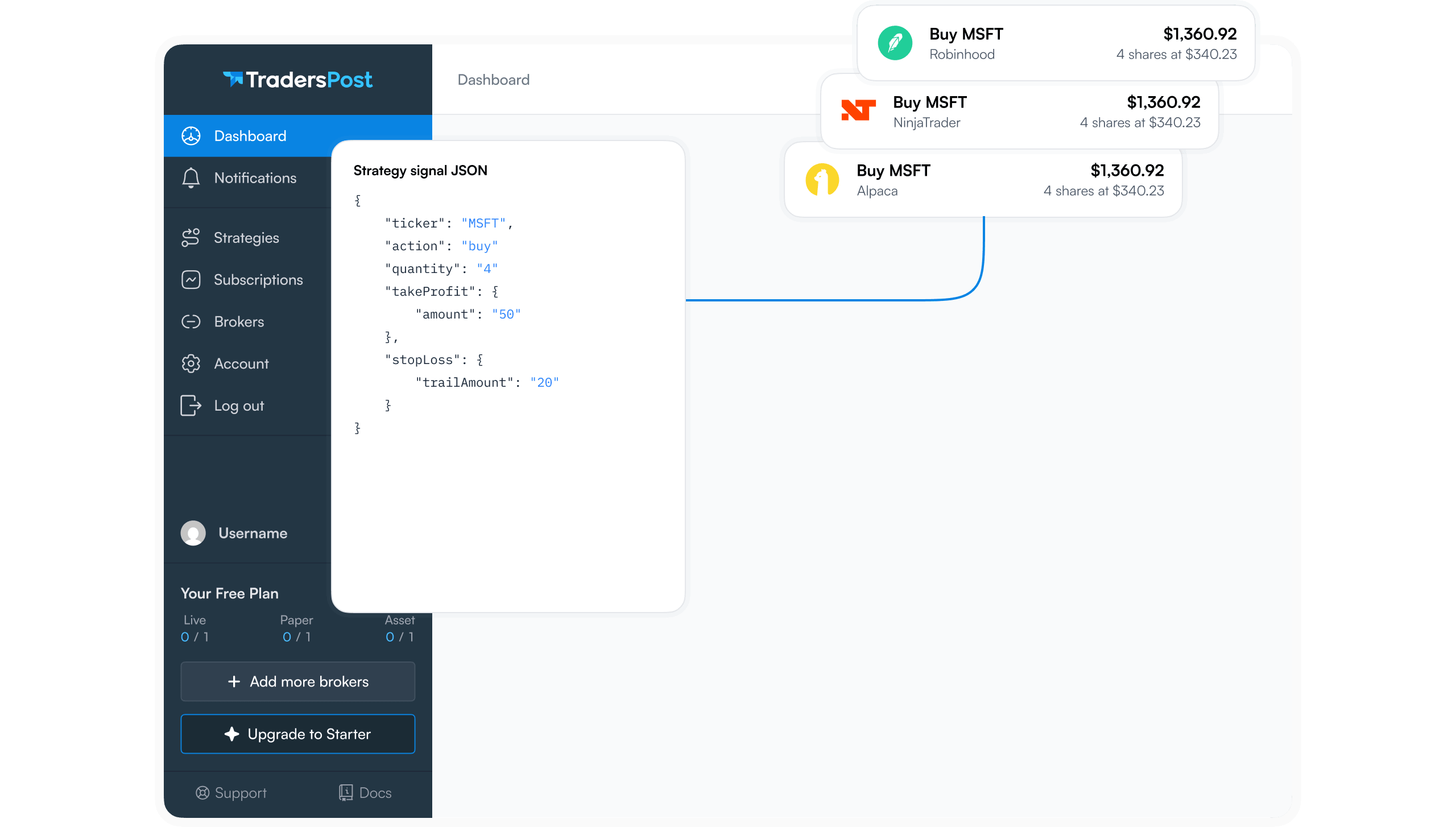
TradersPost connects to both Interactive Brokers and Tradovate via webhook-driven automation, so a strategy running on TradingView can route to whichever broker your volume math favors without rewriting the signal logic.
Recheck When Volume Changes
A plan that is optimal at 2,000 contracts per month may be suboptimal at 500 contracts, so re-evaluate the cost model whenever your trading frequency changes materially. Marginal tier structures like Interactive Brokers' adjust automatically as volume grows; subscription plans require a manual decision to upgrade or downgrade.1 Running the comparison quarterly, or after any significant strategy change that alters trade frequency, prevents paying for a tier or subscription that no longer matches actual activity.
Bottom Line
- Volume tiers at brokers like Interactive Brokers are marginal: crossing a threshold discounts only the contracts above it, not your entire monthly volume.1
- Subscription plans like Tradovate's Monthly and Lifetime tiers discount every contract from the first trade but require a volume break-even calculation before they produce net savings.2
- Futures commissions are quoted per side; double the headline rate to find the round-turn cost before comparing brokers.
- On micro futures, exchange, clearing, and NFA fees often exceed the broker commission, so the headline rate understates the real cost significantly.12
- Zero-commission structures are a different product, not simply a cheaper one; execution quality and order routing differences affect total cost beyond what the commission line shows.3
Frequently Asked Questions
Does IBKR apply tiered rates to my whole month's volume?
No. Interactive Brokers applies tiers on a marginal basis: only contracts above a threshold receive the lower rate, not the entire month's volume.1 A trader executing 500 US futures contracts in a month stays entirely in the first tier at $0.85 per contract, since the 1,000-contract threshold has not been crossed.
Is Tradovate's Lifetime plan worth it?
It depends on total contract sides traded. The Lifetime plan costs $1,499 once and reduces the micro futures commission to $0.09 per side versus $0.39 on the Free plan, a saving of $0.30 per side.2 Divide $1,499 by your per-side savings versus your current plan to find the break-even volume. Remember that exchange, clearing, and NFA fees still apply on top of any Tradovate plan rate and must be included in the full cost comparison.2
Why does my all-in cost exceed the advertised rate?
Broker commission is only one component. Exchange fees, clearing fees, and NFA regulatory fees are charged separately on futures trades and can exceed the broker commission on micro contracts. Interactive Brokers' own example shows a single ES contract costing $0.85 in broker fees plus $1.38 in exchange fees, totaling $2.24 per side.1 Always calculate the all-in cost per side, including all pass-through fees, before comparing broker schedules.
How do I know if a rate is per side or per round turn?
Futures commissions are most commonly quoted per side in the United States, meaning the rate applies separately to both the opening and closing trade. Check the broker's pricing page footnotes or FAQ. If the page shows a rate "per contract" without specifying round turn, assume per side and double it to find the round-turn cost. Some all-in comparisons published by brokers include both sides in a single figure; confirm whether exchange and regulatory fees are also included before treating it as comparable to a per-side broker rate.
Does zero-commission always cost less for high-volume stocks?
Not necessarily. Zero-commission accounts such as IBKR Lite route orders differently than tiered accounts and do not pass through exchange rebates.3 For high-volume traders, differences in fill price resulting from order routing can outweigh the commission savings, making the effective cost of a zero-commission account higher in some scenarios. The right comparison is total cost including execution quality, not the commission rate in isolation.
References
1 Interactive Brokers - Futures Commissions
2 Tradovate - Pricing
3 Interactive Brokers - Stock Commissions