Prop Firm Profit Splits: What Actually Changes
The bi-weekly vs on-demand profit split tradeoff barely exists at futures prop firms. Here is what actually drives your split and what speed costs you.

Marketing

Search for "prop firm profit split" and most results lead to a single number, usually 70% or 90%, presented as if it were the one variable separating a good deal from a bad one. At futures prop firms the reality is more complicated: the split is mostly fixed by the plan you buy, not by how often or how quickly you request a payout. The bi-weekly versus on-demand tradeoff that the question implies barely exists.
This article works through what actually determines your prop firm profit split, what the 70% figure people search for really means, and where the genuine costs of faster access sit. The answer is almost never in the percentage column.
Where the 70% Figure Comes From
A withdrawal ladder, not a split
The 70% number that surfaces in search results is not a fixed profit split at all. At FXIFY Futures it is the second tier in a withdrawal ladder that starts at 60% on payout one and rises through 70%, 80%, 90%, and reaches 100% from the fifth payout onward.1 The tier a trader lands on is determined by how many payouts they have completed, not by how long they waited between them. A trader who completes five payouts in five consecutive eligible windows earns the same 100% tier as one who waits months between each request.
Calling this number a "profit split" conflates two separate figures: the percentage of eligible profit above the buffer zone you can withdraw per request, and the firm's cut of that withdrawal. On Standard accounts at FXIFY Futures an 80% profit split applies on top of the withdrawal percentage, which means a trader on payout one is working through two multipliers simultaneously.1 The example in the FXIFY Futures help documentation makes this concrete: a $100,000 Standard account with $1,500 above the buffer on the first payout yields $900 at the 60% withdrawal tier, then $720 after the 80% profit split, not $900.
How FXIFY Futures structures the tiers
FXIFY Futures Standard and Expert funded accounts both follow the same five-tier ladder: 60% on payout one, 70% on payout two, 80% on payout three, 90% on payout four, and 100% from payout five onward.1 Payout requests can be made every 14 calendar days from the first trade, but the tier percentage advances with the payout count, not with the calendar. A trader who completes all five payouts in ten weeks reaches 100% at the same point as a trader who spaces them out over five months.
What the Split Is Actually Tied To
Plan type drives the percentage
At most futures prop firms the profit split is fixed at the plan level and does not vary with payout frequency. Alpha Futures pays 90% across Zero, Standard, and Advanced qualified accounts regardless of how often a trader requests a withdrawal.2 Tradeify Select Flex and Select Daily both pay a 90/10 split; the choice between them changes payout frequency and caps, not the percentage.3 The split is the same number on both plans, printed in the same column of the same comparison table.
Account stage and cumulative profit
Some firms tie the split to a lifecycle stage rather than a schedule. Elite Trader Funding sim-funded accounts offer up to 100% profit split during the sim-funded phase; the split steps down to 80% when a trader transitions to LIVE ELITE.4 TradeDay uses a milestone structure tied to cumulative net profit rather than time: 50/50 below $4,000 net profit, 80/20 above $4,000, and 90/10 in the Funded Live stage, all on the same plan and irrespective of payout timing.5
Paid add-ons as the split lever
FXIFY Futures offers a profit split increase add-on that must be purchased at checkout: Standard accounts move from 80% to 90%, and Expert or Direct to Sim Live accounts move from 90% to 100%.6 The add-on costs 10% of the selected account price and cannot be added after purchase. GOAT Funded Futures Flex pays 80/20 by default; the optional 90/10 add-on is priced at 20% of the challenge price and must be selected at checkout.7 In both cases the split is determined by whether the add-on was purchased, not by how long the trader waited between payout requests.
The Clearest Counter-Example Runs Backwards
MyFundedFutures: daily plans pay more
MyFundedFutures is the clearest evidence that the assumed pattern does not hold. The Rapid plans, which offer daily payout eligibility, pay a 90/10 profit split as of January 12, 2026.8 The Pro plan, which requires payouts every 14 calendar days, pays an 80/20 split.8 The faster plan pays the higher percentage. Waiting longer on the Pro plan earns a lower split, not a higher one.
Why the pattern runs this way
Firms price daily payout plans at a higher evaluation fee to offset faster cash outflows, and they compensate traders with a higher split rather than a lower one. The bi-weekly Pro plan at MyFundedFutures carries a maximum payout request of $100,000 in the sim-funded stage, which is the real structural benefit of the slower schedule.8 The split differential between plans is a pricing and risk-management decision by the firm, not a reward for patience.
The Real Cost of Speed: Payout Caps
How caps shrink on faster schedules
The genuine cost of faster access is almost always a lower cap per request rather than a lower split percentage. Tradeify Select Daily caps the 50K account at $1,000 per payout request for accounts purchased before September 1, 2026; Select Flex on the same size caps at $3,000. Both pay a 90/10 split.3 GOAT Funded Futures Daily Payouts caps the 50K account at $1,000 per request while the Flex plan on the same size caps at $2,000; the split is 90/10 on Daily and 80/20 by default on Flex.79 A trader who earns $3,000 in a payout cycle on a daily plan with a $1,000 cap needs three separate requests to extract the same gross amount that a 5-day plan pays in one.
Buffer requirements compound the friction
Tradeify Select Daily requires the account balance to remain above a buffer before any withdrawal is permitted: $2,100 on the 50K account. Select Flex has no minimum balance requirement.3 GOAT Funded Futures Daily Payouts likewise requires a $2,100 profit buffer on the 50K before the first request, while the Flex plan has no profit buffer.9 The buffer effectively imposes a minimum threshold that delays the first payout on daily plans more than the word "daily" implies.
The Second Cost: Paying for the Faster Schedule
Add-on fees for daily access
Some firms charge an explicit fee to unlock daily eligibility. Funded Futures Family Velocity charges a monthly add-on of $29 to $69 depending on account size to unlock daily payout eligibility; without it, the standard funded rhythm is every three trading days.10 The Daily Payout Add-On on Velocity also removes the funded consistency rule, so traders buying it are purchasing two changes simultaneously.10 GOAT Funded Futures Daily Payouts is structured differently: it is a separate plan with its own evaluation fee, starting at $89 for the 25K account compared to $109 for the Flex 25K.97
Tighter drawdown as an implicit cost
Tradeify Select Daily uses a smaller maximum drawdown on larger accounts: $2,500 on the 100K versus $3,000 on Select Flex for the same size, and $3,500 versus $4,500 on the 150K.3 GOAT Funded Futures Daily Payouts funded accounts use intraday trailing drawdown; the Flex plan uses end-of-day trailing drawdown.9 The distinction matters for traders who let positions run: intraday trailing chases every open equity peak in real time, while end-of-day only ratchets up at session close on realized profit. The tighter drawdown on daily plans is a structural cost that does not appear in the payout percentage comparison but directly affects how much room a trader has to operate.
The Third Cost: Qualifying Days
Winning day requirements gate payout timing
A requirement to accumulate a minimum number of profitable days before each request can delay payout timing far more than a nominal schedule difference. Topstep's Express Funded Account Standard path requires five winning days of $150 or more net P&L before each payout request; the Consistency path requires three days with a 40% consistency target.11 Alpha Futures requires five winning trading days of $200 profit or more between each withdrawal request, regardless of how much calendar time has elapsed, across Zero, Standard, and Advanced qualified accounts.2 LucidFlex requires profit on at least five separate days per payout cycle, with a minimum daily profit threshold that varies by account size: $100 on the 25K up to $250 on the 150K.12
Plans that skip the day count
The absence of a winning day requirement is the most meaningful speed advantage available. Take Profit Trader PRO accounts have no minimum number of profitable days and no waiting period; traders can request on day one of the funded account.13 GOAT Funded Futures Daily Payouts has no minimum winning day requirement on the funded account; eligibility opens 24 hours after the first trade is placed, subject to the buffer and daily progression rule.9 Eliminating the day count removes the variable that most reliably delays a first payout, regardless of what the nominal schedule says.
One Trade That Genuinely Exists
Larger caps in exchange for waiting
The clearest genuine tradeoff across the plans documented here is cap size versus frequency, not percentage versus frequency. Tradeify Select Flex's $3,000 cap on the 50K is three times the $1,000 cap on Select Daily; both pay 90/10.3 Topstep's Live Funded Account removes payout caps entirely after enough payouts in the Express Funded Account; traders can request up to 50% of the account balance with no dollar ceiling.11 A trader with a consistent daily edge may extract more total dollars per month on a daily plan despite the lower cap per request; a trader with lumpy, high-value days may prefer the higher per-request cap available on a 5-day plan.
Consistency rules as the hidden variable
Some plans impose a consistency rule that limits how much of total profit can come from one day; this can prevent a payout request even when the day count is met. Funded Futures Family Velocity's standard funded account carries a 40% consistency rule that resets after each approved payout; the Daily Add-On removes it.10 GOAT Funded Futures Flex imposes a consistency rule during the evaluation but not on the funded account; Daily Payouts has no funded consistency rule either, meaning the rule difference between these two plans sits in the evaluation, not in the funded trading phase.79
How to Compare Two Offers Properly
Build an apples-to-apples comparison
Comparing only the headline split percentage obscures the variables that most affect actual take-home dollars. Read the split, the cap per request, the buffer requirement, the qualifying day count, the drawdown model, and any add-on cost as a single set. Calculate the maximum dollars extractable per month under each plan given your realistic trading frequency, not the theoretical maximum. A daily plan with a $1,000 cap and several losing days per week may yield less than a 5-day plan with a $3,000 cap. Also verify whether the split percentage shown on the marketing page applies from payout one or only after a ladder: the FXIFY Futures example shows that a displayed 80% split may deliver 60% on the first withdrawal.1
- Read six variables together: split, cap, buffer, qualifying days, drawdown model, add-on cost.
- Calculate realistic monthly extraction, not theoretical maximum.
- Check whether the advertised split applies from payout one or starts lower on a ladder.
- Verify whether the daily drawdown model is intraday or end-of-day; the difference affects operational risk, not just rules compliance.
- Confirm automation policy before choosing a daily plan: some firms prohibit bots on those accounts entirely.
Automating entries changes the qualifying day math
Traders running automated strategies may accumulate winning days faster than discretionary traders, which compresses the practical difference between a 5-day and a daily plan. Qualifying day rules that require a minimum daily profit threshold still apply to automated accounts; a strategy that generates many small trades across a session may or may not meet the per-day minimum depending on how the firm defines a winning day. Firms that prohibit automated strategies on their daily payout plans, as GOAT Funded Futures Daily Payouts explicitly does for bots, Expert Advisors, and automated strategies, remove the speed advantage of automation entirely for those accounts.9
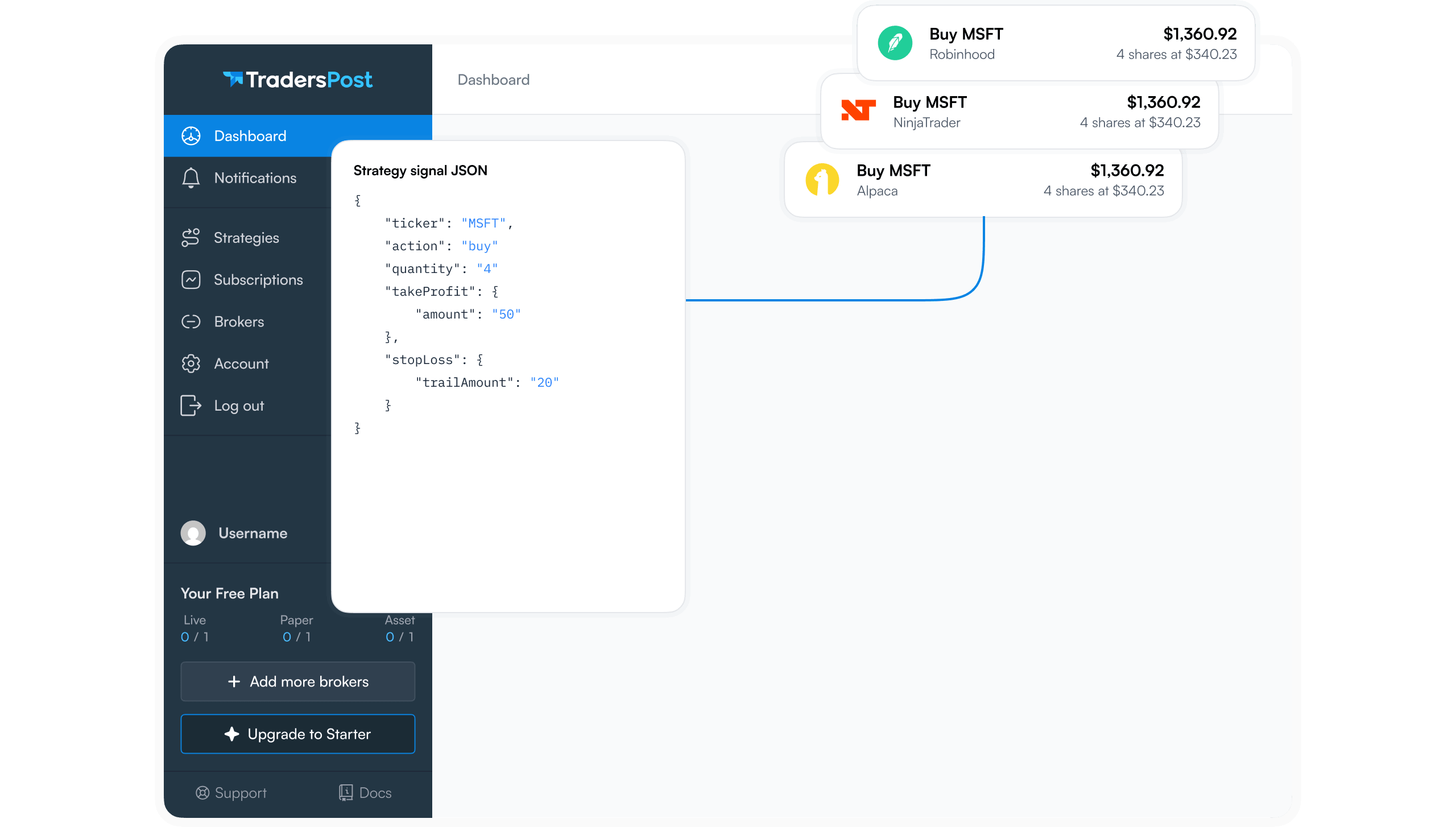
TradersPost routes TradingView alerts to supported futures prop firm accounts via webhook, which means qualifying day accumulation can run without manual order entry. The split and cap structure at the chosen firm still applies exactly as documented by that firm, and automation restrictions at the plan level remain in force regardless of the signal source.
Bottom Line
- No futures prop firm reviewed here pays a higher profit split for choosing a slower payout schedule over a faster one; MyFundedFutures does the opposite, paying 90% on daily Rapid plans and 80% on the bi-weekly Pro plan.8
- The 70% figure common in search results is a withdrawal ladder tier at FXIFY Futures, not a fixed split; a separate profit split percentage further reduces the first payout.1
- The real cost of daily access is a lower payout cap per request, a buffer that must be cleared first, and in some cases a monthly add-on fee or a tighter drawdown model.
- The split percentage is set by the plan purchased, the account lifecycle stage, or a paid add-on chosen at checkout, not by how long a trader waits between requests.
- Plans that eliminate the winning day requirement, like Take Profit Trader PRO and GOAT Funded Futures Daily Payouts, deliver a more meaningful speed advantage than a higher nominal split percentage because they remove the variable that most reliably delays the first payout.139
Frequently Asked Questions
Does waiting for a bi-weekly payout window earn a higher profit split?
No futures prop firm reviewed here pays a higher split for choosing a slower schedule. MyFundedFutures pays 90% on its daily Rapid plans and 80% on its bi-weekly Pro plan, the opposite of what the assumption predicts.8 The split is determined by the plan purchased, the account stage, or a paid add-on, not by how long the trader waits between requests.
What does the 70% split figure in search results actually refer to?
At FXIFY Futures, 70% is the second tier in a withdrawal ladder: traders receive 60% of eligible profit above the buffer on the first payout, 70% on the second, rising to 100% from the fifth payout onward.1 This percentage governs how much of the eligible profit can be withdrawn per cycle. A separate profit split percentage then reduces the trader's final take-home further on Standard accounts.
What is the real cost of choosing a daily payout plan?
The primary cost is a lower cap per payout request. Tradeify Select Daily caps the 50K account at $1,000 per request versus $3,000 on Select Flex; both pay 90/10.3 Daily plans often carry tighter drawdown parameters, a buffer requirement before the first withdrawal is permitted, and sometimes a monthly add-on fee. None of these appear in the headline split percentage.
Which futures prop firms have no minimum winning day requirement?
Take Profit Trader PRO accounts allow requests from day one with no minimum profitable days and no payout window.13 GOAT Funded Futures Daily Payouts opens eligibility 24 hours after the first trade on the funded account with no winning day count required, subject to the buffer and daily progression rule.9 LucidFlex has no fixed payout window and allows requests any day after meeting the profit-on-five-days and positive net profit requirements for the cycle.12
Can I run an automated strategy on a daily payout plan?
It depends on the firm. GOAT Funded Futures Daily Payouts explicitly prohibits bots, Expert Advisors, and automated strategies on that plan.9 Firms that do allow automation on their funded accounts do not alter the split or cap structure for automated traders; all payout rules apply equally. Verify the automation policy for any specific plan before choosing it on the basis of payout speed.
References
1 FXIFY Futures Payout Policy For Standard and Expert Accounts
2 Alpha Futures Payout Policy
3 Tradeify Select Flex and Select Daily Payout Policies
4 Elite Trader Funding Evaluations
5 TradeDay Make It Take It
6 How Do FXIFY Futures Add-Ons Work
7 GOAT Funded Futures Flex Challenge Specifications, Rules and Payouts
8 MyFundedFutures Payout Policy Overview
9 GOAT Funded Futures Daily Payouts Specifications, Rules and Payouts
10 Funded Futures Family Velocity Plan
11 Topstep Payout Policy
12 LucidFlex Payouts
13 Take Profit Trader