Prop Firm Promo Codes: How Discounting Works
Prop firm promo codes rarely expire in practice. Learn why the sale never ends, what the list price means, and how to judge an offer before you buy.

Marketing

Prop firm promo codes are everywhere, and they almost never seem to expire. On any given day you can find multiple futures prop firms running discounts of 35% to 55% simultaneously, each with its own banner, its own code, and its own countdown timer. Understanding why the sale never ends, and what actually changes when you apply a code, is worth five minutes before you buy.
This article walks through what the market looked like on one ordinary day, why deep discounts cost these firms almost nothing to offer, how expiry dates function more as marketing copy than hard cutoffs, and what the list price actually covers once you account for resets and activation fees. It also covers the one thing a discount never changes: the drawdown type, the consistency rules, and the payout structure you are actually buying.
The goal is a clear framework for judging any prop firm offer in about five minutes, whether you are looking at a 55% banner or a tiered code that promises 80% off for the first five uses.
What the Market Looked Like One Day
Simultaneous discounts across firms
On a single ordinary day, multiple futures prop firms were advertising discounts of 35% to 55% simultaneously. TradeDay listed 55% off,1 Tradeify listed 35% off,2 Goat Funded Futures listed 50% off with code SUMMER50,3 and FundedNext listed 47% off.4 These were not coordinated sales events or seasonal promotions. Each firm ran its own banner independently at the same time.
When every competitor is discounting at once, the discounted price is the effective market price, not a temporary reduction. The list price printed above the strikethrough is the anchor the percentage is calculated against, not the price traders actually pay.
Codes with use limits attached
Funded Futures Family advertised tiered codes: VELOCITY at 80% off for the first 5 uses then 70%, PREMIER at 55% off for the first 5 uses then 40%, and code FFF for 90% off S2F Accelerate.5 The use-limit structure means early buyers get a deeper discount than later buyers, which is a deliberate pricing mechanic, not a random cap. Bulenox listed a code called BULENOX described explicitly as an always-on coupon that never expires, making the discount permanent by design.6
Why the Discount Never Ends
Near-zero marginal cost of a sim account
A prop firm evaluation account is a simulated environment. As Take Profit Trader explains in its FAQ, orders do not go to the exchange but are handled by the broker's internal system using their technology to simulate live market conditions.7 Because provisioning one more simulated account costs the firm almost nothing operationally, a deep discount does not meaningfully cut into the operating margin.
The real revenue model is volume: evaluation fees collected across a large number of traders, the majority of whom do not pass. TradeDay disclosed a 36% pass rate between January and June 2026.1 Topstep disclosed that 16.8% of all Trading Combines initiated were successfully completed in 2025.8 Take Profit Trader disclosed that 36.22% of all trading tests were successfully passed between January 1 and December 31, 2025.7
Discounting as a customer acquisition tool
A lower entry price reduces friction on a first purchase, which increases the number of traders who attempt an evaluation and, by extension, the total pool of evaluation fees collected. Repeat buyers who fail and reset are a significant revenue source. TradeDay lists reset fees at the same discounted price as the monthly evaluation fee.1 Tradeify and others offer reset fees as a separate line item on their pricing pages.2 The discount is a front-end acquisition cost recouped through resets, repeat evaluations, and ongoing subscriptions.
The Expiry Date Is Not Load-Bearing
Countdown timers and stated end dates
Funded Futures Family displayed a countdown timer reading "14 Days : 00 Hr : 42 Min : 30 Sec" next to its tiered discount codes, creating urgency around a deadline.5 Tradeify's August promotion banner stated "ENDS 31 AUGUST, 11:59PM EST" with code AUG, while a second code labeled SEP appeared on the same page simultaneously, suggesting the next promotion was already staged before the current one expired.2
When a replacement code is visibly ready before the advertised deadline passes, the expiry date functions as marketing copy rather than a hard cutoff. The practical effect is a continuous discount under a rotating code name.
Always-on codes that bypass the question entirely
Bulenox explicitly describes its BULENOX code as one that "never expires," removing any ambiguity about whether the discount is temporary.6 Alpha Futures advertised code APP50 for 50% off without a visible end date on its pricing page.9 These are not exceptions to the pattern. They are the pattern made explicit.
What the List Price Actually Covers
Monthly subscription versus one-time fee
The billing model varies significantly between firms, and that difference matters more than the discount percentage. Topstep's Trading Combine is billed monthly at $49, $99, or $199 depending on account size, with the subscription rebilling until you pass or cancel.8 MyFundedFutures, Tradeify, Goat Funded Futures, and Bulenox all use one-time pricing with no recurring billing during the evaluation period.23610
The list price before any code is the anchor the discount percentage is calculated against. A 55% discount on a $100 list price and a 55% discount on a $200 list price produce very different actual costs, so comparison shopping requires looking at the post-discount number, not the percentage.
Fees that appear after passing
Topstep charges an Express Funded activation fee of $149 for the Standard path after passing the Trading Combine, which is separate from the evaluation subscription price and is not affected by evaluation discounts.8 Tradeify's Select plan charges an activation fee of $1,500 for the Daily payout path or $4,000 for the Flex path after passing, separate from the evaluation purchase price.11
Reset fees are also separate. Comparing discounted evaluation prices without accounting for likely reset costs, given published pass rates below 40%, understates the total cost to a first payout by a material amount.
A Discount Does Not Change What You Bought
Drawdown type is fixed at purchase
Whether a drawdown is calculated intraday or end-of-day is set by the plan, not the price. TradeDay offers both intraday and end-of-day drawdown variants at different price points; a code applies to whichever variant you select.1 Bulenox requires you to choose between trailing drawdown and end-of-day drawdown before purchase and states this choice is locked for the life of the account.6
An intraday trailing drawdown is monitored in real time including unrealized open positions, which means the threshold can be breached during the day at the worst point of an open trade, not just at the close. A 50% discount on an intraday trailing account does not convert it into an end-of-day account. The risk model is unchanged by the price you paid.
Consistency rules survive the discount
Consistency rules determine whether a single large winning day can disqualify a payout request. Topstep requires that your best day not exceed 55% of total profits on the standard path.8 Tradeify Growth carries a 35% consistency rule on funded accounts.2 The Funded Futures Family S2F plan carries a 25% consistency rule throughout the life of the account.5 Funded Futures Family Premier+ Fast Pass has no evaluation consistency rule, but accounts purchased on or after September 9, 2026 carry a 40% funded consistency rule.12
These rules apply regardless of what code was used at checkout. The evaluation pass rate is also unaffected by price: Take Profit Trader disclosed 36.22% of trading tests were successfully passed between January 1 and December 31, 2025, at whatever price traders paid.7
Payout structure is set by the plan
Profit split percentages, payout frequency, and payout caps are plan-level terms. Tradeify Select Daily pays 90/10 with daily payouts; Tradeify Select Flex pays 90/10 with 5-day payouts. A discount code does not change which payout path you are on.11 Topstep's payout caps range from $2,000 to $12,000 depending on account size and path chosen, and these caps are not altered by any promotional pricing.8
The total cost to a first payout includes the evaluation fee after discount, any reset fees if you fail, any activation fee after passing, and the number of trading days required before a payout is eligible. A discount code only affects the first item on that list.
How to Judge an Offer in Five Minutes
Calculate cost to first payout
Start with the discounted evaluation fee. Then factor in resets. Given that published pass rates cluster between 17% and 36%, most traders will need at least one reset before passing. For monthly subscription models, multiply the monthly fee by the number of months you realistically expect to need, then add the activation fee. A Topstep $50K account at $49 per month plus a $149 activation fee after passing totals at least $198 before any resets.8 Compare the resulting total against the maximum first payout available on that plan to understand the minimum performance required to break even.
Read the drawdown and consistency rules
Identify whether the drawdown is intraday trailing or end-of-day before you buy. Check whether a consistency rule applies to the funded account specifically, not just the evaluation. The Funded Futures Family S2F plan requires 7 qualifying days of at least $200 profit each before a payout can be requested.5 Topstep Standard requires 5 winning days of at least $150 each.8 These qualifying-day requirements affect how quickly you can reach your first payout, independent of how much you paid at checkout.
- Check whether the drawdown is intraday or end-of-day, and confirm which stage it applies to (evaluation only, funded only, or both).
- Check whether the consistency rule applies at the funded stage, not just the evaluation stage.
- Check the minimum number of qualifying trading days before a payout can be requested.
- Check for an activation fee that only appears after passing.
Verify the code actually works before committing
Apply the code at checkout and confirm the price changes before entering payment details. A code that appears in a banner but fails at checkout may be expired or region-restricted. Check the firm's pricing page directly rather than relying on a third-party affiliate link that may carry a different code or an outdated discount amount. If the page shows two codes simultaneously, as Tradeify's August page showed both AUG and SEP, test the one with the higher stated discount first.
Where Automation Fits After Funding
Running an automated strategy on a funded account
Once funded, many traders switch from discretionary to automated execution to maintain consistency and remove emotional decision-making from entries and exits. Prop firm rules that govern position size, drawdown, and consistency are well-suited to automation because a system executes the same logic on every signal without deviation. The pass rate data from multiple firms suggests that rule adherence, not market prediction, is the primary differentiator between traders who complete the evaluation and those who do not.
Connecting TradingView alerts to a prop firm broker
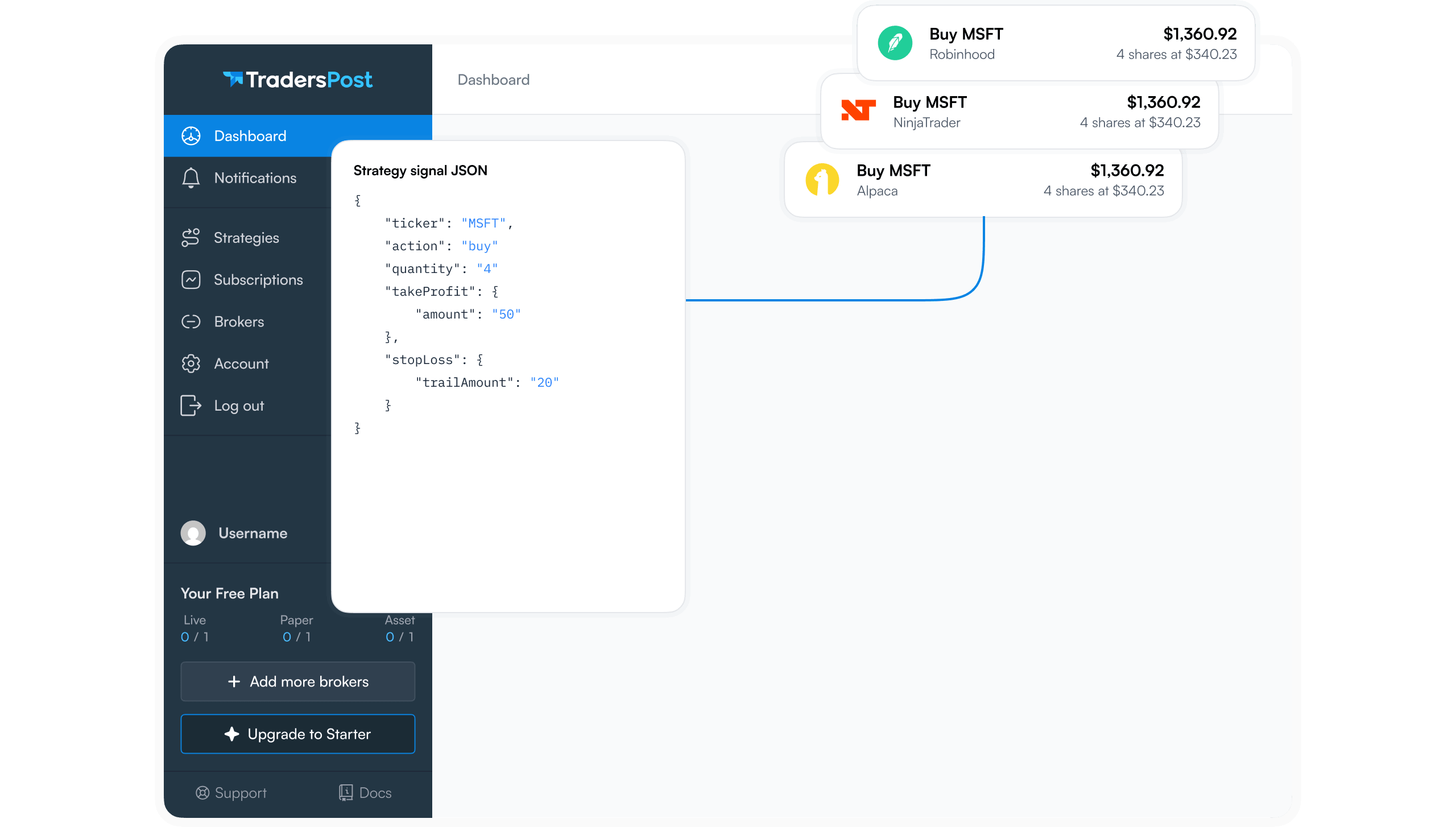
TradersPost routes webhook signals from TradingView to supported futures brokers, letting an automated strategy execute on a funded prop account without manual order entry. A basic signal needs only a ticker and an action field. Position sizing, bracket orders, and stop-loss parameters can all be defined in the payload. For futures, TradersPost standardizes the symbol format to a four-digit year. Because the rollover schedule for continuous symbols like NQ1! may differ from TradingView's, TradersPost documentation recommends using explicit contract symbols such as MNQU2025 rather than continuous symbols in webhook payloads.13
If you are building a strategy to run on a funded account, routing signals through TradersPost means your Pine Script alert can trigger a live order with no manual intervention, which removes the execution lapses that can breach consistency rules or drawdown limits at the worst moment.
Bottom Line
- When all major prop firms discount simultaneously, the discounted price is the market price. The list price is an anchor, not the real starting point.
- Evaluation accounts are simulated with near-zero marginal cost to create, so deep discounts are essentially free for firms to offer. The business model runs on evaluation fee volume, including repeat purchases from traders who reset.
- Expiry dates and countdown timers are frequently followed by replacement codes before the deadline passes. Always-on codes like Bulenox's BULENOX make this explicit.
- A discount code never changes the drawdown type, consistency rules, payout structure, or qualifying-day requirements attached to the plan you select.
- The true cost to a first payout is the discounted evaluation fee plus expected reset fees plus any activation fee. Compare that total to the maximum first payout to assess whether the plan is viable for your situation.
Frequently Asked Questions
Do prop firm promo codes actually expire?
Some codes have stated end dates enforced by countdown timers, but firms often stage a replacement code before the current one expires. Tradeify's August pricing page showed both code AUG and code SEP simultaneously, suggesting the next promotion was ready before the current one ended.2 Other codes are explicitly permanent: Bulenox describes its BULENOX code as one that never expires.6 If a code fails at checkout, contact the firm directly. The discount amount may still be available under a different current code.
Does a discount code change the evaluation rules?
No. The drawdown type, consistency rule, profit target, and payout structure are all set by the plan you purchase, not the price you pay. A 55% discount on an intraday trailing drawdown account does not convert it to an end-of-day account, and the consistency rule that applies to your funded stage is unchanged by the entry price.
Why do prop firms always seem to be running a sale?
Evaluation accounts are simulated environments with near-zero marginal cost to create, so discounting does not meaningfully reduce a firm's operating margin. The primary revenue source is the volume of evaluation fees collected, including repeat purchases from traders who fail and reset. TradeDay disclosed a 36% pass rate between January and June 2026, meaning the majority of traders do not pass on the first attempt.1 A lower entry price reduces friction on the first purchase and increases total volume. When all major competitors are discounting simultaneously, the discounted price becomes the de facto market price.
What is a tiered discount code and how does it work?
A tiered code gives a deeper discount for the first few uses and a shallower discount on subsequent uses. Funded Futures Family's VELOCITY code offered 80% off for the first 5 uses, then 70% off after that.5 The structure is designed to incentivize early purchase decisions. It also means traders who fail and reset consume uses of the tiered code, so repeat buyers may see a shallower discount on their second or third attempt. The deeper discount on early uses does not change what you are buying; it only changes what you pay for it.
How do I calculate the true cost of a prop firm evaluation?
Add the discounted evaluation fee to the expected reset cost multiplied by the number of resets you may need, based on published pass rates. TradeDay disclosed a 36% pass rate between January and June 2026;1 Take Profit Trader disclosed 36.22% of tests passed in 2025.7 For monthly subscription models, multiply the monthly fee by the number of months you expect to need, then add any activation fee charged after passing. Compare the resulting total to the maximum payout available on your first payout request to understand the minimum performance required to break even on your total investment.
References
1 TradeDay – Pricing and Evaluation
2 Tradeify – Futures Prop Firm
3 Goat Funded Futures – Pricing
4 FundedNext – Futures Challenges
5 Funded Futures Family – Straight to Funded (S2F)
6 Bulenox – Accounts and Pricing
7 Take Profit Trader – How It Works and FAQ
8 Topstep – Trading Combine
9 Alpha Futures – Pricing
10 MyFundedFutures – Plans
11 Tradeify – Select Plan
12 Funded Futures Family – Premier+ Plan
13 TradersPost – Futures Trading