Prop Firm Evaluation Rules Compared
Profit targets barely differ between prop firms. Drawdown type, consistency math, and daily loss behavior are where the real differences sit. Compared here.

Marketing

Prop firm evaluation rules look nearly identical from the outside. Every firm leads with the same headline: pass a $50K account, hit your profit target, get funded. The problem is that the headline numbers are the least useful part of the comparison. Across Topstep, Tradeify, Alpha Futures, Funded Futures Family (FFF), TradeDay, and Bulenox, the $50K profit target lands at $3,000 in every case,123 making it the single least useful criterion for choosing a firm.
The real differences sit in three places: the type of drawdown being measured, how consistency rules are constructed and calculated, and whether a daily loss limit pauses your trading or ends it. Each of those variables interacts directly with how you trade, and none of them appear clearly in the summary tables most comparison sites publish.
This article works through each variable using the $50K evaluation as a fixed reference point. If you run automated strategies, there is a dedicated section at the end on which rules create the most friction for algo traders and how routing is handled in practice.
The $50K Evaluation, Side by Side
Profit targets are nearly identical
At $50K, the profit target is $3,000 across Topstep, Tradeify SELECT, Tradeify Growth, Alpha Futures Zero, Alpha Futures Standard, FFF Velocity, FFF Premier+, TradeDay Quick Pay, and Bulenox Qualification.12345 Alpha Futures Advanced is the only outlier at this size, setting its $50K evaluation target at $4,000.3 Beyond that, the profit target is not a differentiator.
The meaningful differences show up elsewhere. Evaluation pricing varies by plan and drawdown choice. Drawdown amounts are not uniform. Minimum trading days range from zero to five. Consistency rules, where they exist, are calculated differently from firm to firm. None of those differences appear in the headline target number.
What actually differs at $50K
Drawdown amounts at $50K are not the same. Alpha Futures Advanced uses a $1,750 maximum drawdown, the tightest buffer in the group.3 FFF Velocity sets its max loss limit at $2,250.4 Bulenox Qualification goes up to $2,500.6 Topstep sits at $2,000,7 and TradeDay Quick Pay uses $2,000 (intraday) or $2,000 (EOD).8 The buffer you have to work with is not uniform even when the profit target is identical.
Minimum trading days span from zero to five. Bulenox Qualification has no minimum day requirement.6 Tradeify Growth requires one day.9 Topstep can be passed in as little as two days.1 Alpha Futures Standard requires two days at the $50K level.3 Tradeify SELECT requires three days due to its consistency rule.2 TradeDay Quick Pay requires five.8
Drawdown Type Is the Real Variable
Intraday trailing vs. end-of-day trailing
Intraday trailing drawdown follows your highest unrealized equity in real time, including open positions. Every new equity peak, open trades included, drags the floor upward immediately, and the floor never comes back down. FFF Velocity uses intraday trailing on every account, evaluation and funded, and the firm documents the consequence clearly: giving back a large open gain can breach the account mid-session, even on a day that would have closed green.4
End-of-day (EOD) trailing drawdown only ratchets up at session close, based on realized profit. Open-profit swings during the day do not move the floor. Elite Trader Funding's EOD plan documents this distinction precisely: unrealized profit does not move the floor, but an intraday dip that touches the current floor still fails the account immediately, even on an open position.10 Tradeify's Growth and SELECT evaluations both use EOD trailing max drawdown, meaning intraday fluctuations do not move the drawdown level, but the level is still enforced in real time.9
Alpha Futures uses EOD trailing drawdown across all plans, where the limit trails from the end-of-day high rather than tick-by-tick during the session.11 The practical distinction is significant under volatility: intraday trailing stops you out on spikes that EOD ignores, and that difference in behavior is the primary reason intraday accounts are priced lower at firms that offer both.
Drawdown type as a paid choice
FFF Premier+ lets traders choose intraday trailing or end-of-day drawdown at checkout. EOD carries a higher monthly price: the Fast Pass 50K is $154 per month with intraday drawdown and $194 per month with EOD drawdown, as of September 2026.5 Bulenox similarly offers trailing drawdown or EOD drawdown as a selection at the account level, with the choice locked for the life of the account.6 TradeDay prices EOD evaluations higher than intraday evaluations at each account size, reflecting the more forgiving mechanics of EOD for traders who scale into winners.8
Static drawdown: a different category
Elite Trader Funding offers a static drawdown plan where the loss floor is fixed from day one and never trails upward, so every dollar of profit becomes permanent cushion.12 The ETF evaluations page describes it directly: a fixed dollar floor set on day one that never trails, so every dollar of profit becomes permanent cushion, making it the most forgiving model and best suited for newer traders.12 Static drawdown is only available on smaller account sizes at ETF, and no other firm in the sources reviewed here offers a static drawdown option, making it a distinguishing feature rather than an industry standard.
Consistency Rules Are Not One Rule
Measured against the profit target
Topstep's Trading Combine uses a 55% consistency target measured against the profit target: your single best day cannot exceed 55% of the profit target. Exceeding that threshold does not fail the account outright; instead, the profit target increases.13 On a $50K account with a $3,000 target, the best-day recommendation is to stay below $1,650.13
Take Profit Trader uses a 50% rule in its test account that also does not fail the account. The firm's FAQ states the rule simply means a trader cannot make 50% or more of the test account's profit target in a single day, and can keep trading until the largest day falls below 50%.14 These target-relative rules create a moving-goalposts effect: a large day raises the bar rather than ending the evaluation.
Measured against total profit accumulated
Alpha Futures Standard applies a 50% consistency rule during the evaluation, measured against total profit earned, not against the profit target.3 Alpha Futures Advanced uses a 40% consistency rule on the evaluation.3 FFF Velocity applies a 40% rule during evaluation measured against total accumulated profit, meaning the largest single day cannot exceed 40% of all profit earned to that point.4 FFF documents the math directly: largest day divided by total profit equals the consistency percentage.4
Tradeify SELECT uses a 40% rule in the same way: no single day can represent more than 40% of total profit. Because of this, the mathematical minimum to pass is three trading days regardless of how large any one day is.2
No consistency rule at all
Tradeify Growth has no consistency requirement during the evaluation, which is why it can be passed in a single trading day.9 Alpha Futures Zero plans carry no consistency rule on the evaluation.3 Alpha Futures Advanced drops the consistency rule entirely on the qualified account.3 Bulenox Qualification lists no consistency rule.6
The absence of a consistency rule is increasingly positioned as a premium feature. FFF Premier+ Fast Pass has no evaluation consistency rule and costs more than Standard precisely because of it.5 For accounts purchased on or after September 9, 2026, the Premier+ funded stage does carry a 40% consistency rule, while earlier purchases retain their original funded terms.5 That kind of purchase-date-dependent rule split is worth understanding before buying.
A Daily Loss Limit Is Not One Rule
Soft breach: pauses trading, not the account
Tradeify Growth has a daily loss limit that operates as a soft breach. Hitting it stops trading for the day but does not fail the account or evaluation. The evaluation simply continues the next trading day.9 The soft-breach limits at the $50K level are $1,250.9
Topstep's daily loss limit in the Trading Combine is optional and works the same way. When it triggers, open positions are flattened, pending orders are canceled, and new trades are blocked until the next session. The account stays eligible for funding.15 Topstep documents this explicitly: triggering the daily loss limit is not a rule violation. It is a temporary break.15
Hard breach: the account is failed
Elite Trader Funding's EOD plan uses a hard-breach daily loss limit. Touching it fails the account immediately, even if the trailing drawdown floor has not been reached.10 ETF's own documentation states that on an EOD plan, the daily loss limit is usually the rule that fails the account, not the trailing drawdown.10 The $50K EOD account carries a $1,100 daily loss limit as a hard breach.10
ETF also offers a TradeShield add-on that converts the hard breach into a soft breach, which means the breach type is itself a purchasable parameter at some firms.10 A comparison table that shows only a dollar amount for a daily loss limit tells you nothing about whether touching it ends your account or simply ends your session.
No daily loss limit
Tradeify SELECT, FFF Velocity, FFF Premier+, and Alpha Futures Advanced carry no daily loss limit during evaluation.2453 The absence of a daily loss limit does not mean unlimited risk. Tradeify SELECT's documentation makes this explicit: no daily loss limit, but the trailing max drawdown floor still applies in real time and touching it immediately fails the account.2
Profit Splits Are Mostly Flat
The 90/10 standard
Topstep, Tradeify, Alpha Futures, FFF Velocity, and MFFU Rapid all publish a 90/10 profit split.123416 This is the default expectation at most firms, not a differentiator. MFFU Builder and PRO plans use an 80/20 split.16 Take Profit Trader's PRO account also uses an 80% split, with the PRO+ live account moving to 90%.14
TradeDay's Make It Take It plan uses a tiered structure: 50/50 below $4,000 in net profit, 80/20 above $4,000, and 90/10 only in the Funded Live account.8 That is a more complex structure than a single split advertised at the top of a pricing page, and it means the 90/10 figure applies only after specific thresholds are cleared.
Payout caps matter as much as the split
Alpha Futures Advanced caps payouts at $15,000 per cycle with no scaling plan on the qualified account.3 FFF Premier+ caps each payout request at 50% of profit up to a per-size maximum: $2,000 on a 50K account.5 That means a high profit split matters less if the per-request cap constrains how much you can withdraw in any given cycle.
Topstep's payout cap on a $50K account goes up to $4,000 on the Standard path and $6,000 on the Consistency path when the Responsible Trading Advantage is enabled.1 The cap structure is worth reading carefully before assuming the advertised split is what you will actually receive on any given payout.
Firms Contradict Their Own Pages
Why comparison tables mislead
Plan parameters change frequently, and the timing of a purchase can determine which rule set applies. FFF Premier+ updated funded consistency rules for accounts purchased on or after September 9, 2026, while earlier purchases retain original terms, creating two sets of live rules for the same plan name simultaneously.5 Tradeify's Growth account position size table notes that accounts purchased before September 12, 2025 use different contract limits than newer accounts, meaning the same plan name produces different trading conditions depending on purchase date.9
Alpha Futures documents that its Premium plan was discontinued as of July 12, 2026, while historical references remain on the site for accuracy.11 A comparison table that does not include a review date is not a reliable source for verifying current terms.
The live plan page is the only source
FFF's plan pages state explicitly that specs and pricing are as of a specific review date and that the checkout always shows current numbers.45 Before purchasing any evaluation, verify current profit targets, drawdown amounts, consistency rules, and daily loss limits directly on the firm's live plan or help center page. Third-party summary tables, including this one, cannot stay current with the pace of parameter changes across this many firms.
Reading This as an Automated Trader
Which rules interact with automation
Consistency rules interact directly with automated strategies. A system that concentrates profit into single high-volatility sessions may trip a 40% or 50% consistency cap even when it is profitable overall. The math is unforgiving: one outsized session forces more total trading days to dilute that day's percentage, and the system may keep triggering it.
Daily loss limits, especially hard-breach variants, can be triggered by automated systems during fast markets before a position has time to recover. The difference between a soft breach that pauses trading and a hard breach that ends the account is a material factor in strategy selection, not an implementation detail. Intraday trailing drawdown is more dangerous for automated strategies that hold through profit spikes and then give back open gains, because the floor ratchets up with every unrealized high-water mark and never comes back down.4
Routing signals to prop firm accounts
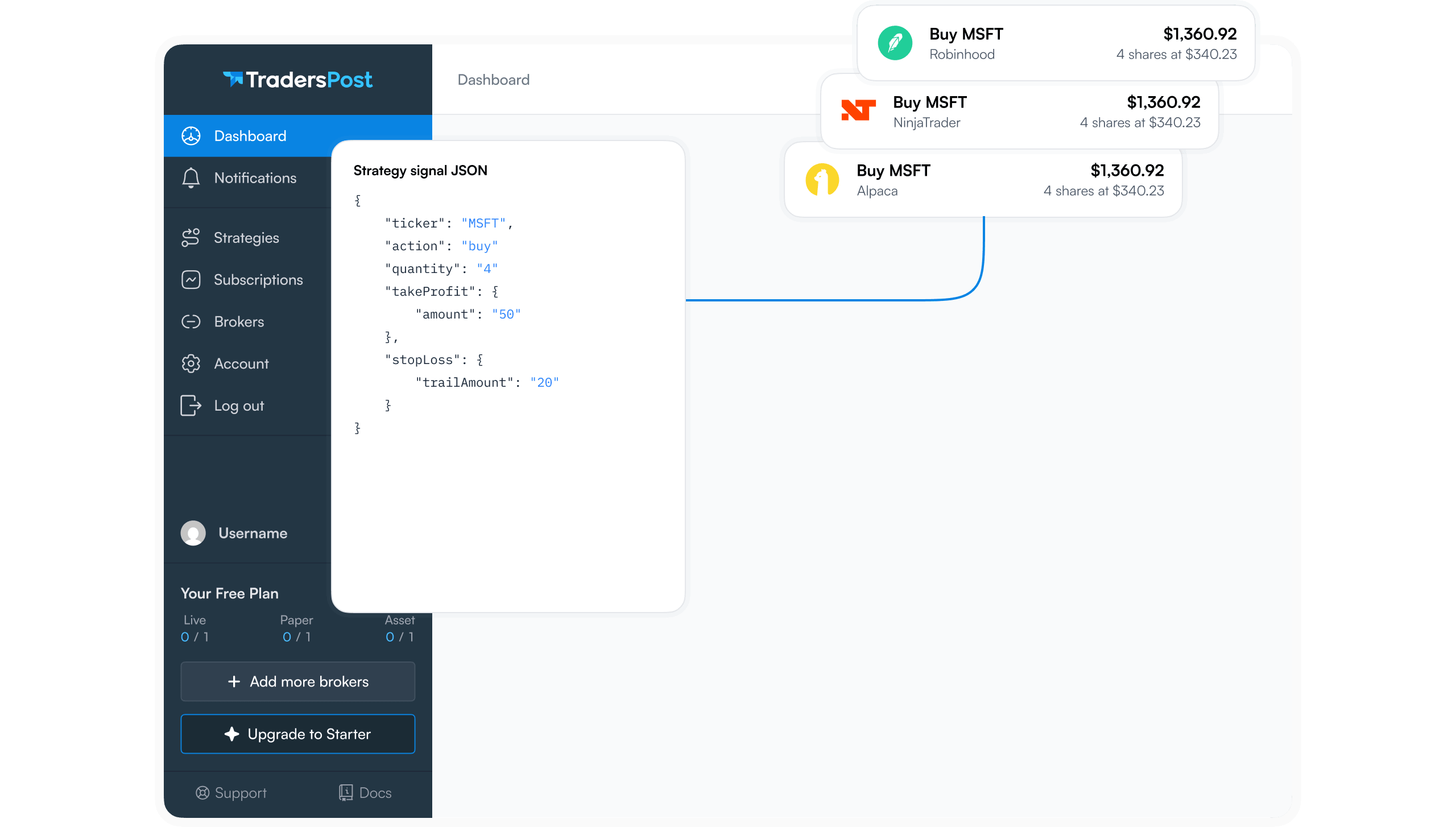
TradersPost connects TradingView and TrendSpider alerts to prop firm accounts through Tradovate and ProjectX, enabling automated execution across evaluation and funded accounts simultaneously. Position sizing, order routing, and account-level risk parameters are handled through TradersPost, but the trader remains solely responsible for ensuring the automation complies with each firm's specific evaluation rules.
The most important step before going live with any automated strategy on a prop firm account is mapping each rule type (consistency cap, daily loss behavior, drawdown model) against the strategy's historical session distribution. A strategy that passes a manual backtest may still generate sessions large enough to breach a 40% consistency rule or trigger a hard daily loss limit before the broader drawdown floor is ever approached.
Bottom Line
- The $50K profit target is $3,000 at nearly every firm. It is not a useful differentiator.
- Drawdown type (intraday trailing vs. EOD trailing vs. static) is the most consequential variable for automated traders who hold through open profit swings.
- Consistency rules are measured differently: some against the profit target, some against total accumulated profit, and they behave differently when breached (account fails vs. target increases vs. payout blocked).
- A daily loss limit that pauses trading and one that ends the account look identical in a comparison table and are completely different in practice.
- Plan parameters change frequently and are sometimes purchase-date-dependent. Only the firm's live plan page reflects current terms.
Frequently Asked Questions
Does a higher profit target mean a harder evaluation?
Not necessarily. Across Topstep, Tradeify, Alpha Futures, FFF, and Bulenox, the $50K profit target is $3,000 at every firm, so the target itself is not a meaningful differentiator.136 The harder variables are the drawdown type, whether a consistency rule applies, and how a daily loss limit is enforced, none of which appear in the headline profit target number.
What is the difference between intraday and end-of-day trailing drawdown?
Intraday trailing drawdown follows your highest unrealized equity in real time, including open positions, so a profit spike on an open trade immediately raises the floor even before you close it.4 End-of-day trailing drawdown only ratchets up at the session close on realized profit, meaning intraday swings do not move the floor, though an intraday dip that touches the current floor still fails the account immediately.10 Several firms let traders choose the model at checkout, with EOD typically priced higher because it is more forgiving for traders who scale into winners.5
Can a consistency rule fail my evaluation on a profitable day?
At Topstep, breaching the consistency target raises the profit target rather than failing the account outright, so the evaluation continues at a higher bar.13 At Take Profit Trader, a large day means you simply need to earn more before the biggest day falls below the 50% threshold.14 The practical consequence is the same: one outsized day forces more total trading days to dilute it, which matters most for automated strategies that occasionally print very large sessions.
Is a daily loss limit that pauses trading the same as one that fails the account?
No. A soft-breach daily loss limit, as used by Tradeify Growth and Topstep, flattens positions and blocks new trades for the rest of the session but leaves the account eligible for funding the next day.915 A hard-breach daily loss limit, as used by Elite Trader Funding's EOD plan, immediately fails the account when touched, even if the trailing drawdown floor has not been reached.10 Comparison tables that show only a dollar amount for the daily loss limit do not distinguish between these two behaviors.
Do prop firm rules change after I buy an evaluation?
Yes, and the timing of a purchase can determine which rule set applies. FFF Premier+ applies different funded consistency rules depending on whether an account was purchased before or after September 9, 2026.5 Plan names remain the same while underlying parameters change, so a comparison table or review written at one date may not reflect current terms. Always verify current rules on the firm's live plan page or help center immediately before purchasing.
References
1 Topstep Prop Firm
2 Tradeify: SELECT vs Growth Evaluation
3 Alpha Futures Evaluation Plans
4 FFF Velocity Plan
5 FFF Premier+ Plan
6 Bulenox Accounts and Pricing
7 Topstep: What is the Maximum Loss Limit?
8 TradeDay Make It Take It
9 Tradeify Growth Evaluation Accounts
10 Elite Trader Funding: End of Day Evaluation
11 Alpha Futures: Maximum Loss Limit Explained
12 Elite Trader Funding: Evaluations
13 Topstep: What is the Consistency Target?
14 Take Profit Trader FAQs
15 Topstep: Daily Loss Limit in the Trading Combine
16 MyFundedFutures