Broker Paper Trading Compared: Which Simulations Are Realistic
Not all broker paper trading environments are equal. See which simulations use real-time data, which use delayed fills, and which have no paper mode at all.

Marketing

Not all broker paper trading environments are created equal. In a broker paper trading comparison, the differences range from real-time NBBO matching with partial fill simulation all the way to instant fills on stale, delayed quotes. Choosing the wrong simulation can make a flawed strategy look profitable, or a sound one look broken.
This article covers every broker available through automated trading platforms that has a paper mode, explains exactly how each simulation works, and identifies which brokers offer no paper environment at all. The goal is to match your strategy type to the environment most likely to give you honest signal before you risk real capital.
The bottom line: simulation quality varies dramatically by broker, and the gap between the best and worst environments is large enough to change your assessment of a strategy's viability.
Who Offers Paper Trading
Brokers with paper mode
Alpaca, TradeStation, Tradier, Tradovate, Interactive Brokers, Bybit, and ProjectX all support paper trading. Paper trading support is a broker-level feature: whether a platform can connect to it depends on whether the broker exposes a separate simulated API endpoint. NinjaTrader uses Tradovate's infrastructure, so its paper mode is the same Tradovate simulation with identical fill mechanics and data limitations.
Brokers with no paper mode
Public.com, Robinhood, Webull, E*TRADE, tastytrade, Coinbase, Kraken, Binance, and Crypto.com have no simulated environment available through their APIs. Traders who rely exclusively on these brokers must use a separate simulation tool or accept that live testing begins with real capital. There is no workaround that produces broker-side paper fills for these integrations.
Alpaca: The Most Honest Simulation
Real-time NBBO matching
Alpaca's paper environment fills orders against real-time NBBO quotes, not synthetic or delayed prices.1 A non-marketable buy limit order will not fill until its limit price is equal to or greater than the best ask; a sell limit will not fill until its limit price is at or below the best bid.1 Regardless of whether you have a paper-only account or a live brokerage account, all orders submitted in paper trading are matched against the best available current market price.1
Partial fill simulation
When an order becomes eligible to fill, Alpaca gives it a random partial fill 10% of the time.1 If the remaining quantity is still marketable after a partial fill, the rest is re-evaluated for a subsequent fill.1 This is one of the few paper environments that surfaces the partial-fill scenario that algo traders routinely encounter in live markets, making it meaningfully more realistic than instant-fill competitors.
What Alpaca paper does not model
Alpaca's documentation is explicit about the gaps. Market impact of large orders is not simulated. Order queue position for non-marketable limit orders is not tracked, so fills arrive sooner than they would live. Price improvement, regulatory fees, dividends, and borrow fees are also absent.1 Order quantity is not checked against NBBO quantities, meaning a very large order can fill even when actual liquidity would not support it.1 For strategies that trade at scale or depend on queue position, even Alpaca paper will flatter results.
Alpaca's own documentation notes that even small amounts of real money can often provide insight into issues not seen in a simulation environment.1
TradeStation: Instant Fills, Not Real Execution
How TradeStation SIM works
TradeStation's SIM API uses fake trading accounts seeded with fake money, and orders are not actually executed; only simulated executions occur with instant fills.2 The SIM base URL differs from the live base URL, so applications must switch endpoints deliberately when moving between environments.2
Implications for strategy testing
Instant fills mean limit orders appear to execute the moment they become marketable, with no queue delay. Strategies that depend on realistic fill timing, such as those placing limit entries near the bid, will appear to perform better in SIM than they will live. TradeStation's own documentation frames the simulator as suited for learning API behavior, exploring API behavior without financial ramification, and testing apps before going live, not for measuring real execution quality.2
Tradier: Correct Logic, Delayed Data
The 15-minute data lag
Tradier's sandbox runs on data delayed by 15 minutes. Order logic follows the same rules as live trading, but the prices driving those decisions are not current. A strategy that looks for intraday breakouts or tight entry conditions will fire on stale quotes, making sandbox results an unreliable proxy for live performance. The delay is long enough that any time-sensitive signal can be structurally mispriced inside the simulation.
What Tradier paper does support
Tradier supports stocks, options, index, and index options in its paper environment. Bracket and OTO order classes are available in the sandbox alongside simple orders. The delayed-data caveat aside, the order lifecycle mirrors live account behavior, so the environment is useful for verifying that bracket logic wires correctly before connecting a live account.
Tradovate and NinjaTrader: Real Fills, No Quotes
Tradovate paper account mechanics
Tradovate's paper environment provides real-time fills. However, the Tradovate connection returns no market data in its paper environment, so quote data does not reach the strategy. Futures traders who need accurate quote-based calculations during paper testing must connect a separate market data source. Without one, any position sizing or entry logic that depends on current bid-ask data will be operating without a price feed from the broker itself.
NinjaTrader inherits the same environment
NinjaTrader is powered by Tradovate's infrastructure, so its paper mode shares Tradovate's fill mechanics and quote limitations. Traders testing on NinjaTrader paper should apply the same caveats: real-time fills are available, but quote data requires an external source.
Bybit: Demo Account, Not Testnet
How Bybit demo trading works
Bybit's demo trading account is an isolated module with its own user ID, separate from both the live account and the testnet.3 The demo environment uses a different API domain: api-demo.bybit.com for REST and stream-demo.bybit.com for private WebSocket streams.3 Public market data streams in the demo environment are identical to mainnet, so price data is real-time.3
Demo account limitations
Not every Bybit API endpoint is available in the demo environment; it is described as a trading experience tool rather than a complete functional replica.3 Orders generated in the demo environment are retained for only 7 days.3 The rate limit is set at the default level and cannot be upgraded, which matters for high-frequency automated strategies.3 API keys for the demo account must be generated from within the demo trading interface and used only with the demo domain.
Interactive Brokers and ProjectX
Interactive Brokers paper
Interactive Brokers supports paper trading with real-time fills and real-time market data. The IBKR paper environment covers the stocks asset class and supports trailing stop orders, OTO, and bracket order classes. IBKR requires an active session connection, which differs from stateless broker integrations and adds a setup consideration for automated strategies running unattended.
ProjectX paper as the default
ProjectX defaults to paper mode rather than live, which makes it unusual among futures-focused brokers. It supports futures only and includes trailing stop, limit, stop, and market order types in paper. ProjectX powers prop-firm environments such as Topstep and The Futures Desk, so its paper mode is often the required evaluation environment rather than an optional simulation. Traders on funded evaluation accounts have no choice but to use it accurately.
The TradersPost Paper Broker
What it does well
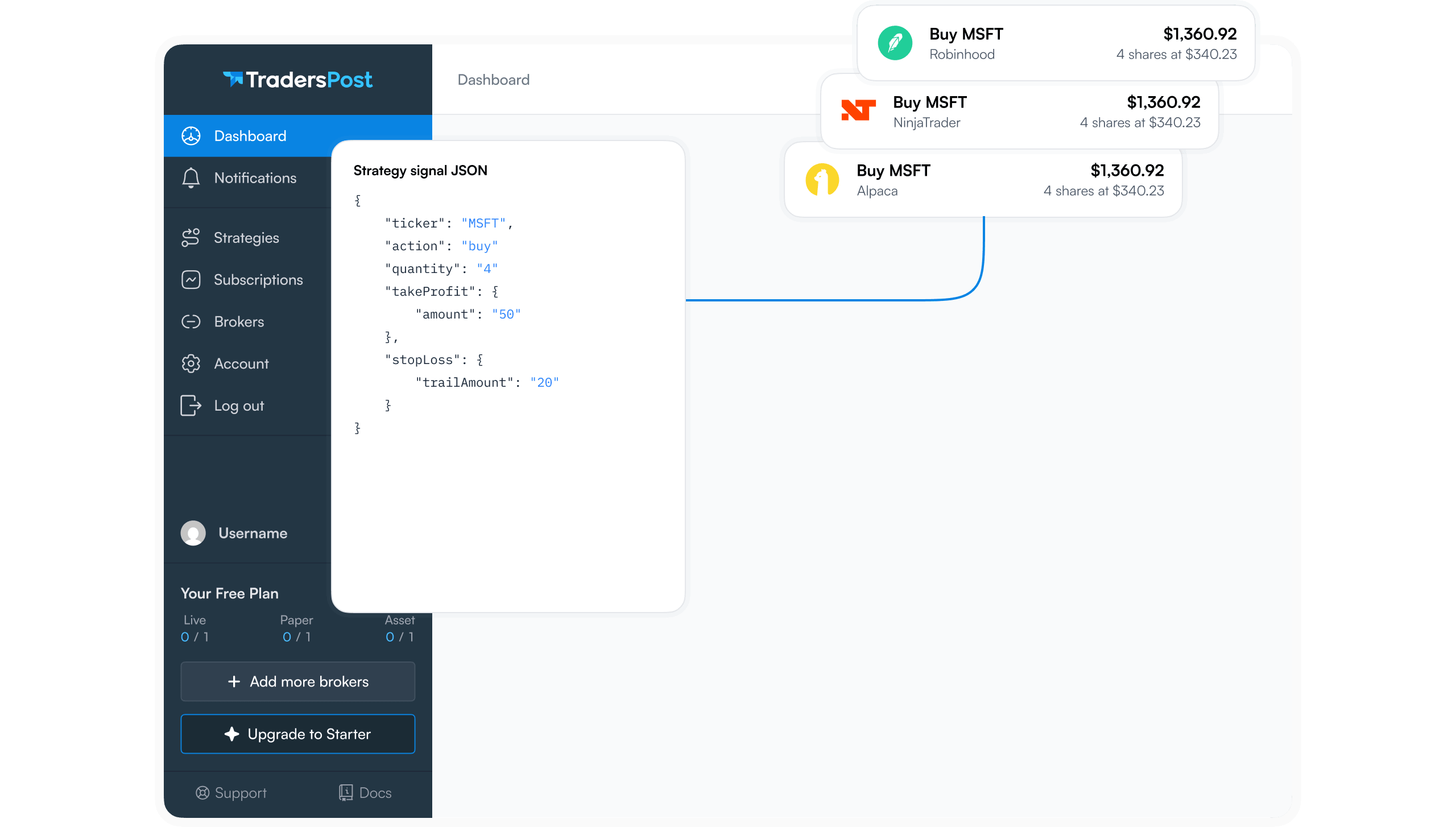
TradersPost includes a built-in paper broker that accepts all asset classes including stocks, options, futures, and crypto, and processes orders without market-hours restrictions, making it practical for verifying webhook configuration before connecting a live or broker-side paper account. Market orders fill at the bid-ask midpoint by default. The market price type is configurable: traders can switch between midpoint, ask, bid, or last price to match their preferred fill assumption.
Where it falls short for strategy measurement
Market hours are not respected: orders fill at any time, day or night, which overstates availability for strategies that depend on market-hours liquidity. Limit orders fill at any specified price without checking whether that price is currently marketable. Options and futures positions do not expire, so contract expiry risk, a real factor in live trading, is never surfaced. The TradersPost documentation explicitly states this paper environment should not be used to measure the performance of a strategy.
Choosing the Right Simulation
Matching simulation to strategy type
Strategies that use limit orders near the bid or ask should favor Alpaca paper, which applies real NBBO matching and occasional partial fills rather than instant execution.1 Futures strategies on Tradovate or NinjaTrader paper get real-time fills but need an external market data source connected to support accurate quote-based sizing calculations. Options traders on Tradier paper should account for the 15-minute data delay when interpreting any sandbox results, since intraday options pricing moves faster than that lag can track.
Using multiple environments in sequence
A practical workflow starts with the TradersPost paper broker to confirm signals and order routing are wired correctly, then moves to a broker-side paper environment to evaluate realistic fill behavior. Graduating to a live account with a small position size often reveals execution issues, such as partial fills and latency, that no paper environment fully replicates. Alpaca's documentation notes that even small amounts of real money can surface issues not visible in simulation.1 The key is treating each layer as a different test rather than assuming a passing paper result predicts live performance.
Ready to test your webhook routing before connecting a live account? Connect the TradersPost paper broker first, confirm your signals fire correctly, then graduate to a broker-side paper environment that matches your asset class and strategy style.
Bottom Line
- Alpaca paper is the most realistic simulation available, using real-time NBBO matching and 10% random partial fill probability, though it still misses queue position and market impact.
- TradeStation SIM fills instantly and is designed for API testing, not execution quality measurement.
- The Tradier sandbox connection runs on 15-minute delayed data, making it unsuitable for evaluating time-sensitive intraday strategies.
- The Tradovate and NinjaTrader connections give real-time paper fills but return no quote data, requiring an external market data source.
- The Robinhood, Webull, E*TRADE, tastytrade, Public.com, Coinbase, Kraken, Binance, and Crypto.com connections offer no paper mode, so live testing starts with real capital there.
Frequently Asked Questions
Which broker paper trading environment uses real-time market data?
Alpaca paper uses real-time NBBO quotes and fills orders against current market prices.1 Interactive Brokers paper also provides real-time fills and real-time market data. Bybit demo uses real mainnet public market data streams for price information.3
Can I test options strategies in a paper trading environment?
Tradier, Alpaca, and TradeStation all support options in their paper environments. Tradier paper runs on 15-minute delayed data, which affects the accuracy of options pricing during testing. The TradersPost paper broker supports options but does not expire contracts, so positions in expired contracts remain open until manually closed.
Why do paper trading results often differ from live trading results?
Most paper environments do not model order queue position, so limit orders appear to fill faster than they would with real competition from other participants.1 Market impact and price slippage from large orders are typically absent from simulations. Fill assumptions, liquidity assumptions, and market data sources differ across platforms, making direct comparisons between environments unreliable.1
Does Bybit paper trading use the same API as the live account?
Bybit demo trading uses a separate domain: api-demo.bybit.com for REST calls, distinct from the live api.bybit.com.3 API keys for the demo account must be generated from within the demo trading interface and used only with the demo domain.3 Not every endpoint available on the live API is supported in the demo environment.3
Which brokers connected to automated trading platforms have no paper mode?
Robinhood, Webull, E*TRADE, tastytrade, Public.com, Coinbase, Kraken, Binance, and Crypto.com all have no paper trading mode available through their APIs. Traders using these brokers exclusively must test strategies using a separate simulation environment or a broker that does offer paper accounts. Switching to a broker that supports paper trading for the same asset class is the most straightforward workaround.
References
1 Alpaca Markets - Paper Trading
2 TradeStation API - SIM vs. LIVE
3 Bybit V5 API - Demo Trading Service