Betterment vs Schwab Intelligent Portfolios
Betterment charges a visible fee. Schwab charges nothing but sweeps cash to its own bank. Compare fees, minimums, and tax-loss harvesting before you choose.

Marketing

Comparing Betterment vs Schwab Intelligent Portfolios comes down to one core question: do you prefer a fee you can see, or a cost embedded in your cash allocation? Betterment charges an explicit advisory fee starting at $5 per month. Schwab Intelligent Portfolios charges nothing upfront and earns revenue through the interest spread on cash swept to its affiliated bank. Both are legitimate approaches, but they have different implications depending on your balance, your tax situation, and what you expect from a robo-advisor.
This article walks through the actual numbers on fees, account minimums, tax-loss harvesting availability, and the cash allocation mechanics that make the Schwab model work. Each section draws directly from Betterment's and Schwab's own disclosures so you can weigh the tradeoffs with accurate figures rather than marketing summaries.
What Each Service Actually Does
Betterment: fee-based robo-advisor
Betterment is an SEC-registered investment adviser that builds and manages diversified ETF portfolios on your behalf, handling trading, rebalancing, and tax management automatically.1 It operates as a standalone platform, not affiliated with a large bank or brokerage, and earns revenue primarily through its advisory fee. That independence means there is no affiliated bank earning a spread on your cash inside the investment portfolio.
Schwab Intelligent Portfolios: no-fee robo
Schwab Intelligent Portfolios is Charles Schwab's automated investing service that builds, monitors, and rebalances a diversified ETF portfolio with no advisory fee charged.2 Schwab's own disclosures state that its affiliated bank earns income on the cash allocation held in every portfolio, and that this revenue model is how the no-fee service is supported.2 Understanding that exchange is the starting point for any honest comparison.
Advisory Fees Compared
Betterment's explicit fee structure
Betterment's base plan charges $5 per month on balances below $24,000, unless the account holder sets up recurring monthly deposits or transfers totaling $200 or more.1 Once a balance reaches $24,000, or the $200 monthly deposit threshold is met, the fee converts to 0.25% annually on the invested balance.1 A Premium plan is available at 0.65% annually and requires a minimum of $100,000 in eligible investments; it adds unlimited 1:1 guidance from a CFP.1
Schwab's zero advisory fee
Schwab Intelligent Portfolios charges no advisory fee and no commissions.2 Schwab Intelligent Portfolios Premium, the upgraded tier, charges a one-time $300 planning fee plus $30 per month billed quarterly, and requires a $25,000 minimum.3 Investors in both tiers still pay the operating expenses embedded in the underlying ETFs.2
Account Minimums
Betterment's no-minimum entry
Betterment's base automated investing plan has no minimum balance requirement, so an investor can open an account and start with any amount.1 The Premium plan requires at least $100,000 in eligible investment accounts per household to enroll and maintain access.1
Schwab's $5,000 floor
Schwab Intelligent Portfolios requires a $5,000 minimum to open an account, and Schwab Intelligent Portfolios Premium requires $25,000.3 That threshold is a practical barrier for investors who are just starting out or deploying smaller balances, and it also affects access to tax-loss harvesting, as covered in the next section.
Tax-Loss Harvesting
Betterment's always-on TLH
Betterment offers tax-loss harvesting as a standard feature of its automated investing accounts, available to activate regardless of account size.4 The service works by selling assets that have declined in value and replacing them with similar investments to maintain portfolio exposure while potentially generating a tax deduction. Losses can offset unlimited capital gains and up to $3,000 of regular income per year.4 Betterment states that nearly 70% of customers using the feature had their taxable advisory fees covered by estimated tax savings.4
Schwab's $50,000 TLH threshold
Tax-loss harvesting in Schwab Intelligent Portfolios is available only for accounts with invested assets of $50,000 or more, and clients must choose to activate the feature.3 Below that threshold, automatic tax-loss harvesting is not available, which is a meaningful gap for investors with moderate balances. This threshold applies to both Schwab Intelligent Portfolios and Schwab Intelligent Portfolios Premium.3
The Cash Allocation Question
How Schwab's cash sweep works
Schwab Intelligent Portfolios allocates a portion of every portfolio to an FDIC-insured deposit account at Schwab Bank, with the size of that cash slice determined by the client's risk profile.2 Schwab's own disclosures state that its affiliated bank earns income on those deposits, and that the lower the interest rate Schwab Bank pays on the cash, the lower the yield for the investor.3 Schwab also discloses that some cash alternatives outside the program pay a higher yield, which means the cash allocation carries an opportunity cost.3
The SEC action on disclosure
The SEC took action against Schwab in 2022 related to how the cash allocation in Schwab Intelligent Portfolios was disclosed to clients. The SEC's 2022 press release is the authoritative source on the specifics of that action; readers who want the full findings should consult it directly at the SEC's website. The existence of that action is relevant context when evaluating how transparent the no-fee model has been in practice.
Betterment's cash handling
Betterment does not impose a required cash allocation inside its investment portfolios in the same structural way Schwab does. Instead, Betterment offers a separate Cash Reserve account with no monthly management fee, keeping cash and invested assets distinct rather than bundled.1 Investors choose whether to hold cash separately; it is not embedded as a drag on the portfolio's return by design.
How to Think About True Cost
When Betterment's fee is worth it
At balances below $24,000 the $5 monthly fee equals 0.25% annually only at exactly $24,000; at lower balances the effective rate is proportionally higher. A $5,000 balance, for example, pays $60 per year, which works out to 1.2% annually. That is a real cost, and investors at small balances should weigh it against the value of features they actually use. The offset is tax-loss harvesting: Betterment makes it available at any balance, and for investors in taxable accounts who can harvest enough losses, the feature can cover the explicit fee.4
When Schwab's zero-fee is misleading
Schwab's no-advisory-fee claim is accurate but incomplete. The cash allocation in every portfolio earns a below-market rate at Schwab Bank, and Schwab earns the spread on those deposits.3 Investors whose risk profile requires a larger cash allocation effectively pay more through the opportunity cost of that cash, not through a line-item fee. Separately, tax-loss harvesting is unavailable below $50,000, so investors between $5,000 and $49,999 receive fewer tax tools than Betterment offers at any balance.3
A useful way to frame the comparison: Betterment shows you what you pay; Schwab builds its revenue into the structure of the product. Neither approach is inherently wrong, but one is easier to evaluate clearly.
Where TradersPost Fits
A different category entirely
Betterment and Schwab Intelligent Portfolios manage portfolios for you: they choose allocations, rebalance automatically, and make decisions on your behalf within your stated risk profile. If you want diversified exposure and hands-off management, both services are built for that job.
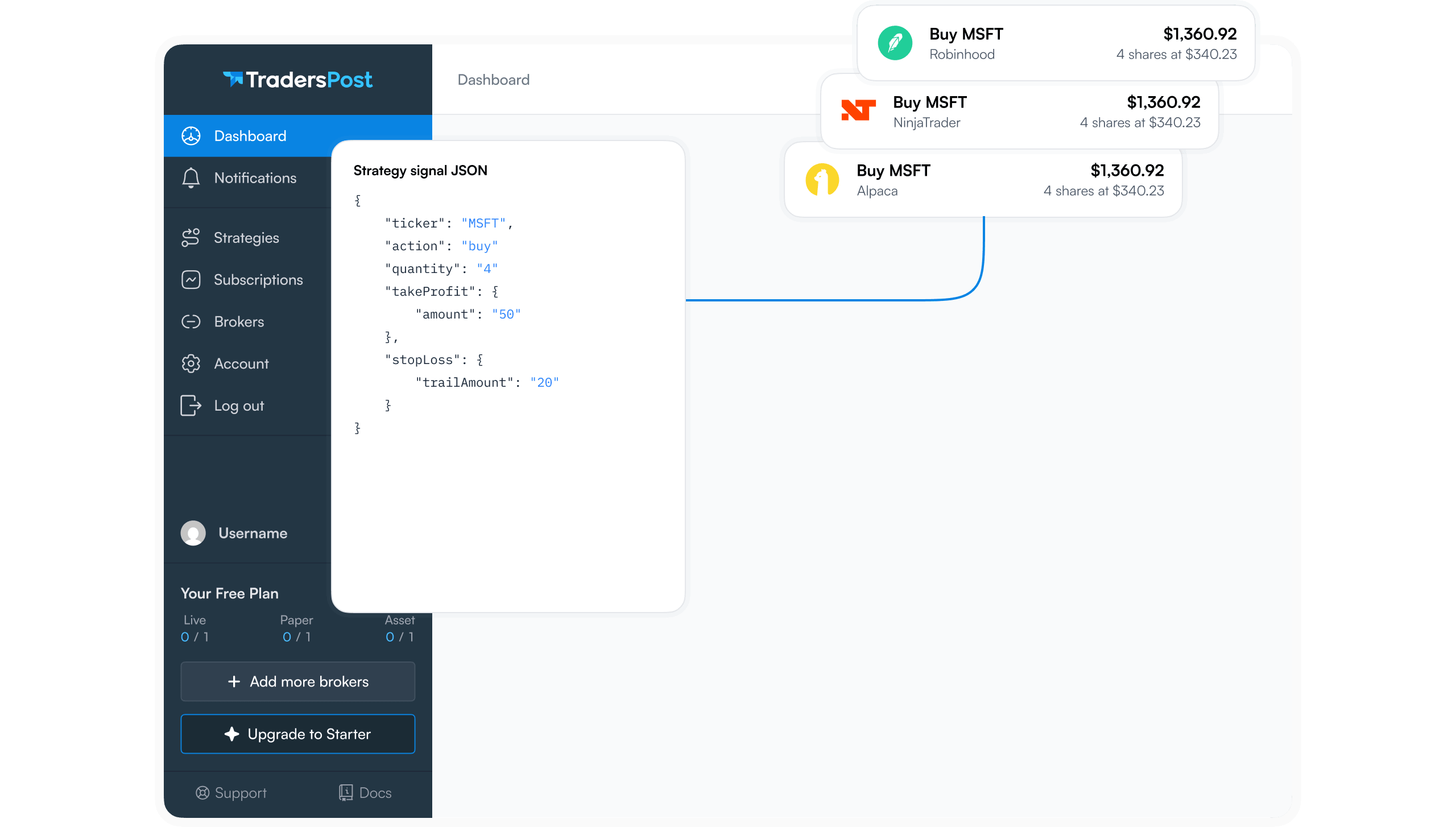
TradersPost does none of that. It is a webhook-driven automation layer that routes trading signals from platforms like TradingView to a connected brokerage account, executing orders defined through strategies the trader writes and controls. No allocation decisions, no discretionary management, and no cash sweep: the account, the strategy, and the capital allocation decisions remain entirely the trader's own.
If you already know what you want to trade, how to size positions, and when to enter and exit, and you want to automate that process without handing it to an algorithm that manages it for you, TradersPost is the type of tool built for that workflow. It is plumbing for self-directed traders, not an advisory service. Start a free trial and connect your first strategy to see how signal-to-order automation works in practice.
Bottom Line
- Betterment charges $5 per month below $24,000 or 0.25% annually above that threshold; Schwab charges no advisory fee but earns revenue on the cash it sweeps to its affiliated bank.
- Schwab requires $5,000 to open an account; Betterment has no minimum on its base plan.
- Betterment offers tax-loss harvesting at any balance; Schwab restricts it to accounts with $50,000 or more in invested assets.
- Schwab's cash allocation carries an opportunity cost: its own disclosures note that some alternatives outside the program pay a higher yield, and the SEC took action in 2022 over how this arrangement was disclosed.
- Neither platform is built for active or algorithmic trading; both manage a portfolio on your behalf within a risk profile you set at signup.
Frequently Asked Questions
Does Schwab Intelligent Portfolios really charge nothing?
Schwab charges no advisory fee and no commissions, but it requires a cash allocation in every portfolio that is swept to Schwab Bank, which earns income for Schwab on those deposits.3 Schwab's own disclosures note that the lower the interest rate Schwab Bank pays on that cash, the lower the yield for the investor, and that some alternatives outside the program pay a higher yield.3 The SEC took action against Schwab in 2022 related to how this arrangement was disclosed to clients.
What is Betterment's management fee?
Betterment charges $5 per month on accounts below $24,000, unless the holder sets up at least $200 in recurring monthly deposits or transfers.1 The fee switches to 0.25% annually once the $24,000 balance threshold is reached or the $200 monthly deposit is active.1 A Premium tier at 0.65% annually is available for accounts with at least $100,000 in eligible investments and adds access to CFP professionals.1
Which platform has better tax-loss harvesting?
Betterment offers tax-loss harvesting as an activatable feature at any account balance, with no minimum threshold.4 Schwab Intelligent Portfolios restricts tax-loss harvesting to accounts with invested assets of $50,000 or more, and clients must opt in.3 For investors with balances under $50,000 who want automated tax-loss harvesting, Betterment is the only option of the two.
Can I open a Schwab Intelligent Portfolios account with less than $5,000?
No. Schwab Intelligent Portfolios requires a $5,000 minimum to open an account.3 Betterment has no minimum balance requirement on its base plan, making it accessible at any starting amount.1
Are these platforms suitable for active or algorithmic traders?
Neither Betterment nor Schwab Intelligent Portfolios is designed for active trading or strategy automation. Both manage a diversified ETF portfolio on your behalf within your stated risk profile. Traders who want to automate their own entry and exit signals need a different type of tool, one that routes alerts to a brokerage account rather than managing the portfolio for them.
References
1 Betterment Pricing
2 Schwab Intelligent Portfolios
3 Schwab Introduces Subscription-Based Financial Planning Option in Its Digital Advisory Service
4 Betterment Tax-Loss Harvesting