Live Q&A for Automated Traders
Comprehensive Q&A session covering automated trading strategies, pairs trading bots, futures contract management, and the future of AI-powered trading algorithms.

Marketing

Automated trading is evolving rapidly, and with that evolution comes questions. In this comprehensive office hours session from March 2025, the TradersPost team tackles real-world challenges facing automated traders, from pairs trading strategies to futures contract rollovers and the growing role of AI in strategy development.
The AI Revolution in Trading Strategy Development
The landscape of automated trading is shifting dramatically. More traders are discovering they can use AI tools like ChatGPT and Grok to program entire trading strategies without traditional coding knowledge. This democratization of algorithmic trading represents a fundamental shift in who can participate in automated markets.
The traditional barrier to entry—coding expertise—is crumbling. Traders can now describe their strategy in plain English and have AI generate the PineScript code for TradingView or the Python code for direct broker integration. This isn't just a minor convenience; it's a complete paradigm shift in strategy development.
Platform Updates That Matter
TradersPost continues to refine its automation platform with updates that directly address trader pain points. Recent improvements include optimized batch processing for closing multiple positions simultaneously, enhanced navigation with breadcrumb trails throughout the application, and more transparent account ID displays across subscription lists.
One particularly valuable update involves real-time quote refreshes. Previously, traders would see stale quotes when reopening modals. Now, every time you open a quote modal, you receive fresh market data—a small change that significantly improves decision-making accuracy.
The platform has also improved how it handles futures contract expirations. With NQ, MNQ, and ES contracts rolling over quarterly, TradersPost now displays prominent warnings when contracts are expiring soon, currently expiring, or have already expired. This visual hierarchy helps traders avoid the common mistake of sending orders to expired contracts.
Futures Contract Rollover Automation
One of the most tedious aspects of futures trading is managing contract rollovers. When the front month contract expires, you need to update all your TradingView alerts to reference the new contract symbol. Miss this update, and your automated strategy stops working.
TradersPost has developed a PineScript solution that automatically detects which futures contract TradingView is currently using as the underlying for its continuous contract. The script matches the current contract by comparing open price and volume data across all forward contract expirations—a clever workaround for the lack of direct API access to TradingView's volume-based rollover logic.
By incorporating this functionality as a library, traders can import it with a single line of code and use the dynamic contract variable in their JSON alert messages. This means your alerts automatically reference the correct futures contract without manual intervention every quarter.
Pairs Trading: A Mean Reversion Classic
Pairs trading emerged as a hot topic in this session. This market-neutral strategy involves simultaneously buying and selling two correlated assets to profit from their relative price movements. When the spread between the two assets widens beyond historical norms, you enter positions expecting mean reversion.
The strategy is one of the first quantitative approaches taught to aspiring algorithmic traders. While conceptually simple—trade the relationship between two assets rather than absolute price direction—the execution requires careful consideration of cointegration and stationarity between the pairs.
PineScript lacks many of the mathematical functions typically used for rigorous pairs trading analysis, such as the Augmented Dickey-Fuller test for cointegration. However, traders can still implement effective pairs strategies by focusing on assets with proven high correlation (0.8 or higher) and manually verifying their historical relationship.
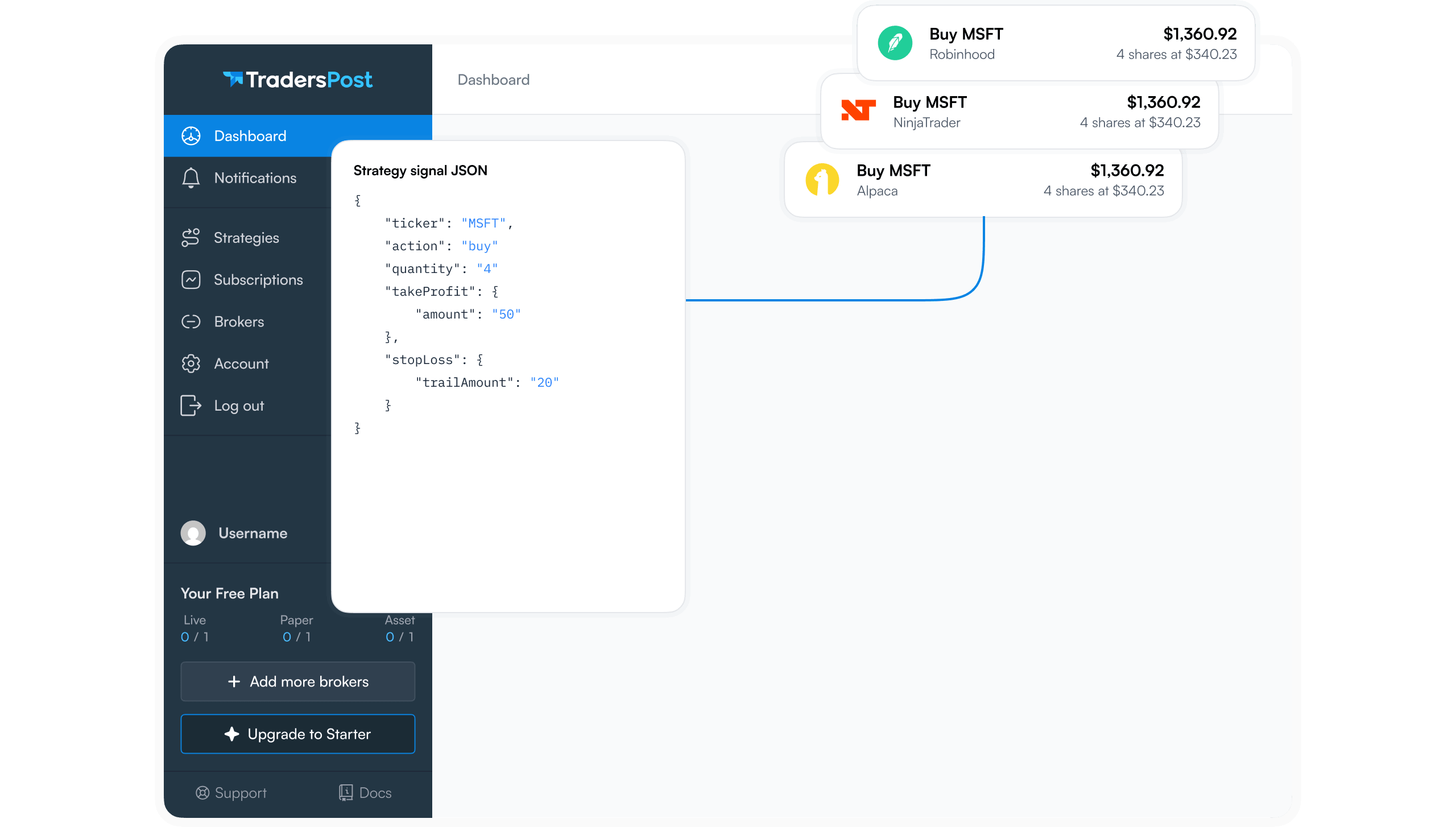
The TradersPost team demonstrated how to set up alerts that fire two separate webhook messages simultaneously—one to buy the first asset and another to sell the second asset. This dual-alert approach allows automated execution of both legs of the pairs trade in response to a single signal.
Why Interactive Brokers Still Struggles
Interactive Brokers remains a popular choice for international traders, but its API continues to frustrate automation developers. The core issue: IBKR's API runs on top of Trader Workstation, meaning API calls are essentially proxying through a GUI application running in the cloud.
This architecture creates a fundamental concurrency problem. When you try to execute two orders simultaneously, they compete for access to the same Trader Workstation instance. Only one can run at a time while the other waits. If the wait exceeds TradersPost's timeout threshold (10 seconds after retries), traders see timeout errors.
Compare this to Alpaca and Robinhood, which average sub-50 millisecond response times. Interactive Brokers typically responds in 500 milliseconds or longer. For traders executing multiple signals across different symbols, this latency compounds quickly.
The TradersPost team suspects IBKR may be working on a new API to compete with more modern brokers, but until that materializes, traders working with IBKR should expect occasional timeout issues, especially when managing multiple positions.
Blueprint Strategy Ideas: What's Next
The Blueprint series continues to explore creative automated trading strategies. Several concepts emerged as potential future episodes:
Pairs Trading Bot: A comprehensive implementation showing how to identify correlated pairs, calculate z-scores, and automate entry and exit signals for mean reversion trades.
Overnight Gap Strategy: Most equity market returns occur overnight rather than during regular trading hours. This strategy would systematically capture overnight moves by entering positions near market close and exiting at the open.
Dividend Capture Bot: Automate the practice of buying stocks before their ex-dividend date and selling after, potentially cycling through multiple dividend-paying stocks throughout the month.
Event-Based Calendar Strategy: Trade around known volatility events like FOMC meetings, CPI reports, and options expiration by combining calendar awareness with technical overbought/oversold conditions.
Astrology Bot: A tongue-in-cheek exploration of whether moon phases and planetary alignments correlate with market movements—more about demonstrating data analysis than serious strategy.
The Reality Check: Back testing Matters
During the session, a Reddit user asked about automating a "simple profitable trading strategy" after spending just four hours with ChatGPT. This prompted an important discussion about expectations and rigor in strategy development.
Four hours of work is just the beginning. A truly robust strategy requires testing across multiple market regimes, timeframes, and volatility environments. Just because a strategy worked manually over two months doesn't mean it will survive automated execution or continue performing in different market conditions.
The team emphasized the importance of:
- Minimum sample size: At least 100 trades, ideally across 5+ years of historical data
- Out-of-sample testing: Verify performance on data the strategy hasn't seen
- Robustness checks: Test across different time periods to account for regime changes
- Transparency: Understand every rule in your strategy and why it exists
Many traders fall victim to hindsight bias, unconsciously changing rules after seeing results. For automated trading, you must codify explicit rules that remain constant across all market conditions. Otherwise, you can't replicate your manual performance.
Dynamic Quantity Calculation and Futures
A common question: Why can't TradersPost calculate position sizes based on account percentage for futures contracts?
The answer lies in margin requirements. Unlike stocks, crypto, or options, the amount required to buy a futures contract isn't the price of the underlying asset. It's a margin requirement that varies based on volatility, broker policies, and other factors.
Since this margin requirement changes daily and brokers don't consistently expose this data through their APIs, TradersPost can't reliably calculate "use 50% of my account equity" for futures positions. Traders must manually specify contract quantities or build their own position-sizing logic in PineScript.
Some brokers like TradeStation's TradeOvate may expose margin requirement data, but until there's a universal standard across all futures brokers, dynamic quantity calculation for futures remains unavailable.
Take profit and Stop Loss Limitations
Not all brokers support bracket orders—where your entry order includes attached take profit and stop loss orders that cancel each other when one fills (OCO: one-cancels-other). For brokers without native bracket support, TradersPost can't simply submit separate TP and SL orders because they wouldn't be linked.
If TradersPost submitted unlinked orders and your stop loss filled, the take profit order would remain open. When price rebounds to your TP level, it would fill and enter a new position—the opposite of risk management.
Implementing custom OCO logic would require TradersPost to monitor order fills in real-time and programmatically cancel corresponding orders. While technically possible, this raises reliability concerns. What happens if the WebSocket connection drops? The stop loss becomes orphaned, defeating its purpose.
Some brokers also explicitly prohibit this kind of "algorithmic order" behavior in their terms of service. For now, the recommendation is to rely on brokers with native bracket order support or manage protective orders through your strategy logic in TradingView.
TradersPost as Your Trading Execution Layer
What emerged from this session is TradersPost's role as the critical execution layer between your strategy logic and your broker. It handles the complexities of:
- Multi-symbol order coordination (like pairs trading)
- Position tracking across multiple strategies
- Account-specific risk parameters
- Broker API quirks and timeout handling
- Real-time balance and position data
By abstracting these challenges, TradersPost allows you to focus on strategy development rather than infrastructure management. Whether you're manually approving trades for debugging or running fully automated strategies across multiple broker accounts, the platform provides the reliability and transparency needed for serious automated trading.
Key Takeaways for Automated Traders
This office hours session reinforced several critical principles:
- AI tools accelerate development but don't eliminate the need for rigorous testing and market understanding
- Broker selection matters—API reliability and latency vary dramatically between providers
- Futures trading requires special handling for contract rollovers and position sizing
- Mean reversion strategies like pairs trading remain viable but need proper mathematical validation
- Small platform improvements compound into significantly better trader experiences over time
- Strategy validation requires extensive testing—never rely on a few weeks of manual results
- Position management complexity makes execution platforms like TradersPost increasingly valuable
The future of retail trading is automated, AI-assisted, and accessible to traders who focus on developing sound strategies rather than building infrastructure. Platforms like TradersPost, combined with visual strategy builders like TradingView and AI coding assistants, are democratizing algorithmic trading in ways that would have seemed impossible just a few years ago.
Whether you're trading pairs, futures, equities, or crypto, the key is to start with solid principles, test extensively, and use automation to execute your edge consistently. The tools exist—now it's about applying them with discipline and continuing to learn from the rapidly evolving automated trading community.