Semi Automated Trading Explained
What semi automated trading means, how it differs from full automation, real tool examples, and the risk controls it still needs before you click submit.

Marketing

Semi automated trading places a human approval checkpoint between signal generation and order entry. Software identifies a setup, but the trader decides whether to accept or reject it. After acceptance, software may handle position sizing, stops, targets, and exits.
The key distinction is not whether software monitors the position. It is whether a person must approve the entry. This structure can preserve human judgment while automating repetitive analysis and trade management, but it still requires coded risk limits, execution checks, and post-trade review.
What Semi Automated Trading Means
Semi-Automated vs Fully Automated
Under fully automated trade management, a system suggests a setup, places the order, and manages the position. Under semi-automated management, the system suggests the setup, the trader accepts or rejects it, and the system manages the accepted trade.1
The dividing line is the approval checkpoint before entry. Both models can monitor positions, move stops, scale out, and close trades after execution. A workflow does not become manual simply because a person approves the initial order.
The Automation Spectrum
Trading automation is better viewed as a spectrum than a binary choice. Full automation enters and exits positions from coded logic without manual clicks. At the opposite end, software may only send an alert, such as a Pine Script notification to a phone, while the trader handles the complete order ticket. Copy execution sits between these models because an external signal is applied using the receiving account's risk settings.2
Terminology varies between tools. Some vendors use semi-automation for alert-only workflows. Others reserve it for systems where a trader approves entry before automated management begins. When comparing platforms, identify exactly which steps remain manual instead of relying on the label.
Semi-Automation Inside Algo Trading
Algorithmic trading uses computer code and market analysis to generate trading decisions from defined parameters. That process can be semi-automated or completely automated, which is why algo trading and automated trading are sometimes used interchangeably even though they do not always mean the same thing.3
A typical algorithmic system inspects data, charts, quotes, or news, generates a signal, fills in order details, monitors the position, and closes it. Semi-automation changes who authorizes or completes the order step. It does not remove the algorithm from the surrounding process.
How a Semi Automated System Works
Four Components Under the Hood
An automated trading system can be separated into four functional components: an entry and exit algorithm, a risk management module, an order execution engine, and a data processing unit. The data unit supplies current information, the algorithm evaluates rules, the risk module determines permitted exposure, and the execution engine communicates the order.4
In a semi-automated setup, data processing and signal logic continue to run automatically. The trader temporarily interrupts the path to execution. If the signal is accepted, the risk module can calculate quantity and stop distance before the execution engine submits the order.
From Signal to Manual Execution
The standard lifecycle is analysis, signal, execution, and position management. Semi-automation interrupts that chain at execution. The trader reviews the suggested direction, entry, order type, and quantity instead of allowing the signal to pass directly to the broker.
After submission, automation can resume. Position management logic may attach a stop and target, trail the stop, reduce the position at predefined levels, or close after an opposing signal. This concentrates human attention on the initial decision without requiring continuous manual monitoring.
Checklist Before Accepting Signals
Before approving a trade, confirm that the entry criteria are present, replicable, and consistent with the instrument's trend and the broader market context. Then define the acceptable risk, entry price, stop price, spread, expected slippage, and resulting order size.5
- Confirm every required setup condition.
- Choose market, limit, stop, or stop-limit execution.
- Calculate size from risk and stop distance.
- Account for spread, slippage, and currency conversion.
- Decide whether to enter once or scale in.
- Check current long, short, and correlated exposure.
A useful approval process should be short enough to complete consistently. If the checklist cannot be applied before the setup changes, either simplify the rules or move more validation into code.
Why Traders Choose Semi Automation
When Human Judgment Adds Value
Human review can add value when a strategy depends on complex patterns or confluences that are easier to interpret visually than encode precisely. Semi-automation combines machine-generated setup detection with a trader's ability to evaluate the surrounding chart before accepting the trade.6
That advantage only exists when judgment is structured. A trader should be able to document why one signal was accepted and another rejected. If the decision cannot be explained afterward, the approval step may be introducing inconsistency rather than useful context.
When Full Automation Wins
Full automation is usually stronger when the logic is mechanical and testable. Moving average crosses, breakout triggers, and ATR-based trailing stops can be evaluated without visual interpretation. Automation also operates across sessions a trader cannot watch and applies the same decision rules during fatigue.7
Risk enforcement is an especially strong case for automation. A coded daily loss limit does not negotiate after several losses. Even if entries require approval, limits on size, spread, total exposure, and daily loss should not depend on another manual decision.
Alert-Based Scanning Gains
Scanner packages reduce the need to watch charts continuously. One documented package scans for multi-timeframe trend alignment, identifies a potential setup, and then uses indicators and rules-based strategy documents for confirmation. Its vendor positions the workflow as a way to increase productivity and reduce time-consuming chart analysis.8
The scanner does not eliminate analysis. It narrows the candidate list so the trader can focus on whether each flagged setup satisfies the strategy's confirmation and entry rules.
Real Semi Automated Trading Tools
Trend-Line-Triggered Strategies
One documented approach lets trader-drawn trend lines control orders. In the example, a dotted red line represents a sell-stop entry, a solid green line represents a profit target, and a green stop line represents the protective exit. The strategy interprets both line color and style when determining the intended order type.9
The trader supplies discretion by drawing and adjusting the lines. Code monitors those objects and submits the corresponding order when price reaches them. This makes the chart annotation the approval and configuration step, while execution remains automated.
Scanner-and-Indicator Packages
A scanner-and-indicator package automates market filtering rather than order submission. The scanner can check trend alignment across multiple timeframes and flag a potential setup. The trader then compares that setup with technical indicators and the package's strategy document before acting.
Tradeguider describes this category as applicable across futures, forex, CFDs, stocks, commodities, options, and crypto markets.10 Actual instrument access still depends on the trader's platform and account.
Alert-to-Manual-Order Workflows
The simplest implementation is a plain alert. A Pine Script condition triggers a phone or desktop notification, and the trader manually confirms direction, quantity, order type, and timing. Signal generation is automated, but execution remains manual.
TradersPost can apply the same approval model by leaving Auto submit unchecked in strategy subscription settings. Signals then remain available for manual handling rather than being submitted to the broker automatically. Enabling Auto submit changes the same signal flow into automatic order submission.
Risk Controls for Semi Automation
Limits That Belong in Code
Six controls should not depend on discretion: per-trade risk, a daily loss cut-off, maximum concurrent positions, a correlation cap, a maximum spread filter, and a kill switch. A manual entry decision does not protect the account if exposure limits disappear after submission.11
- Size each trade from stop distance and permitted equity risk.
- Block new entries after the internal daily cut-off.
- Cap simultaneous positions and correlated exposure.
- Reject entries when spread exceeds the defined threshold.
- Provide an emergency flatten and disable function.
Suggested starting points include 0.25-1% of equity risk per trade and an internal daily loss cut-off set 1.5-2% below the platform's enforced limit.12 These are configuration examples, not universal recommendations. Limits should reflect tested strategy behavior, account rules, and execution costs.
Sizing and Stop Questions
The stop price and acceptable loss must be known before quantity can be calculated. Position sizing should also account for spread, expected slippage, point value, and currency conversion when the instrument and account use different currencies.
The final quantity should be reviewed for practical execution issues. AgenaTrader's checklist specifically flags odd lots because they can produce disadvantageous pricing or execution, and it asks whether the position is too large or should be entered in stages.13
Blocks and Post-Trade Review
Pre-trade controls sit between the signal and broker connection. They can check maximum order size, approved instruments, spread, duplicate orders, and other defined restrictions before an order leaves the workflow.
Post-trade surveillance compares intended entries with actual fills. Logging slippage per trade helps identify differences by session, instrument, or order type. Orders that violated a configured limit should be reviewed even when they were profitable, since the control failure can recur.14
Semi Automation in Prop Evaluations
Daily Loss and Trailing Drawdown
A prop evaluation may calculate its daily loss limit from closed and floating profit and loss in real time. A system that monitors only realized losses can therefore breach the account threshold while a position remains open.15
Trailing maximum drawdown requires separate attention. If the threshold rises with peak equity, an open position can establish a floating gain and then breach the updated floor when that gain disappears. An internal cut-off below the firm's threshold provides room for slippage and spread widening.
Restricted Automation Styles
Prop firm restrictions often focus on execution styles that exploit infrastructure rather than market logic. Latency arbitrage, tick scalping, and cross-account copy trading are examples commonly restricted within evaluations.16
A manual approval click does not automatically make a prohibited strategy compliant. Before connecting any workflow, review the firm's current rules for automation, account copying, maximum loss, trailing drawdown, and permitted execution behavior.
Building Your Semi Automated Workflow
Pick a Confirmation Method
Confirmation can be visual, tool-based, or notification-based. Visual confirmation uses objects such as trend lines. Tool-based confirmation uses a scanner and indicators. Notification-based confirmation presents a plain alert and leaves the complete order decision to the trader.
Each method trades setup effort for response speed. Trend lines require chart preparation before price reaches the area. Scanners find candidates without prior chart annotation. Plain alerts are simple, but they may leave more analysis to complete after the notification arrives.
Decide What Stays Manual
In the standard semi-automated model, only entry approval is manual. Once accepted, the system can manage stops, targets, trailing logic, and partial exits. Other workflows retain manual control over stop adjustments or targets as well.
Define this boundary during strategy design. Decide who selects the order type, calculates quantity, attaches protective orders, manages scaling, and closes the position. A clear boundary prevents both the trader and software from attempting to control the same order.
Route Accepted Signals
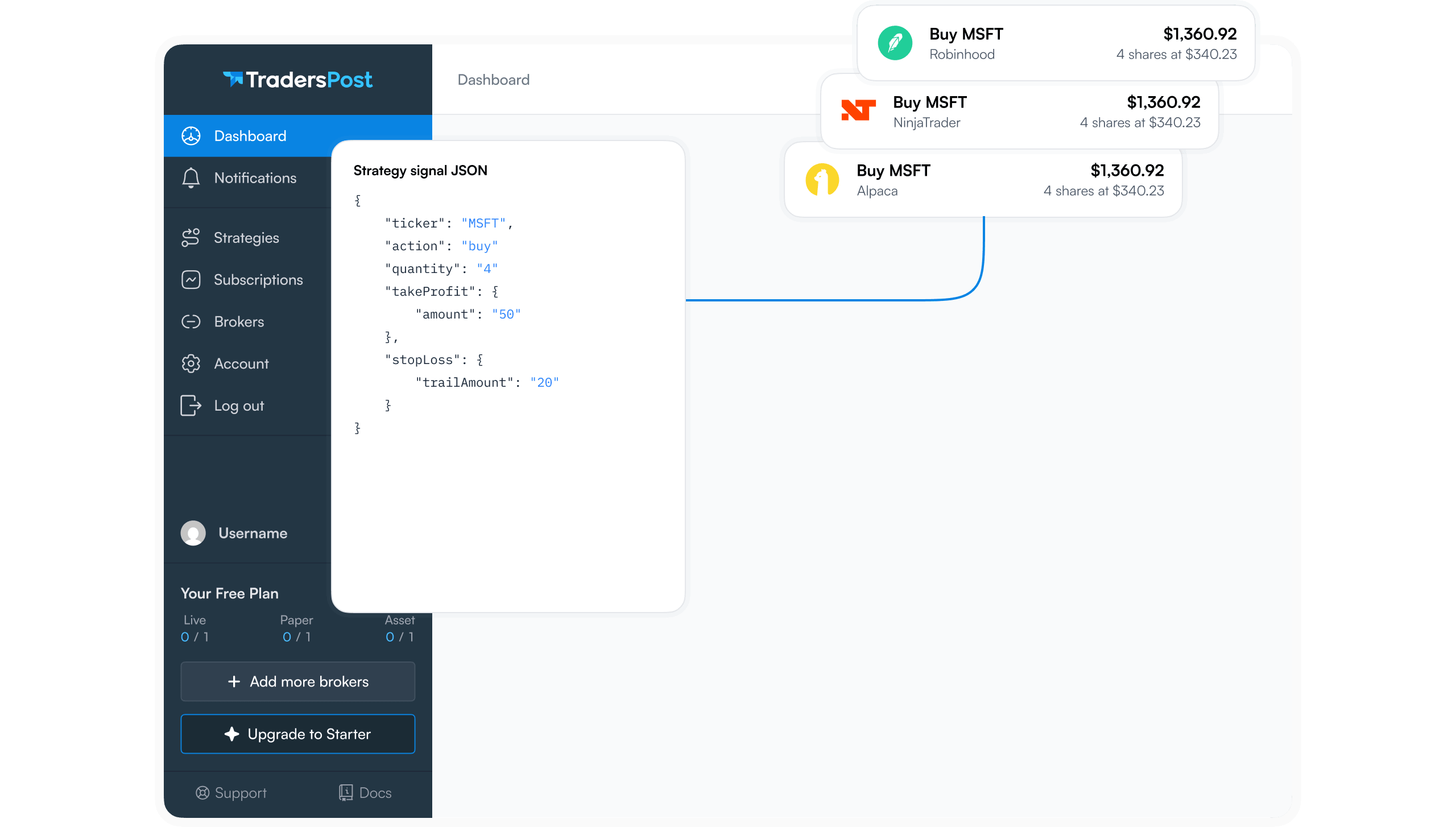
An accepted signal needs a structured instruction containing at least the ticker and action. It may also include quantity, order type, current price, a stop loss, and a take profit. For example:
{
  "ticker": "AMD",
  "action": "buy",
  "price": 143.12,
  "quantity": 1,
  "stopLoss": {
    "type": "stop",
    "percent": 2
  },
  "takeProfit": {
    "percent": 4
  }
}
TradersPost receives JSON instructions at a strategy webhook URL and processes them through strategy subscriptions connected to broker accounts. The Signal Template Creator can also build and submit manual instructions from the Submit Signal page.
Connect a broker, test the complete webhook route with the built-in paper broker, and compare intended orders with the resulting logs before enabling Auto submit. Confirm quantity, direction, stop placement, and duplicate-signal behavior under paper conditions first.
Bottom Line
- Semi-automated trading inserts a human approval checkpoint before entry.
- Signal generation and post-entry management can remain automated.
- Human judgment is most useful when confirmation rules involve visual context.
- Risk limits should remain coded even when entries require approval.
- Paper testing should cover routing, sizing, fills, and failure handling.
Conclusion
Semi automated trading is most effective when the human and software have separate, documented responsibilities. Let software scan markets, calculate risk, and manage repeatable actions. Keep human approval where visual context or strategy-specific judgment genuinely changes the decision.
Do not treat the approval click as a risk control. Per-trade exposure, daily loss, concurrent positions, correlation, spread, and emergency shutdown rules should remain enforceable without discretionary intervention. Start with paper execution, review every signal and fill, and only remove the approval checkpoint after the complete workflow behaves as designed.
Frequently Asked Questions
Semi-Automated vs Fully Automated?
Fully automated systems suggest, place, and manage trades without human entry approval. Semi-automated systems suggest a trade, wait for the trader to accept or reject it, and then may manage the accepted position automatically. The difference is the checkpoint before entry.
Is It Algorithmic Trading?
Yes. Algorithmic trading is the broader process of using code to generate or execute decisions. It can be semi-automated or completely automated. Semi-automated trading is an implementation style within algo trading, not a separate category.
Do I Need to Code?
Not always. Pre-built scanners and indicator packages can provide semi-automated workflows without custom development. Trend-line interpretation, custom alert logic, or specialized order routing may require code. The requirement depends on the chosen confirmation method.
Can Prop Firms Detect It?
Prop evaluations apply account rules regardless of whether a person clicked submit. Firms may also restrict particular automation and copying styles. Review the specific firm's current terms before connecting a semi-automated strategy.
Which Limits Need Automation?
Automate per-trade risk, the daily loss cut-off, maximum concurrent positions, correlated exposure, spread filtering, and the kill switch. These controls should operate independently of entry approval.
References
1 AgenaTrader Docs: Semi Automated Trading
2 Automated Trading: Pros, Cons, and Best Practices
3 Introduction to Algorithmic Trading
4 Automated Trading: Pros, Cons, and Best Practices
5 AgenaTrader Docs: Semi Automated Trading
6 AgenaTrader Docs: Semi Automated Trading
7 Automated Trading: Pros, Cons, and Best Practices
8 Tradeguider SMART Center
9 A Semi-Automated Trend Line Trading Strategy
10 Tradeguider SMART Center
11 Automated Trading: Pros, Cons, and Best Practices
12 Automated Trading: Pros, Cons, and Best Practices
13 AgenaTrader Docs: Semi Automated Trading
14 Automated Trading: Pros, Cons, and Best Practices
15 Automated Trading: Pros, Cons, and Best Practices
16 Automated Trading: Pros, Cons, and Best Practices