How Much Money Needed To Trade Options
There's no universal minimum to trade options. See real broker requirements, contract costs, approval levels, and fees that determine what you actually need.

Marketing

The answer to how much money needed to trade options depends on your broker, account type, approval level, strategy, and the contracts you select. There is no universal deposit that applies to every options account. A trader might buy one call for a few hundred dollars, while a spread or uncovered short option could require a margin account and substantially more available capital.
Start by separating four numbers: the broker's account minimum, the trade's maximum loss, transaction fees, and any funds needed for exercise or assignment. This guide explains each number, compares current broker policies, and shows how to create a realistic options trading budget.
How Much Money Needed To Trade Options
No Legally Required Minimum
Options trading is governed through brokerage approval rather than one universal account-size requirement. FINRA states that an investor must receive specific approval from a brokerage firm before trading options.1 The approval determines which strategies the account may use.
Broker policies illustrate why there is no single deposit answer. CMC Markets states that it does not require a minimum amount to open an options account.2 Merrill Edge advertises options trades with a $0 base commission and no trade or balance minimums, although contract fees still apply.3
Cash Accounts vs Margin Accounts
Your account structure can create a minimum even when the broker has no general opening deposit. Interactive Brokers states that no minimum deposit is required for a cash account, while a margin account requires $2,000 or the non-USD equivalent. An approved individual or IRA application has 270 calendar days to be funded.4
That distinction matters for multi-leg strategies. FINRA says almost all option spread transactions must be executed in a margin account.5 A trader who can afford a spread's debit may still be unable to place it without meeting the broker's margin-account requirements.
Why Requirements Are Broker-Specific
FINRA makes member firms responsible for establishing options approval policies based on customer information and the firm's supervisory framework. Firms may also impose minimum dollar amounts for particular transaction types.6
Compare CMC's no-minimum opening policy with Interactive Brokers' $2,000 margin minimum. The relevant question is not simply, “How much must I deposit?” It is, “How much must I deposit for the account type and approval level my strategy requires?”
How Option Contract Costs Work
Premium and 100-Share Multiplier
A standard-size equity options contract represents 100 shares of the underlying security, and the option's quoted price is its premium.7 A premium quoted at $2.40 therefore represents a $240 contract cost before fees.
For an option buyer, the premium paid is the maximum possible loss.8 That defined loss makes long calls and puts easier to budget than uncovered short options. It does not mean the trade is low risk, since the entire premium can expire worthless.
A Real Dollar Example
An Interactive Brokers lesson compares buying 10 shares of a stock at $160 with buying a call. The shares cost $1,600. A 30-day call with a $170 strike and a $3.50 premium costs $350 because the contract controls 100 shares.9
If the stock reaches $200, the 10-share position gains $400. The option's illustrated profit is $2,650, calculated as 100 multiplied by the $30 intrinsic value, less the $350 premium. If the stock remains below $170 through expiration, the full $350 premium is lost.10
The option creates greater percentage exposure with less initial capital, but it also introduces expiration. Your capital plan must account for both the amount at risk and the limited time available for the thesis to work.
How Spreads Change Cost
The same example turns the long call into a vertical spread by selling a $180-strike call for $1.10, or $110. That credit reduces the net trade cost and maximum loss from $350 to $240.11
The trade-off is capped upside. Gains above the short call's $180 strike are surrendered, making the maximum profit $760. A spread can reduce entry cost, but it changes the payoff structure and normally requires margin-account approval.
Broker Account Minimums Compared
Interactive Brokers
Interactive Brokers requires no minimum deposit for a cash account. Its stated minimum for a margin account is $2,000 or the non-USD equivalent.12 Traders planning to use spreads should evaluate the margin requirement rather than relying on the cash-account minimum.
Merrill Edge
Merrill Edge offers $0 base commission options trades without trade or balance minimums. A $0.65 fee applies to each contract, while the listed exercise and assignment fee is $0 when applicable.13
For frequent or multi-contract trading, the per-contract fee can be more relevant than the advertised base commission. Ten contracts create $6.50 in contract fees for one transaction before considering other applicable charges.
CMC Markets
CMC Markets states that no minimum is needed to open an options account. It charges no options commission, holding fee, or financing fee. Its stated trading costs are the spread and, when an instrument is priced outside the customer's home currency, a currency conversion fee.14
CMC also offers fractional options positions as small as 0.01 of a unit.15 These are OTC, cash-settled products traded through a CFD account, so they should not be treated as identical to exchange-listed equity options.
- Check whether the product is exchange-listed or OTC.
- Confirm whether the strategy requires cash or margin.
- Calculate contract fees for the full number of legs.
- Review exercise, assignment, and settlement mechanics.
Getting Approved to Trade Options
Approval Matters More Than Deposit
A funded brokerage account is not automatically an approved options account. FINRA requires firms to approve or disapprove each customer for options trading before accepting an options order, whether the account is self-directed or receives recommendations.16
During review, the firm must use due diligence to evaluate factors including the customer's options knowledge, investment experience, age, financial situation, and investment objectives. Depositing more money does not guarantee approval for a higher-risk strategy.
Four Common Approval Levels
FINRA identifies four common transaction categories: purchases of puts and calls, covered call writing, uncovered put and call writing, and options spread transactions. A customer can be approved for one category but not another.17
Broker labels and level numbers may differ, so compare the permitted transactions rather than assuming “Level 2” means the same thing everywhere. If your automation depends on a spread or short option, confirm that every leg is allowed before funding the strategy.
Required Options Disclosure
Before approving an account, the firm must provide the Characteristics and Risks of Standardized Options disclosure document. It covers defined terms, exercise procedures, principal risks, and examples of options positions.18 Read it before placing an options transaction, regardless of your planned account size.
Fees That Add to Cost
Contract and Commission Fees
A zero-dollar base commission does not necessarily mean a cost-free trade. Merrill charges $0.65 per contract, so a four-leg strategy using one contract per leg produces $2.60 in contract fees when opened. Closing the full position can generate another set of contract fees.
CMC uses a different model, charging no options commission while collecting the spread and any applicable currency conversion fee. Compare the total round-trip cost for your expected contract count, not one headline price.
Margin for Short Options
FINRA Rule 4210 establishes maintenance margin requirements for options transactions. Firms can also formulate their own margin requirements and review whether higher requirements are appropriate for particular customers or securities.19
Before opening a margin account, a firm must provide a margin disclosure statement explaining the risks of margin trading. This matters because the capital required after entry can increase as the underlying price or volatility changes.
Capital Needed by Strategy Type
Buying Calls or Puts
For a long call or put, the initial contract cost equals the premium multiplied by 100. If a put is quoted at $1.75, one standard contract costs $175 before fees. The premium is the buyer's maximum loss, but the practical budget should also include transaction fees and enough remaining cash to avoid concentrating the account in one expiration.
Selling Covered Calls
Covered call writing is a separate approval category from uncovered option writing. The position is covered because the trader holds the underlying shares needed to meet assignment on the short call. As a result, the capital requirement is driven largely by the cost or value of that share position, not just the option premium.
Selling Uncovered Options
An uncovered, or naked, call has theoretically unlimited maximum loss because the underlying security can continue rising while the writer remains obligated to sell at the strike price.20
FINRA requires firms to apply specific criteria when evaluating customers for uncovered writing and to deliver a special written statement before approval.21 The broker's buying-power requirement is therefore only a starting threshold, not a complete measure of possible loss.
Exercise Requires Extra Funds
Standardized equity options that finish in the money are generally exercised automatically at expiration. Exercising a call requires enough money to buy 100 underlying shares. A call with a $100 strike therefore requires $10,000 to exercise.22
That exercise amount is separate from the premium originally paid. If you do not plan to take delivery, define when the position should be closed and review your broker's expiration procedures before the final trading day.
Before You Commit Real Money
Paper Trade Your Strategy First
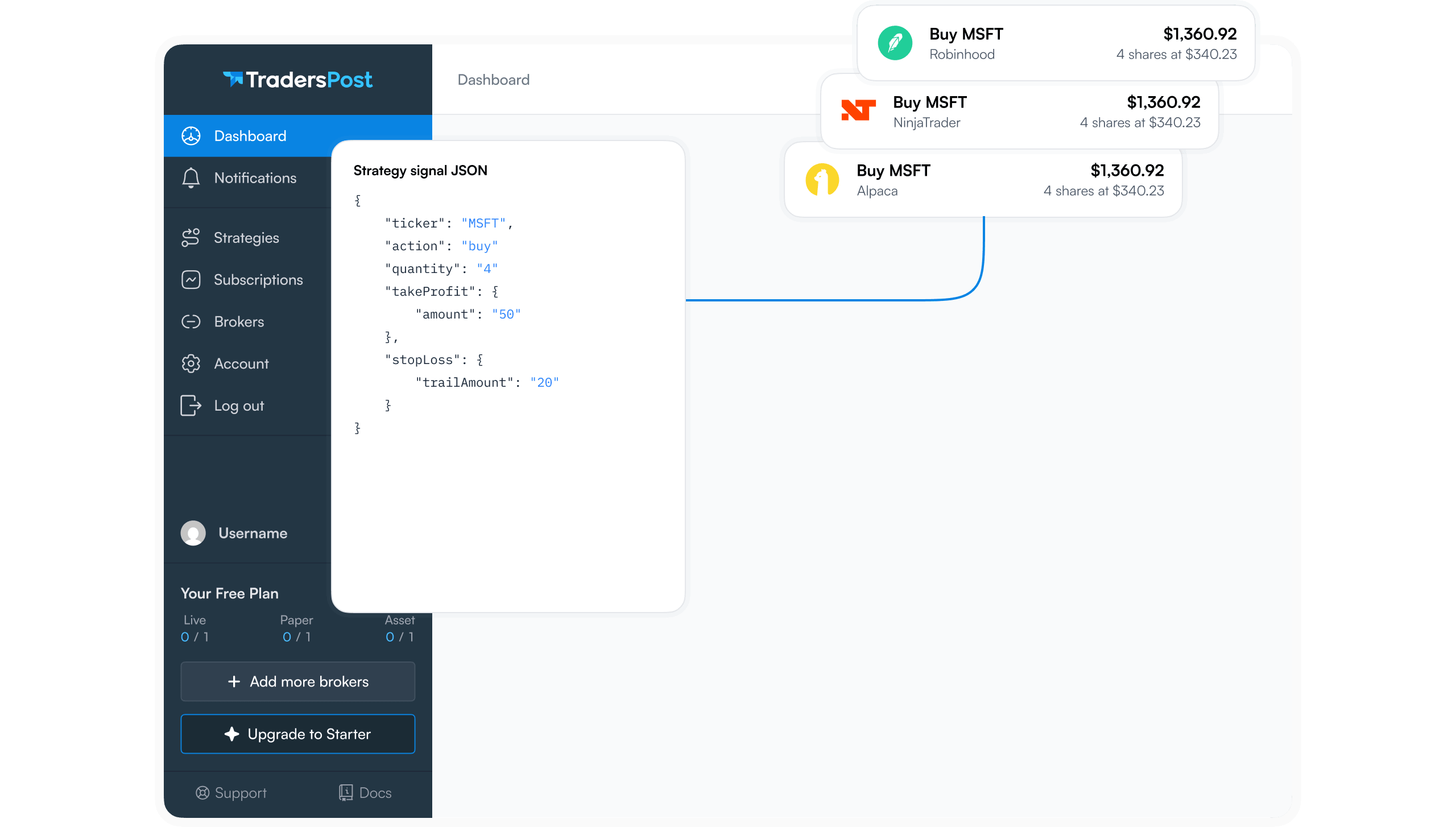
TradersPost provides a built-in paper trading account for testing options strategy logic, along with connections to paper environments offered by supported brokers. Its paper broker fills market orders at the bid-ask midpoint and limit orders at any specified price. Options and futures positions do not expire automatically, remaining open until manually closed.
These mechanics approximate rather than reproduce live execution. Use paper trading to verify signal direction, position sizing, entries, exits, and strategy configuration. Do not treat simulated fills as evidence that live performance will match.
Test before funding: Run the complete options workflow in a paper account, including expiration handling and exit signals, before connecting the strategy to live capital.
Margin Calls Need More Capital
If an underlying security moves against a short options position, or related volatility increases significantly, the seller may have to deposit additional funds. If those funds are not deposited, the brokerage firm may liquidate the options position and other securities positions without notice.23
Keep a capital reserve above the broker's opening requirement. Funding only the exact amount needed to enter a short position leaves no room for changing margin demands or adverse execution.
Assignment and Expiration Risk
Sellers of American-style equity options can be assigned at any time before expiration. Assignment risk is higher on the day before a stock's ex-dividend date because holders of in-the-money calls may exercise early to capture the dividend.24
- Confirm the broker's expiration and exercise deadlines.
- Reserve funds for possible assignment.
- Monitor short calls around ex-dividend dates.
- Close or adjust positions intentionally rather than assuming they will expire.
Bottom Line
- There is no universal minimum deposit for every options account.
- Your broker, account type, approval category, and strategy determine the actual requirement.
- A long option may cost only its premium, but exercise can require enough cash to purchase 100 shares.
- Spreads can lower maximum loss but usually require a margin account.
- Short uncovered options can trigger additional margin demands and losses beyond the opening credit.
Conclusion
The amount needed to trade options is not one fixed deposit. Calculate the premium or collateral required for the strategy, add opening and closing fees, determine whether margin approval is necessary, and reserve capital for exercise, assignment, or changing margin requirements.
Before depositing funds, compare the broker's product structure and approval rules against the exact strategy you intend to trade. Then paper trade the complete workflow so that order logic, position sizing, and expiration handling are tested before real money is at risk.
Frequently Asked Questions
Can I Trade With No Minimum?
Yes, at certain brokers. CMC Markets states that it has no minimum amount for opening an options account. Interactive Brokers states that cash accounts have no minimum deposit, while margin accounts require $2,000 or the non-USD equivalent. A zero deposit minimum does not remove the separate options approval requirement.
Why Is $2,000 Sometimes Required?
Interactive Brokers applies its $2,000 minimum to margin accounts. Because almost all options spreads must be executed in a margin account, that minimum can affect traders who intend to use multi-leg strategies. Margin accounts also remain subject to maintenance requirements.
What If I Cannot Exercise?
In-the-money equity options are generally exercised automatically at expiration. A standard $100-strike call requires $10,000 to purchase 100 shares. Review your broker's procedures and consider closing the contract before expiration if you do not intend to fund exercise.
Does Selling Require More Money?
It can. Buying an option limits maximum loss to the premium paid. Selling an uncovered call creates theoretically unlimited loss exposure, stricter approval standards, and the possibility of margin calls requiring additional deposits.
What Is the Disclosure Document?
The Characteristics and Risks of Standardized Options document explains options terminology, exercise procedures, position risks, and examples. Brokerage firms must provide it before approving an options account, and traders should read it before considering a transaction.
References
1 FINRA: Options
2 CMC Markets: Options Trading
3 Merrill Edge: Options
4 Interactive Brokers: Introduction to Options
5 FINRA Regulatory Notice 21-15
6 FINRA Regulatory Notice 21-15
7 FINRA: Options
8 FINRA: Options
9 Interactive Brokers: Introduction to Options
10 Interactive Brokers: Introduction to Options
11 Interactive Brokers: Introduction to Options
12 Interactive Brokers: Introduction to Options
13 Merrill Edge: Options
14 CMC Markets: Options Trading
15 CMC Markets: Options Trading
16 FINRA Regulatory Notice 21-15
17 FINRA Regulatory Notice 21-15
18 FINRA Regulatory Notice 21-15
19 FINRA Regulatory Notice 21-15
20 FINRA: Options
21 FINRA Regulatory Notice 21-15
22 FINRA: Options
23 FINRA: Options
24 FINRA: Options