What Is DLL in Trading?
DLL in trading means Daily Loss Limit: a per-session loss cap on prop firm accounts. Learn how it works, how it differs from drawdown, and how to size around it.

Marketing

What is DLL in trading? In funded futures and prop trading, DLL means Daily Loss Limit, the maximum amount an account may lose during one trading session. Reaching it can trigger liquidation and a trading lockout, although whether the account survives depends on the firm and account type.
A DLL is separate from maximum drawdown and consistency rules. Traders must track all three independently, confirm what counts toward the daily calculation, and size each trade so a short losing streak does not consume the entire daily allowance.
This guide explains how the limit works, when it resets, how prop firm rules differ, and how to calculate a practical per-trade risk cap.
What Is DLL in Trading?
The Two Meanings of DLL
DLL has two meanings. In computing, it stands for dynamic-link library, a module containing shared functions and data that Windows programs can call. In a funded futures or prop trading account, DLL means Daily Loss Limit.1
The context usually makes the intended meaning obvious. A discussion about Windows software, market data libraries, or programming interfaces may use the computing definition. A prop firm dashboard, evaluation rulebook, or funded-account agreement uses the risk-management definition. This guide covers only Daily Loss Limits.
Daily Loss Limit Defined
A Daily Loss Limit caps the net amount an account can lose within one trading session. Firms commonly express it as a fixed dollar amount associated with the account size or funded-account tier. The counter starts fresh each session rather than carrying the prior day's loss into the next day's allowance.2
The dollar amount is not necessarily a standard percentage of the account's advertised balance. Two firms can label accounts as 50K accounts while assigning different daily limits, calculation methods, and breach consequences.
Why Firms Use DLLs
The DLL acts as an emergency brake. It prevents one uncontrolled session from consuming the account's entire drawdown allowance and can interrupt revenge trading after several losses. It also gives traders a known daily boundary around which to build position sizing and stop placement.
On accounts where a DLL is a soft breach, hitting it ends the session without ending the account. Other programs treat the same event as a terminal breach or apply strike systems after repeated hits, so traders must read the rules for their exact plan rather than assuming every DLL behaves alike.3
How the Daily Loss Limit Works
What Counts Toward the Limit
A typical DLL calculation includes realized losses from closed trades, unrealized losses on open positions, commissions, and fees. Because open losses count, a position can touch the threshold and be liquidated even if it would later have recovered.4
- Realized losses reduce the remaining allowance after trades close.
- Unrealized losses can trigger the limit before a planned stop is reached.
- Commissions and fees can make the final result worse than trade P&L alone suggests.
- Market liquidation can produce a final loss slightly beyond the displayed threshold.
The exact calculation matters for strategies that tolerate substantial intraday heat. Checking only closed P&L can create a false impression that more daily room remains.
When the Limit Resets
Many futures prop firms define the trading session as beginning around 6:00 PM ET and ending around 4:10 PM ET the following day. The DLL resets when the next session begins.5
This reset differs from a trailing drawdown floor. Daily loss headroom becomes available again, but a trailing floor generally does not move back down simply because a new session started. A trader can therefore begin with a fresh DLL while having less cumulative drawdown room than the day before.
What Happens When Hit
On soft-breach accounts, reaching the DLL causes open positions to be liquidated at market, pending orders to be cancelled, and new orders to be blocked until the next session.6
This process can create slippage because liquidation occurs at the available market price rather than at a guaranteed threshold. It also means a trader's personal stop is not the final boundary. If the DLL sits closer than that stop, the account-level control can close the position first.
DLL vs Drawdown and Consistency
DLL vs Maximum Drawdown
The DLL is a session-level cap. Maximum drawdown is an account-level floor based on cumulative performance, often measured from an equity peak or updated under an end-of-day method. A DLL can pause the day, while a drawdown breach generally ends the account.7
Layering a DLL over maximum drawdown prevents a catastrophic session from consuming the entire account buffer at once. The protection does not increase the drawdown allowance. It only limits how quickly the trader can spend it.
Two Independent Failure Modes
The two rules operate independently. An account may have substantial room above its trailing floor yet still breach a terminal DLL during one session. Alternatively, a trader can remain under the DLL every day while cumulative losses gradually move equity down to the drawdown floor.8
Each losing trade can reduce both buffers simultaneously. A pre-session plan should therefore record the current DLL, the remaining distance to the drawdown floor, and the smaller risk amount permitted by those two constraints.
Where Consistency Rules Fit
A consistency rule addresses profits rather than losses. It limits how much of total profit may come from one day, usually as a payout condition. It does not replace the DLL or maximum drawdown.9
- The DLL controls losses within one session.
- Maximum drawdown controls cumulative account losses.
- The consistency rule controls profit concentration for payout eligibility.
How DLL Rules Vary
Intraday vs End-of-Day Accounts
Intraday accounts often rely on a trailing drawdown that updates during the session and may omit a separate DLL. End-of-day accounts more commonly add a DLL because their principal drawdown floor updates only after the session.10
Apex illustrates the distinction. Its Intraday evaluation accounts have no DLL, while EOD evaluation accounts use a fixed DLL based on account size. Funded Performance Accounts use a tier-based DLL across account types.11
DLL Figures by Account Size
For Apex EOD evaluations, the published DLL is $500 for a 25K account, $1,000 for 50K, $1,500 for 100K, and $2,000 for 150K. These limits remain fixed during the evaluation rather than increasing with evaluation profits.12
Those figures should not be treated as an industry formula. Each firm sets its own limits, and the percentage of nominal account size can change between account tiers. Always verify the current dollar amount for the specific product, not just the firm name.
Evaluation vs Funded Phase
Rules can change when an evaluation becomes funded. Published comparisons identify Apex Intraday, Tradeify Select, Top One Elite Daily, and Lucid Pro or Flex among account types where a DLL may appear in the funded phase despite being absent during evaluation.13
On Apex Performance Accounts, the tier and DLL are recalculated once per day using the prior session's closing balance. The DLL may increase as profit reaches higher thresholds, and it does not fall below the original Level 1 amount after a losing stretch.14
Firms Running Without DLLs
No-DLL evaluation examples include MyFundedFutures Flex, Rapid, and Pro plans, Tradeify Select, and Alpha Futures Premium accounts. These products still impose other risk constraints, including their applicable drawdown rules.15
Apex Legacy evaluations and Legacy Performance Accounts also carry no daily maximum drawdown. Their account-level rules remain relevant, but there is no separate daily cap layered over them.16
Sizing Trades Around a DLL
The Per-Trade Risk Formula
Divide the DLL by three or four to estimate a per-trade risk that can absorb several consecutive full losses. A $1,000 DLL produces a range of approximately $250 for four-loss headroom to $333 for three-loss headroom.17
This amount is a ceiling, not a target. Commissions, slippage, correlated positions, and simultaneous signals justify leaving additional space. An automated system should also stop accepting new entries before the firm-level threshold becomes the next exit.
Check the Drawdown Constraint
DLL-based sizing is only half the calculation. A conservative framework also limits per-trade risk to the current distance from equity to the drawdown floor divided by 10. The smaller result becomes the binding risk cap for that session.18
- Record the session's DLL and divide it by three or four.
- Calculate the current distance to the drawdown floor.
- Divide that distance by 10.
- Use the smaller result as the maximum per-trade risk.
- Convert the risk into contracts using the stop distance and instrument value.
Run this check before the first signal. Recalculating while a position is losing invites mistakes and can lead to position sizes that no longer fit the available account buffer.
A Worked Trading-Day Example
Consider a 50K account with a $1,000 DLL trading two ES contracts. A five-point loss costs $500, and a later three-point loss costs $300. The account has now lost $800. On a third trade, a two-point adverse move costs another $200 and reaches the DLL, so the platform liquidates the position even if the trader's planned stop was farther away.19
The lesson is that account-level risk overrides trade-level intent. A stop that permits a $500 loss is not usable when only $200 of daily room remains.
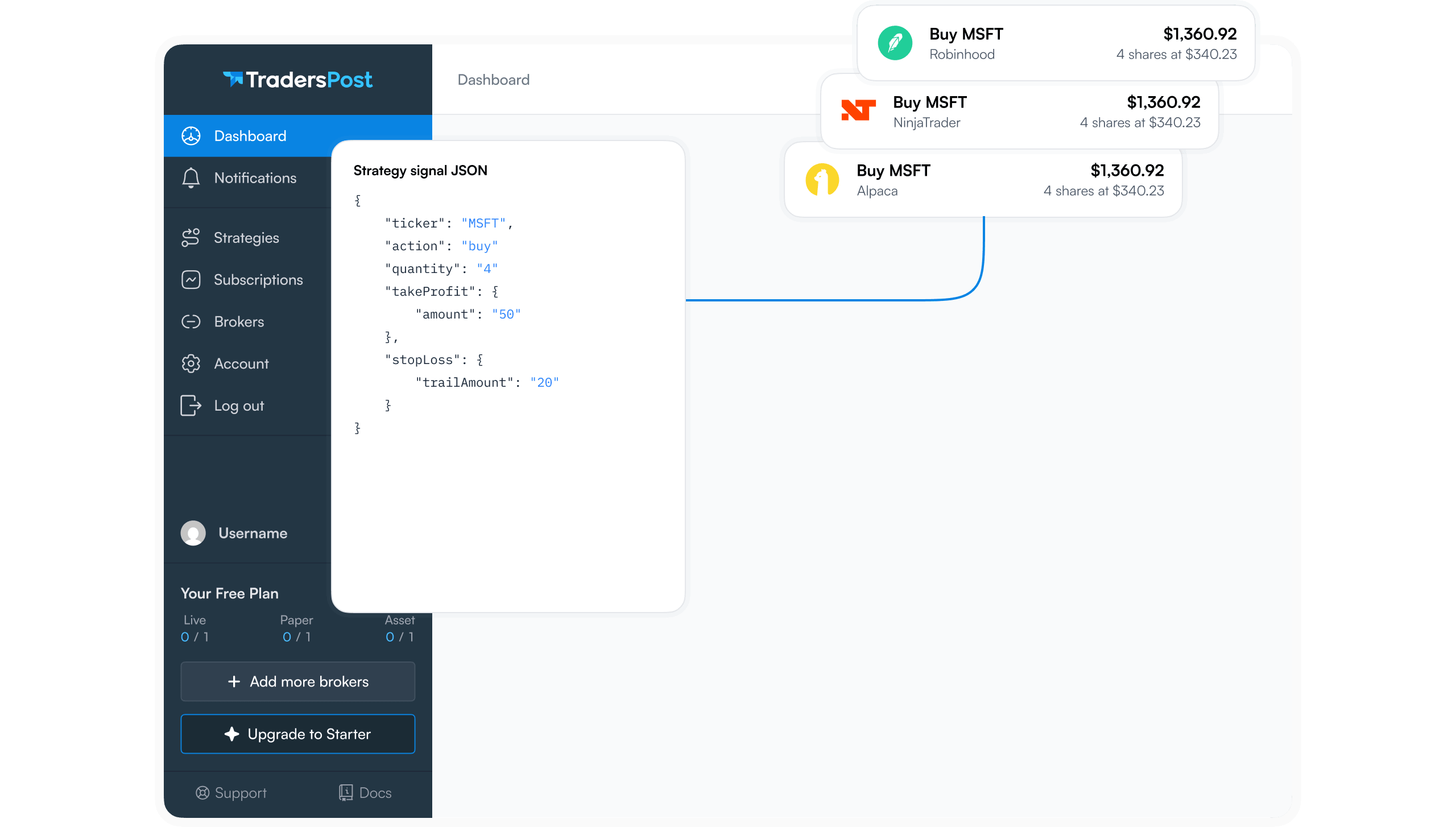
Automate the guardrails: Traders running funded or prop accounts can use TradersPost to route webhook signals with fixed quantities and futures stop losses defined as price or percentage offsets. Futures risk-based dollar sizing is not currently supported, so calculate the permitted contract quantity before sending the signal and test the complete workflow before live deployment.
Common Daily Limit Mistakes
Sizing for Profit Targets
A position large enough to reach the profit target quickly can reach the DLL just as quickly. Before entering, calculate how many points or ticks against the position would consume the remaining daily allowance. Repeat the calculation after every loss because the available room has changed.
Confusing Daily and Total Loss
The DLL and drawdown floor are separate numbers. Treating them as one figure causes traders to overestimate available risk. It also causes confusion after a DLL event because a daily pause may leave one account active while the same event terminates another plan.
Maintain separate dashboard or journal fields for daily headroom, drawdown headroom, current equity, and any strike count. Do not infer one number from another.
Trading Styles That Clash
Wide-stop strategies that hold through significant intraday swings are more likely to make the DLL the binding constraint. Tight-stop systems with several small entries may encounter the trailing drawdown floor first, assuming daily aggregate risk remains controlled.20
Reducing size can preserve the original stop logic, but narrowing the stop changes the strategy. If fitting the DLL requires different entries, exits, or volatility tolerance, test the modified system separately rather than assuming its historical behavior remains valid.
What to Do After Hitting It
Let the Liquidation Happen
Do not add size in an attempt to recover before liquidation. The remaining daily buffer is already depleted, and a market exit can fill beyond the displayed threshold. Adding exposure increases both execution risk and potential damage to the cumulative drawdown buffer.
Stop Trading for the Day
A soft-breach account normally blocks additional orders until the next session. If an account has no DLL, impose the same pause through strategy controls or a written rule. The absence of a firm-enforced limit does not create additional account-level drawdown room.
Reassess Before the Next Session
Before resuming, confirm that the account remains active, check the new DLL, and recalculate drawdown distance. On a tiered Apex Performance Account, the prior closing balance can determine the next session's tier, maximum contracts, and DLL.21
Review whether the loss resulted from normal strategy variance, excessive size, duplicate signals, slippage, or a rule violation. Resume only after the next session begins and the updated limits are documented.
Bottom Line
- DLL means Daily Loss Limit in prop trading.
- It measures session losses separately from maximum drawdown.
- Realized losses, unrealized losses, commissions, and fees may count.
- Divide the DLL by three or four, then compare that result with drawdown-based risk.
- Confirm whether a breach pauses or terminates your exact account.
Conclusion
A Daily Loss Limit is an account-level boundary for one trading session. It can protect a trader from spending the full drawdown during a bad day, but it does not replace stop losses, position sizing, or cumulative drawdown management.
Before trading a prop account, document the DLL amount, reset time, calculation method, funded-phase changes, and breach consequence. Then encode or configure the smallest applicable risk cap in your execution workflow. Testing those controls with simulated signals before deployment is safer than discovering an account rule during liquidation.
Frequently Asked Questions
Does Hitting DLL Close My Account?
It depends on the firm and plan. Some accounts treat it as a soft breach that pauses trading until the next session, while others make it a terminal event or use a strike system. Confirm the current rule for your exact evaluation or funded account before trading.22
How Does DLL Differ From Drawdown?
The DLL caps losses within one session and resets for the next session. Trailing drawdown tracks the account's cumulative distance from a moving or fixed floor. The rules operate independently, so respecting one does not guarantee compliance with the other.
Do All Prop Firms Use DLLs?
No. Certain plans from MyFundedFutures, Tradeify, Alpha Futures, and Apex operate without a separate DLL. They still use other account constraints, so no DLL does not mean unlimited risk.
What Does DLL Mean Elsewhere?
Outside prop trading, DLL usually means dynamic-link library, a shared software library used by Windows programs. Within funded-account rules, it means Daily Loss Limit.
How Much Should I Risk?
Divide the DLL by three or four, then compare that result with the current drawdown-floor distance divided by 10. Use the smaller number as the maximum per-trade risk, with additional room for fees and slippage.
References
1 What Is a Daily Loss Limit in Prop Trading?
2 What Is a Daily Loss Limit in Prop Trading?
3 What Is a Daily Loss Limit in Prop Trading?
4 Daily Loss Limit in Prop Firms
5 Daily Loss Limit in Prop Firms
6 Daily Loss Limit in Prop Firms
7 What Is a Daily Loss Limit in Prop Trading?
8 The Daily Loss Limit Explained
9 What Is a Daily Loss Limit in Prop Trading?
10 Daily Loss Limit in Prop Firms
11 Apex Trader Funding Daily Loss Limit
12 Apex Trader Funding Daily Loss Limit
13 Daily Loss Limit in Prop Firms
14 Apex Trader Funding Daily Loss Limit
15 The Daily Loss Limit Explained
16 Apex Trader Funding Daily Loss Limit
17 The Daily Loss Limit Explained
18 The Daily Loss Limit Explained
19 What Is a Daily Loss Limit in Prop Trading?
20 The Daily Loss Limit Explained
21 Apex Trader Funding Daily Loss Limit
22 Daily Loss Limit in Prop Firms