Prop Firm Reset Fees: Are They Worth It?
Learn what prop firm reset fees cost across major futures firms, when a reset beats buying a new evaluation, and when to skip both.

Marketing

A prop firm reset fee is a one-time charge that restores a breached or stalled evaluation account to its starting balance, letting you continue trading without purchasing an entirely new subscription. Reset fees range from $47 at Elite Trader Funding's End of Day plan1 to full new-account price parity at Topstep.2 That spread is wide enough that the right choice looks completely different depending on which firm you trade and where you are in your billing cycle.
This article covers what a reset actually does, what firms charge, and the arithmetic for deciding between a reset and a fresh evaluation. It also walks through two worked examples and flags the situations where paying for a reset is the wrong call entirely.
What a Reset Actually Does
Balance restored, subscription unchanged
A reset returns a breached or stalled evaluation account to its starting balance without requiring a new evaluation purchase. On subscription-based firms, the billing date does not change after a reset: the subscription continues rolling on its original cycle. Resets do not extend the evaluation period or alter the drawdown rules. You re-enter the same challenge under the same terms, with the same profit target and the same loss limits.
Breach vs. stall: two reasons to reset
A breach reset follows hitting the maximum drawdown or daily loss limit, which closes the account and requires action before trading can resume. A stall reset may be chosen when a trader is deep in the hole but technically still active and wants to restart progress toward the profit target from a clean balance rather than grinding back from a deficit.
Not all firms allow resets on funded or qualified accounts. Funded Futures Family offers funded resets up to three times per account,3 which is a notable exception to the more common pattern of resets being available only during the evaluation phase. Always confirm the policy for the specific stage you hold.
What Firms Actually Charge
Flat-fee models
Elite Trader Funding charges $47 for a reset on its End of Day evaluation, with unlimited resets allowed during the evaluation phase.1 That flat fee applies regardless of how many times you breach, which changes the risk calculus significantly for traders who are early in their billing cycle.
TradeDay prices resets equal to the monthly subscription fee for the account size: $45 on the 25K intraday plan, $59 on the 50K intraday plan, and $108 on the 100K intraday plan.4 The EOD variants carry higher reset prices than their intraday equivalents at the same account size, so traders who selected EOD for its drawdown mechanics should factor that into their reset budget.
Reset equals new account price
Topstep prices a reset identically to the original Trading Combine purchase: $49 for the 50K Standard Path, $99 for the 100K Standard Path, and $199 for the 150K Standard Path.2 When the reset fee matches the new-account price, there is no inherent saving from resetting over starting fresh. The decision becomes about timing and discount code availability rather than the list price itself.
Topstep's promo code policy adds a wrinkle: codes apply to a new Trading Combine or a reset, but not both in the same transaction.2 If a promotional code is available, you must decide which purchase gets the discount before clicking.
Per-account-size and plan variations
Alpha Futures reset fees vary not just by account size but by plan type. The 25K Zero eval reset is $79, the 50K Zero eval reset is $119, and the 100K Zero eval reset is $249.5 On Standard accounts the 150K eval reset is $289, while the Advanced 150K eval reset climbs to $449, reflecting the higher monthly subscription cost.5 Advanced Qualified accounts show no reset option at all, meaning a breach at that stage requires a new purchase rather than a simple reset.5
Take Profit Trader offers PRO account resets up to three times, marketing this as a differentiator versus competitors described as offering no resets on funded accounts.6 Funded Futures Family advertises discounts on both evaluations and resets simultaneously under promotional codes, meaning the effective reset cost can be well below list price during a sale.3
The Arithmetic: Reset or Start Over
When a reset is cheaper
If the reset fee is materially lower than the new-account price, a reset saves cash outright. Elite Trader Funding's $47 reset versus repurchasing a monthly evaluation subscription is a clear example: the reset leaves the existing billing cycle intact while the new account starts a fresh 30-day clock.1 On subscription firms, a reset mid-cycle lets the trader keep the remaining days in the billing period, which adds implicit value that the raw fee comparison does not capture.
Unlimited-reset policies amplify this effect. A trader who breaches on day 8 of a 30-day cycle and resets immediately has 22 days of evaluation time ahead. The same breach on day 28 leaves almost nothing.
When a new account is cheaper
Promotional discounts on new evaluations can undercut the reset price. Funded Futures Family runs codes offering significant discounts off new evaluations,3 which can bring a new account below a list-price reset. Always price both options at checkout before clicking reset. A discount code applied to a new evaluation may produce a lower all-in cost than the reset fee even when the reset is nominally cheaper at list price.
When the reset fee equals the new-account price and no discount applies, starting over is equivalent in cost but may offer other advantages such as a fresh billing cycle or the ability to switch account size.
Timing in the billing cycle
On monthly subscription firms, where you sit in the billing cycle matters as much as the fee itself. A reset on day 2 leaves 28 days of evaluation time ahead; a reset on day 28 leaves almost none. A trader near the end of a billing period should check whether letting the subscription renew naturally restores the account to starting conditions, since that may cost nothing beyond the regular monthly charge. Policies differ by firm, so confirm whether subscription renewal automatically restores the balance or whether a manual reset is still required after renewal.
A Worked Example
50K EOD evaluation scenario
Consider an Elite Trader Funding 50K End of Day evaluation: $2,000 EOD trailing drawdown, $1,100 daily loss limit, $3,000 profit target.1 A trader breaches the $1,100 daily loss limit on day 8 of a 30-day billing cycle, leaving 22 days in the subscription. The reset costs $47. Buying a new evaluation would restart the monthly subscription at full price, making the reset the cheaper path by a meaningful margin while also preserving 22 days of remaining evaluation time.
Topstep 100K scenario
Topstep's 100K Standard Path Trading Combine costs $99 per month, and a reset also costs $99.2 There is no financial incentive to reset over buying new at list price. If a promotional code is available and applies to a new account but not a reset, buying a new account with the code beats paying $99 for the reset at full price. Because Topstep's policy states codes apply to a new Trading Combine or a reset but not both,2 the trader must decide which purchase gets the discount before committing.
When a Reset Is the Wrong Answer
Execution problem, not a run-of-luck problem
If the breach was caused by a systematic flaw in the strategy or a rule misunderstanding rather than an isolated bad session, resetting repeats the same conditions and is likely to produce the same outcome. A reset is a fee paid for another attempt. It does not change the rules, the drawdown structure, or the trader's behavior without deliberate adjustment. Diagnose whether the loss that triggered the breach was within the strategy's normal distribution or a clear error before spending money on a reset.
Reset caps and policy gaps
Some firms cap the number of resets available per account. Take Profit Trader's PRO account allows up to three resets, after which no further resets are available.6 Alpha Futures lists no reset option on Advanced Qualified accounts, meaning a breach at that stage requires a new purchase.5 Confirm the reset policy for the specific product and account stage you hold, not the firm's general marketing page, before assuming a reset is available.
Wrong firm for your strategy
If resets are expensive relative to new-account promotional pricing at a competitor, the reset decision is also a prompt to re-evaluate whether the current firm's drawdown structure suits your trading style. Repeatedly resetting on the same firm without passing is a signal worth examining: both strategy fit and whether the evaluation parameters align with your actual trading behavior deserve scrutiny before paying again.
Before You Click Reset
Four things to check first
- Price a new evaluation at checkout with any available discount code and compare it to the listed reset fee before committing.
- Check where you are in the billing cycle. If renewal is within a few days, waiting may restore the account at no extra cost depending on the firm's renewal policy.
- Verify the reset limit for your specific account: confirm whether resets are still available and whether the reset applies to the evaluation stage or the funded stage you currently hold.
- Confirm that the same product will be reset. Some firms offer multiple plan types and a reset may lock you into the same plan even if a different plan would be preferable.
Automating your next attempt
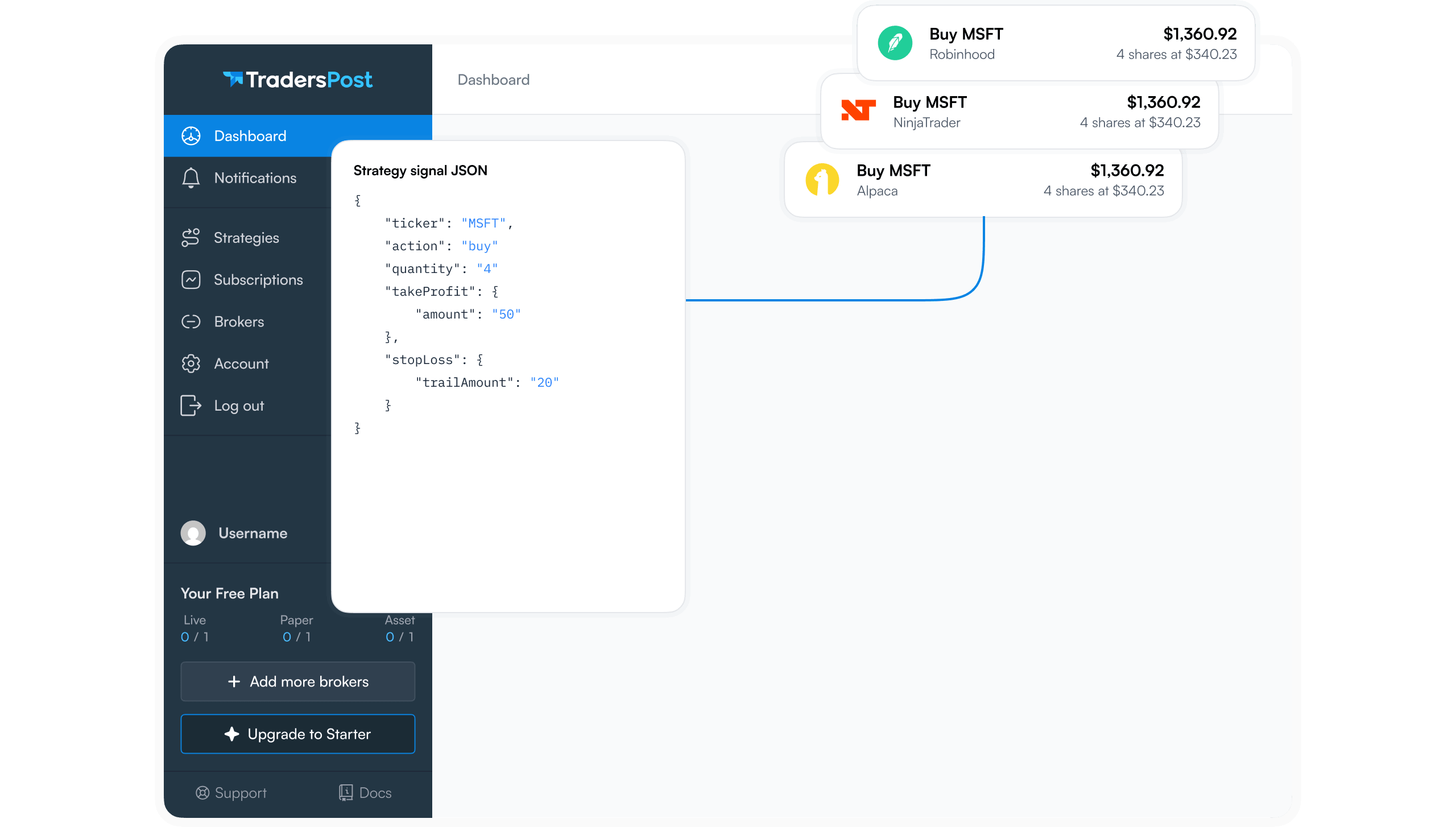
Once a reset or new evaluation is active, traders running rule-based strategies can connect their evaluation account to TradersPost and route TradingView alerts directly to the prop firm account. Removing manual execution from the loop eliminates a common source of unnecessary drawdown breaches: miskeyed position sizes, missed stop orders, or delayed exits that would have been handled automatically by a defined strategy. TradersPost supports connections to futures prop firm accounts and routes TradingView alerts into automated orders, letting stop-loss and take-profit levels fire consistently on every signal.
Bottom Line
- Reset fees range from $47 at Elite Trader Funding's EOD plan1 to full new-account price parity at Topstep.2 The spread is wide enough that the math is different at every firm.
- Always price a discounted new evaluation against the reset fee before deciding. Promotional codes can make a fresh start cheaper than a reset, particularly at firms like Funded Futures Family where both evaluations and resets are discounted simultaneously.3
- On monthly subscription firms, billing-cycle position matters as much as the fee itself. A reset on day 2 is a much better value than a reset on day 28.
- Some firms cap resets or exclude them on qualified or funded-stage accounts entirely. Alpha Futures lists no reset on Advanced Qualified accounts,5 and Take Profit Trader caps PRO account resets at three.6 Verify the policy on your specific product before assuming a reset is available.
- A reset only makes sense if the breach was situational rather than systematic. Paying to repeat the same conditions without changing the approach is not a strategy, it is a fee.
Frequently Asked Questions
Does a reset extend my evaluation subscription period?
No. On subscription-based firms, a reset restores the account balance but does not change the billing date. The subscription continues on its original renewal cycle. A reset late in a billing period leaves very little evaluation time before the next charge, while a reset early in the cycle preserves most of the month.
Can I use a discount code on a prop firm reset?
It depends on the firm. Topstep explicitly states that promo codes apply to a new Trading Combine or a reset, but not both in the same transaction.2 Funded Futures Family runs promotions that discount both evaluations and resets simultaneously, so the effective reset cost during a sale can be well below list price.3 Always check the code terms at checkout, as some codes are restricted to first purchases only.
Are resets available on funded accounts, not just evaluations?
Some firms extend resets to funded stages. Funded Futures Family offers funded resets up to three times per account.3 Take Profit Trader also offers up to three resets on PRO accounts.6 Alpha Futures lists no reset option on Advanced Qualified accounts,5 illustrating that policies differ significantly by firm and account stage.
When does a new evaluation cost less than a reset?
When a firm prices the reset at the same level as a new account, such as Topstep's identical reset and Trading Combine pricing, there is no inherent saving from resetting over starting fresh.2 If a promotional discount applies to a new evaluation but not to a reset, the discounted new account can be cheaper than the full-price reset. At Funded Futures Family, promotional codes have offered large discounts off evaluations, which can bring a new account cost below the standard reset fee.3
How many resets does a firm typically allow?
There is no industry standard. Elite Trader Funding allows unlimited resets on its End of Day evaluation accounts at $47 per reset.1 Take Profit Trader caps PRO account resets at three per account.6 Alpha Futures offers no reset on Advanced Qualified accounts.5 Reset availability depends on the specific plan and account stage, not just the firm name.
References
1 Elite Trader Funding - End of Day Evaluation
2 Topstep - Pricing and Payment Questions
3 Funded Futures Family
4 TradeDay
5 Alpha Futures
6 Take Profit Trader