What Payout Eligibility Calculated EOD Means
Payout eligibility calculated EOD means your account is assessed at session close, not intraday. Here is what that changes about drawdown floors and qualifying days.

Marketing

Payout eligibility calculated EOD means your prop firm evaluates your account once, at session close, using your realized balance only. That single fact changes two things simultaneously: where your trailing drawdown floor will move, and whether the day counts as a qualifying day toward your next payout. If you have seen the phrase on a firm's dashboard and wondered exactly what it governs, this article walks through the mechanics in full.
The EOD model is not the same as having no trailing drawdown. The floor still moves, the daily loss limit still applies intraday, and open losses can still fail your account during the session. What changes is when the floor ratchets upward and what inputs trigger that ratchet.
The sections below cover the ratchet mechanism, payout qualification, the fixed snapshot time, and the specific scenarios that catch traders out despite choosing an EOD plan.
EOD vs. Intraday Equity Assessment
The Core Distinction
End-of-day assessment means the firm evaluates your account balance once, at session close, based on realized profit and loss only. Elite Trader Funding states this directly: the floor never moves up intraday, open profit does not ratchet it, only a higher realized balance at session close does.1
Intraday trailing drawdown works differently. Under that model, every spike in unrealized profit moves the floor upward continuously, so a position that runs $1,500 in your favor and then reverses can permanently tighten your cushion even if you close the session flat. EOD removes that specific pressure point.
What Realized vs. Unrealized Means Here
Realized profit is profit locked in by closing a position before the session ends. Unrealized profit is open-position gain that has not yet been closed; under EOD rules, this does not move the trailing floor upward.1
Open losses are treated differently. My Funded Futures states explicitly that open equity losses are taken into consideration when calculating whether the account failed.2 Elite Trader Funding confirms the same: an intraday dip that touches your trailing floor or your daily loss limit fails the account immediately, even on an open position.1 EOD protects you from one direction of intraday movement, not both.
How the Trailing Floor Ratchets
The Ratchet Mechanism Explained
The trailing drawdown floor moves up only when a new closed-balance high-water mark is recorded at session end. Elite Trader Funding illustrates this with a $50,000 account carrying a $2,000 trailing drawdown.1 On day one, the floor sits at $48,000. If unrealized profit spikes to $1,800 intraday, the floor stays at $48,000 because no position has been closed. Close the day flat at $50,000 and the floor remains $48,000. Close day two at $51,200 and the floor ratchets up to $49,200.
Under live trailing drawdown, every intraday profit spike shifts the floor immediately. EOD waits until you have actually realized the gain, making it a materially less stressful model for traders who scale into winners or sit through intraday noise.
Why Intraday Spikes You Give Back Do Not Hurt You
Because the ratchet only fires at session close on realized balances, a large unrealized gain that reverses before close leaves the floor exactly where it was at the prior session's close. A spike taken back before the EOD snapshot does not permanently shrink the distance between your account balance and the drawdown limit.
My Funded Futures frames this as eliminating the daily drawdown concern so traders can manage their sessions without constant intraday pressure from the floor moving against them.2 That benefit is real, but it applies only to the upward ratchet, not to downside exposure on open positions.
How EOD Governs Payout Eligibility
What Makes a Day Count
A qualifying day toward payout eligibility is assessed at the EOD snapshot. The firm checks whether the account closed the session in a valid state and above required thresholds. Elite Trader Funding requires a minimum of 8 qualified days before a first payout on its EOD plan.1
A day where the account breaches the daily loss limit intraday does not count as a qualifying day, even if the trailing floor was not touched. The daily loss limit and the trailing floor are independent breach conditions; either one can disqualify the day.
Safety Net and Floor Removal
Elite Trader Funding states that once a trader earns realized profits equal to the max drawdown plus $100, the trailing drawdown is permanently removed for payout eligibility.1 My Funded Futures similarly notes the Max EOD trailing locks in at $100 plus the initial starting balance, representing the point at which the floor stops rising against the trader.2
Reaching the safety net threshold is a meaningful milestone: the trailing floor stops functioning as a payout obstacle entirely. Steady accumulation of realized profit is therefore more valuable under EOD plans than chasing single large sessions.
When the EOD Snapshot Is Taken
The Fixed Assessment Time
Because the assessment happens at a fixed session-close time, the exact moment that determines whether the floor moves and whether the day qualifies is predictable. Elite Trader Funding requires all trades to be closed one minute before market close on EOD plans.1
This fixed timing transforms closing flat before the snapshot from an informal habit into a deliberate, rule-driven decision with direct consequences for both the floor and payout qualification. Arriving at the snapshot with an open position is not a neutral event.
EOD Plans Do Not Allow Overnight Positions
Elite Trader Funding explicitly prohibits overnight positions on EOD plans; traders who want to hold through the session close must select a different plan type, such as the Diamond Hands plan.1 Because the EOD ratchet fires at close, any open position at that moment introduces realized P&L into the assessment, which can move the floor or fail the account depending on whether the position is in profit or has breached the loss limit.
The Part That Catches Traders Out
Open Losses Still Count Intraday
EOD calculation does not protect an open position. My Funded Futures states explicitly that open equity losses are taken into consideration when assessing whether the account failed.2 Elite Trader Funding confirms the same: an intraday dip that touches the trailing floor or the daily loss limit fails the account immediately, even if the position is still open.1
The EOD model reduces one type of risk (the upward floor ratchet on unrealized gains) but does not eliminate downside risk from open positions during the session. Traders who assume EOD means intraday drawdown protection are reading the rule incorrectly.
The Daily Loss Limit Is Often What Fails You
EOD plans at Elite Trader Funding pair the EOD trailing drawdown with a hard-breach daily loss limit: $1,100 at the 50K size, $2,200 at the 100K size.1 Elite Trader Funding's worked example shows the daily loss limit is typically the rule that fails an account, not the trailing drawdown floor, because the floor moves slowly while the daily loss limit is a fixed intraday cap.1
Traders who revenge-trade after a bad morning are particularly exposed to this limit. On an EOD account, risk per day matters more than risk per individual trade because one bad session can eliminate the day's qualification and breach the hard limit simultaneously.
What EOD Changes About How You Trade
Session Management Becomes a Rule, Not a Style
Because both the qualifying-day assessment and the floor ratchet happen at close, how you manage the last portion of each session has direct mechanical consequences. Closing flat before the snapshot prevents open positions from introducing unwanted realized P&L into the EOD assessment. The no-overnight-position requirement on EOD plans enforces this session discipline structurally rather than leaving it to the trader's discretion.
Scaling Into Winners Without Floor Penalty
Elite Trader Funding identifies EOD accounts as best suited for traders who scale into winners and sit through intraday noise without wanting every profit spike to ratchet their floor.1 Under live trailing drawdown, adding contracts to a profitable open position increases unrealized profit and therefore immediately tightens the floor. Under EOD, that tightening only happens if the enlarged position is still profitable at close.
The trade-off is the daily loss limit. Because a single hard breach ends the day regardless of where the trailing floor sits, sizing and intraday risk management matter more than risk per individual trade.
Checking Your Own Account Terms
EOD Rules Vary by Firm and Plan
My Funded Futures, Elite Trader Funding, and Take Profit Trader each publish their EOD drawdown rules and payout conditions before account purchase. Verify your firm's specific snapshot time, daily loss limit, minimum qualified days, and safety net threshold before you start trading.
Take Profit Trader's PRO+ tier adds EOD drawdown as an upgrade from the standard intraday model, showing that EOD is not always the default and may require a specific plan selection.3 No two firms apply EOD rules identically. Minimum qualifying days (8 at Elite Trader Funding), consistency requirements (50% on My Funded Futures Builder plan), and safety net thresholds differ across firms and plan tiers, so reading your own firm's published rules is not optional.
Automating Flat-Before-Close With Webhooks
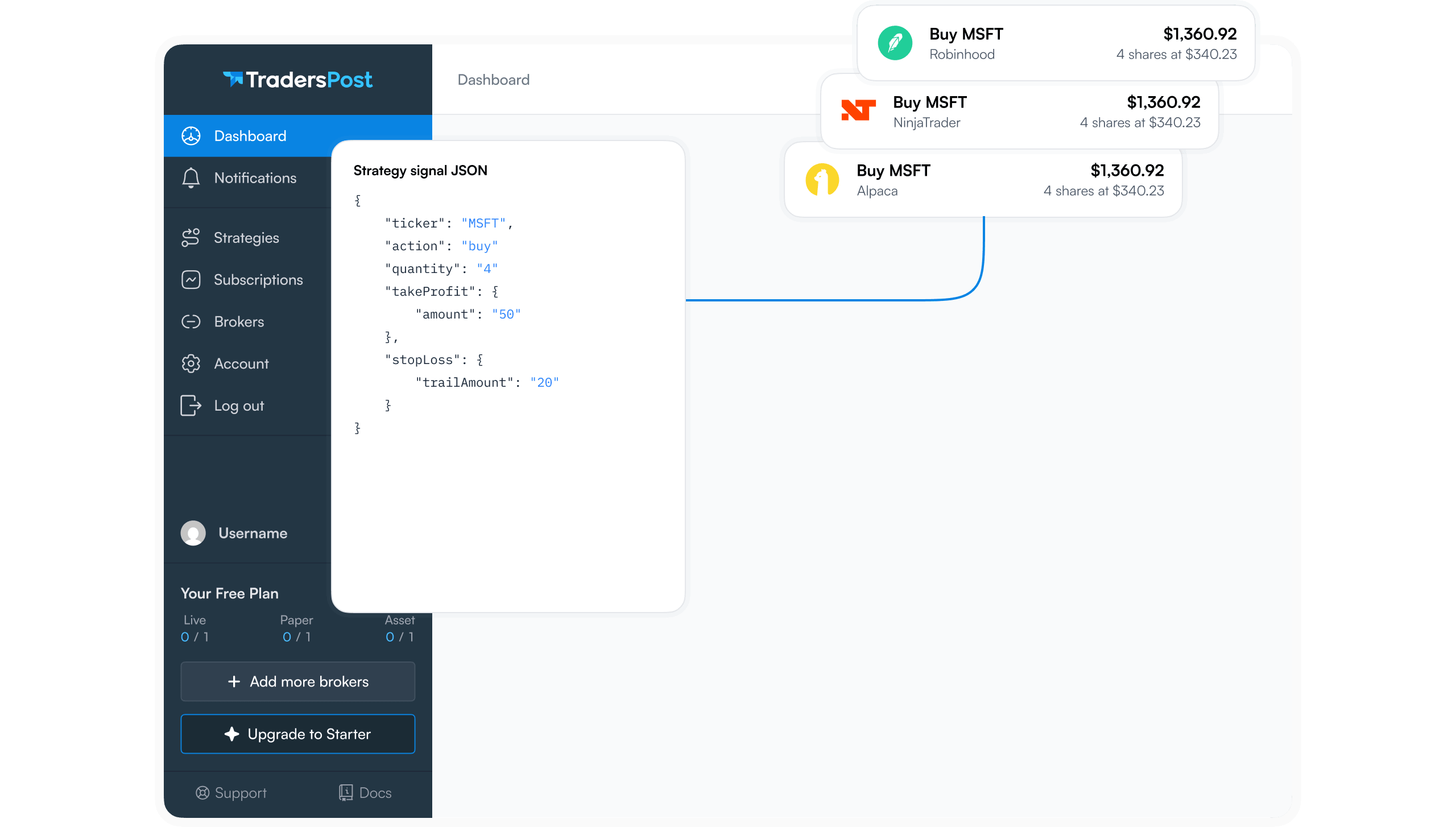
Traders running automated strategies can schedule exit signals to fire before the EOD snapshot, ensuring positions close in time to avoid open-position risk at assessment. TradersPost supports futures trading with webhook-driven order routing, allowing traders to automate flat-before-close exits as part of prop firm session management without manual intervention.4 A webhook payload with {"ticker": "MNQU2025", "action": "exit"} sent a few minutes before the snapshot closes the position and removes it from the EOD assessment entirely.
If your strategy runs on TradingView, you can fire that exit alert on a fixed schedule each session and let the automation handle the rest. The flat-before-close requirement stops being something you have to remember and becomes something the system enforces.
Bottom Line
- EOD assessment means the trailing floor ratchets only at session close, based on realized P&L, not on intraday unrealized gains.
- Open losses still count intraday: an EOD plan does not protect you from a breach during the session.
- A qualifying day is assessed at the EOD snapshot; a daily loss limit breach disqualifies the day even if the trailing floor was not touched.
- Reaching the safety net threshold (realized profits equal to max drawdown plus $100 at Elite Trader Funding) permanently removes the trailing floor as a payout obstacle.
- EOD plans prohibit overnight positions; closing flat before the fixed snapshot time is a rule, not a preference.
Frequently Asked Questions
Does EOD drawdown protect me if a position drops intraday?
No. EOD calculation only changes when the trailing floor moves upward; it does not protect against intraday losses on open positions. My Funded Futures and Elite Trader Funding both state that open equity losses count toward account failure, and an intraday dip that touches the trailing floor or daily loss limit fails the account immediately, regardless of whether the position is still open.12
What happens to the floor if I close flat?
If you close the session at the same balance you started with, the EOD floor does not move. The floor only ratchets up when you close at a new high-water mark. Elite Trader Funding's example illustrates this: a day-one unrealized spike of $1,800 that is given back before close leaves the floor at its starting position.1
How many qualifying days are required before a payout?
Requirements differ by firm and plan. Elite Trader Funding requires 8 qualified days before a first payout on its EOD plan.1 A day where the daily loss limit is breached intraday does not count as a qualified day, even if the trailing drawdown floor was not touched.
Can I hold positions overnight on an EOD account?
No, at least not on EOD plans from Elite Trader Funding, which require all trades to be closed one minute before market close.1 Traders who need to hold overnight should check whether their firm offers a separate plan type that permits it. Elite Trader Funding's Diamond Hands plan is one example of an alternative for overnight holders.
What is the safety net and how does it work?
The safety net is a realized profit threshold that, once reached, permanently removes the trailing drawdown floor as a payout obstacle. Elite Trader Funding sets this at realized profits equal to the max drawdown plus $100.1 My Funded Futures describes a similar lock-in point at $100 above the initial starting balance.2 Once the safety net is hit, the drawdown no longer limits payout eligibility, making consistent accumulation of realized profit more valuable than chasing large single sessions.
References
1 Elite Trader Funding - End of Day Evaluation
2 My Funded Futures - End of Day (EOD) Drawdown Explained
3 Take Profit Trader
4 TradersPost - Futures Trading