How Many Prop Firm Accounts Can You Run?
Most prop firms cap you at 5 funded accounts per household. Here are the verified limits, the hidden caps, and the rules that end all your accounts at once.

Marketing

Knowing how many prop firm accounts you can run is not as simple as picking a number. Most firms cap funded accounts at five per household, but the limit is layered: there is an account count ceiling, a total simulated allocation ceiling, and often a per-user payout cap sitting underneath both. Miss any one of them and you can find yourself holding accounts that produce no additional withdrawable income, or worse, lose all of them at once through a cross-account rule violation.
This article covers the verified account limits at Topstep, Tradeify, Alpha Futures, Take Profit Trader, Funded Futures Family, and MyFundedFutures, along with the two caps most traders overlook and the cross-account rules that end everything simultaneously. The details come directly from each firm's published terms and help documentation.
Whether you are considering your second account or your fifth, the distinctions below will save you from discovering the actual limit through a termination notice.
The Most Common Cap: Five Accounts
Where the five-account limit appears
Five funded accounts is the ceiling you will encounter most often. Tradeify lists a maximum of 5 funded accounts across its 25K, 50K, 100K, and 150K plan sizes.1 Take Profit Trader states that traders can have up to 5 PRO or PRO+ accounts at a time, which would allow trading up to $750K in combined simulated and live capital.2 The number appears consistently enough across firms that treating it as the industry default is reasonable, but the details under it vary significantly.
Funded Futures Family's household limit
Funded Futures Family applies a site-wide limit of 5 active funded accounts per household across all plans combined, including Prime, S2F, Velocity, and Premier.3 The cap applies to funded accounts specifically; evaluation accounts are handled separately under their own rules. The household framing is the critical detail: two traders living at the same address share that pool of five rather than each holding five independently. That distinction can cut the effective limit in half without any explicit notice from the firm.
Topstep: The Outlier
No limit on Trading Combines
Topstep is the clearest exception to the five-account rule. The firm explicitly states there is no limit to the number of Trading Combines a trader can hold.4 Traders are warned to double-check which account they are trading on before starting, because Topstep is not responsible for trades made on the wrong account. With many combines open simultaneously, that warning is worth taking seriously.
The single-profile requirement
The absence of an account count cap comes with a different constraint. All Topstep accounts, including Trading Combines, Express Funded Accounts, and Live Funded Accounts, must exist under one Topstep profile.4 Holding multiple profiles is a Terms of Use violation and can result in account closure or suspension. Traders who have accidentally created a second profile are directed to contact Trader Support rather than attempt to manage it themselves. The single-profile requirement effectively means Topstep controls scale through identity verification, not account count.
Alpha Futures: Evaluations vs. Qualified
Unlimited evaluations, capped qualified accounts
Alpha Futures separates its two stages with different rules for each. Evaluation (Analyst) accounts have no maximum total allocation limit, meaning traders can run several evaluations simultaneously.5 Qualified Analyst accounts are capped at a maximum of 3 per household, totalling up to $450,000 in combined allocation, sourced from clause 8.1.3 of the Alpha Futures Terms and Conditions.5 Traders can mix Zero, Advanced, and Direct plans within that 3-account qualified limit.
Why the stages are treated differently
The logic behind the split is straightforward. The evaluation stage carries no simulated allocation exposure for the firm, which is why no account cap is imposed there. Once a trader reaches Qualified status and begins requesting performance fees, the firm's risk exposure increases, which is reflected in the 3-account household cap.5 Alpha Futures explicitly describes running several evaluations in parallel as a way traders scale faster before reaching the Qualified limit, and the Alpha Futures Zero FAQ confirms traders can run up to 5 accounts simultaneously at the evaluation stage.6
The Two Caps Traders Miss
Total simulated allocation ceilings
Most traders notice the account count first and stop there. The allocation ceiling is the number that actually limits growth. Alpha Futures sets a combined allocation ceiling of $450,000 across all Qualified accounts in a household, not just an account count.5 Take Profit Trader frames its 5-account limit in terms of total capital access: 5 accounts at $150K each equals $750K maximum simulated exposure.2 A trader who opens five $150K accounts hits the capital ceiling at the same time as the account count ceiling. A trader who opens five $25K accounts hits the count ceiling first, with room to grow the allocation by upgrading sizes rather than adding accounts.
Per-user payout caps
The third ceiling is the one that catches traders by surprise after they have already done the work to get multiple accounts funded. Funded Futures Family applies a $100K total payout cap per user across all plans and accounts, regardless of how many funded accounts a trader holds.3 MyFundedFutures Pro plan caps maximum payout requests at $100,000 per user in the sim-funded stage.7 Hitting a per-user payout ceiling neutralizes the marginal benefit of holding additional funded accounts once that threshold is reached. Multiple accounts can allow more frequent payout request cycles, but the cumulative cap limits total extraction regardless.
Cross-Account Rules That End Everything
Hedging across accounts is prohibited
Running multiple accounts does not grant the ability to hedge across them. Alpha Futures names Reverse Trading, defined as going short on one account while long on another, as strictly prohibited at both the Evaluation and Qualified phases.5 Detection results in instant termination of services and closure of all accounts, with profits voided. Tradeify's essential trading rules explicitly prohibit hedging, including opposing positions held across multiple accounts.8 The prohibition is not narrow: opposing positions on correlated products are included in the definition.
Group trading and signal sharing
Alpha Futures also prohibits Group Trading, defined as collaborating with others to execute identical or opposite strategies across unconnected accounts.5 Copying another analyst's trades, as distinct from copy trading from your own external account into your own Alpha Futures account, is explicitly prohibited and leads to instant termination. Tradeify prohibits algorithmic strategies shared with other traders or firms; a trader must be able to prove exclusive ownership of any automated strategy if requested.8 The compliance check is not hypothetical: firms are actively reviewing for shared signal fingerprints across accounts.
Running Multiple Accounts Within the Rules
Each account needs its own strategy
Alpha Futures explicitly states that each account must independently meet its own risk and drawdown rules; a breach on one account does not automatically breach the others.5 Running multiple accounts does not combine contract limits: each account keeps its own maximum position size based on its plan and size. The practical implication is that genuinely separate strategies are both a compliance requirement and the only safe structure, because firms are checking for independence, not for two halves of one hedge.
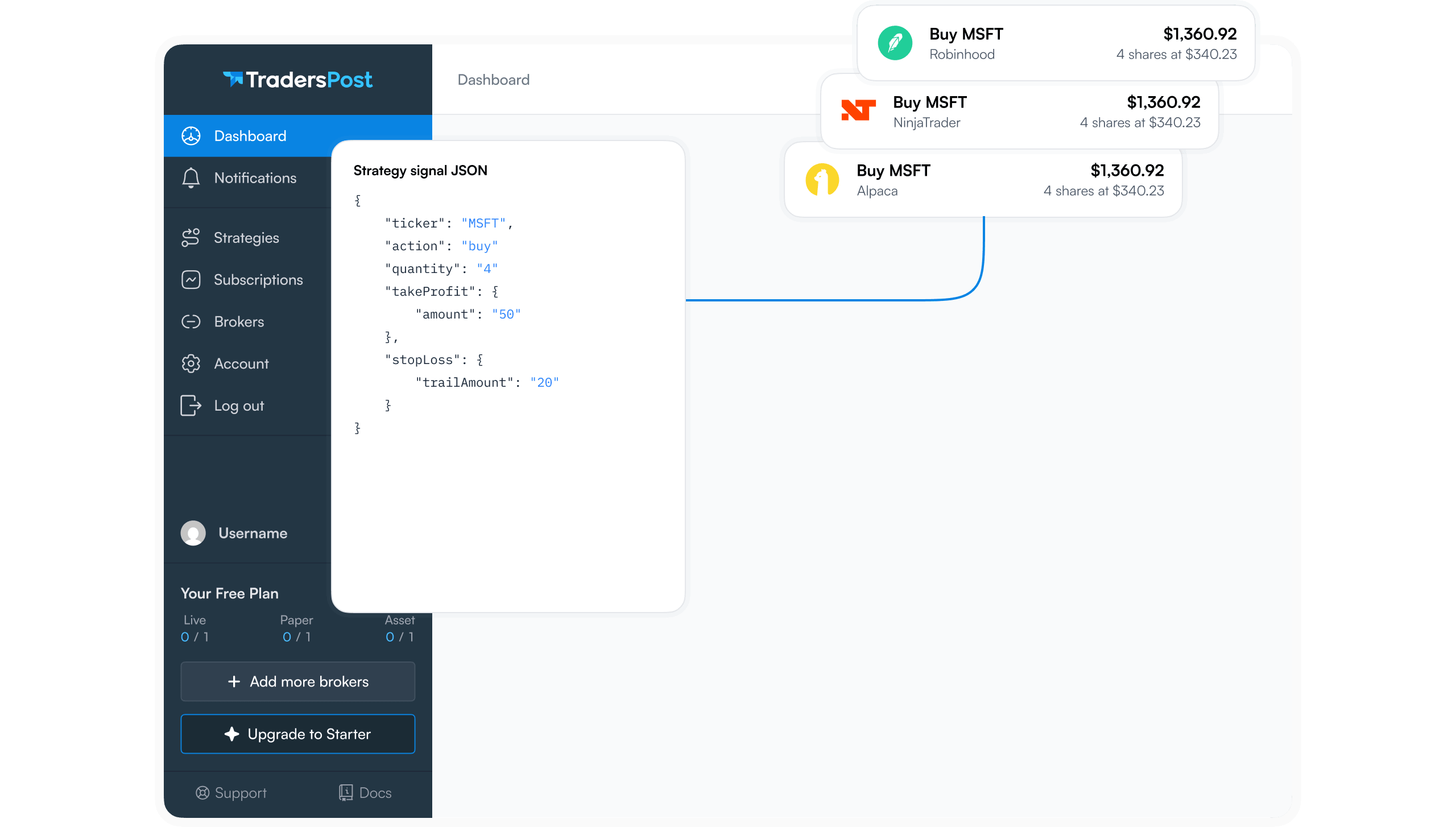
TradersPost connects TradingView alerts to multiple prop firm accounts simultaneously via Tradovate and ProjectX, letting you route separate strategy signals to separate accounts from a single setup without manually switching platforms. That kind of signal-level separation is exactly what compliance with these rules requires in practice.
Copy trading your own accounts
Topstep notes that a trade copier can be used to duplicate trades across multiple accounts and links to its own guide on the subject.4 Alpha Futures permits copy trading from a trader's own external account into their Alpha Futures account, but prohibits copying from another analyst's account.5 Take Profit Trader explicitly allows copy trading across test accounts and up to 5 PRO accounts simultaneously.2 The common thread is ownership: the signal must originate from your own decisions, not from following someone else's positions.
Automation rules across firms
Topstep allows automated trading strategies with conditions: the firm will not help set up or troubleshoot automated strategies, and no exceptions are made for errant trades or malfunctions.4 Tradeify permits algorithmic trading provided the trader owns the strategy exclusively, it is not shared with other traders or firms, it is not high-frequency trading, and the trader can prove ownership if requested.8 Both firms require that automated strategies be tested before going live and that the trader accept full responsibility for any execution errors. These conditions are not advisory; violating them is grounds for account termination.
Before You Open a Second Account
Check if the limit is per person or per household
The distinction between a per-person cap and a per-household cap matters more than most traders realize before they hit it. Funded Futures Family applies its 5-account limit per household across all plans combined, meaning two people at the same address share the pool.3 Alpha Futures applies its 3-Qualified-account limit per household, sourced from clause 8.1.3 of its Terms and Conditions.5 Verify whether the firm you are using defines the cap per individual or per household before opening additional accounts, since the distinction can cut the available limit in half without any advance notice.
Larger account vs. more accounts
Alpha Futures states that if the goal is more size, the cleaner route is choosing a larger account rather than combining smaller ones, because running three accounts does not combine contract limits.5 Per-user payout caps mean that holding more accounts does not increase the maximum a trader can withdraw in total; it only changes the pace at which that ceiling is approached. Monthly subscription fees also compound across accounts. A trader holding three Topstep $150K Trading Combines pays $150 per month per account before passing any of them.4 Running the cost math before opening a second account is not optional if you want the economics to work.
Bottom Line
- Five funded accounts per household is the most common cap, but Alpha Futures caps Qualified Analyst accounts at 3 per household totalling $450,000 in allocation.
- Topstep has no limit on Trading Combines but enforces a strict single-profile rule: multiple profiles are a Terms of Use violation.
- Firms cap three things, not one: account count, total simulated allocation, and lifetime payout per user. Most traders only read the first.
- Hedging across your own accounts is prohibited at both Alpha Futures and Tradeify, with instant termination and profit forfeiture as the stated consequence.
- Each account must run an independent strategy. Multiple accounts do not combine contract limits, and a breach on one does not automatically breach the others.
Frequently Asked Questions
Can I have more than one prop firm account at the same firm?
Yes at most firms, but funded account limits typically range from 3 to 5 per household. Evaluation accounts are often uncapped. Topstep has no cap on Trading Combines but requires all accounts to live under a single profile.4 Alpha Futures allows unlimited evaluations but caps Qualified accounts at 3 per household totalling $450,000.5
Does holding multiple accounts increase how much I can withdraw?
Not always. Funded Futures Family and MyFundedFutures both apply a per-user payout cap of $100,000 regardless of how many funded accounts a trader holds.37 Multiple accounts can allow more frequent payout requests across separate cycles, but the cumulative cap limits the total benefit once that threshold is reached.
Is hedging between two of my own accounts allowed?
No. Alpha Futures explicitly prohibits Reverse Trading, defined as going long on one account and short on another, at both the Evaluation and Qualified stages, with instant termination as the consequence.5 Tradeify's essential trading rules also prohibit hedging across multiple accounts.8 Treat each account as a completely independent strategy with no cross-account positions.
Can I use a copy trader or automated strategy across multiple accounts?
Topstep explicitly permits trade copiers to duplicate trades across multiple accounts.4 Tradeify and Alpha Futures allow automation provided the strategy is exclusively owned by the trader and not shared with others.8 Alpha Futures allows copy trading from your own external account into your Alpha Futures account but prohibits copying another analyst's trades, which results in instant termination.5
What happens if I accidentally create a second profile at the same firm?
At Topstep, multiple profiles are a Terms of Use violation that can result in account closure or suspension. Traders are instructed to contact Trader Support immediately if a second profile was created accidentally.4 Most firms tie all accounts to a single verified identity; a duplicate profile is treated as an attempt to circumvent account caps and carries the same penalties as an intentional violation.
References
1 Tradeify vs Topstep
2 Take Profit Trader - Futures Traders
3 Funded Futures Family - Prime Plan
4 Topstep - Trading Combine Parameters
5 Alpha Futures - Running Multiple Alpha Futures Accounts (2026)
6 Alpha Futures - Zero Plan
7 MyFundedFutures - Payout Policy Overview
8 Tradeify - Essential Trading Rules Overview