10 Pine Script v6 Features for Algorithmic Trading
The 10 most important Pine Script v6 features for algorithmic traders, from dynamic requests and enums to footprint data and runtime logging.

Marketing

Bottom Line
- Dynamic requests enable multi-symbol scanning and sector rotation strategies that were impossible in v5
- Enums and active inputs create professional strategy settings with dropdown menus and conditional visibility
- Runtime logging replaces plot-based debugging for faster strategy development and troubleshooting
- Footprint data provides institutional-grade volume analysis for POC and Value Area strategies
Pine Script v6 is not just a version bump. It is a fundamental expansion of what algorithmic traders can build on TradingView. From multi-symbol scanning inside loops to institutional-grade volume analysis, the features added since the November 2024 launch1 have closed the gap between Pine Script and dedicated algo trading platforms.
This guide ranks the 10 most impactful Pine Script v6 features for algorithmic traders, with practical code examples showing how each one applies to real strategy development. Whether you are building multi-asset rotation systems, volume profile strategies, or just trying to debug your existing code faster, these features will change your workflow.
1. Dynamic Requests for Multi-Symbol Analysis
Dynamic requests are the single most important v6 feature for algo traders. In v5, every request.security() call required a compile-time constant for the symbol and timeframe arguments2. You could not loop through a watchlist or fetch data conditionally. Every symbol needed its own hardcoded line of code.
In v6, request.*() functions accept series string arguments by default2. This means you can call request.security() inside for loops, if blocks, and library functions with dynamically constructed symbol strings3.
//@version=6
indicator("Sector Scanner", overlay = false)
var array<string> symbols = array.from("AAPL", "MSFT", "GOOGL", "AMZN", "NVDA")
float totalRSI = 0.0
for [i, sym] in symbols
    float symClose = request.security(sym, "1D", close)
    totalRSI += ta.rsi(symClose, 14)
plot(totalRSI / symbols.size(), "Avg RSI")
This unlocks multi-symbol dashboards, watchlist scanners, pair trading strategies, and sector rotation systems that iterate through a list of instruments and make decisions based on relative strength or correlation. Scripts are limited to 40 dynamic request calls per execution (64 on Ultimate)3, so plan your loops accordingly.
2. Enums for Type-Safe Strategy Configuration
Algo traders often build strategies with multiple modes, signal types, and filter options. In v5, the standard approach was input.string() with an options array, and a typo in a string comparison would silently break your logic.
V6 enums define a fixed set of named values that the compiler enforces3. Combined with input.enum(), they generate type-safe dropdown menus where invalid values are impossible2.
//@version=6
strategy("Enum Strategy Config")
enum EntryMode
    trend     = "Trend following"
    meanRev   = "Mean reversion"
    breakout  = "Breakout"

EntryMode modeInput = input.enum(EntryMode.trend, "Entry Mode")
float rsiVal = ta.rsi(close, 14)

bool entrySignal = switch modeInput
    EntryMode.trend   => ta.crossover(ta.ema(close, 20), ta.ema(close, 50))
    EntryMode.meanRev => ta.crossover(rsiVal, 30)
    EntryMode.breakout => close > ta.highest(high[1], 20)

if entrySignal
    strategy.entry("Long", strategy.long)
Enums also work as map keys, enabling bounded data structures where each enum member maps to a specific value. This is ideal for tracking per-mode statistics, per-symbol allocations, or signal state counters.
3. Runtime Logging for Fast Debugging
Debugging is where algo traders spend a significant portion of their development time. Before v6, inspecting a variable at runtime meant plotting it on the chart, creating labels, or building debug tables. These hacks cluttered the chart and were slow to iterate on.
V6 adds log.info(), log.warning(), and log.error() functions that send messages to a dedicated Pine Logs pane3. Messages support string formatting and include timestamps4.
//@version=6
strategy("Logging Demo", overlay = true)
float atr = ta.atr(14)
float posSize = strategy.equity / (atr * 2)

if ta.crossover(ta.ema(close, 10), ta.ema(close, 30))
    log.info("Entry signal: price={0}, ATR={1}, posSize={2}",
         str.tostring(close), str.tostring(atr, "#.##"), str.tostring(posSize, "#.##"))
    strategy.entry("Long", strategy.long, qty = posSize)
You can filter logs by severity, trace exactly which bars triggered entries, and verify that your position sizing calculations are correct without adding a single visual element to your chart. This alone can cut strategy development time significantly.
4. Footprint Data for Volume Analysis
The request.footprint() function, added in January 20261, brings institutional-grade volume profile data directly into Pine Script. It returns a footprint object containing the full volume distribution across price levels for each bar3.
//@version=6
indicator("POC Strategy", overlay = true)
footprint fp = request.footprint(100, 70)
if not na(fp)
    float pocPrice = fp.poc().up_price()
    plot(pocPrice, "POC", color.orange, 2)
    // Signal when price reclaims POC from below
    if close > pocPrice and close[1] <= pocPrice[1]
        label.new(bar_index, low, "POC Reclaim", style = label.style_label_up, color = color.green)
You can access the Point of Control, Value Area High and Low, per-row buy and sell volume, volume delta, and imbalance detection3. This enables POC bounce strategies, Value Area mean reversion, delta divergence signals, and stacked imbalance detection. These were previously only available through external tools or crude request.security_lower_tf() approximations. Requires a TradingView Premium or Ultimate plan3.
5. Active Inputs for Professional UI
Algo strategies with many parameters can overwhelm users with irrelevant settings. The active parameter, added to all input*() functions in July 20251, lets you conditionally disable inputs based on other settings3.
//@version=6
strategy("Active Input Demo", overlay = true)
bool useTakeProfit = input.bool(true, "Enable Take Profit")
float tpPercent = input.float(2.0, "Take Profit %", active = useTakeProfit)
bool useTrailingStop = input.bool(false, "Enable Trailing Stop")
float trailPercent = input.float(1.0, "Trail %", active = useTrailingStop)

if ta.crossover(ta.sma(close, 20), ta.sma(close, 50))
    strategy.entry("Long", strategy.long)
    if useTakeProfit
        strategy.exit("TP", "Long", limit = close * (1 + tpPercent / 100))
When "Enable Take Profit" is unchecked, the "Take Profit %" input appears grayed out and cannot be modified. This creates the kind of professional, context-aware settings panels that users expect from polished indicators. For algo traders building strategies for distribution or client use, this is essential.
6. Stricter Boolean Logic for Fewer Bugs
Pine Script v6 removes two sources of subtle bugs that have bitten algo traders for years. First, booleans can no longer be na2. They are strictly true or false, eliminating the three-state ambiguity that caused unexpected behavior in complex conditional chains.
Second, implicit casting from int and float to bool is removed2. Code like if volume must become if volume > 0. This forces explicitness that prevents an entire class of logic errors where zero values were silently treated as false.
//@version=6
strategy("Strict Bool Demo", overlay = true)
// v5: if bar_index worked (implicit cast). v6: explicit comparison required.
if bar_index > 0
    float rsi = ta.rsi(close, 14)
    // v5: bool could be na. v6: always true or false.
    bool isOverbought = rsi > 70
    // No risk of isOverbought being na in conditional chains
    if isOverbought and volume > ta.sma(volume, 20)
        strategy.close("Long")
For algo traders running strategies with real money, stricter type safety means fewer silent bugs that only manifest in specific market conditions.
7. Dynamic For Loops for Adaptive Indicators
The March 2025 update1 changed how for loops evaluate their boundary. In v5, the to_num value was captured once before the first iteration and never rechecked. In v6, it is evaluated before every iteration, so modifying the boundary inside the loop changes the iteration count4.
//@version=6
indicator("Adaptive Support Scan", overlay = true)
int maxLookback = 100
float level = close
int barsBack = 0
for i = 1 to maxLookback
    if low[i] < level
        level := low[i]
        barsBack := i
    if i - barsBack > 20
        maxLookback := i  // Stop searching once 20 bars pass without new low
        break
plot(level, "Support", color.green)
This enables self-adjusting lookback periods, variable-length pattern scanning, and algorithms where the search space contracts or expands based on what the loop discovers. For adaptive indicators that respond to market conditions, this is a significant improvement over the fixed-boundary loops of v5.
8. Bid/Ask Data for Spread Analysis
The February 2025 update1 introduced bid and ask built-in variables that provide real-time best bid and ask prices on the 1T (one tick) timeframe3. These return na on all other timeframes.
//@version=6
indicator("Spread Monitor", overlay = false)
float spread = ask - bid
float spreadBps = (spread / bid) * 10000
plot(spreadBps, "Spread (bps)", color.orange)
hline(5, "Normal Spread", color.gray, hline.style_dashed)
bgcolor(spreadBps > 10 ? color.new(color.red, 90) : na)
For algo traders, bid-ask spread is a critical component of transaction cost analysis. Wide spreads eat into strategy returns, and spread expansion often signals increased volatility or reduced liquidity. You can now build spread monitors, liquidity alerts, and execution quality trackers directly in Pine Script. While limited to tick charts, this data was completely unavailable in the language before.
9. Plot Linestyles for Clear Visualization
The September 2025 update1 added a linestyle parameter to plot() with three options: plot.linestyle_solid, plot.linestyle_dashed, and plot.linestyle_dotted3.
//@version=6
indicator("Multi-MA Strategy", overlay = true)
plot(ta.ema(close, 10), "Fast EMA", color.blue, linestyle = plot.linestyle_solid)
plot(ta.ema(close, 30), "Slow EMA", color.red, linestyle = plot.linestyle_dashed)
plot(ta.sma(close, 200), "Trend Filter", color.gray, linestyle = plot.linestyle_dotted)
This seems simple, but for algo traders who overlay multiple indicators on the same chart, distinguishing between signal lines, filters, and reference levels by line style rather than only by color makes charts significantly more readable. Dashed lines for thresholds and dotted lines for long-term filters are now native options instead of requiring drawing objects.
10. Unlimited Scopes for Complex Strategies
Pine Script v5 enforced a hard limit of 550 local scopes per script2. Every if block, for loop, while loop, switch statement, and function call created a scope. Complex strategies with elaborate risk management, multiple entry conditions, and nested conditional logic would hit this ceiling and fail to compile.
The February 2025 update removed this limit entirely1. Scripts can now contain as many scopes as needed.
//@version=6
strategy("Complex Multi-Condition Strategy", overlay = true)
// In v5, complex strategies with many conditions would hit the 550-scope limit.
// In v6, there is no limit.
for i = 0 to 10
    for j = 0 to 10
        if ta.crossover(ta.ema(close, i * 5 + 10), ta.ema(close, j * 5 + 10))
            if volume > ta.sma(volume, 20)
                if ta.rsi(close, 14) > 50
                    // Each nested block is a scope. No 550 limit in v6.
                    log.info("Signal at EMA({0}) x EMA({1})", str.tostring(i * 5 + 10), str.tostring(j * 5 + 10))
This unblocks multi-asset scanners, parameter optimization grids, ensemble strategies that evaluate dozens of sub-models, and any strategy architecture that requires deep nesting or many conditional branches. Combined with dynamic for loops, unlimited scopes mean Pine Script can now handle genuinely complex algorithmic logic.
Automating Your v6 Strategies
Each of these features makes Pine Script more capable as an algorithmic trading platform. Dynamic requests enable portfolio-level strategies. Footprint data provides institutional-grade signals. Runtime logging accelerates development. And unlimited scopes remove the ceiling on strategy complexity.
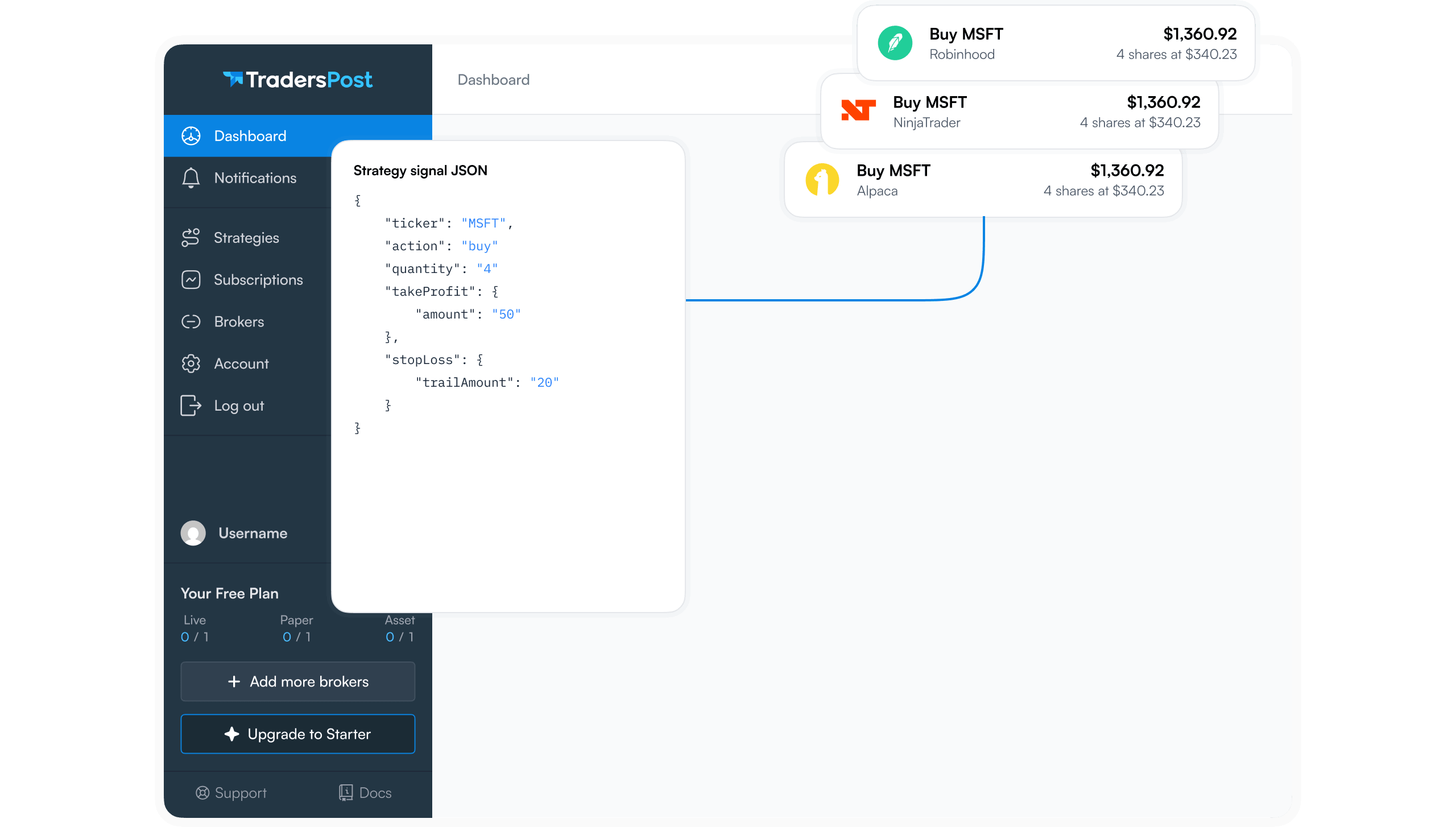
Once your v6 strategy generates reliable signals, the next step is automated execution. TradersPost connects your TradingView strategy alerts directly to supported brokers, routing orders automatically based on your Pine Script signals5. It works with both v5 and v6 strategies, supports stocks, options, futures, and crypto, and handles the broker API integration so you can focus on strategy development.
The webhook payload format is the same regardless of Pine Script version. Set up an alert on your v6 strategy, point the webhook to TradersPost, and your multi-symbol scanner or footprint-based strategy goes from backtest to live execution without writing a single line of broker API code.
For more on Pine Script v6, explore our related guides:
- Pine Script v6: What's New and Why It Matters
- Pine Script v6 Breaking Changes
- Pine Script Strategy Automation Guide
- Pine Script Updates 2025-2026
References
1 Pine Script Release Notes
2 Pine Script v5 to v6 Migration Guide
3 Pine Script v6 Language Reference
4 Pine Script User Manual
5 TradersPost - Automated Trading Platform