Setting Up Vwap Strategies With Dynamic Exits

Marketing

YouTube Link: https://www.youtube.com/watch?v=QbenZJ_XnXc
Published: November 9, 2024
Duration: 42:51
---
VWAP-based trading strategies offer powerful tools for intraday traders seeking to identify high-probability trade setups. When combined with dynamic stop loss and take profit levels based on previous candle values, these strategies become even more effective. This guide walks through building a complete VWAP strategy with bracket orders that automatically manage risk.
Understanding VWAP as a Trading Tool
Volume Weighted Average Price (VWAP) calculates the average price weighted by volume throughout the trading session. Unlike simple moving averages that treat all price points equally, VWAP gives greater weight to price levels where significant volume occurred. This makes VWAP particularly relevant for understanding where institutional participants have established positions.
The indicator resets at the start of each trading session, creating fresh reference points daily. During the first minutes after market open, VWAP provides limited information since insufficient data has accumulated. As the session progresses, VWAP becomes increasingly reliable for identifying support and resistance zones where large traders have shown interest.
Standard deviation bands around VWAP quantify normal price variance from the average. Price reaching the upper band suggests extension away from fair value, potentially signaling exhaustion of the current move. Conversely, price touching the lower band indicates oversold conditions that might precede reversals toward VWAP.
Designing Entry Logic Around VWAP
Effective VWAP strategies align entries with clear market structure. One approach enters trades when price crosses VWAP after establishing a trend. If price consistently remains above VWAP and begins pulling back toward it, a long entry triggers when price closes back above VWAP, confirming support.
Session timing significantly impacts VWAP strategy performance. The first 15 minutes after open often produce whipsaw behavior as the market establishes direction. Strategies that wait until 15-20 minutes after open before taking positions avoid much of this noise while still capturing meaningful moves.
Previous VWAP levels provide additional context for trade decisions. Comparing current price to yesterday's VWAP reveals whether today's action shows strength or weakness relative to recent history. Price holding above prior session VWAP suggests bullish continuation, while failure to reclaim prior VWAP indicates potential weakness.
Calculating Dynamic Stop Loss Levels
Stop loss placement based on recent price action adapts to current market volatility. Rather than fixed percentage stops, dynamic stops reference specific candle levels that represent meaningful technical boundaries. The low of the signal candle often serves as a natural stop level for long positions.
Risk percentage determines position sizing relative to account equity. Professional traders typically risk between 0.5% and 2% of account value per trade. This risk tolerance, combined with the distance from entry to stop, calculates the appropriate position size that aligns with risk management rules.
ATR-based stops provide an alternative approach that adjusts to volatility. Average True Range measures recent price movement magnitude, allowing stops to widen during volatile periods and tighten when price action compresses. Multiplying ATR by a factor between 1.5 and 3 generates stops that accommodate normal price fluctuation.
Setting Take Profit Targets with Risk-Reward Ratios
Risk-reward ratios formalize the relationship between potential loss and potential gain. A 2:1 risk-reward ratio means the take profit target sits twice as far from entry as the stop loss. This mathematical framework ensures that winning trades outweigh losers even with modest win rates.
Previous candle highs and lows often serve as logical profit targets. If entering long at VWAP with stops below the recent swing low, targeting the recent swing high creates a trade bounded by meaningful technical levels. These reference points represent areas where price previously encountered buying or selling pressure.
Multiple profit targets enable partial position management. Taking partial profits at a 1:1 risk-reward ratio locks in gains while leaving remaining position for larger moves. This approach reduces stress by banking profits early while maintaining upside exposure if the trade extends further.
Implementing Bracket Orders in PineScript
Bracket orders submit entry, stop loss, and take profit orders simultaneously. This automation removes emotional decision-making during trade execution and ensures protective stops exist from the moment positions open. The strategy.entry function in PineScript accepts stop and limit parameters that define these levels.
Variable assignment for stop and profit levels enables dynamic calculation on each bar. Declaring variables like stopPrice and takeProfitPrice that update based on current candle data ensures the strategy adapts to changing market conditions. These variables feed into the strategy.exit function that manages position closes.
The strategy.exit function requires careful parameter specification. The stop parameter takes the stop loss price level, while limit accepts the take profit price. Naming the exit order and specifying which entry it applies to ensures proper order matching when managing multiple positions or strategies.
Structuring JSON Payloads for Broker Integration
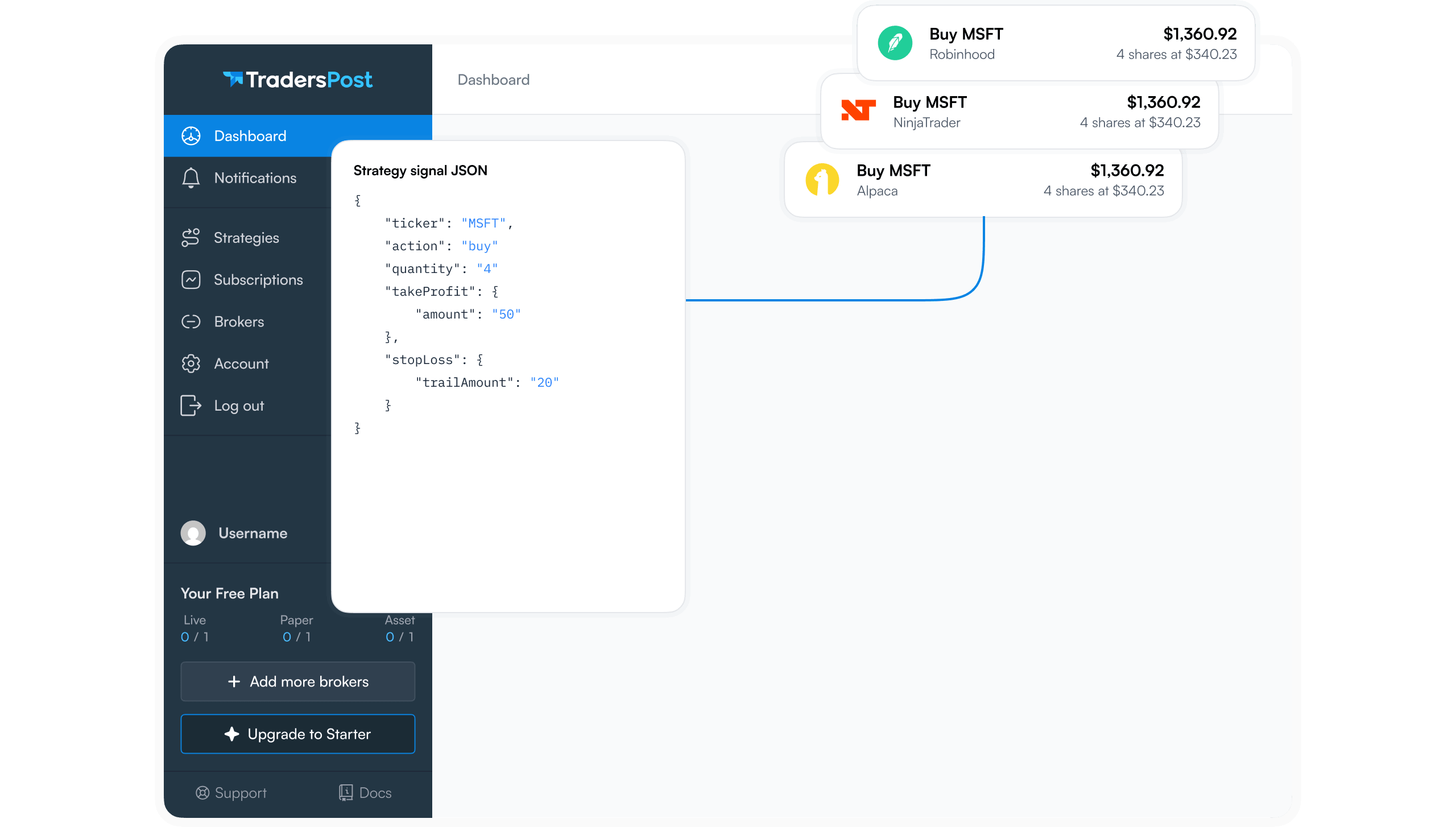
Automated execution requires properly formatted alert messages that broker APIs understand. JSON structure organizes trade data into key-value pairs that specify ticker symbols, action types, quantities, and prices. Each field must use exact naming conventions expected by your automation platform.
The ticker field identifies which instrument to trade using the standard symbol format. Action specifies whether to buy, sell, or exit the position. Quantity indicates how many shares or contracts to trade. Stop and limit price fields define bracket order levels that accompany the entry order.
Dynamic variables populate JSON fields with current trade parameters. Rather than hardcoding specific values, placeholder variables like {{strategy.order.contracts}} inject real-time data into alert messages. This flexibility allows a single alert template to handle varying position sizes and price levels across different market conditions.
Managing Alert Configuration in TradingView
Alert creation connects strategy signals to external automation platforms. The alert condition dropdown selects which strategy events trigger alerts—entry signals, exits, or both. Choosing "strategy" as the condition type creates comprehensive alerts that fire on all strategy order events.
The message field contains the JSON payload that transmits to your webhook endpoint. Carefully formatting this message determines whether orders execute correctly. Extra spaces, missing quotation marks, or incorrect brackets will cause parsing errors that prevent order execution.
Webhook URL configuration directs alerts to the proper destination. This URL, provided by your automation platform, acts as the receiving endpoint for strategy signals. Enabling the webhook notification option ensures TradingView sends the formatted message when strategy conditions trigger.
Testing Bracket Orders in Paper Trading
Paper trading validates strategy behavior without capital at risk. Running strategies on simulated accounts reveals execution issues, timing problems, and logic errors that backtesting often misses. This testing phase should continue until the strategy performs consistently over multiple trading sessions.
Signal verification ensures alerts fire at expected times with correct information. Monitoring both TradingView alerts and platform receipts confirms the complete signal chain functions properly. Mismatches between expected and actual behavior indicate configuration issues requiring correction before live deployment.
Position sizing verification confirms bracket orders use appropriate quantities. Even with correct risk calculations in the strategy, errors in JSON formatting or quantity field specifications can result in oversized or undersized positions. Paper trading exposes these discrepancies before they affect real capital.
Optimizing VWAP Strategy Parameters
Input grouping organizes strategy settings for easy modification. Separating VWAP settings from entry rules and risk management creates logical categories that simplify strategy configuration. This organization becomes particularly valuable when managing multiple strategy variations with different parameter sets.
Standard deviation multipliers adjust the width of VWAP bands based on market characteristics. Higher multipliers like 2.5 or 3 create wider bands suitable for volatile instruments, while lower values like 1.5 or 2 work better for less volatile assets. Testing different multipliers reveals optimal settings for specific markets and timeframes.
Time filters prevent trading during unfavorable market periods. Excluding the first and last 30 minutes of the session avoids erratic opening volatility and illiquid closing periods. These filters can significantly improve strategy performance by concentrating trades during periods of clearer price action.
Common Implementation Mistakes
Hardcoded price levels that don't update dynamically cause strategies to fail as market conditions change. Stop losses and take profit targets must recalculate based on current price data rather than fixed values. Dynamic calculation ensures the strategy adapts to different price ranges and volatility regimes.
Missing error handling for missing data creates vulnerabilities. Network interruptions, data provider issues, or exchange connectivity problems can prevent proper indicator calculation. Strategies should detect these conditions and avoid placing trades when essential data is unavailable.
Over-reliance on backtest results without forward testing leads to disappointment in live trading. Historical optimization often produces unrealistic performance that doesn't translate to real-time execution. Multiple months of paper trading with current market data provides better performance expectations than idealized backtest results.
Real-World Application Considerations
Slippage and commissions significantly impact VWAP strategy profitability. These short-term approaches typically generate multiple trades per day, accumulating costs quickly. Backtest settings should include realistic commission rates and slippage assumptions that reflect actual trading expenses.
Market conditions affect VWAP strategy effectiveness. Strong trending markets favor VWAP strategies that trade pullbacks to the average. Range-bound markets may produce better results with mean reversion approaches that fade extensions away from VWAP. Recognizing current market regime helps determine when to trade actively versus stay flat.
Position management beyond simple bracket orders can enhance returns. Trailing stops that move with price protect profits as favorable moves develop. Scaling into positions at multiple VWAP touches builds size at better average prices. These advanced techniques require additional logic but can improve risk-adjusted returns.
Conclusion
VWAP strategies with dynamic bracket orders provide a structured approach to intraday trading. By calculating stop loss and take profit levels based on recent price action and risk parameters, these strategies adapt to changing market conditions while maintaining consistent risk management. Proper implementation requires careful attention to PineScript syntax, JSON formatting, and thorough testing before live deployment.
Success with VWAP automation demands patience during development and testing phases. Rushing to live trading before validating strategy behavior often results in avoidable losses. Traders who invest time in proper setup, comprehensive testing, and gradual scaling into live positions position themselves for sustainable automated trading results.