TradingView Remix vs Pine Script: When to Use Each
Remix writes Pine Script for you. Learn when to describe your strategy in English, when to code it yourself, and how to validate what Remix produces.

Marketing

TradingView Remix and Pine Script are not competing tools. When you ask Remix to build an indicator or strategy, it writes Pine Script v6, opens the Pine Editor, and applies the result to your chart.1 The tradingview remix vs pine script question is really a workflow question: do you describe your rules in plain English, or do you type the code yourself?
The answer changes depending on how precise your logic needs to be. For boilerplate and first drafts, Remix saves time. For bar timing, repainting behavior, and order handling that directly affects P&L, handwritten Pine gives you control that a generation step cannot guarantee. This article walks through when each approach makes sense and how to check the output before wiring anything to a live alert.
One more constraint worth knowing upfront: Pine Script authoring is blocked entirely on the free TradingView tier, so for free-plan users the comparison is settled before it starts.2
What Remix Actually Is
Not a Competitor to Pine Script
Remix is a Chrome browser extension that lives in a side panel alongside your TradingView chart.3 It is not a scripting language and not a replacement for the Pine Editor. When you prompt it to build an indicator, it generates Pine Script v6, asks for confirmation via a dialog, and then applies the code to your chart.4 The output is Pine Script. The real choice is whether you type that Pine Script yourself or let Remix generate it from a natural-language description.
How Remix Reads Your Chart
The extension reads your chart's current state in real time: active symbol, timeframe, applied indicators, visible price range.5 From there it can switch symbols, add or remove indicators, draw support and resistance zones, set alerts, generate Pine Script, and call external MCP servers. It works in any Chromium-based browser (Chrome, Edge, Brave, Opera, Vivaldi) but not in Firefox or Safari.6
What Changes and What Does Not
Pine Script Is Still the Output
Whether you prompt Remix or type code manually, what lands in the Pine Editor is Pine Script v6. Backtesting, alert conditions, and indicator logic all behave identically because it is the same language either way. Remix asks for confirmation before writing to the Pine Editor, and the Confirm Destructive Actions toggle in Preferences is on by default to prevent accidental overwrites.7
The Plan Gate That Settles It on Free Accounts
Pine Script authoring is strictly blocked on the free TradingView tier. Essential or higher is required to use Remix's code-generation feature.8 Free-plan users can still ask Remix to read and explain existing Pine scripts, look up documentation, and analyze backtest reports, but cannot generate or modify code.9 On a free plan, the Remix-versus-Pine-Script question is answered for you: write the code yourself or upgrade.
Weekly usage scales with your TradingView plan tier: Free 0.25x, Essential 1x, Plus 2x, Premium 5x.10 Upgrading to Essential unlocks Pine coding and raises your usage allowance at the same time.
When to Let Remix Write It
First Drafts and Boilerplate
Remix is well-suited for generating straightforward indicators: EMA crossovers, basic oscillators, anything where exact bar timing is not the deciding factor. Describing a strategy in English first forces you to state your rules explicitly, which often surfaces ambiguity before a line of code is written. Use Remix for boilerplate, including input declarations, security calls, and plot statements, that is tedious to type but easy to verify once generated.
Syntax You Have Forgotten or Someone Else's Script
Remix can read an existing script and explain what each block does, making it useful for auditing inherited or community-published code. Asking it to add built-in alertcondition() hooks to a working indicator is a low-risk task where the AI output is easy to spot-check. One independent review noted that quality is reasonable for straightforward indicators but that edge cases appear with more complex strategies, which means complexity shifts the balance toward writing the code yourself.11
When to Write Pine Yourself
Bar Timing and Repainting
When exact bar timing determines whether a strategy makes or loses money, handwritten code gives you explicit control over barstate.isconfirmed, calc_on_every_tick, and lookahead parameters that Remix may not handle precisely. Repainting is a class of bug where a signal appears on the chart but does not appear in TradingView's Alerts log. The Alerts log is the authoritative record of what alerts actually fired. If your Pine Script suffers from repainting, no automation layer downstream can compensate.12
Verifying that a signal shows in the Alerts log rather than only on the chart or in the Strategy Tester is the first diagnostic step when a trade does not execute as expected. The Strategy Tester list of trades reflects backtesting logic only and has no record of which alerts actually triggered.13
Order Handling That Decides P&L
strategy.entry, strategy.exit, and strategy.close interact with Pine's built-in broker emulator in ways that require deliberate parameter choices: pyramiding, default_qty_type, process_orders_on_close. When the difference between a market order and a limit order on the signal bar changes your backtest results materially, that logic should be coded and reviewed explicitly rather than generated. Remix-generated strategies should always be tested in paper trading before being wired to live alerts, because the generation step does not validate for look-ahead bias or future-data leaks.
How to Check What Remix Gives You
Read Before You Apply
Remix asks for confirmation before writing to the Pine Editor. Use that dialog pause to read the generated code in the preview rather than clicking through. Two things to check immediately:
- Any
security()calls withlookahead=barmerge.lookahead_on, which is the most common source of look-ahead bias in AI-generated Pine Script. - Whether
alertcondition()calls reference confirmed bars (barstate.isconfirmed) if your strategy depends on alerts firing only on bar close.
Paper Trade Before Going Live
Apply the Remix-generated script to your chart, add it to a paper-trading alert, and compare the Alerts log timestamps against the chart signals for at least a week of live bars. If alert log entries do not correspond to chart signals in timing and direction, the issue is in the Pine Script logic and must be fixed before connecting any execution layer. The Strategy Tester list of trades does not log which alerts actually fired; the Alerts log is the correct place to verify real-time behavior.14
A Worked Example
Remix Draft: EMA Crossover Alert
Prompting Remix with "Write a Pine Script v6 indicator that fires an alert when the 9 EMA crosses above the 21 EMA on bar close" produces working code for a well-defined, low-complexity rule. The generated script will include plot statements and alertcondition() hooks. Verify that the crossover condition uses ta.crossover and references close rather than a lookahead-enabled series. This type of prompt, with specific inputs, named outputs, and an explicit bar reference, produces more reliable code than open-ended requests.
Where You Take Over from Remix
If your strategy needs to enter only on the first cross after a higher-timeframe condition is met, that multi-timeframe logic requires careful use of request.security() and explicit lookahead settings that Remix may not resolve correctly. Any parameter that directly controls position sizing, stop placement, or order type in a live strategy should be reviewed and set manually. After editing Remix output, re-run the backtest and re-check the Alerts log in a paper session before promoting to live.
The Workflow Most Traders Land On
Remix for the First Pass, Pine for the Final 20%
Most active traders use Remix to generate a working starting point and then edit the Pine Editor directly for the logic that determines entries, exits, and alert conditions. Session context reuse means follow-up prompts within the same Remix session are cheaper in terms of weekly usage, so iterating on a draft in chat before moving to manual editing is efficient.15
Prompts That Produce Better Code
Structured prompts consistently outperform open-ended ones. Specify the indicator type, the exact crossover or threshold condition, the bar reference (close vs. high/low), and whether you want alertcondition() included. Avoid asking Remix to "build a profitable strategy." This pushes the AI toward prediction framing and produces less precise logic than describing exact entry and exit rules.16 Keep the Confirm Destructive Actions toggle on while iterating to prevent silent overwrites of your Pine Editor.17
Neither One Executes Trades
Remix Stops at Alert Creation
Remix can create price alerts with complex conditions and manage them in bulk through TradingView's native alert system, but it does not route orders to a broker or execute live trades.18 Paper trading through Remix uses real market data but does not connect to a brokerage account; positions and P&L are tracked within the extension only.19 The path from a TradingView alert to a live broker order requires a separate execution layer outside of both Remix and Pine Script.
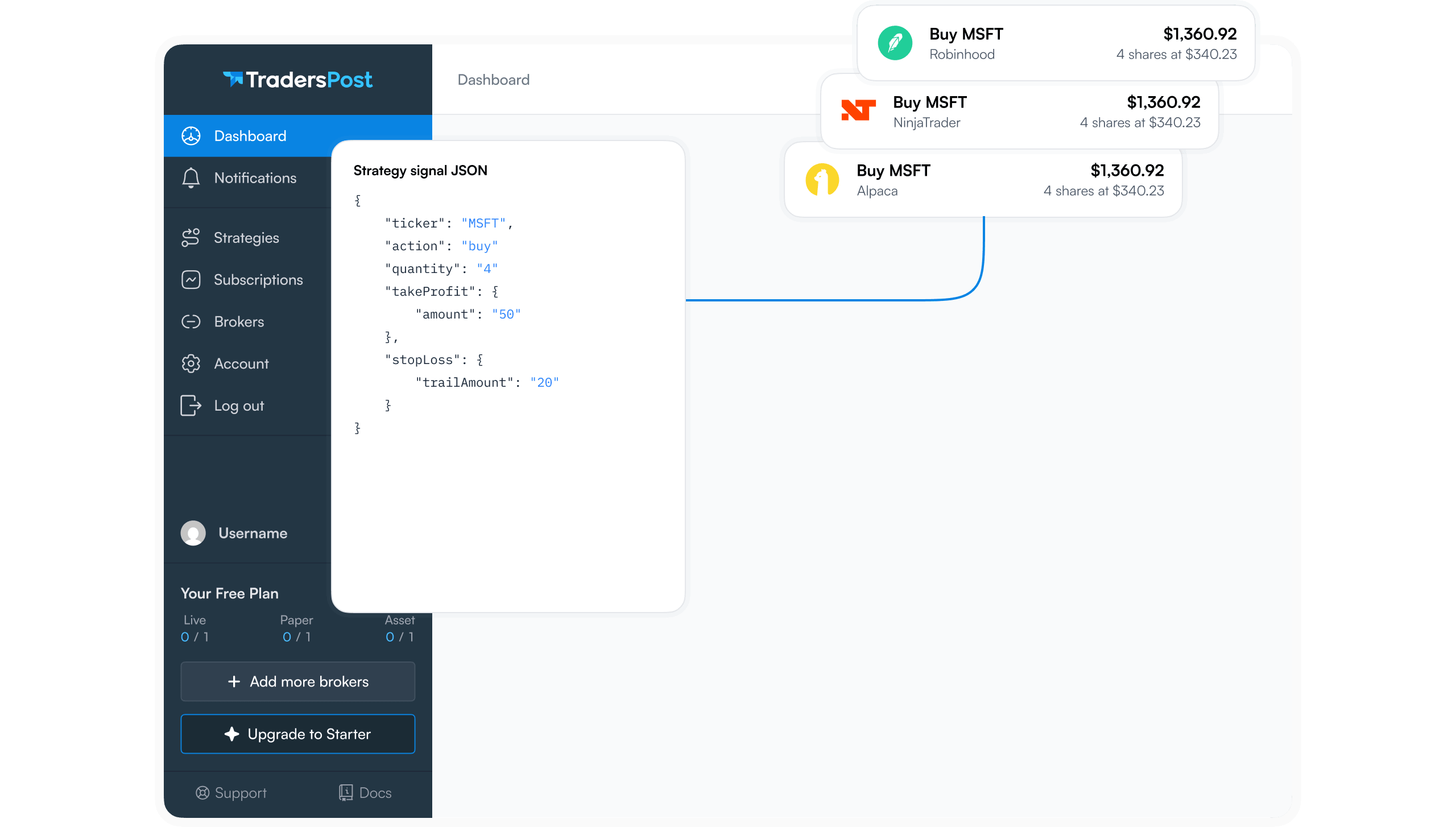
TradersPost connects TradingView alerts to brokers via webhooks. Once your Pine Script strategy fires an alert with a JSON payload, TradersPost routes that signal to your broker as a market, limit, stop, or stop-limit order, handling position sizing and risk controls defined in your strategy subscription settings.
The Alert Is the Handoff Point
Pine Script's alertcondition() function defines when an alert fires. The webhook URL and JSON payload in the alert message define where the signal goes and what it instructs the downstream system to do. The TradingView Alerts log is the authoritative record of what signals actually fired in real time, not the Strategy Tester list of trades, which reflects backtested logic only.20 Verifying that alert log entries match chart signals in timing and direction is the correct first step when a trade does not execute as expected downstream.
Conclusion
The Remix versus Pine Script framing is a false choice. Remix writes Pine Script and applies it to your editor; the language is the same either way. Where the decision actually lives is in how much precision your strategy demands at the point of code generation.
- Remix is not a Pine Script alternative: it outputs Pine Script v6 and applies it to your chart.
- Free TradingView accounts cannot use Remix's Pine authoring feature at all; Essential or higher is required.
- Use Remix for first drafts, boilerplate, and explaining unfamiliar code. Write Pine yourself when bar timing, repainting, or order parameters control your P&L.
- The TradingView Alerts log is the authoritative record of what fired in real time. The Strategy Tester is not.
- Neither Remix nor Pine Script executes trades. A separate execution layer is required to route alerts to a broker.
Frequently Asked Questions
Does Remix replace Pine Script?
No. Remix writes Pine Script v6 and applies it to your Pine Editor. The output is still Pine Script, not a separate language. The choice is whether you describe your rules in English or type the code directly; either way, what runs on your chart is Pine Script.21
Can free TradingView users use Remix to generate Pine Script?
No. Pine Script authoring is blocked on the free tier; Essential or higher is required. Free users can ask Remix to read and explain existing Pine scripts and analyze backtest reports, but cannot generate or modify code. Upgrading to Essential unlocks Pine coding and increases your weekly Remix usage limit at the same time.22
How do I know if Remix-generated Pine Script is safe to use?
Read the generated code before confirming. Check for security() calls with lookahead_on and verify that alert conditions reference confirmed bars. Run the script in paper trading and compare the TradingView Alerts log against chart signals for timing and direction before connecting any live execution. The Strategy Tester list of trades does not log which alerts actually fired; the Alerts log is the correct place to validate real-time behavior.23
Which browsers support TradingView Remix?
Remix works in any Chromium-based browser: Chrome, Edge, Brave, Opera, and Vivaldi. Firefox and Safari are not supported. Native TradingView integration across all browsers is planned after the public beta concludes.24
Can Remix or Pine Script execute live trades automatically?
Neither Remix nor Pine Script sends orders to a broker. Remix can paper trade using real market data within the extension, but that does not connect to a brokerage account.25 Live execution requires a separate layer: TradingView fires an alert with a webhook payload, and a platform like TradersPost routes that signal to a connected broker.
References
1 rollbrains - TradingView Remix Complete Guide (2026)
2 tvremix.xyz - TradingView Remix Official Site
3 Chrome Web Store - TradingView Remix: AI Chart Copilot
4 rollbrains - TradingView Remix Complete Guide (2026)
5 rollbrains - TradingView Remix Complete Guide (2026)
6 tvremix.xyz - TradingView Remix Official Site
7 rollbrains - TradingView Remix Complete Guide (2026)
8 rollbrains - TradingView Remix Complete Guide (2026)
9 tvremix.xyz - TradingView Remix Official Site
10 Chrome Web Store - TradingView Remix: AI Chart Copilot
11 rollbrains - TradingView Remix Complete Guide (2026)
12 rollbrains - TradingView Remix Complete Guide (2026)
13 rollbrains - TradingView Remix Complete Guide (2026)
14 rollbrains - TradingView Remix Complete Guide (2026)
15 rollbrains - TradingView Remix Complete Guide (2026)
16 rollbrains - TradingView Remix Complete Guide (2026)
17 rollbrains - TradingView Remix Complete Guide (2026)
18 tvremix.xyz - TradingView Remix Official Site
19 tvremix.xyz - TradingView Remix Official Site
20 rollbrains - TradingView Remix Complete Guide (2026)
21 rollbrains - TradingView Remix Complete Guide (2026)
22 tvremix.xyz - TradingView Remix Official Site
23 rollbrains - TradingView Remix Complete Guide (2026)
24 tvremix.xyz - TradingView Remix Official Site
25 rollbrains - TradingView Remix Complete Guide (2026)