Stop-Loss Hunting: Can Algorithms Detect It?
Stop clusters are real and measurable. Personal targeting mostly is not. Here is what the microstructure evidence supports and what to do about it.

Marketing

Stop loss hunting detection is one of the most searched topics in retail trading forums, and the frustration behind it is genuine. Price hits your stop, reverses immediately, and the move looks too clean to be coincidence. The question is whether that pattern reflects something measurable and actionable, or whether it reflects the normal mechanics of how liquidity works at levels every participant can see simultaneously.
The short answer is that stop clusters are real, their effect on price is real, and broker execution misconduct is real and has been prosecuted. What is not supported by evidence is the idea that your specific account was targeted, or that any analysis of your own trade history can confirm it. Those are distinct claims, and conflating them leads to bad remedies.
This article works through what the microstructure evidence actually supports, where documented broker misconduct shows up and how it differs from the conspiracy narrative, why detection at the retail level is statistically intractable, and what practical adjustments to placement and sizing actually improve outcomes.
What Traders Mean by Stop Hunting
The Core Claim
The typical narrative runs like this: a broker or large market participant deliberately drives price through an obvious stop level, triggers the resting orders there, and then reverses once the stops are cleared. This story has two meaningfully different versions that require different analysis and different remedies.
The first version is broker-side misconduct: the dealer takes the other side of your trade and has a direct financial incentive to push price through your stop. The second version is market-side behavior: large participants trade toward visible liquidity pools because doing so fills their own large orders at better prices, with your stop being collateral rather than the target. Conflating these two produces confused conclusions. The first is a regulatory matter. The second is a structural feature of how markets function.
Why the Story Persists
Round numbers and swing highs or lows are visible to every participant simultaneously, which means stop placement genuinely clusters there. When price spikes through one of those levels and reverses, confirmation bias makes the move feel intentional even when it is mechanically consistent with a dense cluster of resting orders triggering at once.
The experience also feels personal because you know exactly where your own stop was. The population of thousands of other traders who placed their stops at the same level is invisible to you, which makes the hit feel like it was aimed at you specifically rather than at a predictable liquidity concentration.
Stop Clusters Are Real and Measurable
Where Stops Actually Concentrate
Stops concentrate at round numbers, prior session highs and lows, and obvious swing points because those are the default anchors taught across every technical analysis course and textbook. This is not a conspiracy: when thousands of traders learn the same setups, they place stops at the same locations. The result is predictable liquidity pools at levels any participant with a chart can identify.
Order book data and options market open interest at round strikes confirm the clustering effect independently of any individual trader's experience. The concentration is a structural feature of markets populated by participants using similar analytical frameworks, not evidence of coordination against any particular trader.
Price Behavior at Cluster Levels
Price moves faster once it reaches a stop cluster because stop orders convert to market orders simultaneously, accelerating the move through that level. A dense cluster of triggered stops creates a burst of market-order flow in one direction, which exhausts available liquidity at nearby prices and produces a sharp, fast move.
The acceleration itself is not evidence of targeting. It is the mechanical consequence of many resting orders triggering at once. Distinguishing between "price moved fast because stops were there" and "price was sent there to collect stops" requires a counterfactual that individual trade data cannot provide. Both scenarios produce the same observable price pattern.
Where Broker Misconduct Actually Shows Up
Asymmetric Slippage Across Accounts
Documented broker misconduct does not target individual traders. It shows up as systematic asymmetry across thousands of accounts over time, visible only in aggregate data. Two CFTC enforcement actions establish what real misconduct looks like at scale.
The CFTC ordered FXDD to pay $2.74 million after finding its platform used asymmetric slippage parameters: orders were filled at the original price when slippage favored FXDD, but re-quoted at a worse price when slippage favored the customer. More than 24,900 customer accounts were deprived of $1,828,261 through this mechanism.1
The CFTC ordered FXCM to pay more than $14.2 million, including $8,261,937 in restitution to customers, after finding its platform prevented customers from receiving the benefit of favorable price movements while allowing them to suffer detrimental ones. The conduct affected more than 57,000 accounts.2
What Regulators Can Prove That You Cannot
Regulators detect misconduct by aggregating execution quality data across the full customer population and comparing fills on identical order types under identical conditions. The CFTC enforcement actions against both FXCM and FXDD required review of platform-wide execution data and internal system architecture, not individual trade complaints.12
A single trader examining their own fill history cannot distinguish targeted manipulation from bad luck at a statistically meaningful level. The tools required are access to the broker's internal system architecture and aggregate fill data across the entire customer base. Neither is available to a retail account holder.
Is Detection Statistically Tractable?
The Sample Size Problem
To distinguish intentional targeting from random price volatility at a commonly watched level, a trader would need hundreds of identical setups under controlled conditions: same instrument, same stop location relative to market structure, same volatility regime, same session. Most retail traders do not trade the same setup enough times at the same stop location to generate a sample large enough to reject the null hypothesis of ordinary volatility.
Even a run of ten consecutive stop-outs at the same level is statistically unremarkable if the stop is placed at a level that many other participants also watch. Without knowing the base rate of price reaching and reversing at that level across the full population of traders placing stops there, no inference about targeting is possible from the individual series.
What Your Trade Log Can and Cannot Tell You
Your own trade history can show patterns in fill quality and slippage, and tracking that data is worthwhile. What it cannot show is whether your specific account was singled out. Comparing your actual fill prices against published market data at the same timestamps can reveal execution quality issues, but attributing causation requires the broker's internal system data.
- Track actual fill price versus stop price for every triggered stop, by instrument and session.
- Note whether slippage is consistently worse on one side of the market than the other.
- If a consistent directional asymmetry appears over a large sample, that is a signal worth investigating through a formal complaint, not a trading adjustment.
Practical Stop Placement
Move Off the Obvious Level
Placing a stop exactly at a round number or exactly at a prior swing high puts it in the densest part of the liquidity cluster, where simultaneous triggering causes maximum slippage regardless of whether any actor is targeting it. The mechanical effect of a dense stop cluster is real even when intentional targeting is not.
Offsetting a stop by an amount derived from the instrument's recent volatility, rather than from a round number or textbook swing point, reduces co-location with the largest stop clusters. The goal is not to hide from a targeting actor. It is to avoid the slippage that occurs when many resting orders trigger at once and liquidity at the obvious price is exhausted instantly.
Size the Distance from ATR
Using Average True Range to set stop distance calibrates the stop to actual recent volatility rather than to an arbitrary dollar amount or percentage. A stop placed at one or two ATR multiples from entry is less likely to sit within the normal noise range of the instrument, reducing the frequency of stops triggered by ordinary price movement rather than by any directional move with follow-through.
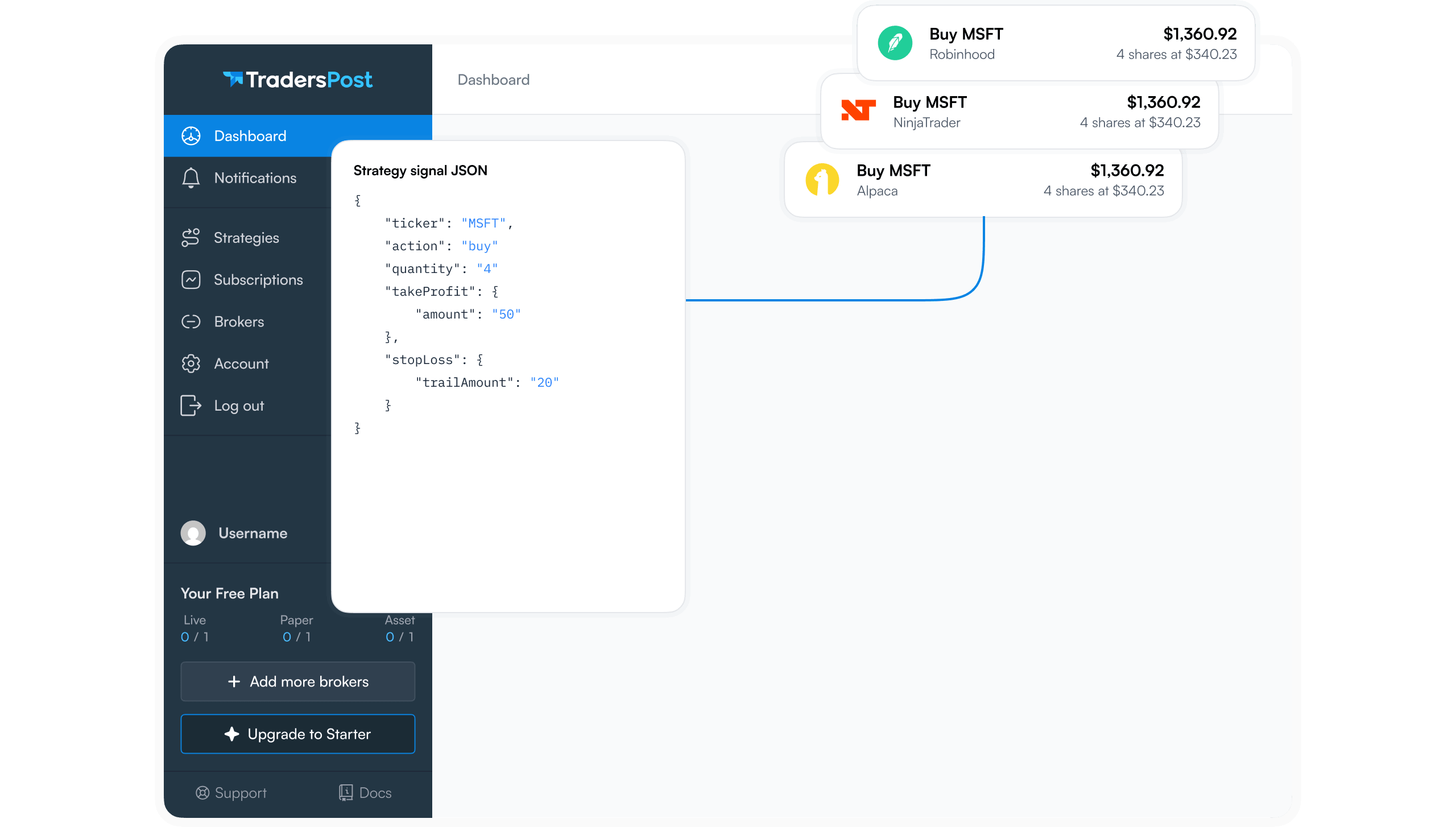
TradersPost supports ATR-based stop placement directly through the webhook payload. Calculate the absolute stop price in Pine Script using ta.atr() and send it as StopLoss.stopPrice, or use StopLoss.percent or StopLoss.amount for relative offsets computed on the signal side before the webhook fires. Either approach keeps the stop distance tied to measured volatility rather than to a fixed level that may sit inside a dense cluster.
Accept the Wider Stop, Reduce the Size
A wider stop with proportionally smaller position size preserves the same maximum dollar loss per trade while giving the position more room to move through normal volatility. This is not optional: wider stop distance requires smaller position size to keep dollar risk constant, and the math is direct.
Shrinking the stop to reduce dollar risk without reducing size is the error. It increases the probability of a stop-out without reducing the worst-case loss in any meaningful way. Position sizing based on risk per trade rather than a fixed share count is the mechanical implementation of this principle, and it works regardless of whether any stop hunting is real in a given case.
Execution Risk Placement Cannot Remove
Stop Orders Are Market Orders After Trigger
Once a stop order triggers, it becomes a market order and fills at whatever price the market offers at that moment. In a fast market or low-liquidity environment, the fill can be substantially worse than the stop price regardless of how carefully the stop was placed. This is not misconduct; it is how stop orders work by design.
Stop-limit orders avoid runaway fills by capping the execution price, but they introduce the risk of no fill at all if price moves through the limit before the order executes. In a fast market at a dense stop cluster, stop-limit orders frequently fail to fill entirely, leaving the position open beyond the intended risk point. Neither order type eliminates execution risk; they shift it between slippage and non-fill.
Slippage Is Part of the Trade Cost
Every stop carries an implicit slippage cost that belongs in the expected value calculation for the strategy, not in the exceptional events column. Tracking actual fill prices against stop prices over many trades builds an empirical slippage distribution for a given instrument and broker, which can then be used to adjust strategy parameters to reflect true costs.
No placement rule eliminates the possibility of a loss larger than planned. Placement adjustments shift probabilities. They do not cap the worst case, and a strategy built on the assumption that stops fill cleanly will underestimate its own tail risk.
What the Evidence Actually Supports
Confirmed: Clusters and Cluster Effects
Stop clustering at round numbers and obvious technical levels is well-supported and explains the observed price behavior at those levels without requiring intentional targeting. The fast-move-and-reverse pattern at stop clusters is consistent with the mechanical effect of dense resting orders triggering simultaneously. Treating this as a structural feature to design around produces better outcomes than treating it as a conspiracy to detect.
Confirmed: Broker Execution Conflicts
Broker-side execution conflicts exist and have been penalized. The CFTC enforcement actions against FXCM and FXDD demonstrate that asymmetric slippage across large customer populations is a real and prosecutable form of misconduct.12 The remedy is regulatory reporting and broker selection, not a detection algorithm applied to your own trade history. Using regulated, exchange-routed brokers with transparent execution reports reduces exposure to this category of risk.
Not Supported: Personal Targeting Detection
No statistical method applied to a single trader's history can confirm that their account was individually targeted rather than caught in ordinary volatility at a widely watched level. The burden of proof required to distinguish targeting from coincidence exceeds what retail-scale data can supply. The actionable conclusion is to adjust placement and sizing mechanics, which improves outcomes regardless of whether targeting is real in any specific instance.
Bottom Line
- Stop clusters at round numbers and swing levels are real, measurable, and explain most of the price behavior traders attribute to hunting. No conspiracy is required.
- Broker execution misconduct is real but operates as asymmetric slippage across thousands of accounts, not as targeting of individuals. Regulators have penalized it; the remedy is broker selection and reporting.12
- No detection algorithm applied to a single account's trade history can distinguish personal targeting from ordinary volatility at a level visible to the entire market.
- The practical fix is placement offset from obvious levels, stop distance sized to ATR, and position size reduced proportionally to maintain consistent dollar risk per trade.
- Every stop is still a market order after trigger, and no placement rule eliminates the risk of a fill worse than planned.
Frequently Asked Questions
Can I detect stop-loss hunting by analyzing my own trade history?
No analysis of a single account's trade history can statistically distinguish personal targeting from ordinary volatility at widely watched price levels. The sample sizes required to reject the null hypothesis of random price movement are far larger than any individual retail trader accumulates at a given setup and stop location. Tracking slippage patterns over time is useful for evaluating execution quality, but attributing causation requires the broker's internal system data, which is not available to account holders.
Is stop-loss hunting illegal?
Broker-side execution manipulation that systematically harms customers is illegal and has been prosecuted. The CFTC fined FXCM more than $14.2 million and FXDD $2.74 million for asymmetric slippage practices affecting tens of thousands of accounts.12 Large participants trading toward visible liquidity clusters is not inherently illegal and is consistent with normal market microstructure. The legal distinction hinges on whether a firm with an execution duty is systematically disadvantaging customers, not on whether price moves through your stop.
Where should I place my stop to avoid a liquidity cluster?
Offset the stop from round numbers and obvious swing points by an amount derived from the instrument's Average True Range rather than from a fixed pip or dollar value. Placing a stop at a textbook level puts it in the densest part of the stop cluster, where simultaneous triggering causes the most slippage. Wider stops require proportionally smaller position sizes to maintain constant dollar risk per trade.
Does a stop-limit protect me from hunting?
A stop-limit avoids the worst runaway fills because it caps the execution price, but it introduces the risk of no fill if price moves through the limit before execution. In a fast market at a dense stop cluster, stop-limit orders frequently fail to fill, leaving the position open beyond the intended risk point. Neither order type eliminates execution risk; they shift it between slippage and non-fill.
How do I evaluate my broker's execution quality?
Compare actual fill prices against published market prices at the time of each order across a large number of trades, tracking whether slippage is systematically worse in one direction. Documented broker misconduct, such as the CFTC actions against FXCM and FXDD, involved asymmetric slippage visible only in aggregate across thousands of accounts, not in individual trade comparisons.12 Regulated brokers with transparent execution quality reports and exchange-routed orders provide the most verifiable execution data.
References
1 CFTC Orders FXDirectDealer, LLC to Pay $2.74 Million for Supervision Failures Relating to Trading Platform
2 Forex Capital Markets LLC Ordered to Pay More Than $14.2 Million to Settle CFTC Charges