Does Basket Trading Reduce Slippage vs Orders?
Basket orders bundle multi-leg trades into one submission, but does that actually cut slippage versus placing separate orders? Here's what the data shows.

Marketing

Does basket trading reduce slippage compared to separate orders? It can reduce slippage caused by delays between related orders, especially when a trader would otherwise enter each leg manually. A basket prepares every leg before submission, shortening the time during which prices can move between the first and last order.
Basket trading does not eliminate exchange-level slippage. Each leg can still fill at a different price, remain pending, partially fill, or be rejected. The practical benefit is narrower timing risk across the complete strategy, not guaranteed execution at the expected price.
The distinction matters most for spreads, hedges, portfolio rebalancing, and automated multi-symbol signals. Traders should evaluate both total basket slippage and the execution quality of each individual leg.
What Slippage Means For Traders
Defining Slippage And Its Causes
Slippage is the difference between the price expected when an order is initiated and the price at which it actually fills. It commonly occurs when prices are moving quickly, available market depth is limited, or volatility increases while an order is being routed and matched.1
Slippage can be favorable or unfavorable, although traders usually focus on adverse slippage. A market buy may fill above the observed price, while a market sell may fill below it. Wide bid-ask spreads and insufficient liquidity can make the difference larger.
Why Order Sequencing Matters
Placing a multi-leg trade through separate order windows creates a time gap between legs. The first order may fill while the trader is still configuring or submitting the next one. This exposure is commonly called legging risk, or leg-out risk when one side of a planned spread remains unfilled.
Manual entry compounds the problem because each symbol, quantity, side, order type, and price must be checked separately. Basket tools reduce this interface delay by letting the trader configure all legs before initiating execution. Manual order entry has been identified as a source of execution delay and additional slippage in multi-order strategies.2
Measuring Automated Trade Slippage
Automated strategies should record the market price when the signal fires and compare it with the actual fill. For a buy, fill price minus signal price measures adverse slippage. For a sell, signal price minus fill price provides the equivalent directional measure.
TradersPost accepts a price field containing the market price when an alert triggers and uses it to help calculate slippage against the fill. If that value is unavailable, the calculation can use applicable signal, limit, or stop prices. This measurement applies to each signal, whether it is submitted alone or within a batch.
Track slippage in both price units and basis points so results remain comparable across instruments. Also separate entry slippage from exit slippage, because liquidity, order type, and session conditions may differ.
How Basket Orders Are Built
Grouping Legs Into One Basket
A basket groups orders across stocks, futures, options, or other supported instruments into one container. The trader adds each leg, reviews the complete set, and initiates submission with one action. The common analogy is a shopping cart: all items are prepared before checkout rather than purchased individually.3
Each leg still has its own ticker, side, quantity, order type, and price instructions. Grouping does not merge the legs into one exchange order. It coordinates their submission through the broker or trading platform.
Execution Sequence Inside A Basket
Execution sequence depends on the platform. In one documented fixed-sequence implementation, buy legs are executed before sell legs.4 Other implementations can arrange legs according to the sequence expected to require the least margin, which may differ from the order in which the trader added them.
The important limitation is that the exchange receives separate orders. Basket legs may be dispatched quickly, but they are not necessarily an atomic transaction in which every leg must fill together. Traders should confirm the documented sequence for their platform before relying on a hedge to execute first.
Margin And Funds Checks
Basket platforms commonly display an estimated required margin before submission. Some also distinguish between required margin, the capital needed to initiate the complete basket, and final margin, the capital blocked after all legs execute and an offsetting hedge is recognized.5
A documented options example showed margin falling from approximately ₹1,08,372 for separately handled exposure to ₹34,659.10 when the basket allowed the system to recognize the hedge.6 The exact benefit depends on the positions, broker calculations, and applicable margin rules.
Does Basket Trading Reduce Slippage
Multi-Leg Strategies And Legging Risk
Basket trading can reduce one specific component of slippage: price movement during the delay between related submissions. Sending exposure and hedge legs from the same prepared basket reduces the manual gap and helps limit execution mismatch.7
This is valuable when the strategy depends on a combined spread rather than the price of either leg alone. If a call spread is expected to cost $1.20, for example, the relevant outcome is the net debit across both fills. Evaluating only one leg can hide deterioration in the combined execution.
Volatile Session Execution Speed
During earnings announcements, economic releases, or other fast sessions, prices can change before a trader finishes entering every order. Basket submission reduces this delay by dispatching prepared legs in quick succession rather than requiring a new order ticket for each one. Published basket-order guidance specifically identifies fast execution as a way to reduce slippage during volatile conditions.8
The improvement will be largest when manual sequencing would have taken several seconds and the instruments are liquid enough to fill promptly. If the market is stable or only one leg is being traded, the basket structure may provide little execution advantage.
What Baskets Cannot Fix
A basket cannot create liquidity or guarantee a quoted price. Its legs are still routed separately and sequentially, so one can execute while another remains pending, partially fills, or is rejected.9
- Market orders can move through multiple price levels.
- Limit orders can remain unfilled when price moves away.
- Thin contracts can retain wide bid-ask spreads.
- Rejected legs can leave unintended directional exposure.
Basket grouping therefore improves submission coordination, not the underlying matching mechanics for each leg.
Institutional Basket Trading And Slippage
Program Desks And Midpoint Liquidity
Institutional basket execution operates at a different scale from retail multi-leg tools. Program trading desks can seek midpoint and block liquidity through directly resting orders, liquidity-seeking algorithms, dark aggregators, and conditional workflows.10
In this setting, execution quality can improve because the workflow is designed to source large contra-side interest while limiting market impact. These results should not be treated as evidence that a retail basket button automatically produces institutional execution.
Measured Slippage Versus VWAP
One documented IEX basket trade captured 55% of in-limit volume across 37 symbols while trading $174 million in notional value. It recorded 1.5 basis points of slippage versus the in-limit VWAP.11
Since the start of 2026, qualifying block-sized midpoint day orders in the same venue analysis sourced more than 19% of in-limit available volume with less than 1 basis point of slippage versus in-limit VWAP. Midpoint block volume at the venue also increased by more than 50% during the reported three-month period.12
These are venue-specific observations, not universal benchmarks. They reflect block-sized resting orders and institutional routing workflows rather than typical retail basket execution.
Protective Basket Order Types
IEX describes a speed bump that delays incoming orders, giving the venue time to process undelayed market data and update pegged prices to the latest national best bid and offer before execution. Its Signal is designed to identify periods when quoted prices may be unstable or crumbling.13
Certain pegged order types use the Signal to avoid execution during elevated instability, while another midpoint peg uses speed bump protection without relying on that Signal. This illustrates why institutional basket results depend on venue mechanics and order design, not merely on grouping symbols together.
Basket Orders Versus Separate Orders
Execution Timing Differences
Separate order entry introduces a delay after every submission. A trader must open another ticket, select the next instrument, check the details, and send it. A basket moves this preparation ahead of the execution decision, so all legs can be dispatched from one completed setup.
That structural difference drives most of the potential slippage reduction. It removes avoidable operator delay, but it does not guarantee simultaneous fills.
Hedge Recognition Differences
When a hedge is placed only after the primary position, the system may initially evaluate the first order as unhedged. The trader can therefore need enough capital for the full standalone margin before the second order is accepted.
A basket presents the complete strategy for pre-submission calculations. When the legs form a recognized hedge, the displayed funds requirement may incorporate the offsetting risk before execution.14 Traders should still maintain enough available funds for price and premium changes.
Risks Remaining With Basket Orders
Partial Fills And Rejected Legs
A basket is not all-or-none unless a specific supported execution mechanism says otherwise. One leg may fill completely while another is pending, partially filled, or rejected. Documented rejection causes include insufficient funds, price band restrictions, invalid order details, and freeze quantity limits.15
Review the order book immediately after submission. A rejected hedge beside a filled exposure leg changes the position from a spread into an unintended directional trade.
Liquidity And Wide Spreads
Illiquid contracts, including far out-of-the-money options, can have wide spreads and limited displayed size. A market order may consume the best quote and continue filling at less favorable prices. Basket grouping does not prevent this outcome.
Use limit orders when the acceptable price matters more than immediate completion. Published guidance recommends limits for illiquid instruments because they protect against adverse pricing, although they introduce non-execution risk.16
Margin Buffer And Reliability
Option premiums and margin requirements can change between review and submission. One basket-order guide recommends keeping a cash buffer of approximately 5% to 10% above the displayed required margin to reduce rejection risk from short-term changes.17
Basket execution also depends on platform reliability. Outages, slowdowns, or order-status delays can interrupt the workflow. Every production process should include a clear procedure for checking fills, identifying missing legs, and controlling accidental exposure.
Using Baskets To Limit Slippage
Use Limits On Sensitive Legs
Assign limit prices to legs where a poor fill would materially change the combined trade. Keep market orders for highly liquid legs only when immediate execution is more important than precise price control.
If one leg repeatedly slips, compare its alert price, prevailing spread, limit price, and fill. Then adjust that leg rather than assuming the complete basket is responsible.
Save And Reuse Templates
Saved or cloned baskets shorten preparation time for recurring strategies. A trader can review current prices, quantities, and order types without rebuilding every leg during a fast market. Some broker tools retain a created basket until the user manually deletes it.18
Templates still require review. Contract expirations, account buying power, spreads, and desired quantities can change between uses.
Automate Multi-Leg Webhook Signals
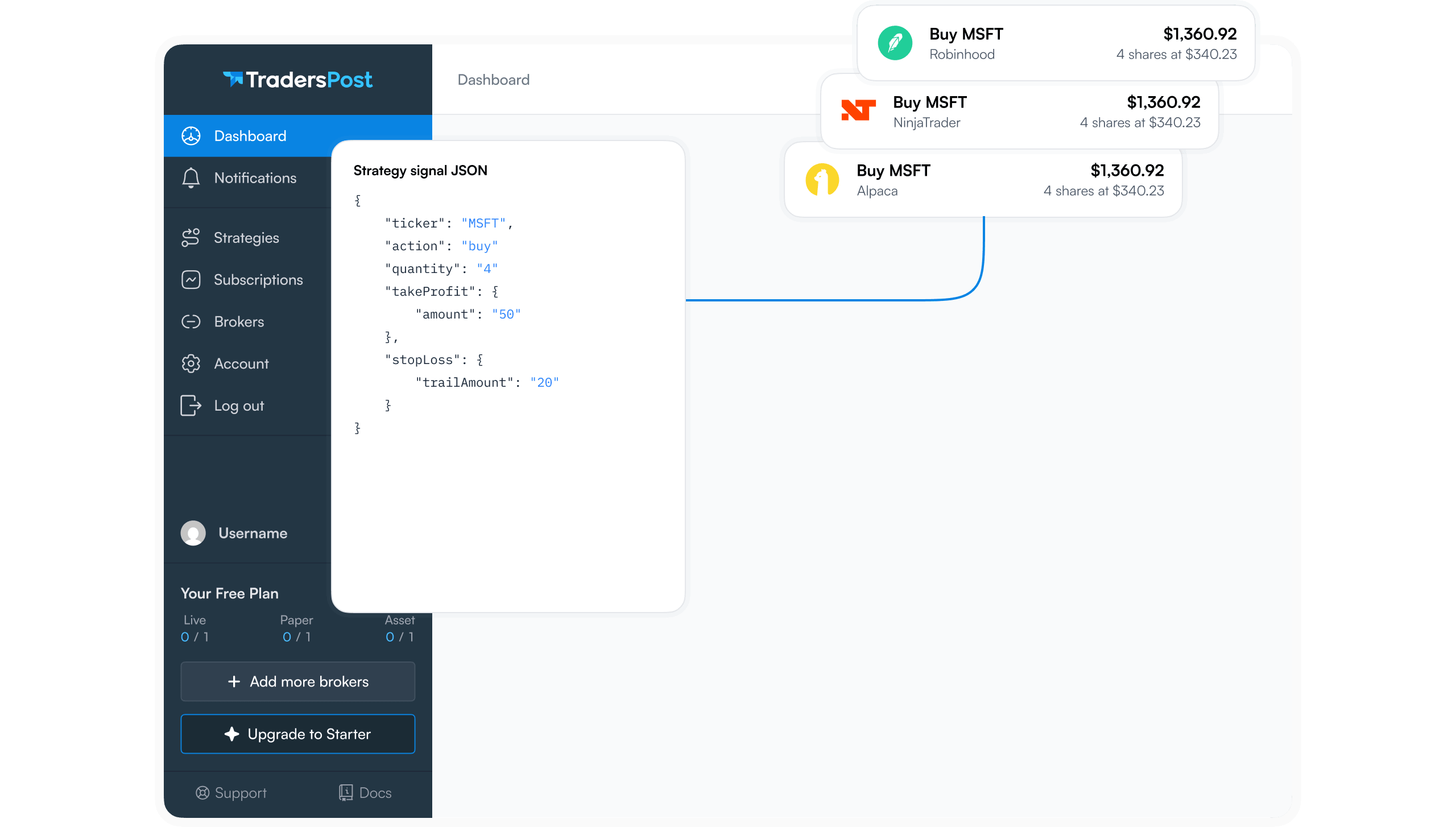
TradersPost can accept a root-level JSON array containing up to five signals when Allow batch signals is enabled. Each item is processed as its own signal. This supports use cases such as entering two contracts together, closing one position while opening another, or laddering multiple limit orders from one alert.
Strategies created before the setting existed have batch signals disabled by default, so the setting must be enabled before an array is accepted. Automation reduces manual submission delay, but traders should still monitor every signal and resulting order independently.
Ready to test the workflow? Enable batch signals, send the setup to a paper account first, and compare each signal price with its resulting fill before considering live execution.
Bottom Line
Basket trading can reduce slippage compared with separate orders when the main source of slippage is the delay between related submissions. It is most useful for multi-leg spreads, hedges, portfolio rebalancing, and automated groups of orders.
- Baskets reduce manual timing gaps and legging risk.
- Each leg remains a separate order and can still slip.
- Limit orders provide price control but may not fill.
- Hedge recognition can reduce required margin.
- Every leg must be checked after submission.
The best evaluation is empirical. Record alert prices, fill prices, timestamps, spreads, and rejection outcomes for basket and separate-order workflows. TradersPost users can begin with paper execution, review per-signal results, and move to live batching only after the process behaves as expected.
Frequently Asked Questions
Do Baskets Guarantee Zero Slippage?
No. Each leg is routed separately and can slip, remain pending, partially fill, or be rejected. Volatility, market depth, and bid-ask spreads continue to affect every individual order.
What Are Required And Final Margin?
Required margin is the capital needed to initiate all basket legs. Final margin is the amount blocked after execution. It may be lower when completed legs create a recognized offsetting hedge.
Can Institutional Baskets Beat VWAP?
Documented midpoint basket executions have reported slippage below 1 to 1.5 basis points versus in-limit VWAP. Those results involved institutional block orders, resting liquidity, and protective venue mechanics, so they are not directly comparable with retail basket tools.
Why Can A Leg Be Rejected?
Common causes include insufficient funds, price band restrictions, invalid order details, and freeze quantity limits. Check the order book immediately because a filled leg without its intended hedge changes the position's risk.
Should Baskets Use Market Orders?
Use limit orders for price-sensitive or illiquid legs. Market orders can be appropriate for liquid legs when completion speed matters more than exact price, but they provide no control over the final fill.
References
1 What Does Slippages Mean, and How Can I Minimise It Using Basket Orders?
2 Master Basket Order Trading in India: A Complete Guide
3 Basket Orders
4 What Does Slippages Mean, and How Can I Minimise It Using Basket Orders?
5 Master Basket Order Trading in India: A Complete Guide
6 Basket Orders
7 What Does Slippages Mean, and How Can I Minimise It Using Basket Orders?
8 Master Basket Order Trading in India: A Complete Guide
9 FYERS Basket Orders Support
10 Basket Trading on IEX
11 Basket Trading on IEX
12 Basket Trading on IEX
13 Basket Trading on IEX
14 FYERS Basket Orders Support
15 What Does Slippages Mean, and How Can I Minimise It Using Basket Orders?
16 Master Basket Order Trading in India: A Complete Guide
17 Master Basket Order Trading in India: A Complete Guide
18 Basket Orders